
Hardware Reconfigurable Devices Market Size, Share & Growth Opportunity by 2034
Coverage: by Type (Auto-Sequencing Memory, On-Chip Memory, Reconfigurable Computer, Host Memory and Others); and Process (Cycle Accurate Simulation, High Performance Computing and Reconfigurable Computing), and Geography (North America, Europe, Asia Pacific, and South and Central America)
- Status : Data Released
- Report Code : TIPTE100000917
- Category : Electronics and Semiconductor
- No. of Pages : 150
- Available Report Formats :


- Last update date : September 17, 2026


2025 Market Size
US$ 9.6 Bn
Base year value
2034 Forecast
US$ 20.43 Bn
Projected by 2034
CAGR 2026-2034
8.75 %
Growth rate
Addressable Market
US$ 134.52 Bn
(2026-2034)
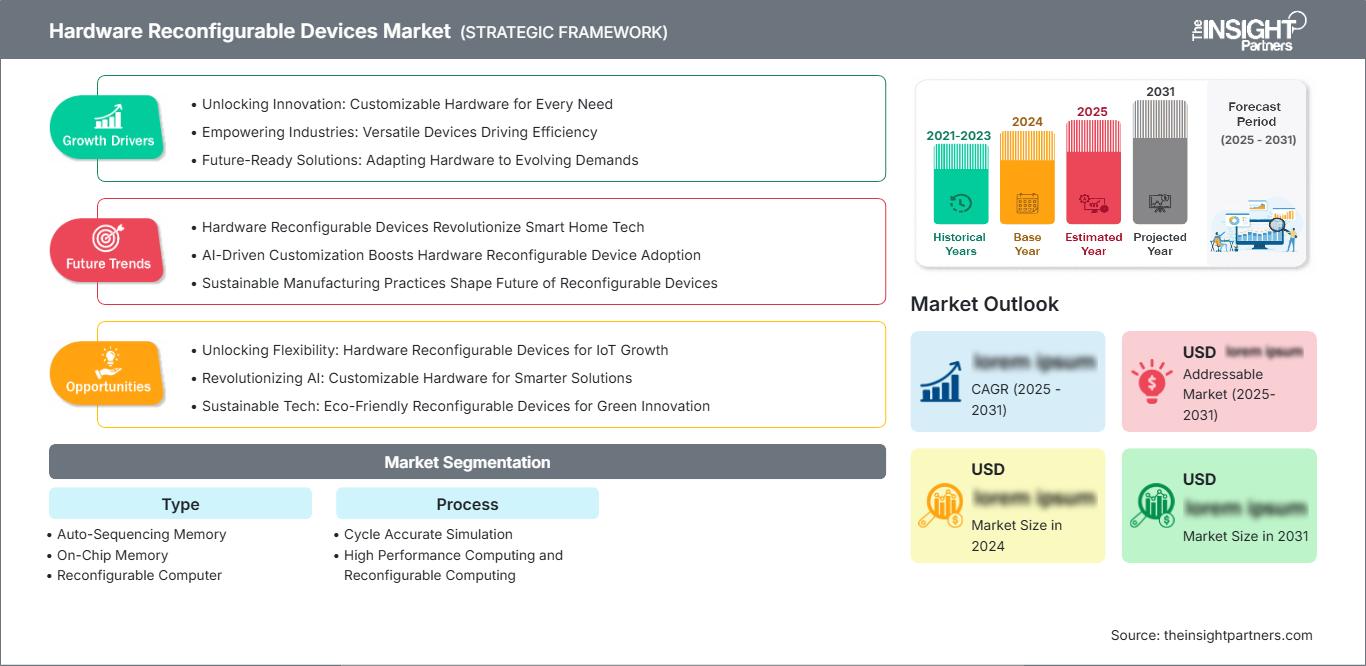
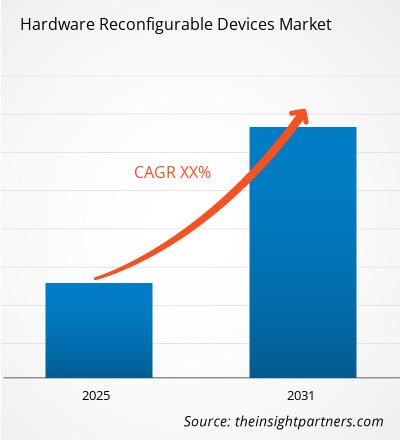
The Hardware Reconfigurable Devices Market was valued at US$ 9.6 Billion in 2025 and is projected to reach US$ 20.43 Billion by 2034, registering a CAGR of 8.75% during 2026–2034. The market encompasses memory architectures, reconfigurable computing platforms, and hardware acceleration technologies that support flexible execution, rapid prototyping, simulation, and high-performance workloads across increasingly heterogeneous computing environments.
North America remains a strategically important market, with the Hardware Reconfigurable Devices Market size supported by advanced semiconductor design capabilities, data-center investment, aerospace and defense programs, and demand for adaptable computing architectures. Regional expansion is expected at a CAGR of 8–10% during 2026–2034, supported by AI acceleration, edge computing, high-performance computing, and continued investment in programmable hardware ecosystems.
Hardware Reconfigurable Devices Market Assessment and Insights
- North America held a 34–38% Hardware Reconfigurable Devices Market share in 2025 and is expected to grow at a CAGR of 8–10% during 2026–2034, supported by AI infrastructure, aerospace and defense modernization, semiconductor R&D, and high-performance computing adoption.
- US represented 90–94% of North American demand in 2025 and is projected to grow at a CAGR of 8–10%, supported by hyperscale computing, defense electronics, and advanced semiconductor development.
- Europe accounted for a 16–20% share in 2025 and is forecast to expand at a CAGR of 7–9%, with Germany, France, the UK, Italy, and the Netherlands supporting automotive, industrial, telecommunications, and aerospace applications.
- Asia Pacific represented a 38–42% share in 2025 and is anticipated to grow at a CAGR of 10–12%, led by China, Japan, South Korea, Taiwan, and India through electronics manufacturing and computing infrastructure.
- Largest Segment: Reconfigurable Computer held a 34–38% market share in 2025 and is expected to grow at a CAGR of 9–11%, reflecting broad adoption in flexible acceleration and computing.
- High Growth Segment: High Performance Computing and Reconfigurable Computing represented a 42–46% market share in 2025 and is projected to grow at a CAGR of 10–12%, driven by AI and workload acceleration.
- Key companies analyzed in detail: Atmel Corporation (Microchip Technology Inc.), Infineon Technologies AG, Texas Instruments Inc., STMicroelectronics N.V., Broadcom Corporation, NVIDIA Corporation, Koninklijke Philips N.V., Alcatel-Lucent S.A., Analog Devices, Inc., and Corsair Components, Inc.
Source: The Insight Partners' analysis based on proprietary research, government publications, company annual reports, investor presentations, industry databases, and expert interviews.
The Hardware Reconfigurable Devices Market is becoming increasingly driven by architectural integration of programmable logic, processors, accelerators, and special memories in computing systems. The devices are being designed in a way that is focused on increasing bandwidth, reducing latency, improving energy efficiency, and ensuring flexibility in deployment. In terms of production, advanced semiconductor process, heterogeneous integration, embedded memory, configurable interconnects, and software-compatible environment have emerged as key factors. This will enable reconfiguration of hardware even after its deployment.
Further growth of the Hardware Reconfigurable Devices Market will be centered on AI inference, edge computing, telecom infrastructure, industrial automation, aerospace electronics, and special workloads at data centers. Investments in resilience of semiconductors and semiconductor manufacturing are also driving procurement considerations. Regulatory and strategic support for domestic semiconductor development can provide further growth potential through an increase in demand for programmable technologies, while security, deterministic processing, and workload acceleration needs are creating new opportunities.
Hardware Reconfigurable Devices Market Report Scope
| Report Attribute | Details |
|---|---|
| Market size in 2025 | US$ 9.6 Billion |
| Market Size by 2034 | US$ 20.43 Billion |
| Global CAGR (2026 - 2034) | 8.75% |
| Historical Data | 2021-2024 |
| Forecast period | 2026-2034 |
Hardware Reconfigurable Devices Market Analysis
Hardware Reconfigurable Devices Market is driven by the demand for flexible computing components, which are able to manage workload changes without altering the entire system. The market comprises such participants as semiconductor companies, memory providers, foundries, IP suppliers, electronic design automation software vendors, board vendors, system integration services companies, and customers. The demand becomes more evident when there is a focus on latency, parallelism, energy consumption, and adaptability after deployment.
The Hardware Reconfigurable Devices Market report indicates that supply factors include the availability of semiconductor manufacturing capacity, advanced packaging technologies, high-speed memory, programmable logic IPs, and development tools. Manufacturers seek differentiation based on performance per watt ratio, security properties, embedded processing capability, and the availability of an ecosystem. The value chain also utilizes reusability of hardware architectures and minimization of redesign. Sophisticated devices may have long qualification times, engineering shortages, and special manufacturing requirements.
Hardware Reconfigurable Devices Market includes competition within programmable logic, configurable memory, acceleration platforms, and embedded computing solutions. Atmel Corporation (Microchip Technology Inc.) has the combination of programmable devices and embedded systems technology, while Infineon Technologies AG and STMicroelectronics N.V. have wide semiconductor technologies. Texas Instruments Inc. and Analog Devices, Inc. have added value to the processing, connectivity, and mixed signal technologies related to configurable systems architecture.
NVIDIA Corporation has been adding strength to the acceleration ecosystems through heterogeneous computing, while Broadcom Corporation remains relevant for networking and infrastructure-based applications. Koninklijke Philips N.V. and Alcatel-Lucent S.A. have historical and application-oriented technology knowledge, while Corsair Components, Inc. has been contributing in the area of high-performance memory and enthusiast computing. Investment focus areas are becoming AI acceleration, tool chain integration, secure programmable architectures, and regional supply resilience.
● REPORT CUSTOMIZATION
Tailor This Report To Align With Your Specific Business Requirements
This report can be customized to align precisely with your business objectives, scope, and target markets. Customization options include tailored segmentation, geography, competitive analysis, and strategic insights to support informed decision-making.
Customize This Report →WHAT YOU CAN ADJUST
- ● Segmentations
- ● Geography
- ● Competitive Analysis
- ● Language Preferences
Hardware Reconfigurable Devices Market: Strategic Insights
Regional Insights
North America Hardware Reconfigurable Devices Market
North America accounted for a 34–38% share in 2025 and is projected to grow at a CAGR of 8–10% through 2034. USA accounts for the majority of regional demand thanks to hyperscale data centers, aerospace and defense applications, sophisticated semiconductor design, and high-performance computing. Canada’s contribution lies in research organizations, telecommunications and advanced electronics, and technology clusters in the region help to facilitate cooperation between semiconductor and system integrators.
The regional ecosystem focuses on low latency acceleration, security processing, and reconfigurable architectures. Defense and aerospace applications require long-life programmable solutions, and data centers are increasingly looking at hardware acceleration for application processing needs. Automotive and industrial applications offer opportunities in edge computing and intelligent controls. The market share of Hardware Reconfigurable Devices can thus be gained from both strategic infrastructure applications as well as custom embedded applications.
U.S. Hardware Reconfigurable Devices Market
The US represented 90–94% of North American demand in 2025 and is expected to grow at a CAGR of 8–10%. Government investments in semiconductor robustness, military modernization, artificial intelligence (AI), and advanced computing contribute to adoption of FPGAs. The country is endowed with an extensive number of semiconductor designers, cloud computing providers, research institutes, and system integrators, thereby forming a well-developed environment for the implementation of programmable logic devices.
FPGA applications include data centers, telecommunications, aerospace, defense, industrial automation, automotive electronic systems, and edge devices. Companies such as NVIDIA Corporation, Texas Instruments Inc., Analog Devices, Inc., Broadcom Corporation, and Atmel Corporation (now Microchip Technology Inc.) have technology positioning within adjacent markets of computing and semiconductors. Architectures incorporating programmable logic together with CPUs, accelerators, memory chips, and secure connectivity are gaining popularity.
Europe Hardware Reconfigurable Devices Market
Europe held a 16–20% share in 2025 and is expected to grow at a CAGR of 7–9%, led by Germany. Contributions by the UK, Germany, France, Italy, and the Netherlands include industrial automation, automotive electronics, telecommunications, aerospace, and semiconductor R&D. The efforts within Europe for semiconductor sovereignty and advanced computing are contributing to an improved environment for flexible hardware design.
The UK has an advantage in research, defense electronics, and high-performance computing. Germany enjoys advantages due to its needs in automotive and industrial automation sectors, while France adds its strength in aerospace, defense, telecommunications, and semiconductor engineering. Italy's contribution is in the area of industrial electronics and embedded systems, whereas the Netherlands brings in advanced semiconductor tools and research capabilities.
APAC Hardware Reconfigurable Devices Market
APAC held a 38–42% share in 2025 and is forecast to grow at a CAGR of 10–12%, with China leading. Demand is driven by manufacturing of semiconductors in Japan, South Korea, Taiwan, and India as well as consumer electronics, telecoms, automotive systems, and computing systems.
Big electronics production centers, expansion of the data center facilities, and national semiconductor development programs drive adoption. Domestic technology capabilities are important for China, automotive and industrial systems for Japan, advanced electronics manufacturing for South Korea and Taiwan, and semiconductor and digital infrastructures for India.
Middle East & Africa Hardware Reconfigurable Devices Market
Middle East & Africa is projected to grow at a CAGR of 6–8% through 2034, with the UAE and Saudi Arabia leading regional demand. Investments in digital infrastructure, data centers, telecommunications, defense technology, and smart-city systems are creating opportunities for adaptable computing architectures.
Industrial and telecom sectors continue to be key in South Africa, whereas RoMEA has new possibilities through infrastructure development. The need for energy efficiency, performance-based networks, processing security, and local computing drives the regional demand. Implementation in this region is still driven by projects rather than in established semiconductor regions where adoption is more consumer-driven.
Segmentation Analysis
Type
The Hardware Reconfigurable Devices Market scope across Type is expected to expand at a CAGR of 8–10% during 2026–2034. Reconfigurable computers maintain a strong position because they can accelerate parallel workloads and support changing algorithms. Memory-oriented architectures remain important where data movement, bandwidth, and latency constrain system performance.
- Auto-Sequencing Memory supports automated data movement and memory-access operations, helping systems reduce processor intervention and improve execution efficiency in workloads requiring predictable sequencing.
- On-Chip Memory provides low-latency data access close to processing resources, supporting acceleration, buffering, and deterministic operations where external-memory delays can reduce overall system efficiency.
- Reconfigurable Computer enables hardware-level adaptation for changing computational requirements, making it strategically important for acceleration, prototyping, specialized workloads, and systems requiring post-deployment flexibility.
- Host Memory provides higher-capacity storage resources for programmable computing systems, supporting data-intensive applications where local memory capacity alone cannot satisfy workload requirements.
Process
The Process segment is projected to grow at a CAGR of 9–11% during 2026–2034. Hardware-based simulation and computing approaches benefit from increasing model complexity, AI workloads, and demand for faster development cycles. High-performance and reconfigurable computing remain particularly important where parallelism and deterministic execution provide measurable advantages.
- Cycle Accurate Simulation supports detailed hardware and system verification by reproducing timing behavior, making it strategically valuable for complex designs where functional validation alone is insufficient.
- High Performance Computing and Reconfigurable Computing combines scalable processing with programmable hardware, supporting AI, scientific workloads, simulation, analytics, and applications requiring high throughput with workload-specific acceleration.
Opportunity Snapshot
| Process | Revenue Contribution (High/Medium/Low) | Trend Tag (MAX 2 words) | Adoption Stage (Emerging/Scaling/Mature) |
|---|---|---|---|
| Cycle Accurate Simulation | Medium | Timing Validation | Mature |
| High Performance Computing and Reconfigurable Computing | High | AI Acceleration | Scaling |
Hardware Reconfigurable Devices Market Growth Drivers and Impact Analysis
Rising Demand for AI and Workload-Specific Acceleration
AI workloads increasingly require high throughput, low latency, and efficient data movement, creating opportunities for programmable hardware alongside CPUs and GPUs. Reconfigurable architectures can be tailored to specific algorithms, pipelines, and inference requirements, enabling organizations to optimize performance without developing completely new silicon for every workload. The commercial impact is visible across data centers, telecommunications, industrial systems, and edge platforms. As AI models become more specialized, customers can prioritize adaptable accelerators that support changing computational requirements. This encourages semiconductor suppliers to integrate programmable logic with processors, memory, networking, and security functions. The resulting architecture shift expands demand for development tools, IP libraries, system boards, and integration services, broadening the economic ecosystem beyond the underlying programmable device itself.
Expansion of High-Performance and Edge Computing
Growing computing requirements at the edge and in high-performance environments are increasing demand for architectures that can process data closer to its source. Reconfigurable hardware can provide deterministic execution and parallel processing for workloads such as signal processing, machine vision, industrial control, and telecommunications. The impact is particularly significant where transferring data to centralized infrastructure introduces latency, bandwidth costs, or security concerns. System designers can configure hardware around specific workloads while retaining the ability to update functionality as requirements evolve. This flexibility is valuable for industrial equipment and infrastructure with long operating lifetimes. Consequently, suppliers are increasingly positioning programmable devices as complements to conventional processors, particularly in systems where energy efficiency, real-time response, and specialized acceleration influence total system performance.
Semiconductor Supply-Chain Resilience and Regionalization
Semiconductor supply disruptions and geopolitical considerations are encouraging governments and technology companies to strengthen regional production capabilities and diversify sourcing. Reconfigurable hardware benefits from this environment because programmable architectures can extend product lifecycles and reduce the need for repeated application-specific silicon redesigns. Manufacturers are investing in manufacturing capacity, advanced packaging, design ecosystems, and regional engineering resources to improve resilience. The impact extends beyond chip production because customers increasingly evaluate software compatibility, long-term availability, qualification support, and second-source options during procurement. Aerospace, defense, automotive, and industrial customers are particularly sensitive to lifecycle continuity. This environment can favor vendors that offer secure architectures, stable development environments, established qualification processes, and predictable supply commitments, strengthening the strategic value of programmable hardware within long-lived electronic systems.
Hardware Reconfigurable Devices Market Future Trends
Convergence of Reconfigurable Hardware and AI Acceleration
Hardware Reconfigurable Devices Market trends are expected to increasingly converge with AI acceleration as programmable architectures become part of heterogeneous computing platforms. Future systems may combine CPUs, GPUs, programmable logic, dedicated AI engines, and high-bandwidth memory within coordinated architectures. The objective will be to assign each workload to the processing resource that delivers the best combination of latency, throughput, flexibility, and energy consumption. Development environments are likely to abstract more hardware complexity, enabling software teams to use familiar programming frameworks while hardware specialists optimize critical pipelines. This convergence can broaden adoption beyond traditional FPGA users by lowering development barriers. It may also increase demand for reusable IP, compiler support, standardized interfaces, and software libraries that enable migration between processor types without extensive redesign.
Embedded Intelligence in Distributed Systems
Distributed computing systems are likely to incorporate greater programmable intelligence directly into network equipment, industrial controllers, vehicles, cameras, and infrastructure devices. Rather than sending every workload to centralized servers, embedded systems can perform filtering, inference, compression, encryption, and signal processing locally. Reconfigurable hardware is suited to these applications because functionality can evolve as algorithms and standards change. Future product development will emphasize smaller footprints, lower power consumption, integrated security, and simplified deployment. This direction could create demand for programmable devices with embedded processors, memory, networking interfaces, and development tools in unified platforms. As connected systems become more autonomous, hardware flexibility can reduce redesign cycles and support longer equipment lifetimes, particularly in industrial and infrastructure environments where replacement costs are high.
Hardware Reconfigurable Devices Market Opportunities
Regional Semiconductor Ecosystem Development
Hardware Reconfigurable Devices Market Forecasts indicate opportunities for companies that establish partnerships with regional semiconductor ecosystems, research institutions, system integrators, and electronics manufacturers. APAC offers scale through electronics production and growing computing infrastructure, while Europe provides opportunities around automotive, industrial, aerospace, and semiconductor sovereignty initiatives. North America remains attractive for advanced computing, defense, and AI applications. Vendors can localize development tools, technical support, evaluation platforms, and reference designs to shorten customer adoption cycles. Partnerships with universities and engineering programs can also expand the developer base required for programmable hardware deployment. Strategic investment should prioritize regions where government support, semiconductor infrastructure, and application demand reinforce one another, enabling suppliers to build sustainable ecosystems rather than relying solely on direct component sales.
Secure Reconfigurable Platforms for Critical Infrastructure
Critical infrastructure operators require computing platforms that can support evolving protocols while maintaining security, reliability, and long operational lifetimes. This creates an opportunity for programmable architectures incorporating secure boot, hardware-based cryptography, authenticated configuration, fault monitoring, and controlled update mechanisms. Telecommunications, aerospace, defense, energy, transportation, and industrial automation can benefit from such platforms because system requirements often change after initial deployment. Suppliers can differentiate through certified security capabilities, long-term availability, lifecycle management, and development environments designed for regulated applications. Investment in reference architectures can accelerate adoption by demonstrating how programmable hardware integrates with existing control systems and network infrastructure. The strongest opportunity lies in applications where adaptability has measurable operational value and where replacing installed equipment would be significantly more expensive than updating its computational functionality.
Recent Developments
- June 2026: Intel unveiled new innovations that address customers’ chip-to-systems-level AI needs with solutions tailored to address their specific industry challenges, including: New rackscale AI infrastructure, Agentic Cloud Offering for Disaggregated Inference, Deep industry solutions, Deep industry solutions, and PC, gaming handheld, and physical AI momentum.
- October 2025: MosChip Technologies, a global silicon and product engineering company, announced that it will launch its new ProductXcelerate Blueprints at Embedded World North America, introducing a unified solutions suite that advances how OEMs design intelligent, connected products in the AI-Led Product Era.
- February 2025: Synopsys, Inc. (Nasdaq: SNPS) announced the expansion of its industry-leading hardware-assisted verification (HAV) portfolio with new HAPS prototyping and ZeBu emulation systems using the latest AMD Versal Premium VP1902 adaptive SoC. The next generation HAPS-200 prototyping and ZeBu-200 emulation systems deliver improved runtime performance, better compile time and improved debug productivity. They are built on new Synopsys Emulation and Prototyping (EP-Ready) Hardware that optimizes customer return on investment by enabling emulation and prototyping use cases via reconfiguration and optimized software. ZeBu Server 5 is enhanced to deliver industry-leading scalability beyond 60 billion gates (BG) to address the escalating hardware and software complexity in SoC and multi-die designs. It continues to offer industry-best density to optimize data center space utilization.
Frequently Asked Questions

- Comprehensive Market Sizing and Forecast Analysis
- Detailed Segmentation Analysis
- In-Depth Market Dynamics Assessment
- Regional and Country-Level Insights
- Competitive Landscape and Company Benchmarking
- Strategic Business Intelligence
Recent Reports
Testimonials

The Insight Partners' SCADA System Market report is comprehensive, with valuable insights on current trends and future forecasts. The team was highly professional, responsive, and supportive throughout. We are very satisfied and highly recommend their services.
RAN KEDEM Partner, Reali Technologies LTDs
I requested a report on a very specific software market and the team produced the report in a few days. The information was very relevant and well presented. I then requested some changes and additions to the report. The team was again very responsive and I got the final report in less than a week.
JEAN-HERVE JENN Chairman, Future Analytica
We worked with The Insight Partners for an important market study and forecast. They gave us clear insights into opportunities and risks, which helped shape our plans. Their research was easy to use and based on solid data. It helped us make smart, confident decisions. We highly recommend them.
PIYUSH NAGPAL Sr. Vice President, High Beam Global
The Insight Partners delivered insightful, well-structured market research with strong domain expertise. Their team was professional and responsive throughout. The user-friendly website made accessing industry reports seamless. We highly recommend them for reliable, high-quality research services
YUKIHIKO ADACHI CEO, Deep Blue, LLC.
This is the first time I have purchased a market report from The Insight Partners.While I was unsure at first, I visited their web site and felt more comfortable to take the risk and purchase a market report.I am completely satisfied with the quality of the report and customer service. I had several questions and comments with the initial report, but after a couple of dialogs over email with their analyst I believe I have a report that I can use as input to our strategic planning process.Thank you so much for taking the extra time and making this a positive experience.I will definitely recommend your service to others and you will be my first call when we need further market data.
JOHN SUZUKI President and Chief Executive Officer, Board Director, BK Technologies
I wish to appreciate your support and the professionalism you displayed in the course of attending to my request for information regarding to infectious disease IVD market in Nigeria. I appreciate your patience, your guidance, and the fact that you were willing to offer a discount, which eventually made it possible for us to close a deal. I look forward to engaging The Insight Partners in the future, all thanks to the impression you have created in me as a result of this first encounter.
DR CHIJIOKE ONYIA MANAGING DIRECTOR, PineCrest Healthcare Ltd.Reason to Buy
- Informed Decision-Making
- Understanding Market Dynamics
- Competitive Analysis
- Identifying Emerging Markets
- Customer Insights
- Market Forecasts
- Risk Mitigation
- Boosting Operational Efficiency
- Strategic Planning
- Investment Justification
- Tracking Industry Innovations
- Aligning with Regulatory Trends





 Get Free Sample for