
HVDC Converter Station Market Share, Size & Demand by 2034
Coverage: by Configuration (Monopolar, Bi-Polar, Back To Back, and Multi-Terminal); Convertor Type (Line Commutated Current Sourced Converters and Voltage Source Converters), Application (Power Industry, Interconnecting Networks, and Oil & Gas), and Geography (North America, Europe, Asia Pacific, and South and Central America)
- Status : Data Released
- Report Code : TIPEL00002130
- Category : Electronics and Semiconductor
- No. of Pages : 150
- Available Report Formats :


- Last update date : September 15, 2026


2025 Market Size
US$ 11.18 Bn
Base year value
2034 Forecast
US$ 23.09 Bn
Projected by 2034
CAGR 2026-2034
8.39 %
Growth rate
Addressable Market
US$ 153.81 Bn
(2026-2034)
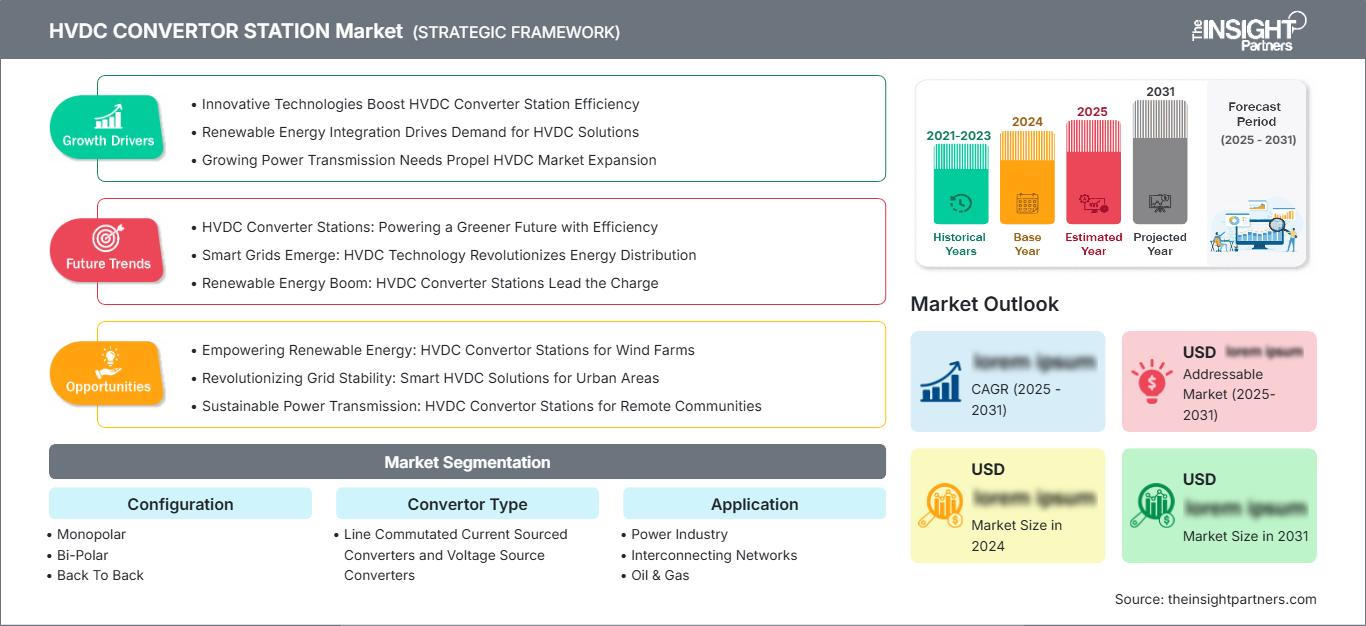
The HVDC Converter Station market is valued at US$ 11.18 Billion in 2025 and is projected to reach US$ 23.09 Billion by 2034, registering a CAGR of 8.39% from 2026 to 2034. The importance of converter stations lies in connecting remote electricity production with high consumption areas. The Market is experiencing continuous growth due to investment in the area of electricity transport and network connection by utilities, transmission companies, and renewable energy generators.
North America is poised for relatively faster growth due to old transmission infrastructure, growing renewable energy generation, and power exchanges between regions that require controllable bulk transmission. The HVDC Converter Station Market size will be driven by growing transmission planning, development of offshore wind energy, and grid improvement efforts. The regional market is forecast to record a CAGR of around 9.0–10.5% during 2026-2034.
HVDC Converter Station Market Assessment and Insights
- North America: North America is expected to account for a 15–18% share in 2025, with a 9.0–10.5% CAGR between 2026–2034. Interregional transmission, renewable integration, and grid resilience programs support project development.
- US: The US is expected to represent 74–79% of North America's 2025 market, growing at a 9.2–10.7% CAGR between 2026–2034, supported by transmission expansion and renewable evacuation requirements.
- Europe: Europe is expected to hold a 20–24% share in 2025, growing at a 9.0–10.0% CAGR between 2026–2034. Germany, the UK, France, and Denmark remain important markets because of offshore wind and cross-border interconnection programs.
- Asia Pacific: Asia Pacific is expected to command a 58–64% share in 2025, growing at a 7.8–9.3% CAGR between 2026–2034. China, India, Japan, and South Korea lead deployment through renewable evacuation and high-capacity transmission programs.
- Largest Segment: The Bi-Polar configuration is estimated to hold a 45–50% market share in 2025, with a 7.8–8.8% CAGR from 2026–2034, reflecting its suitability for high-capacity transmission.
- High Growth Segment: Voltage Source Converters are estimated at a 35–40% market share in 2025, with a 10.0–11.5% CAGR from 2026–2034, driven by offshore and weak-grid applications.
- Key companies analyzed in detail: ABB Ltd., Siemens AG, General Electric Company, C-EPRI Electric Power Engineering Co. Ltd., Toshiba Corporation, Mitsubishi Electric Corporation, Alstom, Crompton Greaves Ltd., Nissin Electric Co. Ltd., Hitachi Ltd.
Source: The Insight Partners' analysis based on proprietary research, government publications, company annual reports, investor presentations, industry databases, and expert interviews.
The technological basis is no longer limited to line commutated converters and is shifting towards more controllable voltage source technology, especially for applications where offshore power generation, weak grids, and compact installations in urban areas come into play. The converter transformers, semiconductor valves, the control system, cooling systems, and protection systems are still key components of station design.
Future implementation will be determined more by issues of grid modernization, renewable energy connection, and electricity trade. According to the International Energy Agency, there is increasing need to develop new transmission networks despite existing limitations in the supply chain of components and the time required to complete a project.
HVDC Converter Station Market Report Scope
| Report Attribute | Details |
|---|---|
| Market size in 2025 | US$ 11.18 Billion |
| Market Size by 2034 | US$ 23.09 Billion |
| Global CAGR (2026 - 2034) | 8.39% |
| Historical Data | 2021-2024 |
| Forecast period | 2026-2034 |
HVDC Converter Station Market Analysis
Increasing electricity consumption, renewable sources of energy that have geographic dispersion, and increased interconnection needs fuel HVDC Converter Station Market growth. The stations offer controlled AC to DC and DC to AC conversion, which allows utility companies to transmit high power quantities through long distances and join asynchronous grids. The chain of activities comprises engineering design, converter transformers, valves, controls and protection systems, cooling systems, cables, civil work, installation, testing, and life cycle support.
Supply factors are affected by the need for engineering expertise and a narrow range of potential suppliers. Transformer production capacity, valve availability, engineering capacity, and testing for each project can be the cause for delays in deliveries. The IEA has stressed that there is supply chain stress for transmission infrastructure, such as increased delivery time and increased cost of components.
The HVDC Converter Station Market report reflects a competitive landscape that is highly concentrated and is impacted by factors such as technology credentials, reference installations, converter platform experience, manufacturing capability, and project implementation expertise in choosing the suppliers. ABB Ltd, Siemens AG, General Electric Company, Mitsubishi Electric Corporation, and Hitachi Ltd. compete in all major applications of the HVDC technology. Regional and specialized players include C-EPRI Electric Power Engineering Co. Ltd, Toshiba Corporation, Alstom, Crompton Greaves Ltd., and Nissin Electric Co. Ltd.
Funding flows towards connecting renewable energy generation zones with main consumption markets. Positioning becomes more integrated, incorporating the provision of converter stations, transmission control systems, digital monitoring, and lifecycle management services. Local manufacturers and engineering companies can benefit from government policies favoring the involvement of domestic businesses. Project execution experience becomes an especially valuable asset since the construction of converter stations involves electrical, civil, protection, control, and commissioning aspects.
● REPORT CUSTOMIZATION
Tailor This Report To Align With Your Specific Business Requirements
This report can be customized to align precisely with your business objectives, scope, and target markets. Customization options include tailored segmentation, geography, competitive analysis, and strategic insights to support informed decision-making.
Customize This Report →WHAT YOU CAN ADJUST
- ● Segmentations
- ● Geography
- ● Competitive Analysis
- ● Language Preferences
HVDC Converter Station Market: Strategic Insights
Regional Insights
North America HVDC Converter Station Market
North America is expected to account for 15-18% share in 2025 with CAGR of 9.0-10.5% in 2026-2034. US will account for most demand, but Canada will also make contribution through long-distance transmission and integration of renewable energy. Aging infrastructure, growing electrical load, and geographic dispersion of generation will drive demand for high-capacity controlled transmission lines. Inter-regional coordination is creating more demand for converter stations that will control power flows between major balancing authorities.
US market is driven by transmission upgrade programs, growth of renewable generation capacity, and demand from heavily electrified industries. Canada adds more potential through hydroelectric exports and needs of long-distance transmission lines. North American projects put emphasis on resiliency of the network, environmental permits, cybersecurity, and compatibility with legacy AC grids. Hence, converter vendors not only have to compete technologically, but also on engineering, management, regulatory, and maintenance experience. Regional prospects are better than global average due to transmission investments.
U.S. HVDC Converter Station Market
The U.S. accounts for about 74-79% of North America's 2025 market share, with a CAGR of 9.2-10.7% during the period 2026-2034. The demand is driven by long-range renewable energy transmission, inter-regional transmission, and grid strengthening. Utilities need technologies that can carry high power amounts while ensuring better control in interconnected yet independent systems. As such, converter stations are becoming crucial parts of large transmission corridors.
Some companies like ABB Ltd., General Electric Company, Siemens AG, and Hitachi Ltd. have developed expertise in transmission technology and engineering that is useful in U.S. transmission. Offshore wind energy projects, renewable energy interconnection queues, and electricity demands from data centers and industrial load centers are some other factors that drive the demand. The economic feasibility of the project depends on transmission usage, permits, interconnection agreement, and financing structure. Thus, the technology of converters is becoming part of the evaluation process.
Europe HVDC Converter Station Market
Europe is estimated to hold a 20–24% share in 2025, with a 9.0–10.0% CAGR from 2026–2034. The region is led by Germany and the UK, followed by France, Denmark, Italy, and Spain. Offshore wind integration, cross-border electricity exchange, and grid decarbonization are major demand foundations. Europe also remains an important technology-development center for VSC-based HVDC systems.
In the UK, HVDC is being developed via offshore wind power connections and interconnections, while in Germany there is development of large-scale north-south transmission corridors. In France, Italy and Spain, there is improvement of interconnection and renewable power evacuation systems. Germany is still a key market due to high level of renewable power integration and large transmission projects. The procurement process in Europe focuses more on small-sized converter stations, eco-compatibility, digitization and offshore grid development.
APAC HVDC Converter Station Market
APAC is expected to capture a market share of 58-64% in 2025 and experience growth at a CAGR of 7.8-9.3% between 2026 and 2034. China still leads, underpinned by ultra-high voltage transmission; followed by India via renewable energy evacuation and interstate transmission; and then Japan, South Korea, and Australia via interconnection and renewable energy integration.
Industrial development, electricity requirements for cities, growth in renewables, and national grid development projects will continue to drive regional deployment. India has the scope for renewable energy transmission across long distances, whereas China continues to build bulk power corridors. Japan and South Korea have scope for interconnection and renewable integration within offshore and islands. There are opportunities for Australia in renewable energy zones and long-distance transmission.
Middle East & Africa HVDC Converter Station Market
MEA Demand is backed by interconnection of grids, renewable energy generation, and big industry applications. The region is projected to achieve a 6.8–8.2% CAGR from 2026-2034, with investments mainly coming from Saudi Arabia and UAE. Other prospects in the region include South Africa due to improvements in its transmission system and diversification of its energy supply.
In Saudi Arabia, there is development of an interconnected transmission system together with renewable and industrial projects, while UAE is adopting HVDC systems for energy operation on offshore facilities. In South Africa, there is need to strengthen the network owing to changes in energy generation patterns. Projects on interconnections across GCC bring demand for controlled power transfers. Consequently, energy-intensive industries and renewable plants form another application base for converters in MEA.
Segmentation Analysis
Configuration
Configuration segment in the HVDC Converter Station market influences system redundancy, power-transfer capacity, controllability, and suitability for specific network architectures. The segment is expected to expand at a 7.8–9.2% CAGR from 2026–2034. Bipolar systems remain important for high-capacity transmission, while multi-terminal configurations gain attention as grids become more interconnected. The HVDC Converter Station Market scope increasingly encompasses flexible configurations capable of integrating multiple generation and load nodes.
- Monopolar: Monopolar configurations remain relevant for selected transmission applications where project economics, capacity requirements, or phased development favor simpler architectures. Their comparatively straightforward arrangement can support specific long-distance and offshore projects.
- Bi-Polar: Bi-polar systems are widely selected for high-capacity transmission because they provide operational flexibility and can maintain partial service under defined contingency conditions. Their established deployment base supports continued utility preference.
- Back To Back: Back-to-back stations enable asynchronous grid interconnection without requiring a long DC transmission corridor. They are strategically relevant where neighboring networks operate with different frequencies or require controlled power exchange.
- Multi-Terminal: Multi-terminal systems support several interconnected nodes and are strategically important for future meshed grids. Their adoption is associated with offshore hubs, renewable clusters, and more flexible regional electricity networks.
Convertor Type
Convertor Type segment in the HVDC Converter Station market is expected to grow at a 7.5–10.5% CAGR from 2026–2034, reflecting continued demand for both established LCC installations and flexible VSC systems. LCC remains important for bulk power transmission, whereas VSC offers controllability, compactness, and suitability for weak-grid and offshore applications. Technology selection depends on power rating, grid characteristics, distance, and project architecture.
- Line Commutated Current Sourced Converters: These converters remain important in high-capacity bulk transmission because of established technology maturity, large project references, and suitability for long-distance power transfer involving strong AC networks.
- Voltage Source Converters: VSC systems are increasingly important for offshore wind, weak-grid connections, urban infeeds, and controllable interconnections. Their independent active and reactive power control broadens application possibilities.
Application
Application segment in the HVDC Converter Station market is projected to expand at a 8.0–9.5% CAGR from 2026–2034, supported by renewable integration, transmission reinforcement, and cross-border electricity exchange. Power-sector projects constitute the principal demand base, while interconnecting networks are gaining strategic importance. Oil and gas applications are developing where offshore operations increasingly require lower-carbon electricity supplied from mainland grids.
- Power Industry: Large utilities use converter stations to transfer electricity across long distances, integrate remote renewable resources, and improve controllability. The segment remains central to major transmission investment programs.
- Interconnecting Networks: Interconnection applications enable controlled electricity exchange between regions or asynchronous grids. Their strategic importance is increasing as countries seek flexibility, balancing resources, and improved utilization of renewable generation.
- Oil & Gas: Oil and gas operators increasingly evaluate HVDC power-from-shore solutions for offshore facilities. Such systems can reduce dependence on local generation and support emissions-reduction objectives.
Opportunity Snapshot
| Application | Revenue Contribution | Trend Tag | Adoption Stage |
|---|---|---|---|
| Power Industry | High | Renewable Evacuation | Mature |
| Interconnecting Networks | Medium | Grid Interconnection | Scaling |
| Oil & Gas | Low | Power From Shore | Scaling |
HVDC Converter Station Market Growth Drivers and Impact Analysis
Expansion of Renewable Power Transmission Corridors
Rapid development of remote solar, wind, and hydroelectric resources is increasing the distance between generation sites and electricity demand centers. HVDC systems provide a technically efficient mechanism for transferring large power volumes over long distances, making converter stations essential at major transmission interfaces. India's renewable evacuation projects illustrate this relationship, while China's large UHVDC corridors demonstrate how converter infrastructure can become part of national energy planning. The impact extends beyond station procurement because projects require converter transformers, valves, control systems, cables, civil works, and specialist commissioning. Consequently, renewable development generates a multiplier effect across the HVDC supply chain. Long-duration transmission programs also improve project visibility for equipment suppliers and support investment in manufacturing capacity, engineering talent, testing facilities, and localized service capabilities.
Grid Modernization and Rising Electricity Demand
Electricity demand is increasing because of industrial electrification, urbanization, digital infrastructure, transport electrification, and new data-intensive facilities. Existing transmission networks in several mature markets were designed for different generation patterns and lower cross-regional power flows. HVDC converter stations can help utilities manage these structural changes by enabling controlled bulk transfers and asynchronous interconnections. The IEA has highlighted the need to accelerate grid investment and identified supply-chain constraints affecting transmission equipment. This creates opportunities for suppliers that can shorten delivery schedules through manufacturing expansion, standardized designs, and stronger procurement coordination. Modernization programs also encourage replacement and refurbishment of aging converter stations, creating a service opportunity alongside new-build demand. The resulting market impact is therefore distributed across new installations, upgrades, digital controls, and lifecycle maintenance.
Growth of Cross-Border and Offshore Power Networks
Cross-border electricity trading and offshore renewable development are expanding the role of controllable transmission technologies. HVDC is particularly suitable for subsea connections because it supports efficient transfer over long distances and can connect remote generation with mainland grids. European offshore wind development has established a significant pipeline of converter-station requirements, while emerging projects in Asia and the Middle East are broadening the addressable opportunity. Converter stations also provide system operators with precise control over power flows, supporting network balancing and congestion management. As interconnection architectures become more complex, developers increasingly evaluate multi-terminal and VSC technologies. This creates additional demand for advanced controls, protection systems, grid-forming capabilities, and compact station designs. Suppliers with offshore engineering and commissioning expertise can therefore capture opportunities across both new interconnectors and renewable export infrastructure.
HVDC Converter Station Market Future Trends
Digitalized Converter Stations and Advanced Control Architectures
Digitalization will increasingly become embedded within converter station design, moving control, protection, monitoring, diagnostics, and asset management toward integrated software-driven architectures. Advanced sensors and analytics can improve visibility of transformer, valve, cooling, and auxiliary-system performance while supporting predictive maintenance. Digital control platforms will also become more important as HVDC links interact with increasingly dynamic AC networks containing renewable generation, storage, and power-electronic loads. The resulting systems are expected to provide faster fault identification, improved operational coordination, and better lifecycle planning. For asset owners, the value proposition will shift from hardware reliability alone toward measurable availability, cybersecurity, maintainability, and data quality. Suppliers that combine converter technology with digital engineering and long-term service capabilities are likely to strengthen their position as utilities seek greater operational intelligence.
Multi-Terminal and Meshed HVDC Networks
Future transmission architectures are expected to move progressively beyond isolated point-to-point links toward interconnected HVDC networks serving several generation and demand nodes. Multi-terminal systems can potentially improve utilization of transmission assets by allowing electricity to flow between multiple locations according to system conditions. Offshore renewable hubs are a major potential application because several wind farms can share transmission infrastructure and connect to multiple national grids. Development remains technically complex because protection, control coordination, interoperability, and fault management must operate across several terminals. Nevertheless, improvements in VSC technology and digital control are increasing the feasibility of more flexible network structures. Over time, standardized interfaces and coordinated regulatory frameworks could reduce project complexity. This HVDC Converter Station market trend would create demand for new converter platforms, advanced protection systems, network-management software, and specialized engineering services.
HVDC Converter Station Market Opportunities
Urban Infeed and Space-Constrained Transmission Projects
Large metropolitan areas increasingly face constraints on transmission corridors, substations, and land availability while electricity demand continues to rise. Compact HVDC converter stations can provide a strategic solution where conventional transmission expansion is difficult because of dense development, environmental restrictions, or limited rights of way. Mumbai provides a recent example, where a 1,000 MW HVDC city-center infeed combines underground cable infrastructure with a compact converter station to increase electricity supplied from outside the city by 50%. Similar requirements could emerge in other megacities experiencing rapid data-center, industrial, and transport electrification. Developers can target this opportunity through compact station engineering, underground cable integration, modular construction, and digital control. Such projects could become important reference installations for suppliers seeking higher-value urban transmission contracts.
Renewable Evacuation and Power-from-Shore Applications
The expanding requirement to transport renewable electricity from resource-rich locations and provide lower-carbon power to offshore industrial facilities creates opportunities across multiple geographies. India's Bhadla-to-Fatehpur project demonstrates the scale of renewable evacuation requirements, with a planned 950 km HVDC connection designed to transmit 6 GW. In the Middle East, power-from-shore projects create another application pathway, particularly for offshore oil and gas facilities. Suppliers can pursue opportunities by combining converter stations with high-capacity transformers, cable systems, grid integration, and lifecycle services. Project developers can also benefit from evaluating station standardization and local manufacturing earlier in procurement. The HVDC Converter Station Market Forecasts therefore points toward opportunities spanning both large renewable corridors and specialized offshore electrification projects.
Recent Developments
- May 2026: General Electric Company discussed India's increasing use of HVDC transmission to move renewable electricity from Gujarat toward major demand centers. The company highlighted HVDC's role in transferring large power volumes efficiently over long distances and linked transmission expansion with India's renewable-energy development. The update reinforces India's importance as a strategic market for advanced transmission technologies.
- April 2026: Hitachi Ltd. announced the successful commissioning of the Mumbai HVDC city-center infeed with Adani Energy Solutions. The 1,000 MW system uses VSC technology and a compact converter station connected through approximately 50 km of underground cable, increasing electricity supplied to Mumbai from outside the city by 50% and supporting grid resilience.
- December 2025: General Electric Company announced a major contract to supply HVDC technology for Adani Energy Solutions' 2.5 GW Khavda–South Olpad transmission corridor in India. The project uses VSC-based HVDC technology to evacuate renewable power from Gujarat's Khavda renewable-energy zone into the national transmission network.
Frequently Asked Questions

- Comprehensive Market Sizing and Forecast Analysis
- Detailed Segmentation Analysis
- In-Depth Market Dynamics Assessment
- Regional and Country-Level Insights
- Competitive Landscape and Company Benchmarking
- Strategic Business Intelligence
Recent Reports
Testimonials

The Insight Partners' SCADA System Market report is comprehensive, with valuable insights on current trends and future forecasts. The team was highly professional, responsive, and supportive throughout. We are very satisfied and highly recommend their services.
RAN KEDEM Partner, Reali Technologies LTDs
I requested a report on a very specific software market and the team produced the report in a few days. The information was very relevant and well presented. I then requested some changes and additions to the report. The team was again very responsive and I got the final report in less than a week.
JEAN-HERVE JENN Chairman, Future Analytica
We worked with The Insight Partners for an important market study and forecast. They gave us clear insights into opportunities and risks, which helped shape our plans. Their research was easy to use and based on solid data. It helped us make smart, confident decisions. We highly recommend them.
PIYUSH NAGPAL Sr. Vice President, High Beam Global
The Insight Partners delivered insightful, well-structured market research with strong domain expertise. Their team was professional and responsive throughout. The user-friendly website made accessing industry reports seamless. We highly recommend them for reliable, high-quality research services
YUKIHIKO ADACHI CEO, Deep Blue, LLC.
This is the first time I have purchased a market report from The Insight Partners.While I was unsure at first, I visited their web site and felt more comfortable to take the risk and purchase a market report.I am completely satisfied with the quality of the report and customer service. I had several questions and comments with the initial report, but after a couple of dialogs over email with their analyst I believe I have a report that I can use as input to our strategic planning process.Thank you so much for taking the extra time and making this a positive experience.I will definitely recommend your service to others and you will be my first call when we need further market data.
JOHN SUZUKI President and Chief Executive Officer, Board Director, BK Technologies
I wish to appreciate your support and the professionalism you displayed in the course of attending to my request for information regarding to infectious disease IVD market in Nigeria. I appreciate your patience, your guidance, and the fact that you were willing to offer a discount, which eventually made it possible for us to close a deal. I look forward to engaging The Insight Partners in the future, all thanks to the impression you have created in me as a result of this first encounter.
DR CHIJIOKE ONYIA MANAGING DIRECTOR, PineCrest Healthcare Ltd.Reason to Buy
- Informed Decision-Making
- Understanding Market Dynamics
- Competitive Analysis
- Identifying Emerging Markets
- Customer Insights
- Market Forecasts
- Risk Mitigation
- Boosting Operational Efficiency
- Strategic Planning
- Investment Justification
- Tracking Industry Innovations
- Aligning with Regulatory Trends





 Get Free Sample for