
High Availability Server Market Share, Demand & Growth by 2034
Coverage: By Availability Level (Availability Level 1, Availability Level 2, Availability Level 3, Others); Operating System (Windows, Unix, Linux, Others); Industry (BFSI, IT and Telecommunications, Retail, Healthcare, Others) , and Geography (North America, Europe, Asia Pacific, and South and Central America)
- Status : Data Released
- Report Code : TIPRE00010825
- Category : Electronics and Semiconductor
- No. of Pages : 150
- Available Report Formats :


- Last update date : September 17, 2026


2025 Market Size
US$ 19.69 Bn
Base year value
2034 Forecast
US$ 38.12 Bn
Projected by 2034
CAGR 2026-2034
7.62 %
Growth rate
Addressable Market
US$ 260.45 Bn
(2026-2034)
The High Availability Server Market was valued at US$ 19.69 Billion in 2025 and is projected to reach US$ 38.12 Billion by 2034, expanding at a CAGR of 7.62% during 2026–2034. The demand is due to the growing need for resilient compute solutions that provide transaction processing, communication, clinical solutions, retail applications, and enterprise applications despite component failures, planned maintenance, and rapid changes in the load.
The CAGR for North America will be in the range of 7.0–7.6% during 2026–2034 due to High Availability Server Market Size gains from well-developed data center facilities, strict service-level agreements, and modernizing the banking, telecommunication, governmental, and healthcare sector IT infrastructures. Growth will be driven by hybrid cloud environments, edge computing solutions, artificial intelligence processing loads, and the replacement of older platforms with new systems.
High Availability Server Market Assessment and Insights
- North America held 36–39% share in 2025 and is growing at a CAGR of 7.0–7.6% during 2026–2034, supported by hybrid-cloud modernization, regulated workloads, and dense data-center capacity.
- US represented 84–87% of North America in 2025 and is growing at a CAGR of 7.1–7.7% during 2026–2034 as AI, financial services, and telecom infrastructure scale.
- Europe accounted for 24–27% share in 2025 and is growing at a CAGR of 6.8–7.4% during 2026–2034, led by Germany, the UK, France, Italy, and Spain.
- Asia Pacific captured 25–29% share in 2025 and is growing at a CAGR of 8.4–9.1% during 2026–2034, led by China, Japan, India, South Korea, and Australia.
- Largest Segment Availability Level 3 held 46–50% market share in 2025 and is growing at a CAGR of 7.8–8.4% during 2026–2034 as enterprises standardize resilient clusters.
- High Growth Segment Linux held 34–38% market share in 2025 and is growing at a CAGR of 8.7–9.4% during 2026–2034 through cloud-native and AI deployment.
- Key companies analyzed in detail: CenterServ International; Cisco Systems, Inc.; Dell Technologies Inc.; Fujitsu Limited; Hewlett Packard Enterprise Development LP; International Business Machines Corporation; NEC Corporation; Oracle Corporation; Quanta Computer Inc.; Stratus Technologies, Inc.
Source: The Insight Partners' analysis based on proprietary research, government publications, company annual reports, investor presentations, industry databases, and expert interviews.
Availability has gone from expensive fault-tolerant mainframe systems to modular x86 clusters, virtualized systems, software-defined availability, and hybrid distributed architectures. Purchasing decisions consider processor power with embedded redundancy for power, memory, hot-swap capability, monitoring, and automated remediation. Considerations during production use would include energy efficiency, acceleration, secure firmware, liquid cooling, and platform standardization. This implies that vendors would be integrating computing, storage, networking, operating systems, and lifecycle management into prequalified offerings that accelerate deployments and recovery.
Investments must increase in regions such as Asia and the Middle Eastern cloud regions as well as geographically diverse edge data centers where application downtime would directly impact revenue or health and safety. Regulatory compliance, business continuity requirements, availability of payment systems, and digital transformation in health care all indicate the need for geographic redundancy with proven recovery capability. Investments should consider scalability, visibility, and managed availability services as government initiatives and data center expansion programs expand geographic coverage beyond the current enterprise infrastructure in North America and Europe.
High Availability Server Market Report Scope
| Report Attribute | Details |
|---|---|
| Market size in 2025 | US$ 19.69 Billion |
| Market Size by 2034 | US$ 38.12 Billion |
| Global CAGR (2026 - 2034) | 7.62% |
| Historical Data | 2021-2024 |
| Forecast period | 2026-2034 |
High Availability Server Market Analysis
High Availability Server Market drivers are applications that suffer any kind of down time resulting in the disruption of transactions, communications, health care, electronic commerce, and manufacturing. The criteria for purchase are recovery time, redundancy, workload migration, automation, security, power consumption, and services coverage. The value chain involves processor/component vendors, OEMs, operating system vendors, virtualization software, cloud providers, system integrators, colocation providers, and managed service providers.
The supply chain relies on advanced processors, memory, storage, network interface cards, power supplies, security hardware, and certified firmware. AI-related applications are driving the need for memory and accelerated computing technology, while typical enterprise workloads continue to be concerned about long lead times and energy considerations. Risks are mitigated by common server design, regional configuration centers, remote management capability, and multi-year support programs. Requirements for upgrades without compromising availability and accommodating hybrid cloud, virtualized and physical workloads have increased.
High Availability Server Market Report includes competition from both broad infrastructure players and fault-tolerance-focused companies. Companies such as Dell Technologies Inc., Hewlett Packard Enterprise Development LP, International Business Machines Corporation, Fujitsu Limited, Oracle Corporation and NEC Corporation offer their solutions in hardware, software and service offerings. Cisco Systems, Inc. focuses on integrated edge and data center platforms, Quanta Computer Inc. on the solution of large-scale system design, and Stratus Technologies, Inc. and CenterServ International on continuous availability and lifecycle management.
Current trend in investments in IT is moving towards AI-capable computing, edge consolidation, proactive operations, and subscription infrastructure models. Competitive advantage no longer comes from the specifications of the processors but from proven failover capabilities, management uniformity, security, application certifications, and serviceability worldwide. Differentiated portfolios are being built by the vendors through mission-critical Unix servers, enterprise Linux clusters, Windows failover capabilities, and cloud integrated solutions. Software partnerships and systems integration allow to expand the reach, while revenue predictability is gained through subscriptions.
● REPORT CUSTOMIZATION
Tailor This Report To Align With Your Specific Business Requirements
This report can be customized to align precisely with your business objectives, scope, and target markets. Customization options include tailored segmentation, geography, competitive analysis, and strategic insights to support informed decision-making.
Customize This Report →WHAT YOU CAN ADJUST
- ● Segmentations
- ● Geography
- ● Competitive Analysis
- ● Language Preferences
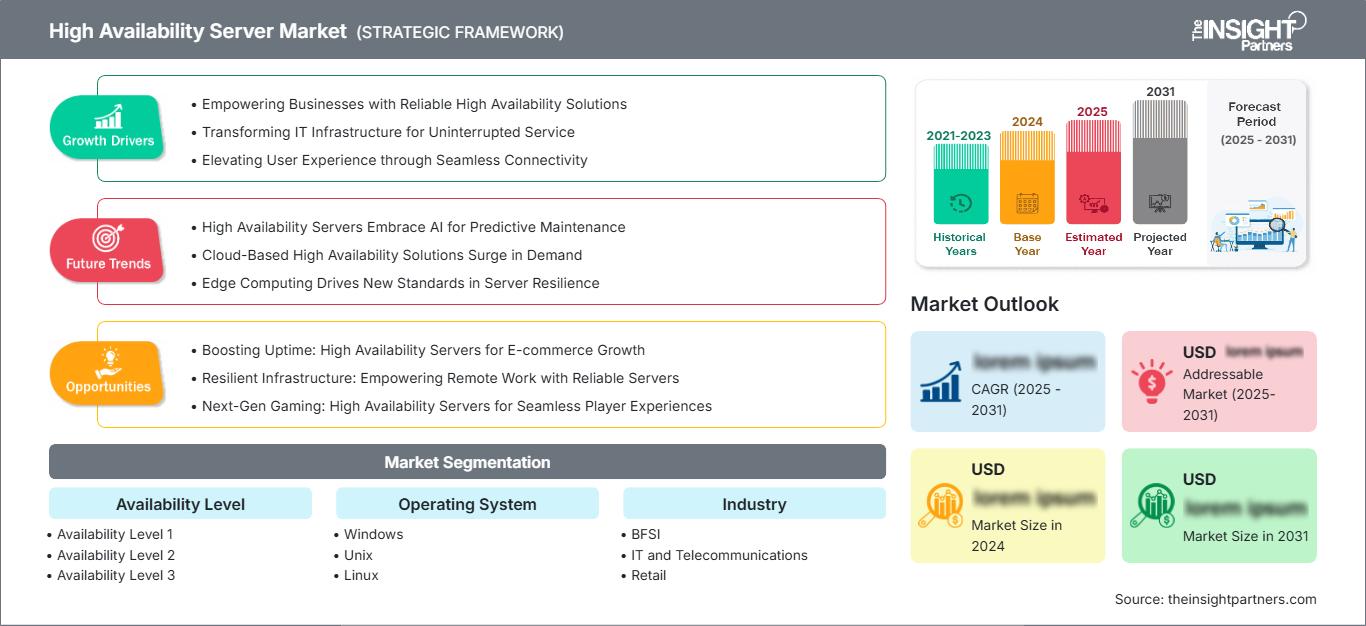
High Availability Server Market: Strategic Insights
Regional Insights
North America High Availability Server Market
The High Availability Server Market share of North America in 2025 is estimated to be 36-39% and the region should grow by 7.0-7.6% CAGR till 2034. The Market share for High Availability Server is influenced by the large number of clouds, developed enterprise data centers, regulated digital services, significant installed base in financial services, telecom, government organizations, healthcare and retail sectors.
The spend on resilience is incorporating clustered server, redundancy in network, storage replication, observability, and cyber-resilience.
There is a need for modernization including AI, edge computing, Windows Server, Enterprise Linux and migration from older proprietary platform. Canada provides a market share with the financial services, public sector cloud, natural resources, and telecom industry. Mexico provides the market share for manufacturing, retail and data centers.
U.S. High Availability Server Market
The U.S. accounted for 84-87% of the total North America market in 2025 and is predicted to exhibit a 7.1-7.7% CAGR between 2026 and 2034. Cloud vendors, financial institutions, payment gateways, telecom firms, healthcare organizations, merchants, governmental organizations, and manufacturers are key contributors driving the requirement for redundant computing. The application landscape prefers databases continuity, virtualization clustering, AI inference, digital archiving, digital payment, and resiliency of branch/edge computing.
Cisco Systems, Inc., Dell Technologies Inc., Hewlett Packard Enterprise Development LP, International Business Machines Corporation, Oracle Corporation, and Stratus Technologies, Inc. offer their direct and indirect presence. Procurement is becoming increasingly linked to availability, security, disaster recovery, and observability rather than availability being just another property of the hardware. Firms have standardized tools for management and automate patching, failover testing, and capacity balancing to manage complexity.
Europe High Availability Server Market
Europe had a share of 24-27% in 2025 and will continue to see growth with a 6.8-7.4% CAGR during the 2034 period. Europe is led by Germany due to its strengths in manufacturing, automotive, financial services, public sector administration, and industrial software where buyers prioritize data sovereignty, energy efficiency, and resilient automation. This region requires Unix renewal, Linux clustering, private cloud computing, and highly resilient edge computing for its factories and logistics infrastructures.
The United Kingdom provides banking, insurance, telecommunication, government, and colocation business opportunities along with operational resilience regulations that improve failover testing and third-party risk management. France leverages public cloud, transport, defense, health care, and energy modernization. Italy and Spain provide digital payment, retail, telecommunication, and public sector workload requirements.
APAC High Availability Server Market
Asia Pacific held 25–29% share in 2025 and is forecast to grow at an 8.4–9.1% CAGR during 2026–2034. The Asia Pacific region had a market share of 25-29% in 2025 and is estimated to register a CAGR of 8.4-9.1% from 2026 to 2034. China dominates due to cloud, telecommunication, financial services, e-commerce, and server production; Japan and South Korea focus on enterprise-grade, high-quality systems and electronic manufacturing.
India contributes the digitization of the banking industry, government and public digitization, telecommunication, and data centers, whereas Australia introduces cloud zones, mining, government, and healthcare. The factors driving Linux clusters, strong edge computing infrastructure, and availability services include the need for data localization, 5G technology, factory automation, and artificial intelligence.
Middle East & Africa High Availability Server Market
MEA and Africa should grow with a CAGR of 7.3% to 8.0% during the period 2026–2034, headed by Saudi Arabia. Government cloud initiatives, fintech transformation, energy infrastructure operations, smart city solutions, and the building of new data centers boost demands for unbroken compute.
The UAE contributes cloud expansion, aviation services, logistics, telecommunications, and ecommerce, Whereas South Africa provides solutions for banking, mining, retail, and public sectors. In RoMEA, the demand is project-based and is based on criteria like power reliability, remote management, cyber security, and serviceability.
Segmentation Analysis
Availability Level
The Availability Level segment should expand at a 7.5–8.1% CAGR during 2026–2034. High Availability Server Market scope by availability level reflects acceptable downtime, application criticality, redundancy depth, and budget. Buyers increasingly migrate from basic component protection toward clustered platforms with automated failover, replicated data, and proactive monitoring, particularly where digital transactions, communications, or safety-related processes require predictable recovery.
- Availability Level 1 serves cost-sensitive workloads requiring improved reliability over standard servers, with demand concentrated in departmental applications, small enterprises, and noncritical systems where brief interruptions remain operationally manageable.
- Availability Level 2 supports business applications needing stronger redundancy and faster recovery, making it relevant for regional banking, retail systems, healthcare administration, and medium-sized virtualized environments.
- Availability Level 3 represents the leading position because clustered failover, redundant subsystems, and automated recovery align with mission-critical databases, telecom platforms, digital payments, and high-volume enterprise services.
Operating System
The Operating System segment is anticipated to advance at a 7.8–8.4% CAGR during 2026–2034. Platform choice follows application compatibility, administration skills, licensing, security, virtualization, and cloud strategy. Windows remains important for corporate applications; Unix retains mission-critical installed bases; Linux gains through containers, cloud-native services, AI, telecommunications, and flexible clustering across commodity and specialized hardware.
- Windows holds substantial enterprise demand through Microsoft application ecosystems, failover clustering, identity integration, and familiar administration across banking, healthcare, retail, government, and midmarket data centers.
- Unix remains strategically important for core banking, telecommunications, government, and transaction systems where proven scalability, vertical integration, long support cycles, and application certification outweigh migration costs.
- Linux records the strongest momentum through open-source economics, Kubernetes, cloud platforms, AI infrastructure, telecom networks, and broad hardware support, enabling scalable active-active designs and automated recovery.
Industry
The Industry segment should grow at a 7.6–8.2% CAGR during 2026–2034. Adoption follows the financial and operational cost of downtime, regulatory oversight, data intensity, and service criticality. BFSI and telecommunications sustain large installed bases, while healthcare and retail expand as digital records, omnichannel transactions, edge analytics, and always-on customer experiences become integral to daily operations.
- BFSI prioritizes transaction integrity, payment continuity, fraud analytics, regulatory reporting, and disaster recovery, supporting premium platforms with rapid failover, replicated databases, encryption, and comprehensive service agreements.
- IT and Telecommunications requires scalable availability for cloud services, network functions, billing, subscriber systems, and edge computing, making automation, density, energy efficiency, and remote management decisive procurement factors.
- Retail demand spans e-commerce, point-of-sale, inventory, fulfillment, and personalized analytics, with resilient servers protecting revenue during seasonal peaks and supporting distributed stores, warehouses, and digital channels.
- Healthcare adopts reliable compute for electronic records, imaging, diagnostics, pharmacy, and clinical communications, where application interruption can disrupt care delivery and strengthen requirements for tested failover procedures.
Opportunity Snapshot
| Industry Vertical | Revenue Contribution | Trend Tag | Adoption Stage |
| BFSI | High | Payment Resilience | Mature |
| IT and Telecommunications | High | Edge Continuity | Scaling |
| Retail | Medium | Omnichannel Uptime | Scaling |
| Healthcare | Medium | Clinical Continuity | Scaling |
High Availability Server Market Growth Drivers and Impact Analysis
Rising Cost of Digital-Service Interruption
Enterprises now depend on continuously available payment, communications, commerce, clinical, and operational systems. Even short outages can halt transactions, delay care, trigger contractual penalties, and damage customer trust. This exposure makes resilient compute a business-continuity investment rather than an optional infrastructure enhancement. Organizations consequently fund clustered servers, redundant power and networking, replicated storage, automated failover, and geographically separated recovery. The market impact includes shorter replacement cycles for unsupported platforms, greater spending on validation and testing, and stronger demand for lifecycle services. Suppliers that quantify recovery objectives, simplify failover exercises, and integrate availability with cybersecurity can secure larger, multiyear engagements.
Hybrid Cloud and Edge Infrastructure Expansion
Applications increasingly span enterprise data centers, public clouds, colocation facilities, and edge locations. This distribution improves proximity and scalability but introduces dependencies across networks, identities, data replication, and orchestration. High-availability platforms address the resulting complexity through consistent management, workload mobility, automated recovery, and local processing when connectivity degrades. Telecom, retail, manufacturing, and healthcare deployments particularly require compact systems that can operate remotely with limited technical staff. The market impact is broader demand for edge-optimized servers, integrated networking, zero-touch administration, and subscription support. Vendors able to provide common controls from core to edge can reduce operational fragmentation and improve platform standardization.
Regulated Resilience Across Critical Industries
Financial institutions, healthcare providers, telecom operators, and public agencies face formal expectations for service continuity, data protection, third-party oversight, and tested recovery. Compliance programs require documented controls, defined recovery objectives, incident reporting, and evidence that critical services can continue through infrastructure failure or cyber disruption. Buyers therefore favor platforms with secure firmware, component redundancy, validated operating-system support, observability, and auditable maintenance. The market impact extends from hardware into consulting, managed services, disaster-recovery exercises, and long-term support. Vendors that align technical designs with operational-resilience frameworks can influence early architecture decisions and defend value beyond commodity server pricing.
High Availability Server Market Future Trends
Autonomous Availability Operations
High Availability Server Market trends will increasingly center on telemetry-driven systems that detect degradation, predict component failure, rebalance workloads, and initiate remediation before service interruption. Artificial intelligence will correlate hardware health, application performance, security events, and capacity conditions across distributed estates. Human operators will retain policy control, but routine diagnostics, patch sequencing, and failover validation will become more automated. This direction raises demand for trusted data models, explainable recommendations, secure management planes, and integration with service-management tools. Vendors that convert server telemetry into measurable reductions in incident duration can create recurring software revenue and stronger customer retention.
Application-Aware Resilience Across Mixed Compute
Future architectures will extend availability from server components to complete application services spanning CPUs, accelerators, containers, databases, storage, and networks. Recovery decisions will account for transaction state, data consistency, latency, and workload priority rather than simply restarting virtual machines. Mixed AI and conventional environments will require resilient accelerator pools, checkpointing, and policy-based placement across on-premises and cloud resources. Open interfaces will become important because enterprises want coordinated recovery without dependence on a single infrastructure layer. Suppliers that validate end-to-end service continuity across heterogeneous stacks can differentiate through application outcomes, not only hardware redundancy.
High Availability Server Market Opportunities
Managed Availability for Midmarket Enterprises
Midmarket organizations often depend on critical applications but lack dedicated resilience engineering teams. Vendors can address this gap with packaged services combining assessment, redundant servers, backup connectivity, monitoring, patch coordination, recovery testing, and outcome-based support. Standardized bundles should target regional banks, hospital groups, retailers, manufacturers, and business-service providers with clear recovery objectives and predictable monthly costs. Investment priorities include remote operations centers, automated health analytics, partner certification, and regional spare-parts coverage. Providers that demonstrate faster recovery and lower administrative burden can convert one-time hardware sales into recurring relationships while expanding adoption beyond large enterprises.
Resilient Edge Platforms for Distributed Operations
High Availability Server Market Forecasts support investment in compact, rugged, remotely managed platforms for telecom sites, stores, clinics, factories, transport hubs, and energy assets. These locations need local continuity when wide-area connectivity fails, yet space, power, and technical staffing are constrained. Suppliers should combine redundant compute, integrated networking, secure remote access, lightweight virtualization, and rapid replacement services. Partnerships with telecom operators, industrial automation vendors, and managed-service providers can accelerate channel reach. Demonstration deployments that quantify avoided downtime and simplify fleet management will strengthen procurement cases and establish repeatable designs across thousands of distributed sites.
Recent Developments
- February 2025: AEWIN Technologies has introduced the MIS-5131-2U2, a 2U2N high-availability storage server designed for mission-critical workloads that require high performance, redundancy, and uninterrupted data access. Powered by Intel Xeon 6 processors with Performance-cores (P-cores), the new storage platform combines two independent computing nodes in a single 2U chassis. The architecture is designed to provide enhanced availability while supporting demanding storage, enterprise computing, and data-intensive applications.
- January 2026: Infortrend Technology has introduced the KS 3000U, an edge AI server designed to help organizations deploy artificial intelligence inference closer to where data is generated. The platform combines computing, storage, operating software, and application management in a single system, targeting businesses that need real-time AI processing without the complexity of conventional infrastructure deployments.
- March 2026: Fort Collins, Colorado — DH2i has announced the general availability of DxEnterprise v26.0 and DxOperator v2, introducing new capabilities designed to improve high availability (HA), disaster recovery (DR), security, monitoring, and operational resilience for SQL Server environments.
Frequently Asked Questions

- Comprehensive Market Sizing and Forecast Analysis
- Detailed Segmentation Analysis
- In-Depth Market Dynamics Assessment
- Regional and Country-Level Insights
- Competitive Landscape and Company Benchmarking
- Strategic Business Intelligence
Recent Reports
Testimonials

The Insight Partners provided valuable market intelligence that supported our global go-to-market strategy. Their team was professional, responsive, and attentive to our feedback, providing thoughtful analysis and helpful methodological clarifications throughout the project.
Junmo Kim Chief Financial Officer (CFO), Enertech Co., Ltd.
The Insight Partners' SCADA System Market report is comprehensive, with valuable insights on current trends and future forecasts. The team was highly professional, responsive, and supportive throughout. We are very satisfied and highly recommend their services.
RAN KEDEM Partner, Reali Technologies LTDs
I requested a report on a very specific software market and the team produced the report in a few days. The information was very relevant and well presented. I then requested some changes and additions to the report. The team was again very responsive and I got the final report in less than a week.
JEAN-HERVE JENN Chairman, Future Analytica
We worked with The Insight Partners for an important market study and forecast. They gave us clear insights into opportunities and risks, which helped shape our plans. Their research was easy to use and based on solid data. It helped us make smart, confident decisions. We highly recommend them.
PIYUSH NAGPAL Sr. Vice President, High Beam Global
The Insight Partners delivered insightful, well-structured market research with strong domain expertise. Their team was professional and responsive throughout. The user-friendly website made accessing industry reports seamless. We highly recommend them for reliable, high-quality research services
YUKIHIKO ADACHI CEO, Deep Blue, LLC.
This is the first time I have purchased a market report from The Insight Partners.While I was unsure at first, I visited their web site and felt more comfortable to take the risk and purchase a market report.I am completely satisfied with the quality of the report and customer service. I had several questions and comments with the initial report, but after a couple of dialogs over email with their analyst I believe I have a report that I can use as input to our strategic planning process.Thank you so much for taking the extra time and making this a positive experience.I will definitely recommend your service to others and you will be my first call when we need further market data.
JOHN SUZUKI President and Chief Executive Officer, Board Director, BK Technologies
I wish to appreciate your support and the professionalism you displayed in the course of attending to my request for information regarding to infectious disease IVD market in Nigeria. I appreciate your patience, your guidance, and the fact that you were willing to offer a discount, which eventually made it possible for us to close a deal. I look forward to engaging The Insight Partners in the future, all thanks to the impression you have created in me as a result of this first encounter.
DR CHIJIOKE ONYIA MANAGING DIRECTOR, PineCrest Healthcare Ltd.Reason to Buy
- Informed Decision-Making
- Understanding Market Dynamics
- Competitive Analysis
- Identifying Emerging Markets
- Customer Insights
- Market Forecasts
- Risk Mitigation
- Boosting Operational Efficiency
- Strategic Planning
- Investment Justification
- Tracking Industry Innovations
- Aligning with Regulatory Trends





 Get Free Sample for