
High-end Inertial Systems Market Trends, Demand & Growth by 2034
Coverage: By Type (High-End Inertial Measurement Units, High-End Accelerometers, High-End Gyroscopes); End-User (Aerospace, Defense) , and Geography (North America, Europe, Asia Pacific, and South and Central America)
- Status : Data Released
- Report Code : TIPRE00021941
- Category : Electronics and Semiconductor
- No. of Pages : 150
- Available Report Formats :


- Last update date : September 10, 2026


2025 Market Size
US$ 10.12 Bn
Base year value
2034 Forecast
US$ 14.99 Bn
Projected by 2034
CAGR 2026-2034
5.03 %
Growth rate
Addressable Market
US$ 117.35 Bn
(2026-2034)
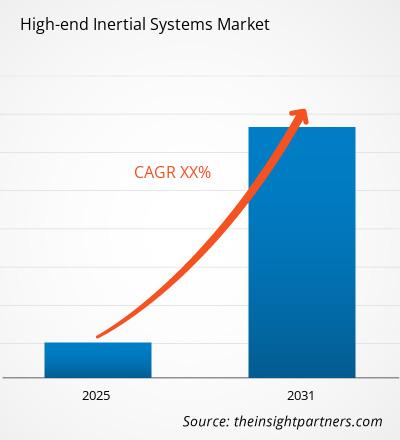
The High-end Inertial Systems market is US$ 10.12 Billion in 2025 and is projected to reach US$ 14.99 Billion by 2034, registering a CAGR of 5.03% during 2026–2034. Market comprises a specific segment within aerospace and defense technologies market focusing on precise measurement of motion, orientation, and acceleration.
The demand for market in North America is forecasted to grow at an estimated 5.0-5.8% CAGR in the period of 2026-2034 fueled by defense spending, modernization of aircraft, and resilient positioning, navigation, and timing needs. The outlook for the High-end Inertial Systems Market size also includes established manufacturing capabilities within aerospace industry and numerous installed platforms. US defense budget totaled US$954 billion in 2025. Commercial aviation demand was robust as well.
High-end Inertial Systems Market Assessment and Insights
- North America: North America is estimated at a 39–43% share in 2025 and is projected to grow at a 5.0–5.8% CAGR between 2026–2034, supported by defense modernization, commercial aircraft programs, resilient navigation, and established supplier qualification.
- US: The US accounts for an estimated 88–92% of North American demand in 2025 and is projected to expand at a 4.9–5.7% CAGR through 2034, led by defense and aerospace programs.
- Europe: Europe is estimated to hold a 27–31% share in 2025 and grow at a 5.4–6.2% CAGR during 2026–2034. France, Germany, the UK, Italy, and Spain benefit from defense investment and aircraft production.
- Asia Pacific: Asia Pacific represents an estimated 19–23% share in 2025 and is expected to expand at a 5.9–6.7% CAGR through 2034. China, Japan, South Korea, India, and Australia support procurement and aerospace manufacturing.
- Largest Segment: High-End Inertial Measurement Units are estimated to hold a 48–52% market share in 2025 and grow at a 4.8–5.6% CAGR through 2034, reflecting broad system integration.
- High Growth Segment: Defense is estimated to account for a 54–58% market share in 2025 and is projected to expand at a 5.5–6.3% CAGR through 2034, driven by resilient PNT requirements.
- Key companies analyzed in detail: Airbus S.A.S., The Boeing Company, Collins Aerospace, Honeywell International Inc., L3Harris Technologies, Inc., Northrop Grumman Corporation, Moog Inc., RTX Corporation, Safran, and Thales S.A.
Source: The Insight Partners' analysis based on proprietary research, government publications, company annual reports, investor presentations, industry databases, and expert interviews.
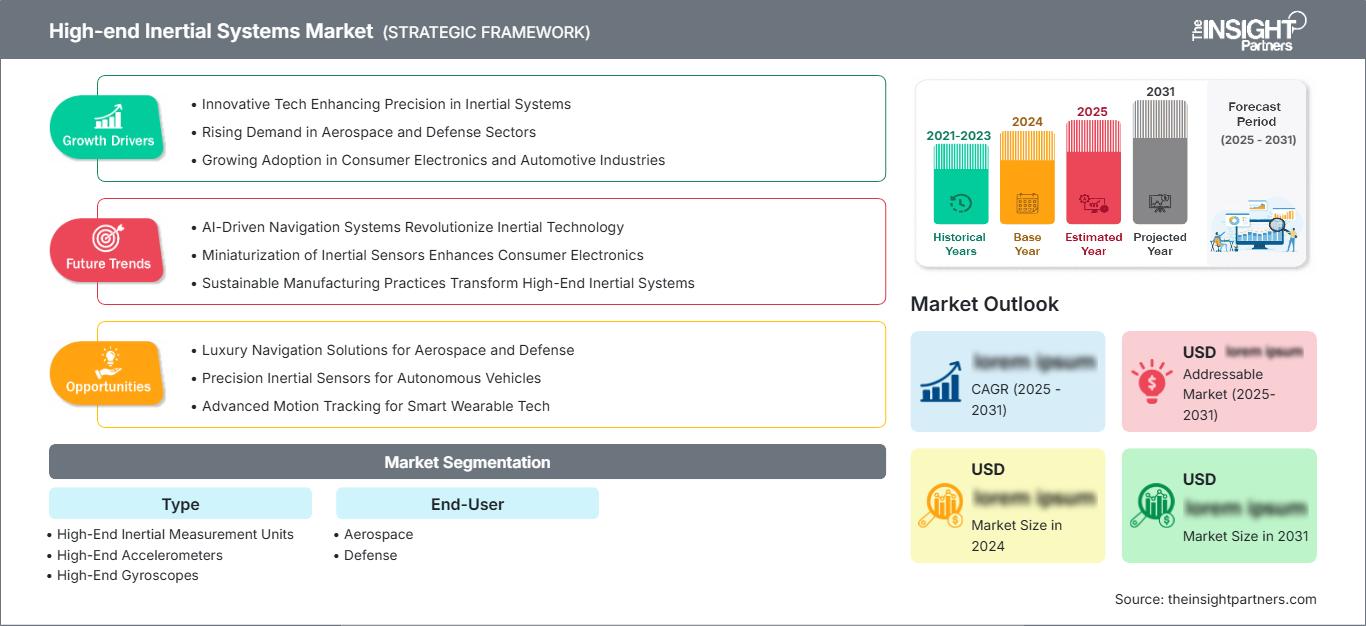
Precision inertial technology has moved away from being mechanically heavy systems into solid state and photonic systems using MEMS technology, fiber optic gyros, ring laser gyros, quartz accelerometers, calibration technology, and DSP. Honeywell states that more than 1.2 million IMU have been made at its Minnesota plant and that the installed base is over 900,000 units, demonstrating the level of qualification of the inertial technology deployed.
The future development stage needs to focus on resiliency, miniaturization, open architecture, and sensor fusion. GNSS jamming and spoofing technologies are increasing the value of autonomous navigation technology, while military budgets are growing in Europe and Asia. SIPRI estimates that global military spending was at US$2.887 trillion in 2025 with European military spending up 14% and Asian/Oceanian military spending up 8.1%.
High-end Inertial Systems Market Report Scope
| Report Attribute | Details |
|---|---|
| Market size in 2025 | US$ 10.12 Billion |
| Market Size by 2034 | US$ 14.99 Billion |
| Global CAGR (2026 - 2034) | 5.03% |
| Historical Data | 2021-2024 |
| Forecast period | 2026-2034 |
High-end Inertial Systems Market Analysis
The growth in demand will be largely associated with aircraft deliveries, platform upgrades, autonomy, and defense applications which require continual navigation. The growth in the High-end Inertial Systems Market will therefore be driven by the value chain, which includes manufacturing of inertial sensors, assembly of gyros and accelerometers, calibration, navigation computing, software, avionics integration, qualifications and maintenance. High-end products have technical premiums due to bias stability, scale-factor accuracy, vibration resistance, temperature performance and life-cycle reliability.
Commercial aviation ensures steady installed platform whereas defense applications generate high technological specifications and qualification cycles. IATA revealed that there was an increase in 5.3% in the global demand for passengers in 2025, with 7.1% increase in international demand despite aircraft and engine deliveries remaining constrained.
Competitive pressure depends on a variety of factors such as proprietary sensor technologies, experience, scale, and platform relationship. Analysis of the High-end Inertial Systems Market Report reveals that Honeywell International Inc., Safran, Thales S.A., Northrop Grumman Corporation, L3Harris Technologies, Inc., and Collins Aerospace are competing on the grounds of navigation-level performance and defense-related integration. Airbus S.A.S. and The Boeing Company drive market demand through platforms, while Moog Inc. provides precision and navigation integration.
Current investment trends are oriented towards PNT resilience, SWaP-C reductions, digitization, and sensor fusion. For example, the product of Safran, BlackNaute, is a navigation solution which combines advanced inertial sensors, GNSS, and timing for use in hostile environments. Meanwhile, Collins Aerospace already developed APNT solutions that were designed to navigate in GPS-degraded conditions. This proves the increasing trend of competitiveness from sensors to navigation architectures.
● REPORT CUSTOMIZATION
Tailor This Report To Align With Your Specific Business Requirements
This report can be customized to align precisely with your business objectives, scope, and target markets. Customization options include tailored segmentation, geography, competitive analysis, and strategic insights to support informed decision-making.
Customize This Report →WHAT YOU CAN ADJUST
- ● Segmentations
- ● Geography
- ● Competitive Analysis
- ● Language Preferences
High-end Inertial Systems Market: Strategic Insights
Regional Insights
North America High-end Inertial Systems Market
North America is expected to have a High-end Inertial Systems Market share of 39-43% in 2025 and is expected to have a CAGR of 5.0-5.8% from 2025 to 2034. The US has dominated the regional demand due to many military aircraft, missiles, space, and autonomous systems. Canada has added depth in aerospace manufacturing whereas regional suppliers have benefitted due to qualifications infrastructure and platform relationships. Defense modernization continues to be the demand driver.
Another demand driver is commercial aviation. According to IATA, there has been 5.3% increase in global passenger-demand growth in 2025 and continued supply constraints of aircrafts resulted in extended operation of existing fleets. This contributes to maintenance and replacement of avionics. Requirements for resilience, export controls, cybersecurity and supply chain continue to make North American suppliers and technology providers more attractive.
U.S. High-end Inertial Systems Market
The US accounts for around 88% – 92% of North America’s demand in 2025 and is expected to grow at a CAGR of 4.9% – 5.7% until 2034. It owes its share to the size of its defense procurements, commercial aerospace manufacturing, and space programs. Companies such as Honeywell International Inc., Collins Aerospace, L3Harris Technologies, Inc., Northrop Grumman Corporation, Moog Inc., and RTX Corporation have considerable technology or platform presence.
Defence is the leading driver of applications since inertial systems provide guidance, navigation, stabilisation, flight control, and targeting. According to SIPRI, the US defence budget in 2025 stood at US$954 billion, despite an annual 7.5% decrease from 2024. In addition, in 2026 the US Congress allocated more than US$1 trillion to the country’s defense.
Europe High-end Inertial Systems Market
Europe is estimated to account for a 27–31% share in 2025 and is projected to grow at a 5.4–6.2% CAGR through 2034, with France representing the leading national technology base. Germany, the UK, Italy, and Spain contribute through defense procurement, aircraft manufacturing, navigation programs, and modernization. European military spending rose 14% in 2025 to US$864 billion.
The UK meets its demands from its aerospace and defense sectors, but there might be delays in procurement due to financial considerations. Germany has enhanced its defense capability and has been spending US$114 billion on military activities in 2025, which is a rise of 24%. France is spending US$68 billion, Italy US$48.1 billion, and Spain US$40.2 billion.
APAC High-end Inertial Systems Market
The Asia Pacific region holds a share of about 19-23% in 2025 and will grow at 5.9-6.7% CAGR until 2034. The leading players in the region include China, followed by Japan, South Korea, India, and Australia. Local demand includes indigenous aerospace production, naval upgrades, missiles programs, autonomy initiatives, and civilian aircraft production.
China invested about $336 billion into its defense forces in 2025, India spent $92.1 billion, Japan invested $62.2 billion, South Korea $47.8 billion, and Australia – $35.3 billion. Such investments ensure continued development in the area of navigation, stabilization, and guidance systems.
Middle East & Africa High-end Inertial Systems Market
The Middle East and Africa region's demand will experience growth of 4.5-5.3% CAGR until 2034, with Saudi Arabia driving the purchase in the region. Other sources of demand will be the UAE and South Africa due to their defense modernization efforts, aerospace programs, and industries. The spending of Saudi Arabia on defense was estimated at $83.2 billion in 2025.
Opportunities in the region can be associated with the air-defense modernization effort, unmanned systems, precision weapons, and aircraft fleets. In particular, Saudi Arabia, the UAE, and the rest of the Gulf countries focus on sovereignty and local industry, whereas Africa will remain selective. Development of infrastructure and difficult operating environment make rugged and temperature-resistant navigation systems more significant.
Segmentation Analysis
Type
Type is projected to grow at a 4.7–5.5% CAGR during 2026–2034. High-end Inertial Measurement Units remain central because they combine multiple sensing functions into integrated navigation assemblies. High-end accelerometers and gyroscopes retain strategic importance where individual sensor performance determines navigation accuracy, stabilization quality, or platform survivability. The High-end Inertial Systems Market scope therefore spans both integrated and component-level architectures.
- High-End Inertial Measurement Units: High-End Inertial Measurement Units occupy the broadest integration role, combining accelerometers, gyroscopes, electronics, calibration, and processing. Demand is strongest where complete navigation or stabilization functionality is required.
- High-End Accelerometers: High-End Accelerometers support precision measurement of linear motion and remain strategically important for guidance, navigation, flight control, and stabilization. Their value rises with requirements for low bias drift and environmental robustness.
- High-End Gyroscopes: High-End Gyroscopes provide angular-rate measurement for navigation and stabilization. Demand favors technologies offering strong bias stability, scale-factor accuracy, vibration tolerance, and reliable operation across demanding aerospace and defense environments.
End-User
End-User is expected to expand at a 5.2–6.0% CAGR from 2026–2034, with defense maintaining the larger revenue contribution. Aerospace demand benefits from fleet expansion and avionics replacement, while defense demand reflects resilient PNT, precision guidance, autonomous platforms, and modernization. The High-end Inertial Systems Market trends increasingly favor systems capable of operating when satellite navigation is unavailable.
- Aerospace: Aerospace applications prioritize long service life, certification, low maintenance, and precise attitude and navigation performance. Commercial and business aviation provide recurring replacement opportunities alongside new aircraft programs.
- Defense: Defense represents the larger strategic opportunity because inertial systems enable navigation and stabilization under contested conditions. Procurement increasingly emphasizes anti-jam resilience, compact integration, ruggedization, and interoperability with multi-sensor architectures.
Opportunity Snapshot
| End-User | Revenue Contribution | Trend Tag | Adoption Stage |
|---|---|---|---|
| Aerospace | High | Fleet Modernization | Mature |
| Defense | High | Resilient PNT | Scaling |
High-end Inertial Systems Market Growth Drivers and Impact Analysis
GNSS Disruption Increases Demand for Autonomous Navigation
Jamming and spoofing threats are changing the operational value of inertial navigation because aircraft, vehicles, missiles, ships, and unmanned platforms require continuity when satellite signals become unreliable. Safran reported that GNSS jamming and spoofing threats increased sharply during 2024 and positioned its BlackNaute system around resilient PNT for electronic-warfare environments. This trend increases demand for high-grade gyroscopes, accelerometers, atomic timing, and sensor-fusion architectures. Procurement decisions are consequently shifting toward complete navigation resilience rather than standalone accuracy specifications. Suppliers capable of integrating inertial sensors with GNSS receivers, clocks, anti-jamming algorithms, and platform software can address broader mission requirements. The commercial impact is a gradual movement toward higher-value navigation assemblies, longer qualification programs, and greater investment in assured positioning technologies.
Defense Modernization Expands Qualified Inertial System Demand
Rising defense expenditure is creating a favorable procurement environment for precision sensing and navigation. Global military expenditure reached US$2.887 trillion in 2025, while Europe increased spending 14% and Asia and Oceania increased spending 8.1%. These changes matter because new aircraft, missile systems, unmanned vehicles, naval platforms, and air-defense systems require multiple navigation and stabilization functions. European rearmament is particularly significant for suppliers with established qualification and local industrial relationships. Defense buyers also increasingly seek domestic or allied supply resilience, strengthening the strategic value of manufacturing capacity and technology ownership. The resulting market effect is not simply higher unit demand; it also encourages investment in production redundancy, environmental qualification, secure electronics, software assurance, and long-term support capabilities.
Aircraft Utilization Sustains Avionics Replacement Requirements
Commercial aviation recovery is supporting a separate replacement pathway for inertial equipment. Global passenger demand increased 5.3% in 2025, while capacity increased 5.2%, and airlines continued facing aircraft delivery and maintenance constraints. Longer aircraft utilization can increase the importance of reliable avionics maintenance and replacement, particularly for systems exposed to continuous vibration, temperature variation, and operating-cycle accumulation. New aircraft programs create additional demand, but the installed fleet creates recurring aftermarket requirements that can moderate the cyclicality of original-equipment production. Suppliers with broad repair networks, certified replacement units, and backward compatibility can therefore capture value across multiple lifecycle stages. This driver also favors established producers because aviation qualification and documentation requirements make rapid substitution difficult once equipment has been integrated into certified aircraft architectures.
High-end Inertial Systems Market Future Trends
Sensor Fusion Will Become the Core Navigation Architecture
Future navigation systems are likely to combine inertial sensors with GNSS, celestial references, terrain data, vision, radar, timing sources, and platform-specific sensors. This evolution will make software and calibration increasingly important alongside raw sensor performance. The High-end Inertial Systems Market forecast is likely to shift toward architectures that continuously estimate sensor error and select the most reliable available reference. Defense platforms will benefit most because contested environments can degrade individual navigation sources. Commercial aerospace can adopt similar approaches where redundancy, operational continuity, and predictive maintenance justify additional processing. Suppliers should therefore invest in fusion algorithms, digital interfaces, cybersecurity, and modular computing rather than treating the inertial package as an isolated hardware component.
SWaP-C Optimization Will Broaden High-End MEMS Adoption
The next generation of high-end inertial equipment will increasingly compete on size, weight, power, and cost while retaining performance appropriate for demanding missions. Honeywell's HG4930 demonstrates this direction through a compact MEMS architecture designed for tactical applications, with a 140-gram package and operation across a broad temperature range. Such architectures can expand deployment into smaller unmanned aircraft, stabilized payloads, robotics, and autonomous ground systems. The trend does not eliminate fiber-optic or ring-laser technologies; instead, it creates clearer performance tiers. Suppliers that deliver near-navigation-grade performance in smaller packages can access applications previously constrained by weight, power, or installation volume.
High-end Inertial Systems Market Opportunities
Resilient PNT Programs Create Premium Technology Niches
Investors and suppliers can target resilient PNT programs where customers accept higher component costs to preserve navigation under interference. The Market Forecasts point toward opportunities in military aircraft, precision-guided systems, unmanned platforms, naval assets, and autonomous vehicles requiring assured positioning. Products combining inertial measurement, secure GNSS, timing, anti-jamming functions, and sensor fusion offer greater differentiation than standalone sensors. Partnerships with defense primes can accelerate qualification, while localized manufacturing can support sovereign procurement objectives. Technology developers should prioritize modular architectures that permit upgrades without redesigning the complete navigation system. This approach can shorten future qualification cycles and create recurring software, calibration, and support revenue alongside hardware sales.
Regional Production Partnerships Can Improve Supply Resilience
Regional aerospace manufacturing programs offer opportunities for companies able to establish localized engineering, testing, calibration, and repair capabilities. India, the Middle East, and selected European markets are strengthening domestic aerospace and defense ecosystems, creating demand for suppliers willing to support local content requirements. Collins Aerospace, for example, opened a 26-acre manufacturing facility in Bengaluru in 2025 with capabilities covering advanced aerospace products and navigation systems. Similar partnerships can reduce logistics exposure, shorten certification feedback cycles, and improve customer support. Investment should focus on high-value production stages rather than duplicating commodity manufacturing. Local calibration, environmental testing, systems integration, and lifecycle services can provide stronger differentiation while allowing core sensor technologies to remain within established global manufacturing networks.
Recent Developments
- April 2025: Thales unveiled a next-generation TopAxyz inertial measurement unit (IMU) integrating three-axis Ring Laser Gyrometer technology with digital MEMS accelerometers, delivering resilient navigation against GPS jamming and spoofing while being 20% smaller, 10% lighter and more power-efficient than the previous design, with first customer deliveries expected in early H2 2026.
- April 2026: Hexagon completed its acquisition of Inertial Sense, strengthening its assured positioning, navigation and timing (PNT) portfolio with tactical-grade GNSS+INS technology, adding more than 30,000 deployed inertial systems across defence and commercial applications and expanding its resilient navigation capabilities for aerospace, defence, autonomy and GPS-challenged environments.
- March 2026: Honeywell introduced the HGuide I700, a commercially available inertial measurement unit (IMU) designed to provide high-performance motion sensing and navigation capabilities for demanding applications.
Frequently Asked Questions

- Comprehensive Market Sizing and Forecast Analysis
- Detailed Segmentation Analysis
- In-Depth Market Dynamics Assessment
- Regional and Country-Level Insights
- Competitive Landscape and Company Benchmarking
- Strategic Business Intelligence
Recent Reports
Testimonials

The Insight Partners' SCADA System Market report is comprehensive, with valuable insights on current trends and future forecasts. The team was highly professional, responsive, and supportive throughout. We are very satisfied and highly recommend their services.
RAN KEDEM Partner, Reali Technologies LTDs
I requested a report on a very specific software market and the team produced the report in a few days. The information was very relevant and well presented. I then requested some changes and additions to the report. The team was again very responsive and I got the final report in less than a week.
JEAN-HERVE JENN Chairman, Future Analytica
We worked with The Insight Partners for an important market study and forecast. They gave us clear insights into opportunities and risks, which helped shape our plans. Their research was easy to use and based on solid data. It helped us make smart, confident decisions. We highly recommend them.
PIYUSH NAGPAL Sr. Vice President, High Beam Global
The Insight Partners delivered insightful, well-structured market research with strong domain expertise. Their team was professional and responsive throughout. The user-friendly website made accessing industry reports seamless. We highly recommend them for reliable, high-quality research services
YUKIHIKO ADACHI CEO, Deep Blue, LLC.
This is the first time I have purchased a market report from The Insight Partners.While I was unsure at first, I visited their web site and felt more comfortable to take the risk and purchase a market report.I am completely satisfied with the quality of the report and customer service. I had several questions and comments with the initial report, but after a couple of dialogs over email with their analyst I believe I have a report that I can use as input to our strategic planning process.Thank you so much for taking the extra time and making this a positive experience.I will definitely recommend your service to others and you will be my first call when we need further market data.
JOHN SUZUKI President and Chief Executive Officer, Board Director, BK Technologies
I wish to appreciate your support and the professionalism you displayed in the course of attending to my request for information regarding to infectious disease IVD market in Nigeria. I appreciate your patience, your guidance, and the fact that you were willing to offer a discount, which eventually made it possible for us to close a deal. I look forward to engaging The Insight Partners in the future, all thanks to the impression you have created in me as a result of this first encounter.
DR CHIJIOKE ONYIA MANAGING DIRECTOR, PineCrest Healthcare Ltd.Reason to Buy
- Informed Decision-Making
- Understanding Market Dynamics
- Competitive Analysis
- Identifying Emerging Markets
- Customer Insights
- Market Forecasts
- Risk Mitigation
- Boosting Operational Efficiency
- Strategic Planning
- Investment Justification
- Tracking Industry Innovations
- Aligning with Regulatory Trends





 Get Free Sample for