
High Power LED Market Growth, Size & Forecast by 2034
Coverage: by Packaging Type (Mesa, Flip Chip, Vertical); Application (Automotive, Back-lighting, Mobile Device, General Lighting, Signals and Signage, Others) , and Geography (North America, Europe, Asia Pacific, and South and Central America)
- Status : Data Released
- Report Code : TIPRE00006039
- Category : Electronics and Semiconductor
- No. of Pages : 150
- Available Report Formats :


- Last update date : September 17, 2026


2025 Market Size
US$ 10.51 Bn
Base year value
2034 Forecast
US$ 23.99 Bn
Projected by 2034
CAGR 2026-2034
9.60 %
Growth rate
Addressable Market
US$ 153.81 Bn
(2026-2034)
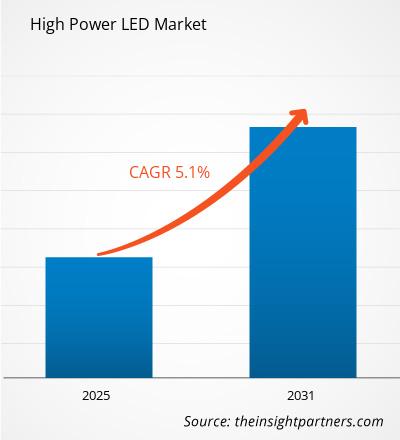
The High Power LED market size is US$ 10.51 Billion in 2025 and is projected to reach US$ 23.99 Billion by 2034, registering a CAGR of 9.60% during 2026–2034. Growth is caused due to the rise in efficiencies, better heat management, superior optical control, and the application of small LED packages in challenging conditions. Growth of the market is estimated to continue due to the introduction of solid-state lighting for cars, illumination, display panels, mobile devices, and signal generation. T
The demand in North America will be led by vehicle electrification, retrofitting for business purposes, connected infrastructures, and efficient purchasing methods. The estimated CAGR of the region during 2026-2034 will be between 8.2% and 9.0%. There are certain aspects such as vehicle lightings, infrastructure development, and replacement of existing lighting systems that will contribute to the High Power LED market size in this region.
High Power LED Market Assessment and Insights
- North America: The region is estimated to hold a 24–28% share in 2025 and expand at an 8.2–9.0% CAGR between 2026–2034, supported by automotive lighting, retrofit programs, commercial infrastructure, and established component ecosystems.
- US: The US represents an estimated 70–74% of North American revenue in 2025 and is expected to grow at an 8.0–8.8% CAGR through 2034, led by automotive, roadway, and commercial applications.
- Europe: Europe is modelled at a 22–26% share in 2025, with an 8.7–9.5% CAGR through 2034. Germany, the UK, France, Italy, and Spain support demand through vehicle technology, efficiency regulation, renovation, and premium lighting.
- Asia Pacific: Asia Pacific is estimated at a 39–43% share in 2025 and is projected to record a 10.2–11.0% CAGR through 2034. China, Japan, South Korea, and India anchor manufacturing, electronics, automotive, and infrastructure demand.
- Largest Segment: General Lighting is estimated to represent a 35–39% market share in 2025 and is modelled to grow at an 8.8–9.6% CAGR through 2034, supported by retrofit and professional lighting.
- High Growth Segment: Automotive is estimated at a 23–27% market share in 2025 and is modelled to expand at a 10.2–11.0% CAGR through 2034, reflecting electrification and advanced illumination.
- Key companies analyzed in detail: Cree LED, EPISTAR Corporation, LG Innotek, Lumileds Holding B.V., Nichia Corporation, Samsung Electronics Co., Ltd., Seoul Semiconductor Co., Ltd., Siemens AG, Signify Holding, and Toyoda Gosei Co., Ltd.
Source: The Insight Partners' analysis based on proprietary research, government publications, company annual reports, investor presentations, industry databases, and expert interviews.
Market developments have shifted away from the simpler form of high-brightness component towards package design tailored to meet the needs of specific applications, which will demand more robust thermal conductance, color control, light extraction efficiency, and electrical current carrying capability. Packaging designs are becoming more influenced by the limitations of each application, while companies incorporate chip, phosphor, substrate, optical, and thermal design together.
In the future, investments will be made in higher efficacy LED products, intelligent controls, vehicle illumination solutions, and circular product design. The emerging markets present an opportunity for direct adoption of technologies due to the existence of inefficient lighting fixtures in residential, commercial, and outdoor areas. There are efficiency standards in Europe, while the US has programs aimed at developing solid state lighting solutions.
High Power LED Market Report Scope
| Report Attribute | Details |
|---|---|
| Market size in 2025 | US$ 10.51 Billion |
| Market Size by 2034 | US$ 23.99 Billion |
| Global CAGR (2026 - 2034) | 9.60% |
| Historical Data | 2021-2024 |
| Forecast period | 2026-2034 |
High Power LED Market Analysis
The demand side is driven by the need for brightness within small form factors. There is an increasing need for automotive headlights, daytime driving lights, display backlighting, street lighting, industrial lighting, and specialist lighting that uses controlled light beams and performs reliably at high junction temperatures. The value chain involves the use of epitaxial materials, LED dies, substrates, packaging materials, phosphors, drivers, optics, thermal interfaces, modules, luminaires, and original equipment integration.
As far as supply side dynamics are concerned, there is a heavy concentration in Asia with production centers in China, Taiwan, Japan, and South Korea. This is due to the availability of expertise in the semiconductor industry and packaging and electronic manufacturing industries. China is one of the world’s largest producers, consumers, and exporters of LED lighting products. Therefore, cost pressures will be the highest on standardized products while there is a relatively higher level of technical barriers for automotive products and specialty products.
Positioning within competition involves intellectual property and qualification for particular applications. Cree LED is specialized in high-power and application-focused parts, whereas Nichia combines its LED development with optical and ultraviolet technology. Samsung Electronics Co., Ltd and LG Innotek build their competencies on the base of display and automotive systems, while Lumileds Holding B.V, Seoul Semiconductor Co., Ltd and Toyoda Gosei Co., Ltd compete by their competencies in packaging, automotive and illumination.
Investment within the strategy is focused on the system level benefits in the High Power LED Market Report. Signify Holding focuses on connected lighting and specific professional applications, whereas Siemens AG is involved through electrification and intelligent infrastructure. EPISTAR Corporation plays an important role in the Asian semiconductor ecosystem. Competitive differentiation therefore relies on thermal architecture, optical efficiency, qualification of reliability, manufacturing flexibility, intellectual property, and integration with increasingly digital lighting systems.
● REPORT CUSTOMIZATION
Tailor This Report To Align With Your Specific Business Requirements
This report can be customized to align precisely with your business objectives, scope, and target markets. Customization options include tailored segmentation, geography, competitive analysis, and strategic insights to support informed decision-making.
Customize This Report →WHAT YOU CAN ADJUST
- ● Segmentations
- ● Geography
- ● Competitive Analysis
- ● Language Preferences
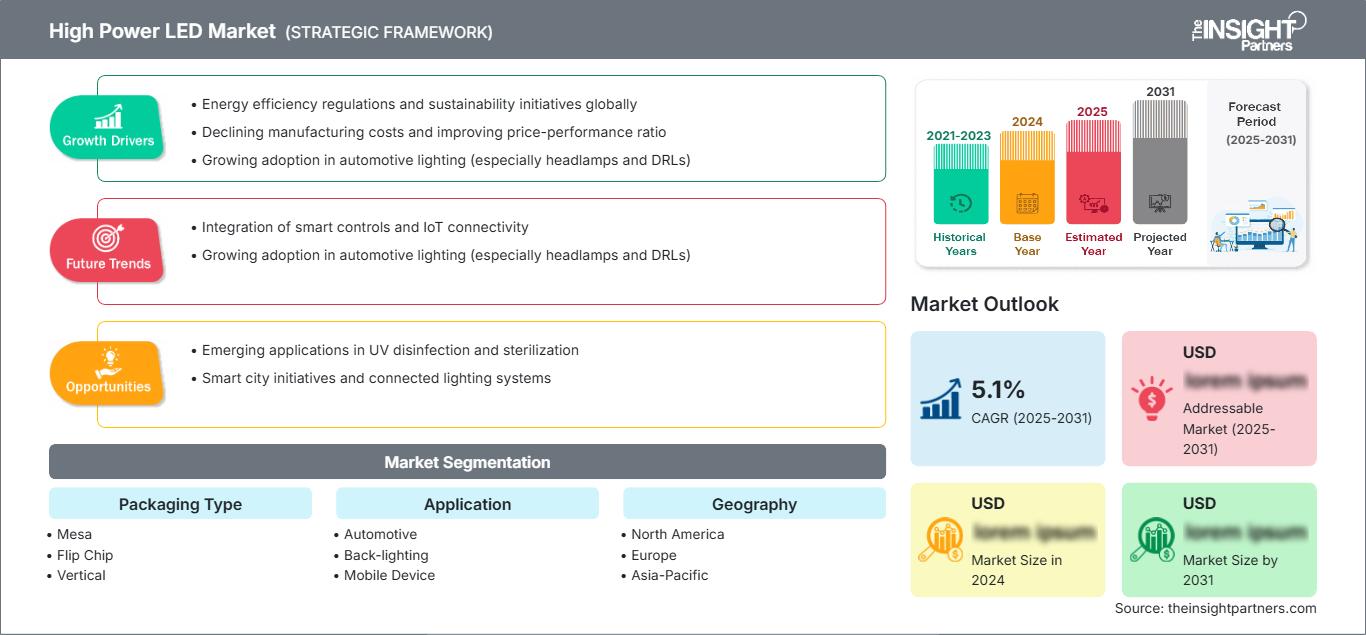
High Power LED Market: Strategic Insights
Regional Insights
North America High Power LED Market
North America will be modeled on the basis of 24-28% of the High Power LED market share in 2025 and an 8.2-9.0% CAGR up to 2034. Factors driving the market include commercial renovation, improvement in roads, advances in automotive lighting and professional lighting procurement. The federal government has been funding research into efficient LED lighting in the US, while performance specifications for external applications have also been set out for procurement.
In the region, the US is the largest market due to the established OEM partnerships and the wide range of applications. Canada plays its part through infrastructure improvement and energy efficiency programs, while Mexico adds significance in the form of automotive lighting applications. The products will increasingly focus on thermal reliability, optical performance, control integration, and lifetime performance, among others.
U.S. High Power LED Market
The United States holds a market share of around 70–74% of the North American region in 2025 and is expected to register growth rates between 8.0%–8.8% CAGR from 2026 to 2034. The demand for LEDs is driven by lighting of roadways, retrofit projects of commercial buildings, automobile industry, and professional lighting.
There are many companies operating in the market including Cree LED, Lumileds Holding B.V., Samsung Electronics Co., Ltd., Signify Holding, and several international players. There is growing need for small size high-output lighting products for adaptive and electronically controlled lighting in the automotive industry. In the commercial sector, there is growing importance for energy efficiency and controllability of lights.
Europe High Power LED Market
The region is forecasted to hold a 22–26% market share in 2025 and will grow at an 8.7–9.5% CAGR up to 2034. Germany dominates in terms of technology due to the automotive production sector, whereas the UK is significant in commercial refurbishment and connected infrastructure; and France, Italy, and Spain are also present due to their role in construction renovation, transportation, hospitality, and outdoors. EU Ecodesign and energy labeling push for efficiency-based purchasing.
The German impact on this market is especially significant as high-end vehicles require high reliability, beam distribution control, and optical performance. Automotive certifications enable sales of more valuable components, and installations from the industrial and commercial sectors make a more diverse replacement pool. Suppliers and manufacturers in Europe and globally compete on compliance, reliability, circularity, and integration, not only on volumes.
Market drivers in the UK include efficiency initiatives in the public sector, improvement in commercial buildings, and intelligent street lighting. There is an increasing preference for equipment that can connect to sensors and other controlling devices while ensuring consistent life cycle performance. Renovation processes offer replacement opportunities; however, complexity in renovation processes may hinder the standalone lighting equipment replacement process.
France merges the need for building renovation with transport needs and public spaces. Italy and Spain offer additional demand through commercial real estate, hospitality, retail space, and infrastructure outside the building. High-output LEDs find favor across the regional markets because of the combination of a compact form factor, lower maintenance requirement, and precise optical distribution that can offset higher component cost.
APAC High Power LED Market
APAC represents a 39-43% market in 2025 and 10.2-11.0% CAGR through 2034. China dominates both demand and production within the region, followed by Japan, South Korea, and India. Professional lighting applications and infrastructure revitalization in Australia drive demand in APAC. Manufacturing strength, policy incentives, and demand drivers in the region will drive adoption.
The volume from China provides stability to the supply chain, while Japan and South Korea provide strength in components and automotive production. Incremental demand from urbanization and industry growth in India drives adoption, alongside efficient commercial and outdoor lighting solutions in Australia. The strengths of manufacturing capability and policy incentives will drive APAC as the primary geography of growth in high-output LED components.
Middle East & Africa High Power LED Market
The Middle East & Africa market is projected to grow with a 7.2% to 8.0% CAGR up to 2034. Leading deployments in the region will come from Saudi Arabia and the UAE, via large-scale infrastructure, hospitality, commercial and urban development projects. Municipal and commercial projects in South Africa continue to be key drivers, with the RoMEA offering replacement opportunities driven by greater energy-efficient lightings penetration.
Energy Efficiency and Infrastructure Modernization will drive demand. While large-scale projects will tend towards high-output fixtures that can operate efficiently in difficult thermal environments, municipalities are increasingly looking for low maintenance solutions. The UAE is at the forefront in the process of removing outdated lamping technologies, which could be replicated across the region in the future.
Segmentation Analysis
Packaging Type
Packaging Type segment in the High Power LED Market is modelled to expand at an 8.7–9.5% CAGR from 2026–2034 as thermal management, current density, optical extraction, and form-factor requirements become more application-specific. Automotive and professional lighting increasingly require packages engineered for high reliability and controlled heat dissipation. Packaging selection also influences optical design, manufacturing yield, service life, and integration costs.
- Mesa: Mesa structures remain relevant where established fabrication processes, optical control, and application familiarity support dependable component production. Their strategic role persists in standardized high-power applications requiring predictable performance.
- Flip Chip: Flip-chip architectures gain attention where improved thermal transfer, compact construction, and higher current handling support demanding illumination. They are strategically important for applications requiring stronger performance from smaller packages.
- Vertical: Vertical structures support applications seeking efficient current pathways and established high-power architectures. Their continued relevance reflects compatibility with mature manufacturing ecosystems and requirements for stable electrical and thermal performance.
Application
Application segment in the High Power LED Market is projected to grow at a 9.3–10.1% CAGR during 2026–2034, reflecting expanding use across automotive systems, displays, mobile devices, general lighting, and signaling. The application mix increasingly rewards higher efficacy, tighter optical control, thermal reliability, and long service life. General illumination remains the largest demand pool, while automotive applications offer stronger incremental value.
- Automotive: Automotive demand is strengthened by electrification, adaptive illumination, daytime running lights, exterior signaling, and premium interior systems. Qualification requirements make reliability and optical precision strategically important for component suppliers.
- Back-lighting: Back-lighting remains relevant across displays and specialized visual equipment, with demand shifting toward thinner architectures, higher brightness, improved color performance, and lower power consumption.
- Mobile Device: Mobile applications prioritize compactness, low power consumption, brightness, and color consistency. Component suppliers compete on miniaturization and efficiency as display architectures become more sophisticated.
- General Lighting: General lighting represents the largest application opportunity because commercial, residential, industrial, and outdoor systems continue replacing older technologies. High-power packages are favored where illumination density and optical performance are critical.
- Signals and Signage: Signals and signage require high visibility, reliability, and consistent color under variable environmental conditions. Transportation, advertising, public information, and industrial systems support continuing component demand.
- Others: Other applications provide diversified demand across specialty illumination, horticulture, ultraviolet systems, entertainment, and industrial uses, reducing dependence on any single end market.
Opportunity Snapshot
| Application | Revenue Contribution | Trend Tag | Adoption Stage |
|---|---|---|---|
| Automotive | High | Adaptive Lighting | Scaling |
| Back-lighting | Medium | Color Efficiency | Mature |
| Mobile Device | Medium | Thin Displays | Mature |
| General Lighting | High | Smart Retrofit | Mature |
| Signals and Signage | Medium | Digital Signage | Scaling |
| Others | Low | Specialty Optics | Emerging |
High Power LED Market Growth Drivers and Impact Analysis
Vehicle Electrification Raises Lighting System Value
Electric vehicles create a favorable environment for higher-value lighting because electronic architectures support more programmable illumination, advanced thermal management, and tighter integration between lighting and vehicle control systems. High-power LEDs can support headlamps, daytime running lights, exterior signaling, and interior functions while maintaining compact packaging. Global vehicle electrification also increases attention to energy consumption because auxiliary electrical loads influence vehicle efficiency. Automotive lighting is therefore shifting from a basic illumination function toward electronically controlled safety and styling hardware. Suppliers that can combine optical performance, thermal reliability, compact packages, and qualification support are better positioned to secure design wins. The resulting procurement environment supports premium component specifications and encourages investment in automated testing, advanced packaging, and application engineering.
Efficiency Standards Sustain Replacement Demand
Efficiency regulation is creating a persistent replacement pathway for LED components across commercial, public, and industrial lighting. The European Union applies mandatory Ecodesign requirements to covered light sources and separate control gear, while the US maintains efficiency specifications for exterior lighting procurement. These frameworks change purchasing criteria by emphasizing measured efficacy, quality, and lifecycle performance rather than nominal wattage. As installed equipment reaches replacement age, buyers can justify higher-performance packages through reduced operating costs and lower maintenance requirements. The effect is particularly important in large installations where energy consumption accumulates across thousands of luminaires. Component manufacturers that can document efficacy, reliability, and compatibility with controls gain an advantage in specification-driven projects, while lower-performing products face increasing qualification barriers
Digital Controls Expand the Value of High-Output Components
Connected lighting is broadening the economic value of high-power LEDs by allowing illumination to respond to occupancy, daylight, scheduling, and operational conditions. The International Energy Agency notes that controls can generate additional savings beyond lamp efficacy, while connected systems can support predictive maintenance and usage analytics. High-output packages become more valuable when paired with optics and controls that deliver light precisely where needed, reducing unnecessary energy consumption. This favors suppliers able to participate beyond the component level through drivers, modules, thermal interfaces, optical systems, and software-compatible architectures. The shift also creates opportunities for retrofit programs because connected controls can improve existing lighting without requiring complete building-system replacement. Product interoperability and lifecycle service capabilities will increasingly influence supplier selection.
High Power LED Market Future Trends
Higher-Efficacy Packages Will Prioritize System-Level Performance
Future product development in the High Power LED Market trends will increasingly focus on system efficacy rather than chip efficacy alone. Manufacturers are likely to optimize package geometry, phosphor conversion, thermal paths, optics, and drive conditions together to increase useful light output. The next generation of products should also address lifetime, color stability, flicker, recyclability, and compatibility with intelligent controls. This direction reflects the growing importance of total system performance as LED technology becomes established across major applications. Early-generation installations are approaching replacement cycles, creating a market for upgrades that deliver more output from existing electrical and mechanical footprints. Suppliers that combine measurable efficiency gains with easier maintenance and better optical control can capture premium retrofit demand.
Automotive Lighting Will Move Toward Programmable Optical Architectures
Automotive lighting is likely to progress toward increasingly programmable optical architectures as manufacturers seek differentiated styling, adaptive safety functions, and better integration with vehicle electronics. High-power LEDs can serve as building blocks for matrix, segmented, and electronically controlled illumination, provided thermal and reliability constraints are managed. Future demand should therefore favor components with tighter binning, higher current capability, predictable lifetime, and compatibility with compact optical systems. The competitive emphasis will shift from raw brightness toward controllability, optical precision, and validated performance under automotive operating conditions. Developments in high-luminance automotive LEDs and related intellectual property already demonstrate the direction of travel, particularly where premium vehicles require advanced exterior lighting functionality.
High Power LED Market Opportunities
Retrofit Platforms Can Monetize the Next Replacement Cycle
The approaching replacement cycle for early-generation LED installations creates an opportunity for suppliers to sell higher-performance components into existing luminaire platforms. Rather than competing only for new construction, manufacturers can target replacement modules that preserve mechanical interfaces while improving efficacy, thermal performance, optical distribution, and control compatibility. The opportunity is strongest in commercial buildings, warehouses, public lighting, hospitality, and industrial facilities where operating hours are high and energy savings materially affect project economics. Product developers should prioritize modularity, documented lifetime, straightforward installation, and compatibility with existing drivers. Partnerships with luminaire manufacturers, electrical distributors, energy-service providers, and facility-management companies can accelerate specification and deployment. The High Power LED Market Forecast rewards suppliers that reduce retrofit complexity while delivering measurable lifecycle benefits.
Emerging-Market Manufacturing Can Broaden Component Access
Investment in regional manufacturing and assembly can create opportunities as LED adoption expands beyond mature markets. Asia Pacific already provides extensive production depth, while India, Southeast Asia, the Middle East, and Africa offer opportunities for localized assembly, distribution, testing, and application engineering. Investors should distinguish between commodity capacity and differentiated capabilities because price competition is intense in standardized components. Localized operations can nevertheless shorten lead times, support customer qualification, reduce logistics exposure, and adapt products to regional infrastructure conditions. High-power automotive, industrial, horticultural, and outdoor applications offer particularly attractive niches where technical support and reliability matter more than the lowest component price. Partnerships with established semiconductor and lighting ecosystems can reduce market-entry risk.
Recent Developments
- February 2026: Cree LED unveiled OptiLamp LEDs, a display technology that integrates driver and control intelligence into every LED pixel, delivering true 1/1 scan operation, enhanced brightness, precise pixel-level control, 24-bit color per channel, smoother color gradations and deep contrast while reducing power consumption, system complexity and maintenance requirements.
- January 2026: Panasonic expanded its KAIROS Alliance Partner program to include LED processor companies Brompton Technology, Colorlight, Megapixel and NovaStar, strengthening interoperability for large-scale live events and rental & staging applications through flexible IT/IP workflows, SMPTE ST 2110 support, faster setup, consistent image quality, reduced operational risk and enhanced creative freedom.
- May 2025: Nichia announced that its high-power 280nm UV-C LED (NCSU434D), integrated into a UV-C LED disinfection device manufactured by Mutoh Industries, was adopted for Shikoku Kakoki’s food and beverage filling machines, enabling mercury-free and environmentally friendly disinfection of food containers, films and caps while supporting the shift away from mercury lamps in food factories.
Frequently Asked Questions

- Comprehensive Market Sizing and Forecast Analysis
- Detailed Segmentation Analysis
- In-Depth Market Dynamics Assessment
- Regional and Country-Level Insights
- Competitive Landscape and Company Benchmarking
- Strategic Business Intelligence
Recent Reports
Testimonials

The Insight Partners provided valuable market intelligence that supported our global go-to-market strategy. Their team was professional, responsive, and attentive to our feedback, providing thoughtful analysis and helpful methodological clarifications throughout the project.
Junmo Kim Chief Financial Officer (CFO), Enertech Co., Ltd.
The Insight Partners' SCADA System Market report is comprehensive, with valuable insights on current trends and future forecasts. The team was highly professional, responsive, and supportive throughout. We are very satisfied and highly recommend their services.
RAN KEDEM Partner, Reali Technologies LTDs
I requested a report on a very specific software market and the team produced the report in a few days. The information was very relevant and well presented. I then requested some changes and additions to the report. The team was again very responsive and I got the final report in less than a week.
JEAN-HERVE JENN Chairman, Future Analytica
We worked with The Insight Partners for an important market study and forecast. They gave us clear insights into opportunities and risks, which helped shape our plans. Their research was easy to use and based on solid data. It helped us make smart, confident decisions. We highly recommend them.
PIYUSH NAGPAL Sr. Vice President, High Beam Global
The Insight Partners delivered insightful, well-structured market research with strong domain expertise. Their team was professional and responsive throughout. The user-friendly website made accessing industry reports seamless. We highly recommend them for reliable, high-quality research services
YUKIHIKO ADACHI CEO, Deep Blue, LLC.
This is the first time I have purchased a market report from The Insight Partners.While I was unsure at first, I visited their web site and felt more comfortable to take the risk and purchase a market report.I am completely satisfied with the quality of the report and customer service. I had several questions and comments with the initial report, but after a couple of dialogs over email with their analyst I believe I have a report that I can use as input to our strategic planning process.Thank you so much for taking the extra time and making this a positive experience.I will definitely recommend your service to others and you will be my first call when we need further market data.
JOHN SUZUKI President and Chief Executive Officer, Board Director, BK Technologies
I wish to appreciate your support and the professionalism you displayed in the course of attending to my request for information regarding to infectious disease IVD market in Nigeria. I appreciate your patience, your guidance, and the fact that you were willing to offer a discount, which eventually made it possible for us to close a deal. I look forward to engaging The Insight Partners in the future, all thanks to the impression you have created in me as a result of this first encounter.
DR CHIJIOKE ONYIA MANAGING DIRECTOR, PineCrest Healthcare Ltd.Reason to Buy
- Informed Decision-Making
- Understanding Market Dynamics
- Competitive Analysis
- Identifying Emerging Markets
- Customer Insights
- Market Forecasts
- Risk Mitigation
- Boosting Operational Efficiency
- Strategic Planning
- Investment Justification
- Tracking Industry Innovations
- Aligning with Regulatory Trends





 Get Free Sample for