
High-Speed Optical Interconnects Market Trends, Demand & Growth by 2034
Coverage: By Type (Single Mode, Multi-Mode); End User (Optical Industry, Others), and Geography (North America, Europe, Asia Pacific, and South and Central America)
- Status : Data Released
- Report Code : TIPRE00016977
- Category : Electronics and Semiconductor
- No. of Pages : 150
- Available Report Formats :


- Last update date : September 17, 2026


2025 Market Size
US$ 18.69 Bn
Base year value
2034 Forecast
US$ 57.37 Bn
Projected by 2034
CAGR 2026-2034
13.27 %
Growth rate
Addressable Market
US$ 330.12 Bn
(2026-2034)
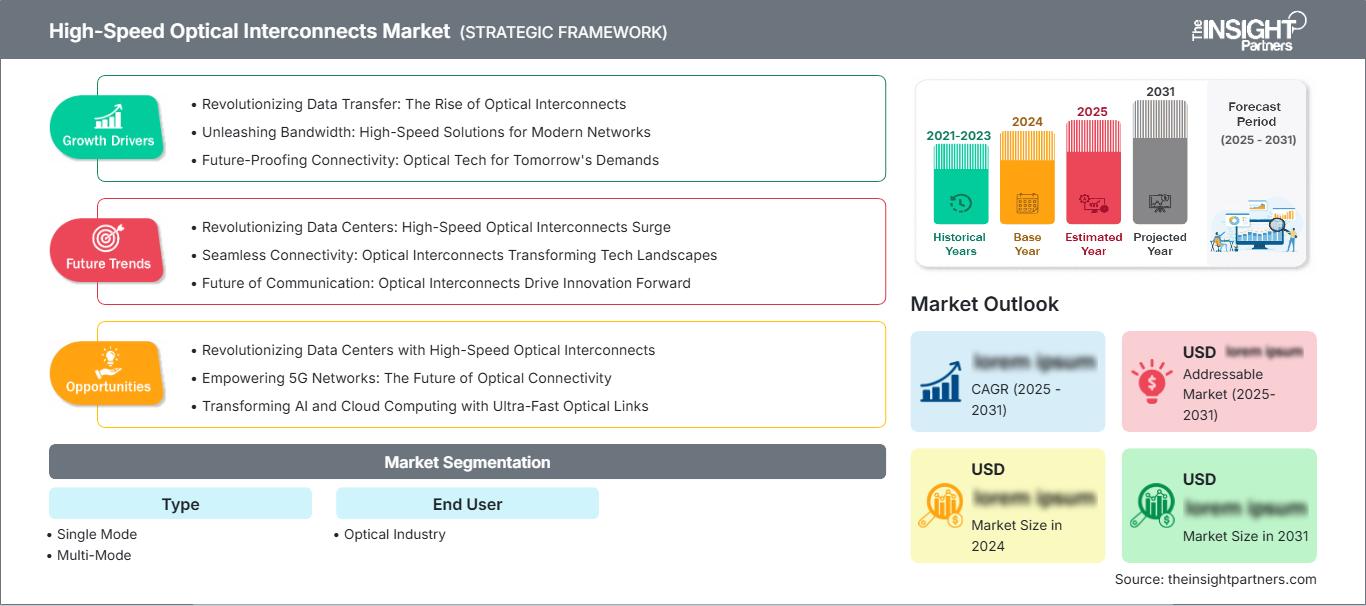
The High-Speed Optical Interconnects Market Size was valued at US$ 18.69 Billion in 2025 and is projected to reach US$ 57.37 Billion by 2034, registering a CAGR of 13.27% during 2026–2034. The market encompasses optical technologies that enable high-bandwidth data transmission across data centers, cloud infrastructure, telecommunications networks, and advanced computing environments. Expansion is being shaped by AI workloads, accelerated computing, hyperscale infrastructure, rising bandwidth requirements, and the transition toward increasingly dense optical connectivity architectures.
North America remains a strategically important market, supported by hyperscale data-center construction, cloud computing investment, AI infrastructure deployment, and accelerated adoption of high-bandwidth networking equipment. The region is estimated to expand at a 13.0–13.5% CAGR during 2026–2034. Increasing rack density and higher interconnect speeds are encouraging operators to deploy optical architectures that improve bandwidth scalability while controlling latency, signal loss, and power consumption.
High-Speed Optical Interconnects Market Assessment and Insights
- North America: North America held 29–31% share in 2025 and is projected to grow at a 13.0–13.5% CAGR during 2026–2034, driven by hyperscale data centers, AI clusters, cloud infrastructure, and high-speed networking upgrades.
- US: The US represented 82–85% of North American demand in 2025 and is expected to expand at a 13.1–13.6% CAGR, supported by hyperscale computing and AI infrastructure.
- Europe: Europe accounted for 24–26% share in 2025 and is forecast to register a 11.9–12.5% CAGR, with Germany, the UK, France, and the Netherlands supporting data-center and telecom modernization.
- Asia Pacific: Asia Pacific represented 35–38% share in 2025 and is expected to grow at a 14.0–14.6% CAGR, led by China, Japan, South Korea, Taiwan, Singapore, and India.
- Largest Segment: Single Mode represented a 68–72% market share in 2025 and is projected to expand at a 12.8–13.2% CAGR, reflecting longer-reach and data-center connectivity requirements.
- High Growth Segment: Multi-Mode represented a 28–32% market share in 2025 and is forecast to grow at a 14.2–14.7% CAGR, supported by short-reach high-density links.
- Key companies analyzed in detail: 3M, Acacia Communications, Inc., Amphenol, Dow Silicones Corporation, FUJITSU OPTICAL COMPONENTS LIMITED, Lumentum Operations LLC, Mellanox Technologies, Inc., Molex LLC, Sumitomo Electric Industries, Ltd., and TE Connectivity.
Source: The Insight Partners' analysis based on proprietary research, government publications, company annual reports, investor presentations, industry databases, and expert interviews.
High Speed Optical Interconnects Market has evolved from legacy fiber optic connections to designs based on increased bandwidth per channel, superior opto-electronic integration, and increased connector density. Silicon photonics, advanced lasers, optical circuit switching, co-packaging of optical components, and higher-speed transceiver technology have been altering designs. As a result, manufacturing is moving towards increased optical alignment, advanced packaging, automation testing, and increased integration of components.
The growth should be focused in the future on investments in AI data centers, cloud regions, high performance computing, and digital infrastructure within North America and Asia Pacific. Europe will get benefits from data center upgrades and improved connectivity, while emerging economies in Asia will benefit from expanding cloud ecosystems. Standards, interoperability, energy savings, and localization of supply chains will become increasingly important in the decision-making process.
High-Speed Optical Interconnects Market Report Scope
| Report Attribute | Details |
|---|---|
| Market size in 2025 | US$ 18.69 Billion |
| Market Size by 2034 | US$ 57.37 Billion |
| Global CAGR (2026 - 2034) | 13.27% |
| Historical Data | 2021-2024 |
| Forecast period | 2026-2034 |
High-Speed Optical Interconnects Market Analysis
High-Speed Optical Interconnects Market growth is being accelerated by AI and accelerated-computing architectures that require substantially greater communication capacity between processors, memory, switches, and storage systems. The market growth outlook is therefore closely linked with data-center networking investments, cloud expansion, and the migration toward 400G, 800G, 1.6T, and future higher-speed interfaces. Optical links offer advantages in reach, bandwidth density, and electromagnetic immunity.
Ecosystem includes fiber optic manufactures, laser and photonic components, modulators, photodetectors, transceivers, connectors, cable assembles, switches, system integrators, and operators of hyperscale data centers. Dynamics of the supply chain include availability of semiconductor fabrication, packaging, fiber availability, connector precision and qualification. Vertical integration will mitigate problems with components, whereas multisourcing approach will continue playing important role in volume rollouts.
Analysis of High-Speed Optical Interconnects Market Report reveals that competition is driven by the following factors – scalability of bandwidth, optical efficiency, packaging density, connector efficiency, thermal considerations, and standardization. Lumentum Operations LLC deals with photonic components & optical technologies, Sumitomo Electric Industries, Ltd. combines optical components and communication. Amphenol, Molex LLC, and TE Connectivity are leaders in high-density interconnects & connectivity.
3M and Dow Silicones Corporation offer capabilities in materials and connectivity which assist the performance of optical interfaces, whereas FUJITSU OPTICAL COMPONENTS LIMITED specializes in optical components. Acacia Communications, Inc. and Mellanox Technologies, Inc. are still connected to cutting-edge optical and networking technology through their parent companies. Investment focus is increasingly on fast lasers, optical engines, advanced packaging, expandable beam connectivity, co-package optics, and local manufacturing for AI infrastructure.
● REPORT CUSTOMIZATION
Tailor This Report To Align With Your Specific Business Requirements
This report can be customized to align precisely with your business objectives, scope, and target markets. Customization options include tailored segmentation, geography, competitive analysis, and strategic insights to support informed decision-making.
Customize This Report →WHAT YOU CAN ADJUST
- ● Segmentations
- ● Geography
- ● Competitive Analysis
- ● Language Preferences
High-Speed Optical Interconnects Market: Strategic Insights
Regional Insights
North America High-Speed Optical Interconnects Market
North America accounted for a 29–31% of the High-Speed Optical Interconnects Market share in 2025 and is expected to exhibit a CAGR of 13.0–13.5% through 2034. The US accounts for most of the demand in this region, whereas Canada has a contribution from cloud infrastructure, telecommunication, research computing, and data-hungry industrial applications. Expansion in hyperscale data center is the key driver for demand growth, wherein AI infrastructure increases the need for bandwidth between computing components. Cloud providers are upgrading their data centers to support accelerated computing and increased network capacity.
There is a robust ecosystem of optical components providers, network infrastructure players, semiconductor firms, and data centers in this region. The focus for demand is on 800G and 1.6T technologies and those that aim to minimize optical power consumption and density. The domestic investment in semiconductor and AI infrastructure further boosts local content. The procurement trends favor supply continuity, interoperability, manufacturing scalability, and support for the rapidly evolving optical networks platform.
U.S. High-Speed Optical Interconnects Market
The US represented 82–85% of North American demand in 2025 and is forecast to expand at a 13.1–13.6% CAGR through 2034. Hyperscale data centers, cloud platforms, AI training infrastructure, high-performance computing, and telecommunications networks are the principal application areas. The market benefits from substantial investment in data-center capacity and advanced computing systems requiring increasingly dense optical links.
Lumentum Operations LLC, 3M, Amphenol, Molex LLC, and TE Connectivity participate across optical components, connectors, assemblies, and related infrastructure. Application demand is increasingly concentrated in AI clusters and high-density server environments, where optical interconnects support communication across racks and network layers. The US also benefits from expanding semiconductor and advanced-packaging capacity, which can strengthen the domestic ecosystem for photonic components and optical-electrical integration.
Europe High-Speed Optical Interconnects Market
Europe accounted for 24–26% share in 2025 and is expected to grow at an 11.9–12.5% CAGR through 2034, with Germany leading regional demand. The UK, France, the Netherlands, and Ireland also contribute through cloud infrastructure, telecommunications, enterprise computing, and data-center development. European buyers emphasize energy efficiency, network resilience, interoperability, and environmental performance alongside bandwidth.
Germany has a substantial industrial and telecommunications base, supporting demand for high-speed connectivity across enterprise networks, automation, automotive computing, and data centers. The UK benefits from hyperscale and colocation facilities, cloud services, financial computing, and telecommunications infrastructure. France combines cloud expansion with government-supported digital infrastructure, while Italy and Spain are strengthening data-center and connectivity ecosystems. The Netherlands remains strategically important as a digital connectivity hub, supporting regional interconnection and network traffic requirements.
APAC High-Speed Optical Interconnects Market
APAC represented 35–38% share in 2025 and is forecast to grow at a 14.0–14.6% CAGR through 2034, making it the leading regional market. China leads demand, followed by Japan, South Korea, Taiwan, Singapore, and India. Electronics manufacturing, semiconductor capacity, cloud infrastructure, telecommunications, and AI investment are strengthening regional optical requirements.
China benefits from extensive data-center and electronics ecosystems, while Japan and South Korea support advanced semiconductor and communications infrastructure. India is rapidly developing cloud and digital infrastructure, and Australia contributes through data-center investment and regional connectivity. Industrial policies supporting semiconductor localization, digitalization, and advanced manufacturing should reinforce demand for scalable optical interconnect technologies across APAC.
Middle East & Africa High-Speed Optical Interconnects Market
Middle East & Africa region is estimated to see a growth rate of 12.3–12.9% CAGR until 2034, with the UAE and Saudi Arabia dominating demand in the region. Data center build-out, cloud deployment, telecommunication network modernization, smart city projects, and digital infrastructure investments have opened up opportunities for high-speed optical networking.
There is significant development of digital infrastructure in Saudi Arabia, while UAE takes advantage of its role as a regional cloud and connectivity center. South Africa continues to be a key African country for data centers and telecoms. Demand from RoMEA is driven by enterprise digitalization and build-out of connectivity infrastructure. Scalability of fiber-based networks that can support cloud services and AI is increasingly important for regional providers.
Segmentation Analysis
Type
Type segmentation determines transmission reach, bandwidth architecture, connector design, optical source requirements, and application economics. Single Mode remains the dominant category and is projected to grow at a 12.8–13.2% CAGR during 2026–2034. Multi-Mode is expected to register a faster 14.2–14.7% CAGR as short-reach, high-density data-center architectures continue evolving.
- Single Mode: Single-mode technology remains strategically important for longer-reach connectivity and high-bandwidth networking, particularly where signal integrity, transmission distance, and future capacity upgrades influence infrastructure design.
- Multi-Mode: Multi-mode technology supports short-reach applications where high-density connectivity, cost efficiency, and compact data-center architectures are important, creating opportunities in intra-rack and inter-rack networking.
End User
End User demand is concentrated in the Optical Industry, encompassing manufacturers and integrators developing fiber-optic communication equipment, photonic components, transceivers, connectors, and optical networking systems. The segment is projected to grow at a 13.3–13.8% CAGR during 2026–2034. High-Speed Optical Interconnects Market scope is broadening as optical technologies move closer to processors and become integral to AI-oriented system architectures.
- Optical Industry: Optical industry participants require scalable interconnect technologies for transceivers, optical engines, connectors, switches, and photonic systems, with bandwidth density and interoperability becoming increasingly important.
Opportunity Snapshot
| End User | Revenue Contribution (High/Medium/Low) | Trend Tag (MAX 2 words) | Adoption Stage (Emerging/Scaling/Mature) |
|---|---|---|---|
| Optical Industry | High | AI Networking | Scaling |
High-Speed Optical Interconnects Market Growth Drivers and Impact Analysis
AI Clusters Are Accelerating Bandwidth Requirements
Artificial intelligence workloads are increasing communication requirements between accelerators, memory, switches, and storage systems. As compute density rises, network bottlenecks can limit utilization of expensive processors, making high-speed optical connectivity strategically important. Optical links can provide higher bandwidth and longer reach than many copper alternatives while supporting dense network architectures. This dynamic is changing purchasing priorities from simple connectivity toward bandwidth-per-port, power efficiency, latency, thermal behavior, and upgradeability. The commercial impact extends across lasers, photodetectors, transceivers, connectors, fiber assemblies, and optical switching technologies. Suppliers capable of supporting rapid transitions from one generation of interface speed to the next can strengthen their position with hyperscale and cloud customers. Demand should therefore remain closely correlated with AI infrastructure deployment and the increasing scale of accelerated-computing clusters.
Data Center Density Is Increasing the Value of Optical Connectivity
Increasing server density places greater pressure on data-center network architectures, particularly where high-speed connections must operate within constrained rack and facility environments. Optical interconnects can address bandwidth requirements across longer distances and dense switching configurations while reducing susceptibility to electromagnetic interference. As facilities transition toward higher-speed interfaces, operators must also consider connector density, installation time, maintenance access, signal integrity, and thermal management. These considerations create demand for advanced connector systems, optical circuit switches, high-density cable assemblies, and compact transceiver packages. The impact is particularly significant for hyperscale facilities, where thousands of optical connections may be deployed within a single infrastructure program. Suppliers that combine optical performance with installation efficiency and scalable manufacturing can gain relevance as data-center operators seek predictable deployment schedules and lower operational complexity.
Cloud Infrastructure Expansion Is Broadening Optical Deployment
Cloud service expansion is increasing the number of data centers, network interconnection points, and high-capacity links required to support enterprise applications, streaming, analytics, AI, and distributed computing. Regional cloud expansion also increases demand for optical connections between facilities, metropolitan networks, and internal data-center systems. This creates opportunities across multiple transmission distances rather than limiting demand to a single optical architecture. Cloud operators increasingly require interoperable products that can be deployed across standardized infrastructure while maintaining predictable performance. The resulting market impact includes greater demand for pluggable optics, optical components, fiber assemblies, and high-density connectors. It also encourages suppliers to develop modular products that support upgrades without requiring complete infrastructure replacement. This approach can reduce deployment risk while allowing network capacity to scale alongside evolving application requirements.
High-Speed Optical Interconnects Market Future Trends
Co-Packaged Optics Will Move Optical Functions Closer to Compute
High-Speed Optical Interconnects Market trends are increasingly moving optical functions closer to switching and computing silicon. Co-packaged optics can reduce electrical travel distances between processors and optical engines, potentially improving signal integrity and power efficiency as interface speeds rise. Adoption will depend on packaging reliability, thermal management, serviceability, manufacturing yield, and ecosystem standardization. Over time, optical engines may become more tightly integrated with switching platforms, particularly in AI-oriented networks where bandwidth requirements grow rapidly. This transition could change the competitive structure by increasing the importance of photonic packaging, semiconductor integration, advanced substrates, and optical-electrical co-design. Suppliers that establish manufacturing processes capable of maintaining alignment, thermal stability, and yield at scale may gain strategic advantages as optical connectivity becomes increasingly integrated into compute and networking platforms.
Expanded-Beam Connectivity Will Improve High-Density Deployment Efficiency
Expanded-beam optical connectors are likely to gain attention as data-center operators seek faster installation and lower maintenance requirements at very high connection densities. By reducing sensitivity to contamination and simplifying repeated mating, these architectures can address operational challenges associated with large-scale fiber deployments. Adoption should initially focus on environments where installation speed, connector durability, and maintenance access have measurable economic value. Standardization will be important because hyperscale operators generally prefer interoperable solutions that can be sourced from multiple suppliers. As optical networks move toward higher fiber counts and more frequent upgrades, connector designs that simplify deployment could become increasingly relevant. This trend also creates opportunities for suppliers with expertise in precision optics, materials science, high-density ferrules, cable assemblies, and automated connector manufacturing.
High-Speed Optical Interconnects Market Opportunities
Localized Photonic Manufacturing Can Reduce Supply-Chain Exposure
High-Speed Optical Interconnects Market Forecasts point toward opportunities for regional manufacturing of photonic components, transceivers, connectors, and cable assemblies as data-center infrastructure becomes strategically important. Localization can reduce transportation exposure, improve customer responsiveness, and provide greater control over qualification and production scheduling. North America and Asia Pacific offer particularly attractive environments because of strong AI infrastructure, semiconductor ecosystems, and cloud investment. Europe can also support localized production where energy efficiency and digital sovereignty influence procurement. Suppliers can combine global component platforms with regional final assembly, testing, and inventory to balance scale with responsiveness. Investment priorities should include automated optical alignment, photonic packaging, high-speed testing, and traceable manufacturing systems. These capabilities can strengthen supply resilience while supporting customers facing rapid technology-generation changes and compressed infrastructure deployment schedules.
High-Density Optical Assemblies Can Increase Value per Deployment
The opportunity to provide complete optical assemblies extends beyond individual connectors or components by integrating fiber, ferrules, transceivers, shielding, thermal management, and tested interfaces. Customers can benefit from simplified installation, reduced integration work, and more predictable system performance. This model is particularly relevant for AI data centers, where large numbers of connections must be installed rapidly and maintained with minimal disruption. Suppliers can differentiate through customized fiber counts, connector configurations, cable lengths, and testing services while maintaining standardized underlying architectures. Investment in automated assembly, inspection, and optical testing can improve consistency and reduce production variability. As network architectures become denser, customers may increasingly prefer qualified assemblies over fragmented component procurement. This creates a pathway toward higher-value relationships based on engineering capability, quality assurance, deployment support, and lifecycle service.
Recent Developments
- August 2026: Vuzix Corporation (NASDAQ: VUZI), a leading supplier of AI-powered smart glasses, waveguides and augmented reality technologies, announced that it has begun shipping its first Causeway waveguide bridge samples to select prospective customers and ecosystem partners, and is making a broader optical interconnect evaluation kit available for AI data center optical interconnect applications, including co-packaged optics (CPO) architectures.
- July 2026: SuperX AI Technology Limited (NASDAQ:SUPX), a NASDAQ-listed full-stack AI infrastructure solutions provider, announced that SuperX Optical Communications Pte. Ltd., a Singapore joint venture jointly established by SuperX, a Singapore subsidiary of Suzhou TFC Optical Communication Co., Ltd. and APEX VERVE LIMITED, has completed business registration and full capital contribution, marking the official launch of the joint venture agreement..
- May 2026: 3M (NYSE: MMM) announced it has joined a group of leading technology companies to establish a new multi-source agreement (MSA) focused on advancing open, interoperable specifications for expanded beam optical (EBO) connectivity in AI infrastructure. Expanded beam optical technology is increasingly seen as a critical enabler for AI infrastructure, offering advantages in reliability, ease of maintenance, and performance in high-density environments. As hyperscale and enterprise AI deployments grow, standardized approaches to optical connectivity are expected to play a key role in reducing complexity and accelerating time to deployment.
Frequently Asked Questions

- Comprehensive Market Sizing and Forecast Analysis
- Detailed Segmentation Analysis
- In-Depth Market Dynamics Assessment
- Regional and Country-Level Insights
- Competitive Landscape and Company Benchmarking
- Strategic Business Intelligence
Recent Reports
Testimonials

The Insight Partners provided valuable market intelligence that supported our global go-to-market strategy. Their team was professional, responsive, and attentive to our feedback, providing thoughtful analysis and helpful methodological clarifications throughout the project.
Junmo Kim Chief Financial Officer (CFO), Enertech Co., Ltd.
The Insight Partners' SCADA System Market report is comprehensive, with valuable insights on current trends and future forecasts. The team was highly professional, responsive, and supportive throughout. We are very satisfied and highly recommend their services.
RAN KEDEM Partner, Reali Technologies LTDs
I requested a report on a very specific software market and the team produced the report in a few days. The information was very relevant and well presented. I then requested some changes and additions to the report. The team was again very responsive and I got the final report in less than a week.
JEAN-HERVE JENN Chairman, Future Analytica
We worked with The Insight Partners for an important market study and forecast. They gave us clear insights into opportunities and risks, which helped shape our plans. Their research was easy to use and based on solid data. It helped us make smart, confident decisions. We highly recommend them.
PIYUSH NAGPAL Sr. Vice President, High Beam Global
The Insight Partners delivered insightful, well-structured market research with strong domain expertise. Their team was professional and responsive throughout. The user-friendly website made accessing industry reports seamless. We highly recommend them for reliable, high-quality research services
YUKIHIKO ADACHI CEO, Deep Blue, LLC.
This is the first time I have purchased a market report from The Insight Partners.While I was unsure at first, I visited their web site and felt more comfortable to take the risk and purchase a market report.I am completely satisfied with the quality of the report and customer service. I had several questions and comments with the initial report, but after a couple of dialogs over email with their analyst I believe I have a report that I can use as input to our strategic planning process.Thank you so much for taking the extra time and making this a positive experience.I will definitely recommend your service to others and you will be my first call when we need further market data.
JOHN SUZUKI President and Chief Executive Officer, Board Director, BK Technologies
I wish to appreciate your support and the professionalism you displayed in the course of attending to my request for information regarding to infectious disease IVD market in Nigeria. I appreciate your patience, your guidance, and the fact that you were willing to offer a discount, which eventually made it possible for us to close a deal. I look forward to engaging The Insight Partners in the future, all thanks to the impression you have created in me as a result of this first encounter.
DR CHIJIOKE ONYIA MANAGING DIRECTOR, PineCrest Healthcare Ltd.Reason to Buy
- Informed Decision-Making
- Understanding Market Dynamics
- Competitive Analysis
- Identifying Emerging Markets
- Customer Insights
- Market Forecasts
- Risk Mitigation
- Boosting Operational Efficiency
- Strategic Planning
- Investment Justification
- Tracking Industry Innovations
- Aligning with Regulatory Trends





 Get Free Sample for