
HVAC Contained Servers Market Demand, Share & Growth by 2034
HVAC Contained Servers Market Size and Forecasts (2021–2034), Global and Regional Share, Trends, and Growth Opportunity Analysis Report Coverage : By Type (Below 20 U, 20 to 40 U, Above 40 U); Application (BFSI, IT and Telecom, Manufacturing, Retail, Education, Healthcare, Government and Defense, and others); Geography (North America, Europe, Asia-Pacific, Middle East & Africa, South and Central America)
- Status : Data Released
- Report Code : TIPRE00039459
- Category : Electronics and Semiconductor
- No. of Pages : 150
- Available Report Formats :


- Last update date : September 15, 2026


2025 Market Size
US$ 1.84 Bn
Base year value
2034 Forecast
US$ 7.61 Bn
Projected by 2034
CAGR 2026-2034
17.06 %
Growth rate
Addressable Market
US$ 39.48 Bn
(2026-2034)
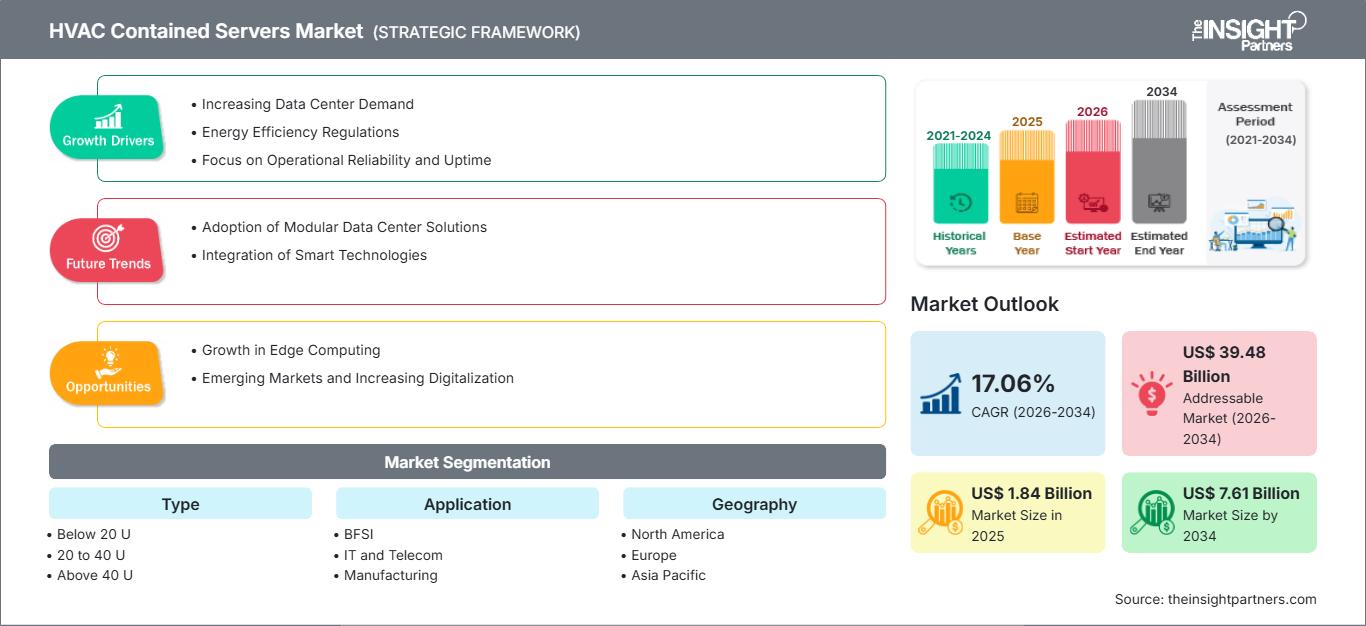
The HVAC Contained Servers Market reached US$ 1.84 Billion in 2025 and is projected to attain US$ 7.61 Billion by 2034, expanding at a CAGR of 17.06% during 2026–2034. Demand reflects the need to place secure, thermally controlled computing capacity in offices, factories, hospitals, branches, campuses, and public facilities where conventional data-center rooms are impractical, expensive, or too slow to commission.
Across North America, the HVAC Contained Servers Market size is expected to advance at a modelled 16.0–17.0% CAGR through 2034. Dense edge workloads, data-sovereignty requirements, and constrained construction schedules encourage pre-engineered enclosures that combine rack space, precision cooling, power distribution, monitoring, and physical protection. Adoption is strongest where distributed sites need predictable deployment, remote supervision, and resilience without building dedicated white space.
HVAC Contained Servers Market Assessment and Insights
- North America: The region held a modelled 34–36% share in 2025 and is expected to grow at 16.0–17.0% CAGR during 2026–2034, supported by edge modernization, AI-ready enterprise infrastructure, and nationwide service networks.
- US: The country represented 82–84% of North American demand in 2025 and is projected to expand at 16.2–17.2% CAGR during 2026–2034.
- Europe: Europe accounted for a modelled 25–27% share in 2025 and should rise at 15.0–16.0% CAGR through 2034, led by Germany, the UK, France, Italy, and Spain.
- Asia Pacific: Asia Pacific captured a modelled 28–30% share in 2025 and is forecast to grow at 18.0–19.0% CAGR through 2034, led by China, Japan, India, South Korea, and Australia.
- Largest Segment: 20 to 40 U held a modelled 46–48% market share in 2025 and is expected to record a 16.5–17.5% CAGR during 2026–2034.
- High Growth Segment: IT and Telecom represented a modelled 24–26% share in 2025 and is projected to grow at 18.5–19.5% CAGR during 2026–2034.
- Key companies analyzed in detail: Black Box Corporation, Vertiv Group Corp., STULZ GmbH, Schneider Electric SE, Hitachi, Ltd., Crenlo Engineered Cabs, EIC Solutions, Inc., Tripp Lite, Rackmount Solutions, Inc., and Karis.
Source: The Insight Partners' analysis based on proprietary research, government publications, company annual reports, investor presentations, industry databases, and expert interviews.
The category has developed from individually sourced cabinets and room air conditioning units to integrated infrastructure solutions based on proven thermal enclosures. These now incorporate racks, variable speed cooling, UPS, power distribution, sensor integration, fire systems interface, access management, and remote alarming. Manufacture is trending towards configurable platforms as opposed to custom metalwork solutions while providing the option for NEMA enclosure ratings, acoustics, redundancy and outdoor installation. Increased heat density is moving design engineers to focus on flow paths and return temperatures more than cabinet sizing.
In the period to 2034, expansion is expected throughout Southeast Asia, India, the Gulf, Eastern Europe, and Latin America's industrial hubs as cloud access, automation, and digital public services expand beyond major cities. There will be an emphasis on modular systems that can be implemented adjacent to processes as opposed to being housed within dedicated buildings. Energy efficiency legislation, refrigerant phase-out, security needs, and resilience requirements will make suppliers successful who demonstrate life cycle performance, service networks, and air and liquid cooling options without requiring immediate building renovations.
HVAC Contained Servers Market Report Scope
| Report Attribute | Details |
|---|---|
| Market size in 2025 | US$ 1.84 Billion |
| Market Size by 2034 | US$ 7.61 Billion |
| Global CAGR (2026 - 2034) | 17.06% |
| Historical Data | 2021-2024 |
| Forecast period | 2026-2034 |
HVAC Contained Servers Market Analysis
Growth of HVAC contained servers market is driven by distributed computing, space limitation, and the need to secure IT infrastructure outside engineered data halls. The applications such as branch banking, telecom aggregation, manufacturing control, healthcare imaging, retail analytics, and campus computing demand localized processing within controlled environment with respect to temperature, humidity, dust, and access. The value chain consists of enclosure manufacturers, precision cooling technology providers, UPS/PDU suppliers, monitoring software vendors, integrators, contractors, and field services companies.
The supply chain relies upon compressors, fans, heat exchangers, controllers, sheet metal, switchgear, and skilled engineers. While 20-40U standardized solutions provide scalability, more robust solutions are required for harsher environments that can include resistance to corrosion, sealing the cables, filtration, and proper ratings. Redundancy, monitoring, support, and compliance with refrigerant standards are among the requirements beside cooling capacity that buyers demand along with the price.
According to HVAC Contained Servers Market report, competition is transitioning from cabinet provision into an offering of complete, serviced infrastructure. Competitors such as Vertiv Group Corp., Schneider Electric SE, and STULZ GmbH use extensive product lineups with worldwide support services, while Black Box Corporation and Rackmount Solutions, Inc. focus on installation, connection, and applicability. EIC Solutions, Inc. and Crenlo Engineered Cabs cater to applications requiring sealed environmental protection.
Investment is planned for the design of modular micro data centers, intelligent controls, refrigerant replacement, and liquid-enabled racks. Hitachi, Ltd. contributes its experience in industrial and digital infrastructure, whereas Tripp Lite helps integrate racks with power solutions for Eaton. Karis offers enclosures tailored to particular requirements. The competitive advantage comes from the thermal efficiency, service from an existing installed base, channel capability, and coordination of enclosure, power, cooling, and monitoring into a single accountability model.
● REPORT CUSTOMIZATION
Tailor This Report To Align With Your Specific Business Requirements
This report can be customized to align precisely with your business objectives, scope, and target markets. Customization options include tailored segmentation, geography, competitive analysis, and strategic insights to support informed decision-making.
Customize This Report →WHAT YOU CAN ADJUST
- ● Segmentations
- ● Geography
- ● Competitive Analysis
- ● Language Preferences
HVAC Contained Servers Market: Strategic Insights
Regional Insights
North America HVAC Contained Servers Market
North America represented a modelled 34% to 36% HVAC Contained Servers Market Share in 2025 and is poised to grow at 16.0% to 17.0% CAGR for 2026 to 2034. Modernizing enterprise edges, inference AI, secure government computations, and digital industrial transformation drive demand. This region boasts a combination of large-scale existing IT estates and developed integrators, colocation, controls, power, and precision-cooling ecosystems, allowing containment systems to become a repeatable infrastructure.
The highest growth rate will be seen in branches that are remotely based, manufacturing plants, laboratories, health care complexes, and telecommunication rooms whereby downtime and disruption of construction will cost the business. Implementations in Canada are centered around distributed public services and natural resources processing while Mexico is benefiting from its manufacturing and logistics infrastructure. Customers now require remote monitoring, redundant cooling, secure access, and rapid replacement solutions. Products from Vertiv Group Corp., Schneider Electric SE, STULZ GmbH, Black Box Corporation, and Tripp Lite improve reliability but are hampered by electrical service installation duration, lack of technicians, and permits.
U.S. HVAC Contained Servers Market
The U.S. represented a modelled 82–84% of North American demand in 2025 and is projected to grow at 16.2–17.2% CAGR during 2026–2034. Cloud-connected branches, defense facilities, hospital networks, automated factories, and low-latency retail systems create a broad application base. Organizations use contained racks to add resilient compute without waiting for conventional data-center construction or expanding central facilities.
Relevant product lines or service capabilities exist for Vertiv Group Corp., Schneider Electric SE, STULZ GmbH, Black Box Corporation, EIC Solutions, Inc., Rackmount Solutions, Inc., Crenlo Engineered Cabs, and Tripp Lite. The BFSI sector requires security and continuity. Manufacturing needs filtration and environmental protection while the health sector is concerned with serviceability. For government purchasers, access control and proof of resilience are mandatory considerations. Assessments now look at total power consumption, refrigeration approach, alarm capability, serviceability, and national coverage capability. Retrofitability still plays an important part due to the need for projects in occupied buildings.
Europe HVAC Contained Servers Market
Europe contributed around 25–27% in 2025 and projected to grow at 15.0–16.0% CAGR between 2026 and 2034, with Germany being at the forefront. The high exposure to energy costs, requirement for data residency, automation in industry, and limitation of urban real estate floor space are some factors that facilitate efficient containment infrastructure solutions. The manufacturing industry in Germany requires robust systems, and the availability of local expertise in precision cooling enhances the system specification confidence.
In the case of the UK, the market will be driven by financial services, telecom, edge computing, and public sector modernization, which results in demands for secure cabinets to be installed in branches, exchanges, campuses, and offices. France will benefit from defense, healthcare, transportation, and sovereign digital infrastructure. Italy has industrial clusters and distributed commercial operations, and Spain has its cloud and connectivity infrastructures to encourage edge computing. The European market is characterized by heavy emphasis on energy performance, low global warming potential refrigerants, acoustic noise management, life cycle service, and compliance documentation.
APAC HVAC Contained Servers Market
In 2025, Asia Pacific held a modelled market share of 28–30%, and is projected to register a CAGR of 18.0–19.0% during 2026–2034, driven by China. China utilizes its strategy of manufacturing, telecommunication, cloud computing, and smart cities, whereas Japan and South Korea focus on infrastructure that is robust and compact in nature for sophisticated industry and IT operations.
In India, programs related to data localization, digital services, and enterprise modernization increase the potential market size. Australia provides support for mining, government services, healthcare, and regional edge facilities. Favoring factors include policy incentives, rollout of 5G, industrial automation, and lack of access to customized data centers.
Middle East & Africa HVAC Contained Servers Market
MEA and Africa are expected to experience 17.0%–18.0% CAGR during 2026–2034, with UAE as a leader. There is high demand for sealed, energy-efficient, and remotely manageable enclosures due to sovereign cloud initiatives, telecommunication infrastructure modernization, government modernization, and harsh climatic conditions.
Saudi Arabia is characterized by diversification of economy and development of new digital infrastructure, while UAE provides logistics, services, and regional headquarters opportunities. South Africa is characterized by requirements from mining, financial, telecommunication, and government industries. In RoMEA there is high interest in energy-efficient systems due to restricted power grids and distances to services.
Segmentation Analysis
Type
Type is projected to register a modelled 16.5–17.5% CAGR during 2026–2034. The HVAC Contained Servers Market scope ranges from compact branch cabinets to large, high-capacity enclosures. Selection depends on equipment count, thermal load, redundancy, service clearance, acoustic limits, floor loading, and future expansion. Standard 20 to 40 U formats offer the broadest balance of density, transportability, and deployment flexibility.
- Below 20 U: Compact systems serve branches, classrooms, clinics, retail sites, and telecom rooms where limited equipment, low noise, rapid installation, and secure environmental control outweigh expansion capacity.
- 20 to 40 U: Mid-sized cabinets hold the largest position by balancing standard rack compatibility, cooling efficiency, service access, mobility, and sufficient capacity for enterprise edge, industrial, and institutional workloads.
- Above 40 U: Large enclosures support dense server, storage, and networking configurations, making them strategically important for AI inference, consolidated edge sites, laboratories, and facilities requiring higher redundancy.
Application
Application is expected to expand at a modelled 17.0–18.0% CAGR during 2026–2034. Adoption is led by IT and Telecom, but the addressable base is diversified across regulated, industrial, commercial, and public environments. Purchasing criteria vary by application: BFSI emphasizes continuity and security, manufacturing requires environmental protection, healthcare values validation, and education prioritizes manageable, standardized infrastructure.
- BFSI: Banks and insurers use contained servers for branches, trading support, surveillance, and disaster recovery, prioritizing access control, redundancy, remote monitoring, auditability, and rapid field service.
- IT and Telecom: Edge clouds, network aggregation, AI inference, and 5G infrastructure create the strongest growth profile, requiring modular systems that accommodate rising density and hybrid cooling.
- Manufacturing: Plants deploy protected cabinets near machinery and control systems, where dust, heat, vibration, electromagnetic exposure, and production continuity make ruggedization and maintainability strategically important.
- Retail: Stores and distribution sites support analytics, video, inventory, and transaction processing through compact infrastructure that limits noise, protects equipment, and enables centralized remote supervision.
- Education: Schools, universities, and research campuses value standardized enclosures for labs, administration, security, and local computing, balancing budget discipline with safety, acoustics, and simple maintenance.
- Healthcare: Hospitals and clinics require reliable thermal control for imaging, records, diagnostics, and connected-care systems, emphasizing uptime, cleanability, traceability, secure access, and service responsiveness.
- Government and Defense: Agencies use contained infrastructure for secure communications, surveillance, command systems, and distributed services, favoring physical protection, controlled access, redundancy, and documented supply-chain assurance.
Opportunity Snapshot
| Application | Revenue Contribution | Trend Tag | Adoption Stage |
| BFSI | Medium | Branch Resilience | Scaling |
| IT and Telecom | High | Edge AI | Scaling |
| Manufacturing | High | Factory Edge | Scaling |
| Retail | Medium | Store Analytics | Scaling |
| Education | Low | Campus Compute | Emerging |
| Healthcare | Medium | Clinical Edge | Scaling |
| Government and Defense | Medium | Secure Compute | Mature |
HVAC Contained Servers Market Growth Drivers and Impact Analysis
Distributed Computing Moves Closer to Operations
Enterprises are processing more video, telemetry, transactions, and machine data near users and equipment to reduce latency, bandwidth dependence, and operational disruption. Contained servers let organizations deploy standardized compute in branches, factories, clinics, stores, campuses, and communications sites without constructing full data rooms. Commercial impact extends across cabinets, precision cooling, UPS, power distribution, sensors, access systems, integration, and maintenance. The International Energy Agency reported that data-center electricity demand rose 17% in 2025 and could double by 2030, reinforcing the need for efficient thermal design as distributed capacity expands. Suppliers that package tested components and provide remote monitoring can shorten deployment while protecting uptime.
Retrofit Constraints Favor Self-Contained Infrastructure
Many organizations need additional computing capacity inside occupied buildings, legacy facilities, or industrial sites that lack raised floors, dedicated cooling, or secure white space. A self-contained enclosure isolates heat, controls airflow, protects equipment, and reduces dependence on room conditions. Retrofit ease is commercially decisive: Uptime Institute’s 2025 cooling survey found that 46% of respondents considered integration into existing infrastructure a leading viability criterion for direct liquid cooling. The same procurement logic benefits packaged cabinets because buyers can add cooling and power incrementally. Vendors that minimize structural work, acoustic disruption, refrigerant piping, and commissioning complexity can unlock projects that conventional construction would delay or render uneconomic.
Operational Resilience Raises Lifecycle Requirements
Contained servers protect workloads that increasingly support production, clinical services, payments, communications, and public operations. Buyers therefore evaluate redundancy, alarms, access control, filtration, refrigerant compliance, spare parts, and technician coverage rather than cooling capacity alone. Uptime Institute’s 2025 global survey reported that one in ten impactful outages still caused serious or severe disruption, sustaining investment in resilient infrastructure. Commercially, this favors suppliers with tested system architectures and service organizations over fragmented component purchases. Recurring maintenance, remote diagnostics, and lifecycle upgrades become important revenue streams, while customers gain clearer accountability. Vendors that document thermal margins and recovery procedures can compete more effectively in regulated and mission-critical applications.
HVAC Contained Servers Market Future Trends
Hybrid Thermal Architectures Become Standard Options
HVAC Contained Servers Market trends will increasingly center on hybrid systems that retain air cooling for general equipment while supporting rear-door exchangers, coolant distribution, or direct-to-chip loops for denser processors. This approach lets operators upgrade selected racks without rebuilding entire facilities. Uptime Institute’s 2025 cooling survey showed perimeter air cooling remained used by 75% of respondents, while direct liquid cooling reached 22%, indicating coexistence rather than abrupt replacement. Vendors will respond with liquid-ready frames, coordinated controls, leak detection, accessible manifolds, and flexible heat-rejection interfaces. Procurement will reward architectures that preserve serviceability and redundancy across mixed generations.
Autonomous Thermal Optimization Expands
Sensors, variable-speed fans, compressor controls, and infrastructure software will increasingly coordinate around real-time server load, ambient conditions, door status, and component health. Future enclosures will use anomaly detection to identify airflow obstruction, refrigerant degradation, filter loading, and thermal imbalance before service interruption. Buyers will prefer explainable automation that recommends actions while preserving human approval for control changes. Fleet-level analytics will enable operators to compare energy use, alarms, and capacity across hundreds of distributed sites. Standard interfaces and cybersecurity controls will determine adoption because remote optimization must not create operational risk or lock customers into closed monitoring ecosystems.
HVAC Contained Servers Market Opportunities
Build Repeatable Edge Infrastructure Programs
Systems integrators and equipment vendors can convert one-off cabinet purchases into multi-site programs for banks, retailers, hospitals, manufacturers, schools, and government agencies. HVAC Contained Servers Market Forecasts support standardized designs with controlled options for rack height, redundancy, acoustics, filtration, security, and monitoring. A template-based approach reduces engineering effort, simplifies spares, and improves technician familiarity across distributed estates. Suppliers should combine site surveys, factory integration, commissioning, remote support, and refresh planning under measurable service levels. Financing and phased deployment can lower initial barriers, while fleet analytics create recurring value. Success depends on defensible configuration governance and dependable regional service coverage.
Engineer for Harsh and Underserved Locations
Specialists can target factories, utilities, mines, transport hubs, telecom sites, defense facilities, and remote clinics where dust, humidity, salt, vibration, unstable power, or limited maintenance constrain conventional IT. Investment priorities include sealed cable entry, corrosion-resistant materials, replaceable filters, wide ambient operating ranges, redundant fans, secure battery integration, and remote diagnostics. Local partnerships for installation and spares can be more valuable than adding product variants. Suppliers should validate systems under realistic thermal and environmental conditions and document recovery procedures. Premium pricing is sustainable when the enclosure avoids production interruption, equipment failure, or costly construction in locations unsuitable for standard server rooms.
Recent Developments
- January 2026: Trane Technologies has launched its new DCDA series Coolant Distribution Unit (CDU), developed specifically for data centers across the Asia-Pacific region. The solution is designed to address the growing cooling demands created by artificial intelligence (AI), high-performance computing and increasingly dense server infrastructure. As data centers handle more powerful computing workloads, conventional air-cooling systems are facing challenges in managing rising heat loads. Liquid cooling is increasingly being adopted as an efficient alternative for high-density computing environments.
- March 2026: Schneider Electric has introduced its new Altivar HVAC Drive family, comprising the ATH200 and ATH600 variable-speed drives, designed to help commercial and mission-critical facilities improve energy efficiency, system reliability and building-management integration. The company says the new drives can deliver more than 30% energy savings in suitable HVAC applications.
- August 2026: Bosch Home Comfort Group has introduced a new portfolio of Evcon and Guardian heating and cooling systems designed specifically for multifamily residential projects across the United States and Canada. The offering is aimed at giving developers, engineers and contractors greater flexibility when designing and installing HVAC systems for apartments, condominiums and townhouses.
Frequently Asked Questions

- Comprehensive Market Sizing and Forecast Analysis
- Detailed Segmentation Analysis
- In-Depth Market Dynamics Assessment
- Regional and Country-Level Insights
- Competitive Landscape and Company Benchmarking
- Strategic Business Intelligence
Recent Reports
Testimonials

The Insight Partners' SCADA System Market report is comprehensive, with valuable insights on current trends and future forecasts. The team was highly professional, responsive, and supportive throughout. We are very satisfied and highly recommend their services.
RAN KEDEM Partner, Reali Technologies LTDs
I requested a report on a very specific software market and the team produced the report in a few days. The information was very relevant and well presented. I then requested some changes and additions to the report. The team was again very responsive and I got the final report in less than a week.
JEAN-HERVE JENN Chairman, Future Analytica
We worked with The Insight Partners for an important market study and forecast. They gave us clear insights into opportunities and risks, which helped shape our plans. Their research was easy to use and based on solid data. It helped us make smart, confident decisions. We highly recommend them.
PIYUSH NAGPAL Sr. Vice President, High Beam Global
The Insight Partners delivered insightful, well-structured market research with strong domain expertise. Their team was professional and responsive throughout. The user-friendly website made accessing industry reports seamless. We highly recommend them for reliable, high-quality research services
YUKIHIKO ADACHI CEO, Deep Blue, LLC.
This is the first time I have purchased a market report from The Insight Partners.While I was unsure at first, I visited their web site and felt more comfortable to take the risk and purchase a market report.I am completely satisfied with the quality of the report and customer service. I had several questions and comments with the initial report, but after a couple of dialogs over email with their analyst I believe I have a report that I can use as input to our strategic planning process.Thank you so much for taking the extra time and making this a positive experience.I will definitely recommend your service to others and you will be my first call when we need further market data.
JOHN SUZUKI President and Chief Executive Officer, Board Director, BK Technologies
I wish to appreciate your support and the professionalism you displayed in the course of attending to my request for information regarding to infectious disease IVD market in Nigeria. I appreciate your patience, your guidance, and the fact that you were willing to offer a discount, which eventually made it possible for us to close a deal. I look forward to engaging The Insight Partners in the future, all thanks to the impression you have created in me as a result of this first encounter.
DR CHIJIOKE ONYIA MANAGING DIRECTOR, PineCrest Healthcare Ltd.Reason to Buy
- Informed Decision-Making
- Understanding Market Dynamics
- Competitive Analysis
- Identifying Emerging Markets
- Customer Insights
- Market Forecasts
- Risk Mitigation
- Boosting Operational Efficiency
- Strategic Planning
- Investment Justification
- Tracking Industry Innovations
- Aligning with Regulatory Trends





 Get Free Sample for