
Hybrid Fiber Coaxial Market Demand, Trends & Forecast by 2034
Coverage: by Technology (DOCSIS 3.0 and Below, DOCSIS 3.1); Component (CMTS/CCAP, Fiber Optic Cable, Amplifier, Optical Node, Optical Transceiver, Splitter, CPE) , and Geography (North America, Europe, Asia Pacific, and South and Central America)
- Status : Data Released
- Report Code : TIPRE00008029
- Category : Electronics and Semiconductor
- No. of Pages : 150
- Available Report Formats :


- Last update date : September 15, 2026


2025 Market Size
US$ 13.03 Bn
Base year value
2034 Forecast
US$ 24.82 Bn
Projected by 2034
CAGR 2026-2034
7.42 %
Growth rate
Addressable Market
US$ 170.61 Bn
(2026-2034)
The Hybrid Fiber Coaxial Market was valued at US$ 13.03 Billion in 2025 and is projected to reach US$ 24.82 Billion by 2034, registering a CAGR of 7.49% during 2026–2034. Operators are modernizing installed cable access networks with distributed architectures, virtualized headends, higher-spectrum outside plant, optical nodes, amplifiers, and advanced customer premises equipment to deliver greater upstream capacity, lower latency, and more reliable residential and business connectivity.
Across North America, Hybrid Fiber Coaxial Market size is expected to expand at a modeled 7.2–7.6% CAGR through 2034. Cable networks already reach more than 90% of U.S. households, creating a large upgradeable footprint for DOCSIS, distributed access, and intelligent amplifiers. Competitive pressure from fiber and fixed wireless is accelerating node segmentation, spectrum expansion, cloud-native CCAP adoption, and symmetrical multigigabit service deployment.
Hybrid Fiber Coaxial Market Assessment and Insights
- North America: Holds 38–40% share in 2025 and grows at a 7.2–7.6% CAGR during 2026–2034, supported by extensive cable coverage, DOCSIS 4.0 investment, node segmentation, and virtualized access platforms.
- US: Accounts for 86–88% of North America in 2025 and advances at a 7.3–7.7% CAGR as operators expand symmetrical multigigabit services over existing connections.
- Europe: Represents 25–27% share in 2025 and grows at a 6.3–6.7% CAGR, led by Germany, the UK, France, the Netherlands, and Belgium through DOCSIS 3.1 upgrades.
- Asia Pacific: Captures 23–25% share in 2025 and expands at a 8.2–8.6% CAGR, with China, Japan, South Korea, India, and Australia supporting selective cable modernization and dense urban broadband.
- Largest Segment: DOCSIS 3.1 holds 65–69% market share in 2025 and grows at a 7.8–8.2% CAGR through 2034 as operators extend usable spectrum and upstream capacity.
- High Growth Segment: CMTS/CCAP represents 20–24% market share in 2025 and advances at a 9.0–9.4% CAGR through 2034 as distributed and virtualized access architectures scale.
- Key companies analyzed in detail: ARRIS International Limited; Ciena Corporation; Cisco Systems, Inc.; CommScope; Corning Incorporated; Huawei Technologies Co., Ltd.; Nokia Corporation; PCT International, Inc.; Vantiva SA; ZTE Corporation.
Source: The Insight Partners' analysis based on proprietary research, government publications, company annual reports, investor presentations, industry databases, and expert interviews.
The technology development journey of cable access includes analog television broadcasting, fiber deepening, two-way amplification, optical nodes, and DOCSIS iterations. Today’s manufacturing is moving towards remote PHY devices, virtual cable modem termination systems, compatible customer equipment, and outside plant capable of supporting either 1.2 GHz or 1.8 GHz. Suppliers should integrate silicon, radiofrequency engineering, optical transportation, power delivery, cooling, and software validation efforts to support network upgrades in service without disrupting connectivity on an extensive installed base.
For the period until 2034, investments will be focused on deployment of DOCSIS 4.0 in North America, optimization of DOCSIS 3.1 in Europe, and selective upgrades in Latin America, Asia, and the Middle East. CableLabs sets specifications up to 10 Gbps download speeds and 6 Gbps upload speeds for DOCSIS 4.0. Regulatory broadband requirements stimulate adoption of higher-capacity fixed networks. Openness, energy efficiency, cybersecurity, and migration capability are becoming more and more important in the purchasing decision-making process.
Hybrid Fiber Coaxial Market Report Scope
| Report Attribute | Details |
|---|---|
| Market size in 2025 | US$ 13.03 Billion |
| Market Size by 2034 | US$ 24.82 Billion |
| Global CAGR (2026 - 2034) | 7.42% |
| Historical Data | 2021-2024 |
| Forecast period | 2026-2034 |
Hybrid Fiber Coaxial Market Analysis
The Hybrid Fiber Coaxial Market will be driven by the increased upstream bandwidth demand, device concurrency, cloud applications, and the need of service providers to preserve their existing network investment. DOCSIS 4.0 would allow for symmetrical multigigabit service delivery using the same existing Hybrid Fiber Coaxial infrastructure, allowing the reduction of the necessary civil work for immediate replacement with fiber. Consequently, the demand extends from the headend, software, and CCAP Core to Nodes, amplifiers, passives, transceivers, and gateways.
The supply at the upstream level is made up of RF semiconductors, optical components, specialty cable, connectors, power, and broadband silicon. At the midstream level, there is the integration of the access platform, outside plant, telemetry, and customer premises equipment. The integration is followed by engineering of spectrum, segmentation, and maintenance programs. Interoperability becomes better, but qualification cycles and silicon dependence could be challenges to the program.
Analysis of Hybrid Fiber Coaxial market report reveals competitive dynamics in terms of full stack access providers, optical transport providers, cable makers and premises equipment suppliers. ARRIS International Limited, CommScope hold extensive DOCSIS and optical transport portfolios respectively, whereas Cisco Systems, Inc., Nokia Corporation, Huawei Technologies Co., Ltd., and ZTE Corporation compete in access platforms, routing solutions, software and broadband gateways.
The investment will be in virtualized CCAP, remote PHY, 1.8GHz infrastructure, impairment automation, and converged HFC/Fiber operations. Ciena Corporation and Corning Incorporated provide optical transport and fiber deepening services, PCT International, Inc. supplies last mile connectivity, while Vantiva SA is for premises devices. Strategy competition depends on interoperability roadmaps, lifecycle management, power efficiency, cybersecurity, and migration management.
● REPORT CUSTOMIZATION
Tailor This Report To Align With Your Specific Business Requirements
This report can be customized to align precisely with your business objectives, scope, and target markets. Customization options include tailored segmentation, geography, competitive analysis, and strategic insights to support informed decision-making.
Customize This Report →WHAT YOU CAN ADJUST
- ● Segmentations
- ● Geography
- ● Competitive Analysis
- ● Language Preferences
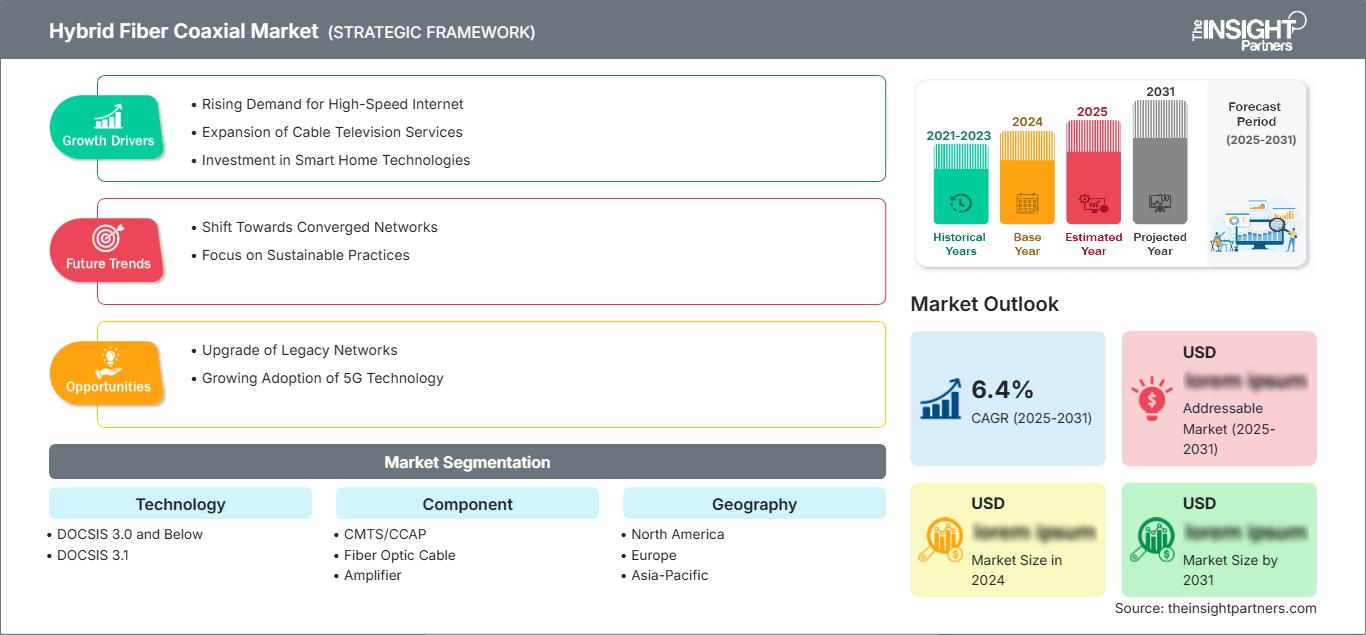
Hybrid Fiber Coaxial Market: Strategic Insights
Regional Insights
North America Hybrid Fiber Coaxial Market
North America represented 38–40% of global revenue in 2025 and is projected to record a 7.2–7.6% CAGR during 2026–2034. Hybrid Fiber Coaxial Market share reflects extensive cable coverage, sizeable installed coaxial plant, and sustained spending on distributed access. CableLabs notes that U.S. cable broadband networks reach more than 90% of households, giving operators a broad base for phased electronics upgrades.
Regional value is being driven by the U.S., while Canada provides advanced cable networks, and Mexico is providing urban cable deployment. Operators are switching to optical analogs, using remote PHY technology, splitting nodes, increasing upstream spectrum, and installing smart amplifiers. Equipment procurement is being done with backward compatible products, which can support DOCSIS 3.1 users as well as allow future migrations towards DOCSIS 4.0. Increased competition through FTTH and fixed wireless is creating an urgent need, but HFC infrastructure continues to be economically viable due to lower costs in ducting, drops, powering, and skilled labor.
U.S. Hybrid Fiber Coaxial Market
The U.S. accounted for 86-88% of revenue in North America in 2025 and is forecasted to grow at a 7.3-7.3% CAGR through 2034. Operators are rolling out symmetrical plans, installing digital nodes, and implementing Full Duplex or Extended Spectrum DOCSIS, based on plant architecture. Comcasts implementations show that multi-gigabit services can be deployed on the current residential plant by making staged upgrades with legacy modems being supported.
ARRIS International Limited, CommScope, Cisco Systems, Inc., Vantiva SA, Corning Incorporated, and PCT International, Inc. have relevant products and channels. Application trends include telework, cloud gaming, interactive video, security connectivity, and broadband business services with better upstream capability. Operators now look at automated impairment detection, software defined access and common operational systems between HFC and fiber. The preference of fiber is an obstacle for HFC operators, but investment in HFC can bring quicker capacity gains compared to rebuilding drops and distribution plant. Reconstruction will prolong the payback period.
Europe Hybrid Fiber Coaxial Market
Share of Europe is between 25% to 27% in 2025 and is predicted to have a CAGR of 6.3% to 6.7%. The leader in the region is Germany owing to high number of cable homes, competition of gigabit services and DOCSIS 3.1 deployment. UK maintains its growth potential with strong cable presence in cities and convergence strategy, where the operators develop fibers only where needed and leave the coaxial drop feasible.
In France, enhanced cable networks and fiber buildouts foster HFC network upgrades rather than blanket redevelopments. Italy and Spain provide limited cable opportunities in light of operator presence, tourist hubs, and MDUs. High cable market penetration and advanced service levels characterize Belgium and the Netherlands. Manufacturers in Europe have to focus on energy saving, security issues, interoperability, and the goal of gigabit connectivity for every home by 2030 under the Digital Decade program.
APAC Hybrid Fiber Coaxial Market
Share of APAC in 2025 was 23–25%, and the forecasted CAGR is 8.2–8.6%. China is ahead in equipment manufacturing and select network upgrades, while Japan and South Korea concentrate on reliability and urban density. India represents selective market opportunities via cable companies and multi-dwelling broadband access. Australia retains strong HFC penetration in its national access network.
Fiber is leading APAC’s fixed broadband, and therefore the focus is more on upgrading the existing assets, rather than building greenfields. Digital transformation driven by government, localized equipment manufacturing, and high population density drive the upgrade process, and intense FTTH competition demands prudent capital investments.
Middle East & Africa Hybrid Fiber Coaxial Market
MEA is expected to advance at a 6.8–7.2% CAGR through 2034. The UAE leads premium urban broadband and hospitality connectivity, while Saudi Arabia’s digital infrastructure programs create selective access-network opportunities. South Africa provides the region’s most established cable-related engineering and enterprise demand, with the rest of MEA remaining project-led.
Power resilience, heat, dust, import logistics, and technician availability shape equipment choices. Fiber-first national strategies limit broad HFC expansion, but existing hospitality, campus, residential, and television distribution systems can justify node, amplifier, and passive upgrades when reuse materially lowers construction cost.
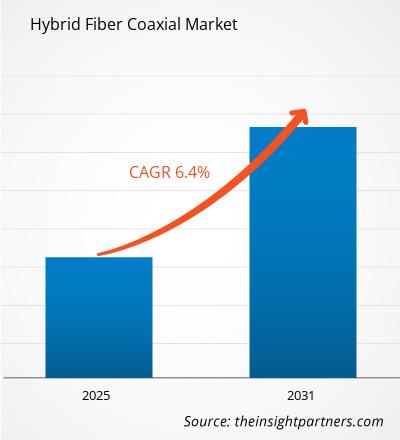
Segmentation Analysis
Technology
Technology is projected to expand at a 7.4–7.8% CAGR during 2026–2034. The Hybrid Fiber Coaxial Market scope spans legacy capacity management and advanced spectrum expansion. DOCSIS 3.1 dominates current spending because it supports gigabit services on mature plant, while earlier generations remain installed in price-sensitive networks and require compatible customer equipment, maintenance, and gradual migration.
- DOCSIS 3.0 and Below: Legacy systems retain a meaningful installed base in smaller networks, sustaining demand for compatible modems, amplifiers, passives, maintenance spares, and carefully sequenced modernization.
- DOCSIS 3.1: The leading technology supports higher spectral efficiency, OFDM, gigabit service tiers, and flexible upstream upgrades, making it the principal bridge toward distributed access and DOCSIS 4.0 readiness.
Component
Component is modeled to grow at a 7.6–8.0% CAGR through 2034. Value creation is distributed across centralized or virtualized access control, optical transport, powered outside plant, passive RF distribution, and customer devices. Procurement increasingly favors interoperable modules, remote telemetry, lower power consumption, and field-replaceable designs that can support phased spectrum expansion without rebuilding the complete network.
- CMTS/CCAP: Core platforms control subscriber access and spectrum resources, with virtualized CCAP and distributed architectures gaining strategic importance through scalability, automation, and multi-vendor interoperability.
- Fiber Optic Cable: Fiber deepening connects headends, hubs, and nodes, reducing serving-group size and supporting capacity expansion while preserving coaxial distribution close to subscribers.
- Amplifier: Intelligent 1.2 GHz and 1.8 GHz amplifiers extend network spectrum, support higher upstream performance, and deliver operational telemetry without requiring immediate removal of powered cascades.
- Optical Node: Digital and remote PHY nodes move signal processing closer to customers, improve signal quality, simplify segmentation, and form the operational foundation for distributed access.
- Optical Transceiver: Pluggable and embedded optics connect access platforms with nodes, enabling higher-capacity transport, flexible reach, and more efficient headend-to-edge architecture.
- Splitter: Passive splitters remain essential for distributing RF signals across homes and multidwelling units, with higher-frequency compatibility becoming critical during DOCSIS spectrum upgrades.
- CPE: Cable modems and gateways translate network capacity into customer experience, making Wi-Fi performance, cybersecurity, backward compatibility, and remote management decisive purchasing criteria.
Opportunity Snapshot
| Component | Revenue Contribution | Trend Tag | Adoption Stage |
| CMTS/CCAP | High | Virtual CCAP | Scaling |
| Fiber Optic Cable | High | Fiber Deepening | Mature |
| Amplifier | Medium | Smart Amplifiers | Scaling |
| Optical Node | High | Remote PHY | Scaling |
| Optical Transceiver | Medium | Pluggable Optics | Scaling |
| Splitter | Low | 1.8 GHz | Mature |
| CPE | High | Unified Modems | Scaling |
Hybrid Fiber Coaxial Market Growth Drivers and Impact Analysis
Installed Cable Footprints Lower the Cost of Capacity Expansion
Large cable footprints create a powerful economic driver because operators can upgrade electronics, spectrum, and segmentation while retaining ducts, drops, powering, and much of the coaxial distribution network. CableLabs reports that cable broadband reaches more than 90% of U.S. households, making staged upgrades relevant to a broad service base. The market impact spans CMTS/CCAP cores, optical nodes, amplifiers, passives, transceivers, and modems rather than a single equipment category. Operators can target congested serving groups first, align spending with subscriber demand, and preserve revenue during construction. Suppliers benefit when products support mixed generations, remote provisioning, and modular field replacement. The approach does not eliminate eventual fiber migration, but it improves timing flexibility and lets operators monetize existing infrastructure while competitive conditions and capital costs evolve.
Upstream Demand Makes DOCSIS Modernization More Urgent
Video collaboration, cloud backup, connected cameras, creator workloads, gaming, and business applications are increasing the strategic importance of upstream capacity. CableLabs states that DOCSIS 4.0 supports up to 10 Gbps downstream and 6 Gbps upstream capacity, materially exceeding earlier upstream limits. This capability pushes operators to evaluate high-split DOCSIS 3.1, Full Duplex DOCSIS, Extended Spectrum DOCSIS, and associated outside-plant readiness. Market demand shifts toward symmetrical-capable nodes, amplifiers, unified silicon, stronger telemetry, and gateways that can expose new service tiers. Higher upstream performance also improves the competitiveness of HFC in small-business and premium residential segments. Deployment decisions remain plant-specific because cascade depth, spectrum condition, ingress, and powering determine whether electronics replacement, node segmentation, or fiber extension provides the strongest return.
Distributed Access and Automation Improve Network Economics
Distributed access moves physical-layer or media-access functions closer to subscribers, reducing analog optical constraints and enabling more flexible headend design. CableLabs’ June 2025 interoperability event included three core suppliers and five remote PHY suppliers on a single network, indicating broader multi-vendor maturity. Virtualized CCAP adds elastic capacity, software release agility, and common operational tooling, while intelligent amplifiers and proactive network maintenance help identify impairments before customer impact. The commercial effect extends beyond equipment replacement: operators can consolidate facilities, automate troubleshooting, and coordinate HFC with fiber access. Vendors that provide open interfaces, accurate telemetry, lifecycle software support, and field-tested interoperability gain stronger positioning. Operators still require disciplined orchestration and cybersecurity, because distributing intelligence increases the number of managed endpoints and dependencies.
Hybrid Fiber Coaxial Market Future Trends
Unified DOCSIS 4.0 Platforms Reduce Upgrade Fragmentation
Hybrid Fiber Coaxial Market trends will increasingly center on unified devices that support both Full Duplex and Extended Spectrum DOCSIS paths. Shared silicon and configurable nodes, amplifiers, and modems can reduce inventory fragmentation while allowing operators to select architectures according to spectrum, cascade, and powering conditions. Interoperability testing in 2025 demonstrated growing participation across cores, remote PHY devices, and customer equipment. Over time, procurement will favor platforms that preserve DOCSIS 3.1 compatibility, expose software-controlled spectrum options, and simplify field qualification. The result should be faster deployment, lower sparing complexity, and stronger vendor competition, provided operator orchestration systems can manage mixed configurations reliably.
Converged HFC and Fiber Operations Become Standard
Operators will increasingly manage HFC and fiber through shared cloud-native access, assurance, and subscriber platforms. Common policy control, telemetry, provisioning, and workforce tools can lower operational duplication while networks evolve neighborhood by neighborhood. Ciena Corporation, Corning Incorporated, Cisco Systems, Inc., Nokia Corporation, Huawei Technologies Co., Ltd., and ZTE Corporation can participate through optical transport, routing, access software, and fiber infrastructure. HFC nodes may progressively become fiber aggregation points, enabling selective FTTP overlays without abandoning productive coaxial assets. Investment will therefore shift from isolated access technologies toward architectures that let operators choose the most economical physical medium while maintaining consistent service and operational experience.
Hybrid Fiber Coaxial Market Opportunities
Retrofit Packages for 1.8 GHz Outside Plant
Hybrid Fiber Coaxial Market Forecasts support investment in coordinated retrofit packages covering amplifiers, taps, splitters, connectors, power supplies, nodes, and test procedures. Operators need validated combinations rather than individually rated components because end-to-end performance depends on cascade behavior, return-path noise, shielding, and field installation. Suppliers can create neighborhood-level design tools, inventory kits, technician training, and acceptance testing that shorten deployment cycles. PCT International, Inc., CommScope, and ARRIS International Limited are positioned around last-mile and access-network requirements, while optical and software partners extend the solution. Commercial models can include plant audits, staged qualification, and managed spares, converting fragmented component demand into repeatable modernization programs with clearer performance accountability.
Automated Assurance Services for Mixed-Generation Networks
Mixed DOCSIS generations, distributed devices, and expanding upstream spectrum create demand for assurance platforms that correlate modem telemetry, node performance, amplifier condition, ingress signatures, and customer experience. Vendors can build recurring software and services revenue through anomaly detection, topology inference, capacity forecasting, and technician workflow integration. Operators benefit from fewer truck rolls, faster fault isolation, and better prioritization of node splits or plant repairs. Successful offerings require explainable diagnostics, secure data handling, open APIs, and support for equipment from multiple suppliers. Partnerships among access vendors, analytics specialists, and field-service organizations can accelerate adoption, particularly for mid-sized operators lacking large internal engineering teams.
Recent Developments
- February 2025: Vecima Networks Inc. (TSX: VCM) announced today its “Turbocharged” DOCSIS 3.1 support for Entra Remote MACPHY nodes with System Release 24.2.0. Vecima’s Entra SC-1D2 and SC-2D Remote MACPHY Nodes enable Broadband Service Providers (BSPs) to access the compelling advantages of Distributed Access Architecture (DAA) and provide a cost-effective, easy to deploy, and future-proof path to 10 Gig Internet access. Turbo DOCSIS 3.1 support significantly increases the available high-speed data bandwidth that can be offered within an existing 1.2 GHz HFC (Hybrid Fiber Coax) plant.
- June 2025: Harmonic announced that Vectra, one of the largest internet providers in Poland, has selected Harmonic's industry-leading cOS virtualized broadband platform to accelerate its multigigabit broadband service expansion, enable selective migration to deep fiber infrastructure and power its new wholesale fiber and DOCSIS offerings. This deployment marks the world's first implementation of Harmonic's PTP-less capability for distributed access architecture (DAA), setting new standards of excellence for broadband deployments with increased reliability, simplified operations and cost savings.
- July 2026: Vecima Networks has secured an exclusive agreement with Canadian telecommunications operator Videotron to support the modernization of its hybrid fiber/coaxial (HFC) broadband network. The financial details of the agreement were not disclosed. Under the agreement, Videotron will deploy several components from Vecima’s Entra portfolio, including the Entra virtual Cable Modem Termination System (vCMTS), ERM3-series Remote PHY Devices (RPDs) and the EN9000 Generic Access Platform (GAP) node. The technologies are designed to help Videotron transition toward a next-generation, software-defined DOCSIS network.
Frequently Asked Questions

- Comprehensive Market Sizing and Forecast Analysis
- Detailed Segmentation Analysis
- In-Depth Market Dynamics Assessment
- Regional and Country-Level Insights
- Competitive Landscape and Company Benchmarking
- Strategic Business Intelligence
Recent Reports
Testimonials

The Insight Partners' SCADA System Market report is comprehensive, with valuable insights on current trends and future forecasts. The team was highly professional, responsive, and supportive throughout. We are very satisfied and highly recommend their services.
RAN KEDEM Partner, Reali Technologies LTDs
I requested a report on a very specific software market and the team produced the report in a few days. The information was very relevant and well presented. I then requested some changes and additions to the report. The team was again very responsive and I got the final report in less than a week.
JEAN-HERVE JENN Chairman, Future Analytica
We worked with The Insight Partners for an important market study and forecast. They gave us clear insights into opportunities and risks, which helped shape our plans. Their research was easy to use and based on solid data. It helped us make smart, confident decisions. We highly recommend them.
PIYUSH NAGPAL Sr. Vice President, High Beam Global
The Insight Partners delivered insightful, well-structured market research with strong domain expertise. Their team was professional and responsive throughout. The user-friendly website made accessing industry reports seamless. We highly recommend them for reliable, high-quality research services
YUKIHIKO ADACHI CEO, Deep Blue, LLC.
This is the first time I have purchased a market report from The Insight Partners.While I was unsure at first, I visited their web site and felt more comfortable to take the risk and purchase a market report.I am completely satisfied with the quality of the report and customer service. I had several questions and comments with the initial report, but after a couple of dialogs over email with their analyst I believe I have a report that I can use as input to our strategic planning process.Thank you so much for taking the extra time and making this a positive experience.I will definitely recommend your service to others and you will be my first call when we need further market data.
JOHN SUZUKI President and Chief Executive Officer, Board Director, BK Technologies
I wish to appreciate your support and the professionalism you displayed in the course of attending to my request for information regarding to infectious disease IVD market in Nigeria. I appreciate your patience, your guidance, and the fact that you were willing to offer a discount, which eventually made it possible for us to close a deal. I look forward to engaging The Insight Partners in the future, all thanks to the impression you have created in me as a result of this first encounter.
DR CHIJIOKE ONYIA MANAGING DIRECTOR, PineCrest Healthcare Ltd.Reason to Buy
- Informed Decision-Making
- Understanding Market Dynamics
- Competitive Analysis
- Identifying Emerging Markets
- Customer Insights
- Market Forecasts
- Risk Mitigation
- Boosting Operational Efficiency
- Strategic Planning
- Investment Justification
- Tracking Industry Innovations
- Aligning with Regulatory Trends





 Get Free Sample for