
In-Circuit Test Market Size, Trends & Demand by 2034
Coverage: by Type (Analog In-Circuit Test, Mixed In-Circuit Test); Portability (Compact, Benchtop); Application (Consumer Electronics, Aerospace and Defense, Medical Equipment, Others) , and Geography (North America, Europe, Asia Pacific, and South and Central America)
- Status : Data Released
- Report Code : TIPRE00009544
- Category : Electronics and Semiconductor
- No. of Pages : 150
- Available Report Formats :


- Last update date : September 18, 2026


2025 Market Size
US$ 1.25 Bn
Base year value
2034 Forecast
US$ 1.59 Bn
Projected by 2034
CAGR 2026-2034
2.75 %
Growth rate
Addressable Market
US$ 12.92 Bn
(2026-2034)
The In-Circuit Test Market is valued at US$ 1.25 Billion in 2025 and is projected to reach US$ 1.59 Billion by 2034, registering a CAGR of 2.75% during 2026–2034. The market covers Analog In-Circuit Test and Mixed In-Circuit Test systems across Compact and Benchtop configurations, serving Consumer Electronics, Aerospace and Defense, Medical Equipment, and Others applications. Demand is linked to PCBA complexity, manufacturing quality requirements, shorter production cycles, and the need to detect component and assembly defects before final system integration.
North America remains a structurally important manufacturing and technology hub, with the In-Circuit Test Market size expected to expand at a modeled 2.9–3.4% CAGR during 2026–2034. Demand is supported by aerospace and defense electronics, high-reliability medical equipment, and localized electronics manufacturing. Increasing board complexity and pressure to reduce defect escapes are encouraging manufacturers to retain automated electrical test within production workflows while integrating it with functional and boundary-scan methods.
In-Circuit Test Market Assessment and Insights
- North America: North America is estimated to hold a 35–39% In-Circuit Test Market share in 2025 and grow at a 2.9–3.4% CAGR between 2026–2034. Aerospace electronics, medical equipment, industrial controls, and established automated manufacturing infrastructure support sustained testing investment.
- US: The US is estimated to represent 78–82% of North American demand in 2025, with a 3.0–3.5% CAGR during 2026–2034, led by defense electronics and high-reliability manufacturing.
- Europe: Europe is estimated to account for a 27–30% share in 2025 and expand at a 2.8–3.3% CAGR during 2026–2034. Germany, France, the UK, and Italy benefit from industrial electronics and aerospace production.
- Asia Pacific: Asia Pacific is estimated to represent a 27–31% share in 2025 and record a 3.1–3.6% CAGR during 2026–2034. China, Japan, South Korea, Taiwan, and India support demand through extensive electronics manufacturing.
- Largest Segment: Mixed In-Circuit Test is estimated to hold a 58–62% market share in 2025 and grow at a 2.9–3.4% CAGR during 2026–2034 as boards incorporate increasingly diverse signal types.
- High Growth Segment: Compact systems are estimated to capture a 36–40% market share in 2025 and expand at a 3.2–3.7% CAGR during 2026–2034, supported by flexible production environments.
- Key companies analyzed in detail: Acculogic Inc., Digitaltest GmbH, HIOKI E.E. CORPORATION, Keysight Technologies, Inc., Konrad GmbH, Kyoritsu Test System Co., Ltd., Seika Machinery, Inc., SPEA S.p.A., Teradyne, Inc., and Test Research, Inc.
Source: The Insight Partners' analysis based on proprietary research, government publications, company annual reports, investor presentations, industry databases, and expert interviews.
Production test has come from electrical fault detection to quality control in manufacturing. The modern generation production tests include in-circuit testing, boundary-scan test, programming, functionality check, and diagnostics. This development is due to more densely packed PCBA, small packages of components, mixed signal design, and increased cost of defect not being detected. Fixturing, library of software, test point optimization, and automated fault isolation continue to be critical considerations for economic deployment of testing systems.
The future demand in the In-Circuit Test Market will largely come from Asia Pacific manufacturing, local electronics manufacturing in the region, and investment in high reliability production lines. Manufacturers in North America and Europe will focus on robustness of their supply chains and automation of inspection processes. Requirements by regulations in aerospace, defense, medical devices, and industrial electronics increase the need for traceability and quality control. All of this supports investments in test equipment that increases test coverage without increasing the production footprint and operator skills.
In-Circuit Test Market Report Scope
| Report Attribute | Details |
|---|---|
| Market size in 2025 | US$ 1.25 Billion |
| Market Size by 2034 | US$ 1.59 Billion |
| Global CAGR (2026 - 2034) | 2.75% |
| Historical Data | 2021-2024 |
| Forecast period | 2026-2034 |
In-Circuit Test Market Analysis
The development of In-Circuit Testing Market is driven by increasing circuit complexity, higher quality objectives, and the economic benefits of detecting faults in manufacturing rather than downstream assembly. Electrical test automation allows for reproducible measurement of component values, connectivity, polarity, shorts, opens, and selected parametric conditions. Consumer electronics represent a key application market segment, while aerospace, defense, and medical manufacturers pay more attention to traceability, reliability, and control over manufacturing processes.
The value chain comprises test system manufacturers, fixture providers, software companies, probes and interfaces providers, electronics manufacturers, contract manufacturers, and service providers. The economics of a test system depends on test coverage, throughput, fixture costs, programming effort, maintenance costs, and frequency of product changes. Supply dynamics are thus increasingly influenced by modularity and software reuse capabilities of platforms.
The In-Circuit Test Market forecast shows that competitive positioning ranges from specialist ICT suppliers to diversified electronic test companies. Teradyne, Inc. offers a wide range of production board testing solutions, and Keysight Technologies, Inc. provides board test equipment with extensive measurement features. Acculogic Inc. offers test equipment along with development services in automated test systems, whereas Digitaltest GmbH and SPEA S.p.A. offer dedicated electronics manufacturing test equipment. HIOKI E.E. CORPORATION, Test Research, Inc., Konrad GmbH, Kyoritsu Test System Co., Ltd., and Seika Machinery, Inc. cater to special needs.
Investment emphasis has moved towards increased test throughput, software diagnostic tools, modularity and integration with the Manufacturing Execution Systems. The suppliers are also offering their equipment for mixed volume applications wherein the manufacturers demand changeover speeds without compromising the test process. According to In-Circuit Test Market report, the competitive differentiation is moving away from hardware capability to include overall test economics, ease of programming, fast service, fixture flexibility and test architecture compatibility.
● REPORT CUSTOMIZATION
Tailor This Report To Align With Your Specific Business Requirements
This report can be customized to align precisely with your business objectives, scope, and target markets. Customization options include tailored segmentation, geography, competitive analysis, and strategic insights to support informed decision-making.
Customize This Report →WHAT YOU CAN ADJUST
- ● Segmentations
- ● Geography
- ● Competitive Analysis
- ● Language Preferences
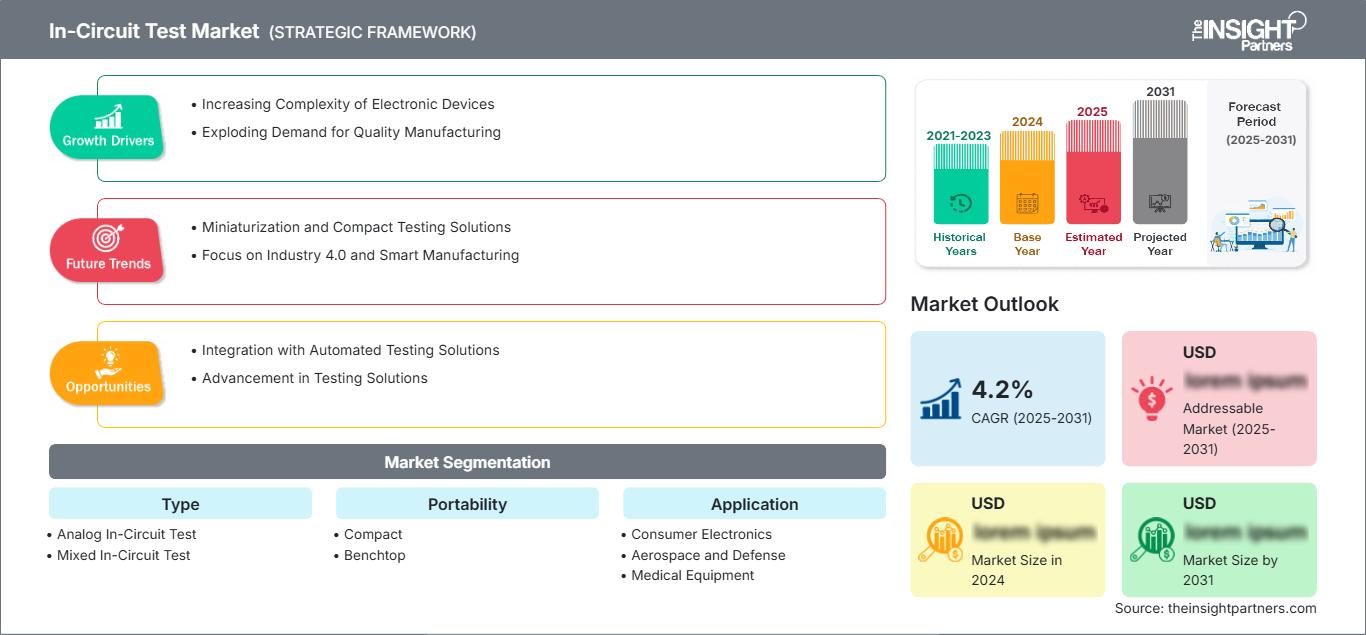
In-Circuit Test Market: Strategic Insights
Regional Insights
North America In-Circuit Test Market
North America is estimated to represent a 35–39% share in 2025 and is modeled to expand at a 2.9–3.4% CAGR through 2034. The US continues to be the anchor in this region, thanks to its aerospace and defense electronics, medical, communication, and manufacturing facilities. The high reliability demands make electrical testing of complex PCBAs highly automated.
Canada is able to provide contributions in the form of its aerospace, industrial electronics, and specialized manufacturing capabilities, while Mexico receives its advantages from electronics assembly and nearshoring. In terms of manufacturing needs, there is an increasing focus on diagnostics, traceability, and flexible test programming. Re-shoring and diversification of supply chain can result in increased investment in the manufacturing equipment domestically.
U.S. In-Circuit Test Market
The United States represents an estimated 78–82% of North American demand in 2025 and is modeled to grow at a 3.0–3.5% CAGR through 2034. However, aerospace and defense electronics continue to be relevant since qualification, traceability, and lower defect tolerance make automated PCB test desirable.
The medical devices, industrial controls, and consumer electronics manufacturing are other areas of application for this type of technology. The companies such as Acculogic Inc., Keysight Technologies Inc. and Teradyne Inc. stay visible on the market through their testing solutions, programming capabilities or electronic measurement products. The manufacturers become more interested in technologies that unite in-circuit test with functional testing, programming and boundary scan.
Europe In-Circuit Test Market
Europe is estimated to hold a 27–30% share in 2025 and is modeled to grow at a 2.8–3.3% CAGR through 2034. Germany is the leading market, supported by industrial automation, automotive electronics, medical technology, and high-reliability manufacturing. France and the UK add aerospace and defense demand.
There is an advantage that Germany has due to the concentration of the manufacturing of electronics and their engineering expertise. Testing the demand in France is done with the help of aerospace, defense, transportation and industrial electronics. The UK takes care of aerospace, medical devices, communications and specialized electronics. Italy helps because of its industrial machinery and electronics manufacturing. And Spain has an advantage due to its automotive and industrial manufacturing. Traceability, diagnostics and flexibility have become essential for regional manufacturers.
APAC In-Circuit Test Market
APAC is estimated to represent a 27–31% share in 2025 and is modeled to grow at a 3.1–3.6% CAGR through 2034. China leads the region, followed by Japan, South Korea, Taiwan, and India. Extensive electronics manufacturing creates a large installed base for automated board testing.
China has an advantage in volume production of electronics, while Japan has advanced systems for the manufacturing of industrial and consumer electronics. South Korea and Taiwan also have contributions in electronics and semiconductor manufacturing, while India is developing its electronics assembly capabilities. Australia has lower but specialized demands. The localization programs, export manufacturing, and improved quality requirements drive the adoption of automated test equipment. The manufacturers are moving toward platforms that handle multiple product variants.
Middle East & Africa In-Circuit Test Market
Middle East & Africa is modeled to grow at a 2.4–2.9% CAGR through 2034. Saudi Arabia and the UAE lead regional demand, supported by industrial diversification and electronics investment. South Africa provides a comparatively developed electronics manufacturing base, while the Rest of MEA remains application-specific.
Opportunities in the region are associated with industrial automation, telecommunication systems, defense electronics, and the emergence of new manufacturing programs. The countries of Saudi Arabia and the United Arab Emirates are establishing advanced industrial systems, while South Africa is backing its aerospace industry, defense industry, mining operations, and industrial electronics. There is less demand than in developed manufacturing regions since many advanced assemblies are imported from overseas. However, localization programs and infrastructure investments can help build up demand for production testing equipment in certain locations.
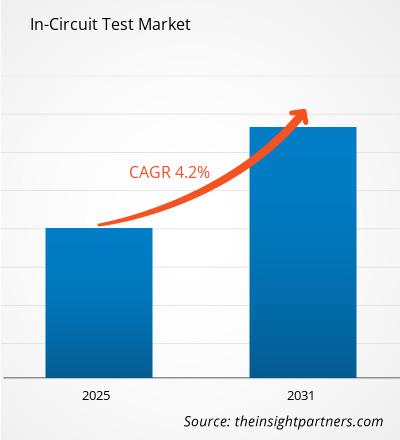
Segmentation Analysis
Type
Type is modeled at a 2.8–3.3% CAGR during 2026–2034. The In-Circuit Test Market scope across Analog In-Circuit Test and Mixed In-Circuit Test reflects changing PCBA architectures and test coverage requirements. Mixed-signal boards increasingly require measurement approaches capable of handling diverse electrical characteristics without creating excessive fixture or programming complexity.
- Analog In-Circuit Test: Analog systems remain important for boards dominated by resistive, capacitive, inductive, and analog semiconductor components. They provide efficient structural and parametric checks where analog measurements form the principal production quality requirement.
- Mixed In-Circuit Test: Mixed In-Circuit Test addresses boards combining analog and digital circuitry. Its strategic importance increases as electronics manufacturers seek broader coverage from fewer test insertions while accommodating increasingly complex PCBA architectures.
Portability
Portability is modeled at a 2.9–3.4% CAGR during 2026–2034. Compact and Benchtop configurations serve different manufacturing environments, with purchasing decisions influenced by throughput, available floor space, board complexity, product mix, and the frequency of production changeovers. The In-Circuit Test Market scope increasingly favors flexible equipment architectures.
- Compact: Compact platforms appeal to manufacturers with constrained production footprints and varied product configurations. Their flexibility supports distributed testing, engineering environments, and manufacturing cells where equipment mobility and rapid deployment have strategic value.
- Benchtop: Benchtop systems remain relevant for engineering, lower-volume manufacturing, troubleshooting, and specialized production. Their accessible configuration can support manufacturers requiring controlled testing without the infrastructure associated with larger automated production stations.
Application
Application is modeled at a 2.7–3.2% CAGR during 2026–2034. Consumer Electronics provides volume-driven demand, while Aerospace and Defense and Medical Equipment emphasize reliability and traceability. The In-Circuit Test Market growth across applications depends on board complexity, production scale, defect economics, and the required level of automated quality assurance.
- Consumer Electronics: Consumer electronics manufacturers prioritize throughput, repeatability, and rapid product changeovers. ICT remains strategically relevant where high production volumes make early defect detection economically valuable and justify automated test programming.
- Aerospace and Defense: Aerospace and defense applications emphasize reliability, documentation, traceability, and stringent manufacturing controls. ICT supports these priorities by identifying component and assembly faults before boards progress into higher-value system integration stages.
- Medical Equipment: Medical equipment manufacturers require consistent production quality and traceable processes. Automated electrical testing supports controlled manufacturing by identifying defects before clinical equipment assembly, reducing downstream rework and potential reliability risks.
- Others: Other applications include industrial controls, communications equipment, automotive electronics, and specialized electronics. Demand varies by production scale and reliability requirements, creating opportunities for flexible test systems with configurable coverage.
Opportunity Snapshot
| Application | Revenue Contribution (High/Medium/Low) | Trend Tag (MAX 2 words) | Adoption Stage |
| Consumer Electronics | High | High Throughput | Mature |
| Aerospace and Defense | Medium | Reliability Testing | Scaling |
| Medical Equipment | Medium | Traceable QA | Scaling |
| Others | Low | Industrial Controls | Emerging |
In-Circuit Test Market Growth Drivers and Impact Analysis
Increasing PCBA complexity raises demand for automated fault detection
Modern PCBAs integrate more components, tighter layouts, higher pin counts, and mixed electrical functions, increasing the probability that manual inspection alone will miss manufacturing defects. Automated electrical testing gives consistent measurement results and diagnostic procedures, thus making the procedure useful even before the board goes through the costly assembly process. The effect is felt more when a faulty PCBA might result in reworking throughout different production stages or even spoil the high-value end product. The companies are now considering test coverage along with speed and effort spent on programming the equipment rather than viewing ICT as an independent inspection procedure. Equipment that can adapt easily to changes in board design can help minimize costs resulting from frequent changes in product design.
Higher quality requirements increase the value of early defect isolation
Aerospace, defense, medical, industrial, and communications manufacturers face substantial costs when electrical defects are detected late in assembly. Initial isolation cuts down the time required for troubleshooting and enables the manufacturer to determine whether the problem is due to components, soldering, connection or assembly. ICT, being automated, is therefore not only beneficial in terms of process control in manufacturing but also in quality control at the end of the line. Its significance is enhanced in scenarios where there is a need for documentation of tests done, consistency of procedures used and record of quality. In industries where there is a high level of reliability, ICT becomes a necessity regardless of low production levels compared to consumer electronics due to the associated high costs.
Flexible manufacturing increases demand for scalable test platforms
Electronics manufacturers increasingly operate multiple product variants, shorter production runs, and geographically distributed manufacturing lines. This environment creates demand for test platforms that can be configured rapidly without excessive fixture, programming, or operator intervention. Compact systems can serve flexible production cells, while larger automated platforms remain important for high-volume manufacturing. The commercial impact is a gradual shift toward modular architectures that allow manufacturers to scale capacity or add test functionality without replacing the entire platform. Software compatibility also becomes strategically important because manufacturers can reuse libraries, diagnostics, and test strategies across product generations. Suppliers that combine hardware flexibility with engineering support can therefore capture value from both new equipment purchases and ongoing program changes. This reinforces the role of service, programming, fixture design, and lifecycle support.
In-Circuit Test Market Future Trends
Convergence of ICT with functional and boundary-scan testing
The In-Circuit Test Market trends are likely to increasingly favor unified platforms that combine structural, parametric, programming, boundary-scan, and selected functional tests. Manufacturers want broader defect coverage without creating additional production bottlenecks or transferring boards between multiple stations. Software orchestration can coordinate different test methods and consolidate results into a single production record. This approach is particularly relevant for complex electronics where conventional ICT may not fully characterize high-speed or mission-mode behavior. The future competitive advantage will therefore depend on how effectively suppliers combine complementary methods while preserving throughput and diagnostic clarity. Platforms that support incremental expansion can also reduce capital risk, allowing manufacturers to add capabilities as product requirements evolve. Such architectures should improve equipment utilization across product families and production volumes.
Data-driven diagnostics reshape production test economics
Future systems are expected to use richer test data to identify recurring manufacturing patterns, isolate process drift, and support predictive quality management. Instead of treating each failure as an independent event, manufacturers can correlate measurements across components, board revisions, production lines, and time periods. This can improve troubleshooting and help engineers identify systematic causes before defect rates escalate. Integration with manufacturing execution systems and factory analytics will become increasingly important as production environments become more connected. Artificial intelligence may assist diagnosis, although practical deployment will depend on reliable datasets, explainability, and compatibility with existing test software. Suppliers that provide structured data access, visualization, and analytics alongside test hardware can strengthen customer retention. The result is a broader role for ICT within digital manufacturing quality systems.
In-Circuit Test Market Opportunities
Expansion of electronics manufacturing in India and Southeast Asia
The In-Circuit Test Market Forecasts point toward opportunities in emerging electronics manufacturing locations where production capacity is expanding and manufacturers are adopting more formalized quality systems. India and Southeast Asia are particularly relevant because electronics assembly, contract manufacturing, and component ecosystems are developing across multiple product categories. Equipment suppliers can target these markets through localized engineering support, training, fixture services, and modular platforms suited to varying production volumes. Partnerships with contract manufacturers can provide access to multiple programs and reduce customer-acquisition costs. Suppliers should also consider regional service centers because rapid troubleshooting is important when automated test equipment becomes a production bottleneck. A localized support model can therefore improve equipment utilization and create recurring revenue through programming, maintenance, calibration, and upgrades while supporting long-term customer relationships.
Test modernization for high-reliability electronics
Manufacturers of aerospace, defense, and medical electronics provide an opportunity for suppliers to position advanced ICT as part of broader quality-assurance modernization. These customers increasingly require documented processes, controlled configuration management, reliable diagnostics, and evidence of production consistency. Suppliers can respond with systems offering stronger data management, secure software environments, configurable test coverage, and integration with manufacturing execution platforms. The opportunity is not limited to replacing aging equipment. Existing production lines can be upgraded through new fixtures, software, measurement modules, or complementary test technologies. Vendors that provide lifecycle modernization programs can address capital constraints while extending installed equipment utility. This approach also creates recurring service opportunities and can strengthen supplier relationships with customers whose products remain in production for many years.
Recent Developments
- July 2026: Mixx Technologies acquired Bengaluru-based Sophic Silicon Technologies and entered a multi-year manufacturing collaboration with Kaynes Semicon. The transactions strengthen Mixx’s semiconductor design and manufacturing capabilities in India, supporting development of a next-generation AI silicon platform and expanding its Bengaluru R&D operations.
- August 2025: Circuit Check acquired Solution Sources Programming (SSP), combining SSP’s expertise in Design for Test, Boundary Scan, In-Circuit Test, and Functional Test with Circuit Check’s fixture design and automated test engineering capabilities. The acquisition expands Circuit Check’s Silicon Valley presence and creates an integrated test, programming, and manufacturing solution.
- January 2025: Agile Circuit Technologies Group acquired UK-based Active-PCB Solutions, expanding its electronics manufacturing services through capabilities spanning electronic and mechanical assembly, prototyping, and volume production. The acquisition strengthens ACT Group’s ability to provide integrated manufacturing support across product development and production requirements.
Frequently Asked Questions

- Comprehensive Market Sizing and Forecast Analysis
- Detailed Segmentation Analysis
- In-Depth Market Dynamics Assessment
- Regional and Country-Level Insights
- Competitive Landscape and Company Benchmarking
- Strategic Business Intelligence
Recent Reports
Testimonials

The Insight Partners' SCADA System Market report is comprehensive, with valuable insights on current trends and future forecasts. The team was highly professional, responsive, and supportive throughout. We are very satisfied and highly recommend their services.
RAN KEDEM Partner, Reali Technologies LTDs
I requested a report on a very specific software market and the team produced the report in a few days. The information was very relevant and well presented. I then requested some changes and additions to the report. The team was again very responsive and I got the final report in less than a week.
JEAN-HERVE JENN Chairman, Future Analytica
We worked with The Insight Partners for an important market study and forecast. They gave us clear insights into opportunities and risks, which helped shape our plans. Their research was easy to use and based on solid data. It helped us make smart, confident decisions. We highly recommend them.
PIYUSH NAGPAL Sr. Vice President, High Beam Global
The Insight Partners delivered insightful, well-structured market research with strong domain expertise. Their team was professional and responsive throughout. The user-friendly website made accessing industry reports seamless. We highly recommend them for reliable, high-quality research services
YUKIHIKO ADACHI CEO, Deep Blue, LLC.
This is the first time I have purchased a market report from The Insight Partners.While I was unsure at first, I visited their web site and felt more comfortable to take the risk and purchase a market report.I am completely satisfied with the quality of the report and customer service. I had several questions and comments with the initial report, but after a couple of dialogs over email with their analyst I believe I have a report that I can use as input to our strategic planning process.Thank you so much for taking the extra time and making this a positive experience.I will definitely recommend your service to others and you will be my first call when we need further market data.
JOHN SUZUKI President and Chief Executive Officer, Board Director, BK Technologies
I wish to appreciate your support and the professionalism you displayed in the course of attending to my request for information regarding to infectious disease IVD market in Nigeria. I appreciate your patience, your guidance, and the fact that you were willing to offer a discount, which eventually made it possible for us to close a deal. I look forward to engaging The Insight Partners in the future, all thanks to the impression you have created in me as a result of this first encounter.
DR CHIJIOKE ONYIA MANAGING DIRECTOR, PineCrest Healthcare Ltd.Reason to Buy
- Informed Decision-Making
- Understanding Market Dynamics
- Competitive Analysis
- Identifying Emerging Markets
- Customer Insights
- Market Forecasts
- Risk Mitigation
- Boosting Operational Efficiency
- Strategic Planning
- Investment Justification
- Tracking Industry Innovations
- Aligning with Regulatory Trends





 Get Free Sample for