
Industrial Copper Cable Market Size, Share & Forecast by 2034
Coverage: by Type (Coaxial, Unshielded Twisted Pair, Shielded Twisted Pair); Industry Vertical (Automotive, Mining, Power and Energy, Oil and Gas, Others) , and Geography (North America, Europe, Asia Pacific, and South and Central America)
- Status : Data Released
- Report Code : TIPRE00005431
- Category : Electronics and Semiconductor
- No. of Pages : 150
- Available Report Formats :


- Last update date : September 21, 2026


2025 Market Size
US$ 248.71 Bn
Base year value
2034 Forecast
US$ 317.75 Bn
Projected by 2034
CAGR 2026-2034
2.76 %
Growth rate
Addressable Market
US$ 2,571.16 Bn
(2026-2034)
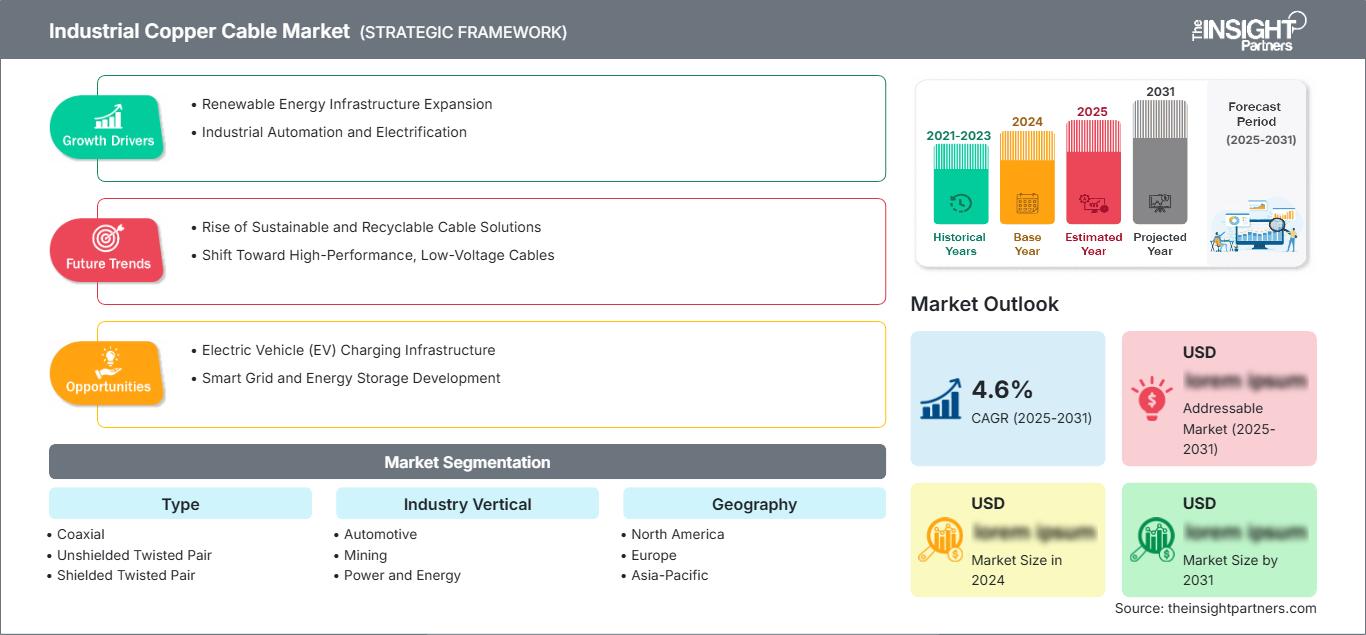
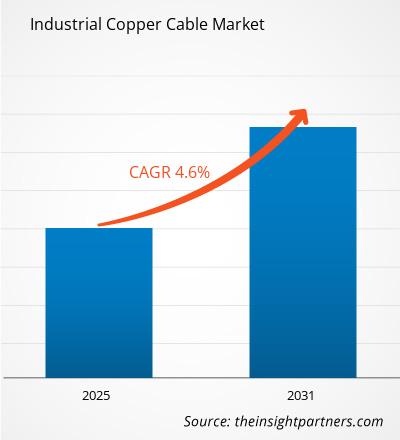
The global Industrial Copper Cable market was valued at US$ 248.71 billion in 2025 and is expected to reach US$ 317.75 billion by 2034; it is estimated to record a CAGR of 2.76% during 2026-2034.
Industrial Copper Cable Market Assessment and Insights
- North America: North America is expected to hold a 25–29% share in 2025 and expand at a 3.4–4.0% CAGR between 2026–2034, supported by grid renewal, industrial automation, data centers, and domestic manufacturing investment.
- US: The US is estimated to account for 72–76% of North American demand in 2025, advancing at a 3.2–3.8% CAGR between 2026–2034 as electrification and infrastructure modernization accelerate.
- Europe: Europe is projected to represent a 24–28% share in 2025 and grow at a 2.7–3.3% CAGR between 2026–2034, led by Germany, the UK, France, Italy, and Spain through grid modernization and automotive electrification.
- Asia Pacific: Asia Pacific is estimated at a 36–40% share in 2025 and is expected to grow at a 3.5–4.2% CAGR between 2026–2034, with China, Japan, South Korea, and India supporting industrial and infrastructure deployment.
- Largest Segment: Unshielded Twisted Pair is estimated at a 44–48% market share in 2025, with a 3.4–4.0% CAGR between 2026–2034, supported by industrial networking and economical installation.
- High Growth Segment: Automotive is estimated at a 24–28% market share in 2025 and is expected to grow at a 4.2–4.8% CAGR between 2026–2034, driven by electrification and vehicle connectivity.
- Key companies analyzed in detail: ACOME, Cables RCT, CME Wire and Cable, COFICAB, Coroplast Fritz Müller GmbH & Co. KG, General Cable Technologies Corporation, KEI Industries Limited, Sumitomo Electric Industries, Ltd., Superior Essex Inc., and The Okonite Company.
Source: The Insight Partners' analysis based on proprietary research, government publications, company annual reports, investor presentations, industry databases, and expert interviews.
The Industrial Copper Cable Market has transformed from basic point-to-point electrical wiring to application-focused cables that are required for automation, fast device communication, vehicle electronics, and distributed power systems. Copper continues to have value in situations where there is a need for conductivity, ease of termination, flexibility, and electromagnetic behavior. Designers are focusing increasingly on design parameters such as shape of conductors, insulation, shielding, fire resistance, and installation features to suit industrial environments.
In future, growth prospects for the Market for Industrial Copper Cables will be more focused towards upcoming industrial centers, renewable power networks, electric transportation, and digital infrastructures. There is growing interest in reliability, low material content, recycling capabilities, and regional sourcing. Focus on energy efficiency, infrastructure stability, product safety, and material security will further support the demand for differentiated cables.
Industrial Copper Cable Market Report Scope
| Report Attribute | Details |
|---|---|
| Market size in 2025 | US$ 248.71 Billion |
| Market Size by 2034 | US$ 317.75 Billion |
| Global CAGR (2026 - 2034) | 2.76% |
| Historical Data | 2021-2024 |
| Forecast period | 2026-2034 |
Industrial Copper Cable Market Analysis
Copper Cables for Industrial Applications is dependent upon the growth of the electricity grids, automation, vehicles, and other digital facilities. Copper cables continue to be preferred where resistance, termination convenience, and reliable signal transfer is essential. The value chain involves refined copper, rods, drawing, stranding, insulation, shielding, jacketing, testing, distribution, and installation of projects. Availability of materials and efficiency of manufacturing processes have an importance in terms of profitability.
The demand is also affected not by the quantity of cables but by the requirements of the project. Customers need copper cables that provide thermal stability, mechanical strength, electromagnetic compatibility, fire performance, and specific bending characteristics. It means that supply is more favorable for producers who can combine standard products with custom solutions. Fluctuations of copper prices should be taken into account in purchases. Recycling reduces dependence on primary materials.
Competitive positioning is defined by a range of factors such as geographic footprint, engineering expertise, certification coverage, scale of manufacturing operations, and customer qualification. ACOME has relevance to both automotive and telecommunication segments; Cables RCT and CME Wire and Cable cater to industrial applications with special requirements in terms of connectivity solutions. COFICAB has an automotive focus, whereas Coroplast Fritz Müller GmbH & Co. KG has involvement in cabling and wiring solutions that require application engineering.
Other competitors include General Cable Technologies Corporation, KEI Industries Limited, Sumitomo Electric Industries, Ltd., Superior Essex Inc., and The Okonite Company. The competitive landscape is becoming increasingly rewarding to capacity localization, copper-alloying expertise, automated manufacturing, and customer programs. The result of this is that strategic investment is increasingly made in areas other than pure volume.
● REPORT CUSTOMIZATION
Tailor This Report To Align With Your Specific Business Requirements
This report can be customized to align precisely with your business objectives, scope, and target markets. Customization options include tailored segmentation, geography, competitive analysis, and strategic insights to support informed decision-making.
Customize This Report →WHAT YOU CAN ADJUST
- ● Segmentations
- ● Geography
- ● Competitive Analysis
- ● Language Preferences
Industrial Copper Cable Market: Strategic Insights
Regional Insights
North America Industrial Copper Cable Market
North America is estimated to represent a 25–29% share of Industrial Copper Cable Market in 2025 and expand at a 3.4–4.0% CAGR through 2034. USA continues to be the main demand driver, driven by grid upgrades, industrial automation, data center build-out, and investments in local production. Canada helps with mining, energy, utilities, and infrastructure development.
Modern industrial facilities demand reliable copper cabling for motors, control systems, instrumentation, structured cabling systems, and power distribution. Data center build-out helps to increase the demand for metal cabling, however, fiber optic cables continue to dominate high capacity applications.
U.S. Industrial Copper Cable Market
The US is estimated to account for 72–76% of North American Industrial Copper Cable Market in 2025 and grow at a 3.2–3.8% CAGR through 2034. Demand is supported by manufacturing reshoring, utility investment, data-center development, and electrification across industrial facilities. Industrial automation is increasing the need for reliable control and communication cabling.
Automotive plants, mining operations, energy facilities, and large commercial infrastructure are significant users. Manufacturers including General Cable Technologies Corporation, Superior Essex Inc., and The Okonite Company maintain relevance across US cable applications, while global suppliers compete through engineered products and project relationships. The market increasingly values domestic availability, compliance, durability, and delivery reliability.
Europe Industrial Copper Cable Market
Europe is estimated to hold a 24–28% share in 2025 and expand at a 2.7–3.3% CAGR through 2034, with Germany representing the leading country. The regional outlook is shaped by industrial decarbonization, grid reinforcement, automotive electrification, renewable integration, and stricter requirements for efficient infrastructure.
In the UK, the focus on transmission reinforcement and renewables incorporation has created the need for dependable cables. Germany, with its strong industrial base and investments in automobiles, machinery, and energy transition, continues to drive demand for copper cables. France is benefited by its transport, industrial modernization, and power infrastructure initiatives, while Italy and Spain also provide demand through their manufacturing, renewable generation, grid reinforcement, and electrification projects. Traceability and recyclability are important criteria in Europe's procurement process.
APAC Industrial Copper Cable Market
APAC is estimated to account for 36–40% of Industrial Copper Cable Market in 2025 and expand at a 3.5–4.2% CAGR through 2034, with China leading. Japan and South Korea remain important for advanced manufacturing, while India and Australia support infrastructure, mining, and energy investment.
China benefits from extensive industrial capacity and electrification. India is supported by manufacturing expansion and power infrastructure, while Japan and South Korea emphasize automotive and high-technology production. Australia contributes through mining and energy projects. Policy support for industrial modernization, grid expansion, electric mobility, and renewable generation strengthens regional cable requirements.
Middle East & Africa Industrial Copper Cable Market
Middle East and Africa demand is projected to expand at a 3.8–4.5% CAGR through 2034, led by Saudi Arabia within the regional grouping. UAE infrastructure and data-center investment, Saudi energy and industrial diversification, and South African mining and power requirements provide distinct demand centers.
Rest of MEA demand is tied to utilities, construction, mining, hydrocarbons, and industrial development. Copper cables remain relevant where ruggedness and dependable electrical connectivity are required. Energy diversification and infrastructure modernization should gradually broaden applications beyond conventional oil and gas facilities, although project financing and copper-price exposure remain important procurement constraints.
Segmentation Analysis
Type
Industrial Copper Cable Market scope by type is shaped by the balance between bandwidth, electromagnetic protection, installation cost, and operating environment. Type demand is expected to expand at a 3.0–3.8% CAGR during 2026–2034, with unshielded constructions retaining broad industrial adoption while shielded designs gain relevance where interference is material.
- Coaxial: Coaxial cables remain strategically relevant for specialized signal transmission, legacy industrial systems, surveillance, and selected high-frequency applications where controlled impedance and established connector ecosystems support dependable performance.
- Unshielded Twisted Pair: Unshielded twisted pair remains widely deployed for industrial Ethernet and structured communications because of economical installation, broad equipment compatibility, manageable termination, and adequate performance in controlled electromagnetic environments.
- Shielded Twisted Pair: Shielded twisted pair is increasingly selected in electrically noisy factories, process plants, and machinery environments where improved electromagnetic protection supports stable communication and reduces interference-related operational risks.
Industry Vertical
Industrial Copper Cable Market analysis across industry verticals reflects differing requirements for power distribution, communication, environmental durability, and safety. The industry vertical segment is expected to grow at a 3.2–4.0% CAGR during 2026–2034, with automotive showing the strongest expansion profile as electrified vehicles increase wiring complexity.
- Automotive: Automotive demand is increasingly shaped by electrification, advanced driver-assistance systems, connected vehicles, and charging infrastructure, creating requirements for compact, flexible, thermally stable, and application-specific copper cable assemblies.
- Mining: Mining operations require robust cables for mobile equipment, processing systems, controls, and communications, with durability and resistance to mechanical stress remaining central purchasing criteria.
- Power and Energy: Power and energy applications require dependable copper conductors for equipment interconnection, control systems, distribution assemblies, and auxiliary infrastructure supporting grid modernization and distributed generation.
- Oil and Gas: Oil and gas facilities continue to use engineered copper cables for instrumentation, control, communications, and electrical systems where temperature, chemical exposure, safety, and reliability requirements influence specification.
- Others: Other industrial applications include manufacturing, transportation infrastructure, building systems, and specialized machinery, where copper remains relevant for dependable connectivity and equipment-level electrical integration.
Opportunity Snapshot
| Industry Vertical | Revenue Contribution | Trend Tag | Adoption Stage |
|---|---|---|---|
| Automotive | High | EV Wiring | Scaling |
| Mining | Medium | Mine Automation | Scaling |
| Power and Energy | High | Grid Renewal | Mature |
| Oil and Gas | Medium | Asset Electrification | Mature |
| Others | Medium | Factory Automation | Scaling |
Industrial Copper Cable Market Growth Drivers and Impact Analysis
Grid modernization and electrification are increasing cable intensity
Electricity infrastructure is becoming more cable-intensive as utilities replace aging equipment, integrate distributed generation, expand substations, and strengthen industrial connections. According to the IEA, increased investments in grids are required in order to cater to increased energy consumption. Such an environment creates opportunities for the use of copper in electrical conductors in equipment, control systems, distribution systems, and industries. The conductivity properties and existing ecosystem of connections of copper make it advantageous when there are limitations of space and maintenance issues for other options. The implications of such a development go beyond utilities since grid expansion leads to the construction of plants, data centers, recharging stations, and renewable energy stations.
Industrial automation is expanding communication and control requirements
Automation of factories leads to more motors, sensors, controllers, drives, robots, and surveillance becoming available for use in industrial facilities. Every such connection demands power supply or data transmission that are resistant to vibration, temperature changes, interference from electromagnetic fields, and challenging installation conditions. Copper cables are needed as some industrial Ethernet topologies as well as other interfaces still work on copper at reasonable distances. From a business perspective, there is a trend towards engineered solutions rather than basic commodities, and differentiation can be achieved through shielding, flexibility, interface capability, fire resistance, and long-life performance. For vendors, the upgrade of existing installations can go along with factory automation initiatives resulting in repetitive demand irrespective of building of a new factory.
Vehicle electrification is raising wiring complexity and specification requirements
Electrification alters the architectural design of cars in the form of high voltage systems, batteries, power electronics, charging systems, thermal management systems, and advanced communication systems. Copper plays a significant role due to the high electrical conductivity, small cross-sectional sizes and processing techniques that make copper appropriate for use in cars. This impact extends beyond personal cars since commercial vehicles, buses, construction equipment and advanced mobility systems require more sophisticated wiring systems. Suppliers of such automotive components focus on lightness, reduced size packages, heat resistance, shielding and connectivity. For instance, the product offering of COFICAB shows the shift within the industry towards high voltage, connectivity, autonomy and lightweight applications.
Industrial Copper Cable Market Future Trends
Data-center power architecture will create specialized copper demand
Future Industrial Copper Cable Market trends will increasingly reflect the physical infrastructure required to support high-density computing. According to the International Energy Agency, the use of data centers' electricity increased by 17% in 2025, whereas the investments by five big tech corporations were more than US$400 billion. Though optical fibers are dominant in high capacity connections, copper is still crucial in power transmission, short range networking, grounding, cooling devices, and facilities. The future installations will place a greater focus on the current density, heat dissipation, tight routing, and reliable installations. The suppliers can react through specialized conductors, better insulation, more efficient connecting systems, and high-density devices.
Material efficiency and circular copper systems will shape product design
Industrial cable manufacturers are likely to increase attention to conductor optimization, recycled copper, recoverable insulation, and designs that reduce material use without compromising electrical performance. Industrial customers are increasingly evaluating environmental attributes alongside technical compliance, particularly in Europe and multinational procurement programs. Future product development should therefore combine conductivity with lower material intensity, improved recyclability, and transparent sourcing. Digital manufacturing systems can support tighter dimensional control and reduce process scrap, while closed-loop recovery can return valuable copper to production. The resulting market structure may favor manufacturers that can document material provenance, recovery pathways, and lifecycle performance. Such capabilities could become important differentiators in long-duration infrastructure contracts where environmental criteria increasingly influence supplier selection.
Industrial Copper Cable Market Opportunities
Localized manufacturing can strengthen supply resilience
Industrial Copper Cable Market opportunities are emerging from the localization of cable production near major manufacturing and infrastructure clusters. Recent supply disruptions and volatile raw-material markets have encouraged industrial buyers to evaluate lead times, inventory security, dual sourcing, and regional production capability more closely. Manufacturers can respond by expanding drawing, stranding, insulation, and finishing capacity close to automotive, energy, mining, and industrial customers. Localization can also improve customization because application-specific products require shorter engineering and qualification cycles. Investment decisions should prioritize plants with flexible production lines capable of serving multiple cable types and industries. Partnerships with copper suppliers, equipment manufacturers, and system integrators can further reduce procurement risk. The strongest opportunities are likely to arise where infrastructure spending, industrial expansion, and import-dependency reduction occur simultaneously.
Advanced copper products can capture higher-value industrial applications
Industrial Copper Cable Market Forecasts indicate an opportunity to move beyond commodity products toward cables engineered for difficult thermal, mechanical, electromagnetic, and installation conditions. Automotive electrification, mining automation, process industries, and high-density electrical infrastructure require products that perform consistently under demanding operating conditions. Manufacturers can invest in copper alloys, optimized conductor geometries, advanced insulation systems, shielding structures, and application-specific connector interfaces. Such development supports higher-value positioning while reducing dependence on simple volume competition. Certification and qualification capabilities are equally important because industrial customers often require extensive validation before changing suppliers. Companies with strong engineering teams can use co-development programs to establish early positions with equipment manufacturers and major industrial users. This approach can improve customer retention and create more predictable project pipelines.
Recent Developments
- April 2026: Aurubis and NKT have entered into a multi-year agreement for the supply of copper products across the European value chain. Under the agreement, Aurubis will supply several NKT production sites in Europe with low-carbon copper wire ROD primarily used in high-voltage cables.
- February 2026: Molex introduces Impress Co-Packaged Copper Solutions, a compression based on-substrate connector and mating cable assembly that delivers near ASIC connectivity at 224Gbps PAM‑4 and beyond. Its compact, durable socket simplifies maintenance and future-proofs high-density AI and hyperscale data center architectures.
- April 2025: Amphenol Communications Solutions (ACS), a global leader in high performance interconnect solutions, and Semtech Corporation (Nasdaq: SMTC), a high-performance semiconductor, IoT systems and cloud connectivity service provider, introduced a leading-edge 1.6T OSFP Active Copper Cable (ACC) product featuring Semtech's CopperEdge 224G/lane linear equalizer/redriver ICs, targeted for use in next-generation AI/ML and data center infrastructure.
Frequently Asked Questions

- Comprehensive Market Sizing and Forecast Analysis
- Detailed Segmentation Analysis
- In-Depth Market Dynamics Assessment
- Regional and Country-Level Insights
- Competitive Landscape and Company Benchmarking
- Strategic Business Intelligence
Recent Reports
Testimonials

The Insight Partners' SCADA System Market report is comprehensive, with valuable insights on current trends and future forecasts. The team was highly professional, responsive, and supportive throughout. We are very satisfied and highly recommend their services.
RAN KEDEM Partner, Reali Technologies LTDs
I requested a report on a very specific software market and the team produced the report in a few days. The information was very relevant and well presented. I then requested some changes and additions to the report. The team was again very responsive and I got the final report in less than a week.
JEAN-HERVE JENN Chairman, Future Analytica
We worked with The Insight Partners for an important market study and forecast. They gave us clear insights into opportunities and risks, which helped shape our plans. Their research was easy to use and based on solid data. It helped us make smart, confident decisions. We highly recommend them.
PIYUSH NAGPAL Sr. Vice President, High Beam Global
The Insight Partners delivered insightful, well-structured market research with strong domain expertise. Their team was professional and responsive throughout. The user-friendly website made accessing industry reports seamless. We highly recommend them for reliable, high-quality research services
YUKIHIKO ADACHI CEO, Deep Blue, LLC.
This is the first time I have purchased a market report from The Insight Partners.While I was unsure at first, I visited their web site and felt more comfortable to take the risk and purchase a market report.I am completely satisfied with the quality of the report and customer service. I had several questions and comments with the initial report, but after a couple of dialogs over email with their analyst I believe I have a report that I can use as input to our strategic planning process.Thank you so much for taking the extra time and making this a positive experience.I will definitely recommend your service to others and you will be my first call when we need further market data.
JOHN SUZUKI President and Chief Executive Officer, Board Director, BK Technologies
I wish to appreciate your support and the professionalism you displayed in the course of attending to my request for information regarding to infectious disease IVD market in Nigeria. I appreciate your patience, your guidance, and the fact that you were willing to offer a discount, which eventually made it possible for us to close a deal. I look forward to engaging The Insight Partners in the future, all thanks to the impression you have created in me as a result of this first encounter.
DR CHIJIOKE ONYIA MANAGING DIRECTOR, PineCrest Healthcare Ltd.Reason to Buy
- Informed Decision-Making
- Understanding Market Dynamics
- Competitive Analysis
- Identifying Emerging Markets
- Customer Insights
- Market Forecasts
- Risk Mitigation
- Boosting Operational Efficiency
- Strategic Planning
- Investment Justification
- Tracking Industry Innovations
- Aligning with Regulatory Trends





 Get Free Sample for