
Inertial Sensing Systems Market Share, Size & Demand by 2034
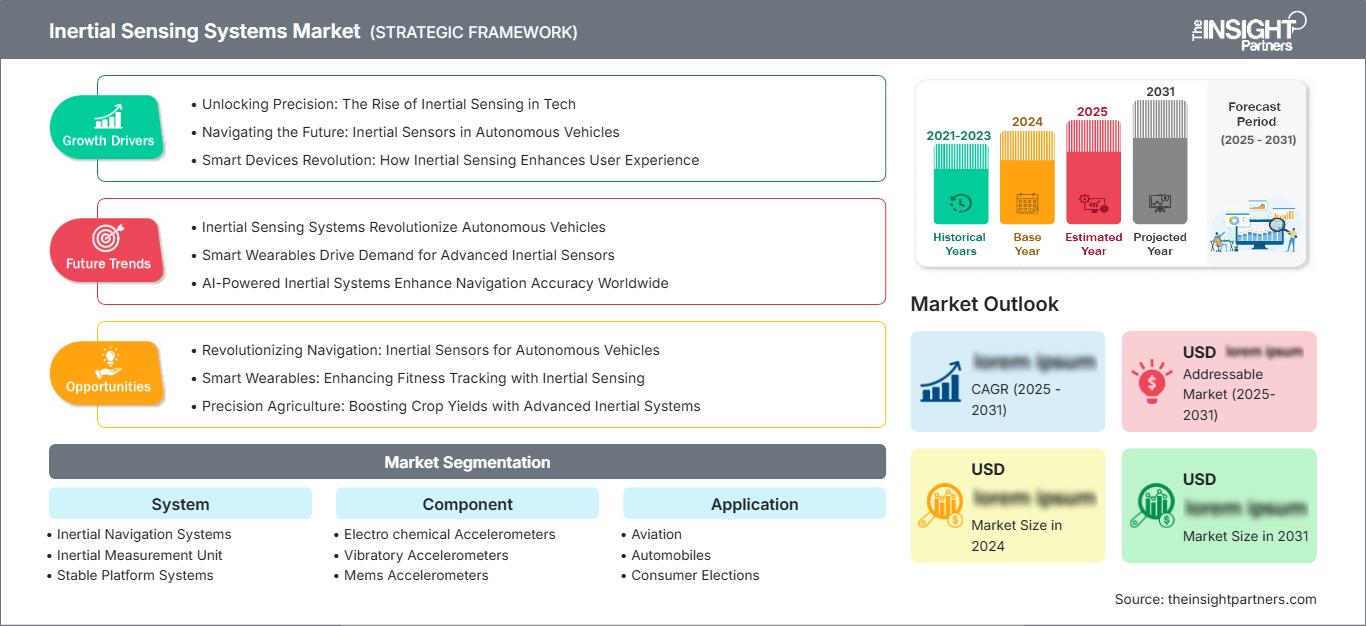
Coverage: By System (Inertial Navigation Systems, Inertial Measurement Unit, Stable Platform Systems, Strap down Systems, Others); Component (Electro chemical Accelerometers, Vibratory Accelerometers, Mems Accelerometers, Angular accelerometers, Gyroscopes, Others); Application (Aviation, Automobiles, Consumer Elections, Defense, Others) , and Geography (North America, Europe, Asia Pacific, and South and Central America)
- Status : Data Released
- Report Code : TIPRE00023224
- Category : Electronics and Semiconductor
- No. of Pages : 150
- Available Report Formats :


- Last update date : September 18, 2026


2025 Market Size
US$ 13.07 Bn
Base year value
2034 Forecast
US$ 19.87 Bn
Projected by 2034
CAGR 2026-2034
4.76 %
Growth rate
Addressable Market
US$ 149.49 Bn
(2026-2034)
The Inertial Sensing Systems market was valued at US$ 13.07 billion in 2025 and is expected to reach US$ 19.87 billion by 2034; it is estimated to record a CAGR of 4.76% during 2026-2034.
Inertial Sensing Systems Market Assessment and Insights
- North America: North America represented a 34–38% Inertial Sensing Systems Market share in 2025 and is projected to grow at a CAGR of 5.5–6.0% during 2026–2034, supported by aerospace modernization, defense procurement, autonomous platforms, and resilient positioning requirements.
- US: The US accounted for 68–72% of North American demand in 2025 and is expected to expand at a CAGR of 5.6–6.1%, driven by military navigation and unmanned-system programs.
- Europe: Europe held a 25–29% share in 2025 and is expected to register a CAGR of 5.0–5.5%, with France, Germany, the UK, Italy, and Spain supporting aerospace, automotive, defense, and industrial sensor adoption.
- Asia Pacific: Asia Pacific represented a 27–31% share in 2025 and is forecast to grow at a CAGR of 6.0–6.6%, led by China, Japan, South Korea, and India through automotive electronics, industrial automation, and defense localization.
- Largest Segment: Defense accounted for a 35–39% market share in 2025 and is expected to expand at a CAGR of 5.7–6.2%, reflecting resilient navigation and guidance requirements.
- High Growth Segment: MEMS accelerometers held a 22–26% market share in 2025 and are projected to grow at a CAGR of 7.2–7.8%, benefiting from miniaturization and lower power consumption.
- Key companies analyzed in detail: Analog Devices, Bosch Sensortec GmbH, Colibrys Ltd., Honeywell International Inc., iXblue SAS, Kearfott Corporation, KVH Industries, Inc., Meggitt plc, Northrop Grumman Corporation, and Safran.
Source: The Insight Partners' analysis based on proprietary research, government publications, company annual reports, investor presentations, industry databases, and expert interviews.
The Inertial Sensing Systems Market has matured from heavy mechanical navigation assemblies to compact solid-state systems where MEMS accelerometers and gyroscopes increase the operating bandwidth of inertial solutions. Calibration, digital processing, sensor fusion, and packaging improve reliability while shrinking both size and power consumption. Manufacturing will become more differentiated on accuracy, environmental robustness, software integration, and ability to certify solutions other than simply the sensors themselves.
Future growth in the Inertial Sensing Systems Market may well involve extending into new aerospace manufacturing facilities, autonomy projects, and defense modernization programs in Asia Pacific and the Middle East. Procurement that focuses on electronics production capabilities can spur local assembly and qualification of products. Meanwhile, regulations around aviation safety, military effectiveness, and autonomy reliability are driving demand for greater integrity of inertial systems that perform reliably under degraded or denied GNSS conditions.
Inertial Sensing Systems Market Report Scope
| Report Attribute | Details |
|---|---|
| Market size in 2025 | US$ 13.07 Billion |
| Market Size by 2034 | US$ 19.87 Billion |
| Global CAGR (2026 - 2034) | 4.76% |
| Historical Data | 2021-2024 |
| Forecast period | 2026-2034 |
Inertial Sensing Systems Market Analysis
The demand in the Inertial Sensing Systems Market is being driven by the requirement for uninterrupted positional, velocity, and orientation sensing in case satellite-based navigation fails. More and more industries like aviation, defense, autonomous vehicles, marine applications, robotics, and industry are combining inertial data with GNSS data, vision, radar, magnetic field sensing, or other references. Hence, the value chain includes sensors development, electronics, calibration, embedded algorithms, navigation software, system integration, qualification, and life-cycle support services. Manufacturers capable of integrating sensor accuracy with software compensation can serve more platform needs.
The Inertial Sensing Systems Market report shows that supply chain is divided by the performance level of the product. High-end applications for navigation systems will always require strict bias stability, vibration tolerance, temperature behavior, and long calibration. In contrast, automotive and consumer industries will focus on volume, affordability, size, and energy consumption. The advancements in semiconductor industry are making MEMS more consistent and integrated, but specialized inertial sensors still will be in need of heavy testing and application-focused design. The industry, thus, represents a two-tier system with high-volume sensors manufacturers and specialized navigation systems suppliers.
The competitive landscape involves diversified semiconductor firms, aerospace suppliers, defense contractors, and specialized navigation solution providers. Analog Devices Inc. and Bosch Sensortec GmbH capitalize on semiconductor and MEMS technology, whereas Honeywell International Inc., Northrop Grumman Corporation, Kearfott Corporation, and Safran focus on high integrity aerospace and defense applications. iXblue SAS and KVH Industries, Inc. bring in specialized positioning for navigation and stabilization applications, whereas Colibrys Ltd. and Meggitt plc are contributing unique sensors and aerospace solutions.
Strategic positioning is increasingly about combining sensors with navigation algorithms and full platform solutions, as opposed to offering discrete parts. There is a drive towards miniaturization of IMUs, navigation robustness, innovative gyros, and custom electronics. Recent product developments illustrate the direction towards smaller SWaP, open architecture solutions, and operation without GPS. Relationships with defense primes, aircraft makers, vehicle designers, and governmental bodies help shorten qualification processes and create a revenue stream.
● REPORT CUSTOMIZATION
Tailor This Report To Align With Your Specific Business Requirements
This report can be customized to align precisely with your business objectives, scope, and target markets. Customization options include tailored segmentation, geography, competitive analysis, and strategic insights to support informed decision-making.
Customize This Report →WHAT YOU CAN ADJUST
- ● Segmentations
- ● Geography
- ● Competitive Analysis
- ● Language Preferences
Inertial Sensing Systems Market: Strategic Insights
Regional Insights
North America Inertial Sensing Systems Market
North America accounted for a 34–38% share in 2025 and is projected to expand at a CAGR of 5.5–6.0% through 2034. US is still the largest source of demand driven by military air forces upgrading, autonomy, precision, and commercial air transport upgrades. Canada provides support to the demand through aerospace production, navigation equipment, and automation industry. Additional support comes from needs for reliable positioning in environments where GNSS signal can be jammed, degraded or lost.
The regional eco-system includes semiconductor producers, aerospace producers, defense manufacturers and navigation companies. Investments are shifting to small MEMS IMUs, multi-sensor navigation and resilient positioning solutions. Defense procurement continues being a catalyst for applications. The autonomous maritime, unmanned aerial and advanced automotive industries create additional commercial applications. The existing qualification facilities and engineering intensity will support the suppliers who have already been certified.
U.S. Inertial Sensing Systems Market
The US represented 68–72% of North American demand in 2025 and is forecast to grow at a CAGR of 5.6–6.1%. Applications within aerospace and defense continue to be the most compelling for the industry, with inertial technology being applied in aircraft navigation, missiles, unmanned platforms, stabilization, pointing, and precision positioning. The automotive and robotics industry presents other volume opportunities.
Honeywell International Inc., Northrop Grumman Corporation, Kearfott Corporation, Analog Devices Inc., and KVH Industries Inc. play key roles in the domestic industry in terms of sensors, IMUs, navigation solutions, and related electronics. The increasing focus on resilience of PNT, lower SWaP, and interoperability is driving adoption of digital MEMS and hybrid navigation systems.
Europe Inertial Sensing Systems Market
Europe represented a 25–29% share in 2025 and is projected to grow at a CAGR of 5.0–5.5%. The UK has aerospace and defense capability, Germany has automotive electronics and industrial automation, whereas France has aerospace, defense, and navigation system capabilities. Italy and Spain contribute via aircraft manufacturing, defense electronics, industrial robotics, and mobility systems.
France continues to be a leading nation due to its existing aerospace and defense eco-system and its capabilities in inertial navigation. Germany leverages the use of automotive and industrial sensors, whereas the UK enables aerospace electronics and autonomous systems. Italy and Spain have become more relevant via their efforts in defense modernization and aircraft manufacturing.
APAC Inertial Sensing Systems Market
APAC represented a 27–31% share in 2025 and is expected to grow at a CAGR of 6.0–6.6%. China is the largest market, driven by applications in aerospace, automotive electronics, industrial automation, and localization of defense. Japan and South Korea are advanced electronics countries, and India is growing in defense production and aerospace applications. Australia makes its contribution through the modernization of its defense, autonomous systems, and navigation applications. In the region, the growth in industrial automation and vehicle electrification creates more demand for miniaturized sensors. Policy push toward domestic semiconductors and defense production is also contributing to the ecosystem in the region.
Middle East & Africa Inertial Sensing Systems Market
Middle East & Africa demand is smaller but strategically important, with growth expected at a CAGR of 4.5–5.2%. The Saudi Arabia and UAE are the market leaders in the region due to their investment in defense modernization, aerospace, autonomy, and infrastructure. The South African market provides support through aerospace, mining, defense, and industrial uses.
Demand from other parts of the MEA market comes from navigation needs in energy infrastructure, marine, mining, and remote industrial facilities. The investments in airports, autonomous inspection, and defense platforms can result in the increased use of rugged inertial systems. Saudi Arabia is a market leader, while the UAE is building up its position through investments in aerospace and advanced mobility.

Segmentation Analysis
System
The System segment is expected to grow at a CAGR of 4.9–5.5% during 2026–2034 as platform operators increasingly require integrated navigation, stabilization, and measurement capabilities. Demand is strongest where inertial performance, reliability, and continuity are mission-critical. System-level integration is also gaining importance as users seek lower SWaP and simplified platform qualification.
- Inertial Navigation Systems: These systems provide continuous position, velocity, and attitude estimation for aircraft, vessels, missiles, vehicles, and autonomous platforms. Their strategic importance increases where satellite-based navigation requires independent backup.
- Inertial Measurement Unit: IMUs combine accelerometers and gyroscopes to measure linear and angular motion. Adoption spans aerospace, defense, robotics, industrial automation, automotive systems, and autonomous machines requiring compact motion references.
- Stable Platform Systems: Stable platform systems support highly accurate navigation and stabilization by isolating sensing elements from platform motion. They remain relevant in demanding aerospace, defense, marine, and precision-instrument applications.
- Strap down Systems: Strapdown architectures directly mount inertial sensors to the moving platform and rely on computational processing. Their lower mechanical complexity supports compact designs, improved reliability, and integration into modern digital platforms.
Component
The Component segment is projected to register a CAGR of 6.1–6.7% through 2034. Semiconductor innovation is improving sensor sensitivity, packaging, calibration, and integration, while application-specific requirements continue to preserve demand for multiple sensing technologies across performance classes and operating environments.
- Electro chemical Accelerometers: Electrochemical sensing technologies offer high sensitivity for specialized measurement requirements. Their application remains concentrated in precision environments where stable response characteristics and specialized engineering justify higher system complexity.
- Vibratory Accelerometers: Vibratory designs provide robust motion measurement and can support demanding navigation and industrial applications. Their performance characteristics make them valuable where durability and repeatable sensing are essential.
- Mems Accelerometers: MEMS accelerometers are increasingly important because they combine compact dimensions, low power consumption, manufacturability, and digital integration. Their applicability spans automotive, consumer, industrial, aerospace, and defense platforms.
- Angular accelerometers: Angular accelerometers measure rotational acceleration and support specialized guidance, stabilization, and motion-analysis functions. Demand is concentrated in advanced navigation and control systems requiring precise dynamic measurements.
- Gyroscopes: Gyroscopes provide angular-rate information essential to navigation, stabilization, and control. Technologies range from MEMS devices to high-performance optical and resonant architectures serving different precision, environmental, and cost requirements.
Application
The Application segment is forecast to grow at a CAGR of 5.2–5.8% during 2026–2034. Defense and aviation remain important high-value applications, while automobiles and consumer electronics expand unit volumes. Increasing autonomy is strengthening the need for accurate motion and orientation data across platform classes.
- Aviation: Aviation applications require high-integrity attitude, navigation, and stabilization information. Commercial and military aircraft increasingly combine inertial systems with satellite and alternative navigation sources to maintain operational continuity.
- Automobiles: Automotive applications are expanding through advanced driver assistance, autonomous driving, vehicle dynamics, navigation, and electronic stabilization. Sensor fusion and increasingly software-defined vehicle architectures support broader inertial adoption.
- Consumer Elections: Consumer electronics applications use inertial sensors for orientation, motion tracking, image stabilization, gaming, wearable devices, and user-interface functions. High-volume production favors compact, low-power, highly integrated architectures.
- Defense: Defense applications require resilient navigation, guidance, targeting, stabilization, and platform control under challenging environmental and electromagnetic conditions. Continued modernization supports demand for accurate, rugged, and increasingly compact inertial technologies.
Opportunity Snapshot
| Application | Revenue Contribution (High/Medium/Low) | Trend Tag | Adoption Stage |
| Aviation | High | Flight Autonomy | Mature |
| Automobiles | Medium | Vehicle Dynamics | Scaling |
| Consumer Elections | Medium | Motion Tracking | Mature |
| Defense | High | Resilient PNT | Mature |
Inertial Sensing Systems Market Growth Drivers and Impact Analysis
GNSS vulnerability is increasing demand for independent navigation references
Jamming, spoofing, and blocking of signals have raised the importance of inertial references in military and commercial applications. In situations where satellite signals fail to perform optimally, inertial references offer an opportunity for continued provision of positions, velocities, and attitudes, especially in conjunction with alternative references. The need for such references has resulted in inclusion of the requirements in procurement guidelines for aircrafts, unmanned aerial vehicles, missiles, vehicles, and marine vessels. Suppliers have begun to integrate navigation solutions that involve combining inertial sensing with vision, magnetic, radar, and other sources. It is not only about the sales of sensors due to the requirement for resilient navigation involving software, calibration, integration, and maintenance. For assured positioning, better IMUs and gyroscopes are likely to attract more customers.
Miniaturization is broadening inertial sensing across autonomous platforms
Progress made in MEMS manufacturing, packaging, signal conditioning, and digital correction is resulting in shrinking of the physical form factors of inertial sensing modules and increased energy efficiencies. Such progress allows the use of inertial sensing abilities in small unmanned aircrafts, robots, industrial machines, automobiles, wearable devices, and small-size navigational devices. The reduction of SWaP demands is especially crucial for battery-powered autonomous devices, as sensor power consumption influences their endurance and operational costs. Such a trend results in the growth of unit sales despite the fact that the sensor price is lower than the price of sophisticated navigational devices. Inertial sensor manufacturers capable of providing such benefits without any sacrifice in terms of calibration stability and environmental performance will be in position to serve wider markets.
Defense modernization is sustaining demand for high-integrity inertial technologies
Naval Defense organizations are focusing on the factors of navigation resilience, precision guidance, autonomy, and survivability of the platforms, encouraging continued development of inertial technology systems. Modern aircrafts, artillery systems, missiles, unmanned aerial systems, and naval defense platforms have an increasing need for navigation with accuracy, even in cases where their positioning references are compromised. Hence, current procurement projects have an increased need for systems that are shock-resistant, temperature-stable, with minimum drift, secured architecture, and compatibility with the current digital architecture. This results in a situation where the market demands systems from qualified suppliers with extensive defense experience. This market is also open to newer small-scale technologies if they satisfy the performance criteria without being large and consuming more energy.
Inertial Sensing Systems Market Future Trends
Multi-modal resilient navigation will become a standard architecture
The Inertial Sensing Systems Market trends indicate that future navigation systems are likely to combine inertial sensing with multiple independent information sources rather than relying on a single external reference. Vision, magnetic-field mapping, radar, LiDAR, celestial references, and low-earth-orbit signals can complement inertial outputs when GNSS becomes unavailable. This architecture will encourage software-defined navigation platforms capable of selecting and weighting inputs according to operating conditions. For suppliers, competitive differentiation will increasingly depend on algorithms, sensor fusion, integrity monitoring, and rapid adaptation rather than sensor specifications alone. Defense and autonomous applications are likely to lead adoption because their operating environments place greater emphasis on continuity and resilience. Commercial aviation and advanced mobility platforms may follow as certification frameworks and computing capabilities mature. The result will be greater integration between sensing hardware and navigation software.
Low-SWaP inertial modules will penetrate more autonomous machines
Inertial modules are expected to become smaller, more energy efficient, and easier to integrate as MEMS performance improves. This progression will support autonomous robots, drones, industrial vehicles, advanced automotive systems, and compact aerospace platforms that previously faced limitations related to sensor size or power consumption. Standardized interfaces and embedded processing can further reduce integration complexity, allowing platform developers to deploy inertial functions without extensive custom electronics. At the same time, higher-end systems will retain specialized gyroscopes and accelerometers where long-duration accuracy and harsh-environment performance remain essential. The market will therefore become increasingly segmented between high-volume compact devices and precision navigation modules. Suppliers that successfully bridge these categories through scalable architectures can address broader application portfolios while maintaining differentiated performance across price and precision tiers.
Inertial Sensing Systems Market Opportunities
Local manufacturing partnerships can expand adoption in emerging defense markets
Emerging defense markets offer opportunities for inertial technology suppliers that establish local manufacturing, assembly, testing, and maintenance capabilities. Governments increasingly seek domestic participation in strategic electronics and defense supply chains, creating incentives for technology-transfer arrangements and regional partnerships. India, the Middle East, and selected Asia Pacific economies are particularly relevant because of expanding aerospace and defense procurement. Suppliers can improve market access by combining validated inertial technology with local integration, training, calibration, and lifecycle support. Such partnerships can also reduce qualification barriers where procurement programs favor domestic content. Investment should prioritize facilities capable of environmental testing and final system integration rather than commodity assembly alone. A localized operating model can strengthen customer relationships while supporting long-term recurring revenue from upgrades, maintenance, and replacement programs.
Resilient navigation platforms create opportunities beyond standalone sensor sales
The shift toward integrated positioning, navigation, and timing architectures creates opportunities for companies to expand from component supply into complete navigation solutions. Combining IMUs with software, alternative references, integrity monitoring, and platform-specific interfaces can increase system value and create stronger customer retention. Inertial Sensing Systems Market Forecasts therefore increasingly depend on the pace of autonomy, GNSS resilience requirements, and deployment of multi-modal navigation architectures rather than sensor volumes alone. Companies can pursue this opportunity through modular products that scale from compact autonomous platforms to high-end aerospace systems. Strategic acquisitions, software partnerships, and joint development programs can accelerate capability expansion. Suppliers should also invest in certification, cybersecurity, and lifecycle engineering because these capabilities can differentiate integrated solutions where customers prioritize operational assurance over individual component specifications.
Recent Developments
- December 2025: Safran was selected by Moog to provide its Skynaute inertial reference unit for Moog’s Genesys avionics suite supporting Lockheed Hercules platforms. The selection strengthens Safran’s position in aircraft navigation applications and demonstrates continued integration of HRG Crystal technology into advanced avionics architectures.
- November 2025: Honeywell International Inc. received US government authorization for remaining variants of its M-Code embedded GPS inertial navigation systems, enabling broader deployment across military aircraft. The authorization covers the smaller FALCN form factor and supports applications including collaborative combat aircraft and advanced fighter platforms.
- October 2025: Safran unveiled Blacknaute in the US for GPS-denied and electronic-warfare-contested environments. The system combines HRG Dual Core inertial technology with resilient navigation capabilities and an open architecture designed for current and emerging US Department of Defense platforms.
Frequently Asked Questions

- Comprehensive Market Sizing and Forecast Analysis
- Detailed Segmentation Analysis
- In-Depth Market Dynamics Assessment
- Regional and Country-Level Insights
- Competitive Landscape and Company Benchmarking
- Strategic Business Intelligence
Recent Reports
Testimonials

The Insight Partners provided valuable market intelligence that supported our global go-to-market strategy. Their team was professional, responsive, and attentive to our feedback, providing thoughtful analysis and helpful methodological clarifications throughout the project.
Junmo Kim Chief Financial Officer (CFO), Enertech Co., Ltd.
The Insight Partners' SCADA System Market report is comprehensive, with valuable insights on current trends and future forecasts. The team was highly professional, responsive, and supportive throughout. We are very satisfied and highly recommend their services.
RAN KEDEM Partner, Reali Technologies LTDs
I requested a report on a very specific software market and the team produced the report in a few days. The information was very relevant and well presented. I then requested some changes and additions to the report. The team was again very responsive and I got the final report in less than a week.
JEAN-HERVE JENN Chairman, Future Analytica
We worked with The Insight Partners for an important market study and forecast. They gave us clear insights into opportunities and risks, which helped shape our plans. Their research was easy to use and based on solid data. It helped us make smart, confident decisions. We highly recommend them.
PIYUSH NAGPAL Sr. Vice President, High Beam Global
The Insight Partners delivered insightful, well-structured market research with strong domain expertise. Their team was professional and responsive throughout. The user-friendly website made accessing industry reports seamless. We highly recommend them for reliable, high-quality research services
YUKIHIKO ADACHI CEO, Deep Blue, LLC.
This is the first time I have purchased a market report from The Insight Partners.While I was unsure at first, I visited their web site and felt more comfortable to take the risk and purchase a market report.I am completely satisfied with the quality of the report and customer service. I had several questions and comments with the initial report, but after a couple of dialogs over email with their analyst I believe I have a report that I can use as input to our strategic planning process.Thank you so much for taking the extra time and making this a positive experience.I will definitely recommend your service to others and you will be my first call when we need further market data.
JOHN SUZUKI President and Chief Executive Officer, Board Director, BK Technologies
I wish to appreciate your support and the professionalism you displayed in the course of attending to my request for information regarding to infectious disease IVD market in Nigeria. I appreciate your patience, your guidance, and the fact that you were willing to offer a discount, which eventually made it possible for us to close a deal. I look forward to engaging The Insight Partners in the future, all thanks to the impression you have created in me as a result of this first encounter.
DR CHIJIOKE ONYIA MANAGING DIRECTOR, PineCrest Healthcare Ltd.Reason to Buy
- Informed Decision-Making
- Understanding Market Dynamics
- Competitive Analysis
- Identifying Emerging Markets
- Customer Insights
- Market Forecasts
- Risk Mitigation
- Boosting Operational Efficiency
- Strategic Planning
- Investment Justification
- Tracking Industry Innovations
- Aligning with Regulatory Trends





 Get Free Sample for