
IoT Node and Gateway Market Share, Demand & Growth by 2034
Coverage: by Hardware (Processor, Connectivity IC, Memory Device, Logic Device, and Sensors); Application (Consumer Electronics, Building Automation, Industries, and Retail), and Geography (North America, Europe, Asia Pacific, and South and Central America)
- Status : Data Released
- Report Code : TIPRE00003105
- Category : Electronics and Semiconductor
- No. of Pages : 150
- Available Report Formats :


- Last update date : September 28, 2026


2025 Market Size
US$ 599.27 Bn
Base year value
2034 Forecast
US$ 1,900.7 Bn
Projected by 2034
CAGR 2026-2034
13.68 %
Growth rate
Addressable Market
US$ 10,809.92 Bn
(2026-2034)
The IoT Node and Gateway Market was valued at US$ 599.27 Billion in 2025 and is projected to reach US$ 1,900.7 Billion by 2034. The market will experience a CAGR of 13.68% between 2026 and 2034. Growth will be driven by the growing number of connected end points, increased edge processing needs, and adoption of interoperable gateways in consumer, commercial, and industrial sectors.
North America is technologically advanced with a forecasted CAGR of 12.8-13.6% until 2034. IoT Node and Gateway Market Size is positively affected by enterprise edge upgrading, reliable semiconductor sourcing programs, and wide-spread availability of 5G coverage. Existing cloud infrastructure and federal manufacturing policies facilitate quick certification of secure processors, connectivity chips, and robust gateways for industrial, utility, building, and decentralized retail infrastructures.
IoT Node and Gateway Market Assessment and Insights
- North America: Accounted for 31–33% share in 2025 and is projected to expand at 12.8–13.6% CAGR during 2026–2034, supported by industrial networking, edge AI, cybersecurity upgrades, and semiconductor localization.
- US: Represented 82–86% of North American revenue in 2025, with a 12.9–13.7% CAGR through 2034 as factories, utilities, retailers, and building operators modernize connected infrastructure.
- Europe: Held 24–26% share in 2025 and is forecast to grow at 12.4–13.2% CAGR, led by Germany, the UK, France, Italy, and Spain through industrial digitization and data-access regulation.
- Asia Pacific: Captured 29–31% share in 2025 and is expected to record 14.8–15.8% CAGR, with China, Japan, South Korea, India, and Australia scaling manufacturing automation, smart infrastructure, and 5G.
- Largest Segment: Hardware represented 59–63% market share in 2025 and is projected to grow at 12.7–13.5% CAGR through 2034 as edge systems require integrated processing, memory, sensing, and connectivity.
- High Growth Segment: Industries accounted for 31–35% market share in 2025 and is forecast to expand at 15.0–16.0% CAGR through 2034, driven by predictive maintenance, machine vision, and resilient OT connectivity.
- Key companies analyzed in detail: Advantech Co., Ltd., Cisco Systems, Inc., Hewlett Packard Enterprise Company, Huawei Investment & Holding Co., Ltd., Intel Corporation, Microchip Technology Incorporated, NXP Semiconductors N.V., STMicroelectronics N.V., TE Connectivity Ltd., and Texas Instruments Incorporated.
Source: The Insight Partners' analysis based on proprietary research, government publications, company annual reports, investor presentations, industry databases, and expert interviews.
The evolution of the market has moved away from cloud-based telemetry and towards decentralized intelligence within nodes and gateways. Processor architectures include multicore processing, neural acceleration, secure enclaves, and deterministic networking, while connectivity options have expanded from Wi-Fi and Bluetooth to cellular, Ethernet, and low-power wide area networking. Manufacturing has placed an emphasis on modular designs, software portability, and longevity due to the demand of industrial buyers for ten years of availability. At the same time, sensor fusion and local analytics will decrease bandwidth use and latency, in addition to minimizing the risk associated with transmitting operational data.
In future, there will be an expansion of deployment beyond the current deployments of North America and Europe into Asia-Pacific industrial belt, Middle Eastern infrastructure construction, and Sub-Saharan utilities. The capital expenditure trend is towards a gateway architecture with protocol translation, containerization of applications, remote management capability, and hardware security. Market challenges of data portability on devices, cyber security requirements, spectrum efficiency, and semiconductor fabrication will provide impetus in procurement decisions and drive certification of platforms by manufactures.
IoT Node and Gateway Market Report Scope
| Report Attribute | Details |
|---|---|
| Market size in 2025 | US$ 599.27 Billion |
| Market Size by 2034 | US$ 1,900.7 Billion |
| Global CAGR (2026 - 2034) | 13.68% |
| Historical Data | 2021-2024 |
| Forecast period | 2026-2034 |
IoT Node and Gateway Market Analysis
IoT Node and Gateway market development is driven by the requirement to harvest, standardize and take action on machine data near its origin point. Growth of connected devices, increasing AI workloads, and more stringent uptime expectations lead to higher demand for processors, sensors, memory, and multi-protocol communications capabilities. The value that gateways provide is protocol translation, telemetry filtering, and continuity of operations when connections to the cloud drop off.
Market participants range from semiconductor firms to modules suppliers, from CMs to gateway OEMs, from network operators to cloud providers, from distributors to systems integrators. Market dynamics are positive although buyers continue to seek second sources, extended lifecycles and local manufacturing. Winning designs will be driven by software references, certification for security, power consumption, and heterogeneous fleet management.
IoT Node and Gateway Market Report shows that the competition will shift from performance of the components to entire edge platforms. Advantech Co., Ltd. and Cisco Systems, Inc. stress rugged and industrial networking solutions, while Hewlett Packard Enterprise Company and Huawei Investment & Holding Co., Ltd. tie edge platform solutions to enterprise management capabilities. Intel Corporation provides scalable computing architectures for gateways and embedded computing.
Semiconductor players distinguish themselves through their portfolios. Microchip Technology Incorporated, NXP Semiconductors N.V., STMicroelectronics N.V., TE Connectivity Ltd., and Texas Instruments Incorporated integrate processing, connectivity, sensing, analog, and secure element capabilities. Investments focus on edge AI accelerators, development tools, security services, and software-defined connectivity. Therefore, strategic positioning requires the reduction of customer integration time and maintenance of component availability over the years of deployment.
● REPORT CUSTOMIZATION
Tailor This Report To Align With Your Specific Business Requirements
This report can be customized to align precisely with your business objectives, scope, and target markets. Customization options include tailored segmentation, geography, competitive analysis, and strategic insights to support informed decision-making.
Customize This Report →WHAT YOU CAN ADJUST
- ● Segmentations
- ● Geography
- ● Competitive Analysis
- ● Language Preferences
IoT Node and Gateway Market: Strategic Insights
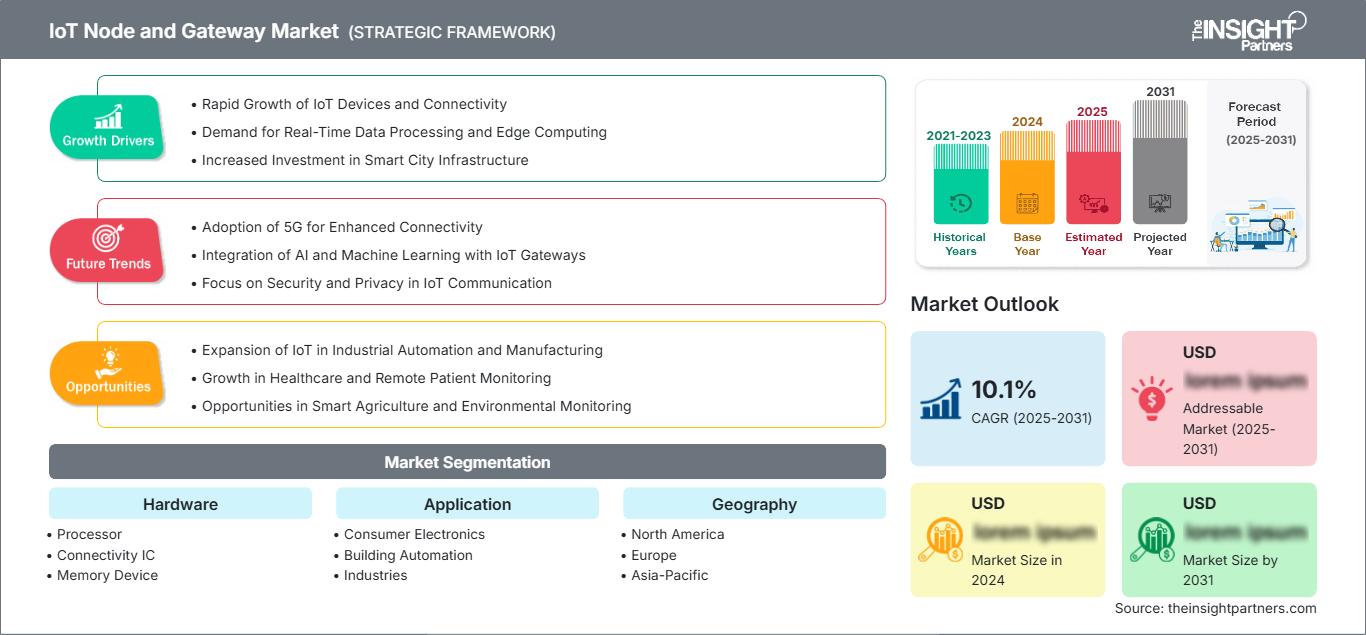
Regional Insights
North America IoT Node and Gateway Market
In North America, there was 31-33% IoT Node and Gateway Market Share in 2025, and this region will hold 12.8-13.6% CAGR during 2025-2034. The development of cloud computing platforms, industrial Ethernet adoption, investments made in private wireless networks, and advancement in cybersecurity further increase the demand for edge gateways. There is also a semiconductor program that ensures that the latest analog and connectivity chips are available in the region.
Gateways are used by utilities to control substations and renewable energy assets, and manufacturers link programmable controllers, robotics, and vision systems. Retailers and property managers rely more and more on consolidation of cameras, sensors, access control, and energy systems into managed edge systems. Purchases tend to prefer longevity of hardware, zero trust, over-the-air capabilities, and universal management.
U.S. IoT Node and Gateway Market
The United States made up 82% to 86% of North America's revenue in 2025 and will grow at a rate of 12.9% to 13.7% CAGR. Government programs for semiconductors, cloud capabilities, and automation channel adoption aid the growth. Manufacturers are refreshing plant networks, utilities are digitizing field assets, and retailers are using computer vision, e-shelving, and automated inventory.
Cisco Systems, Inc., Hewlett Packard Enterprise Company, Intel Corporation, Microchip Technology Incorporated, Texas Instruments Incorporated, and TE Connectivity Ltd. have significant engineering, channel, or customer presence. The applications demand is focused increasingly on inference at edge, secure remote access, predictive maintenance, and energy management. Buyers prefer modular gateways that can include 5G, Wi-Fi, Ethernet, and serial interfaces without rebuilding the entire infrastructure.
Europe IoT Node and Gateway Market
In 2025, Europe was projected to have a 24-26% market share with a projected 12.4-13.2% CAGR. Germany has been leading due to its machinery, automotive, and process automation sectors. UK has been investing in smart building and logistic and retail applications. Regulations in Europe with respect to access to data and cybersecurity require the manufacturers of devices to make compatible, traceable, and upgradable connected products.
France is leading with its modernization of industry and energy management solutions; Italy is using gateways in its niche manufacturing and commercial buildings applications; and Spain is deploying smart infrastructure, renewable energy monitoring, and logistics. Europe’s fragmented base ensures that there will always be a demand for protocol conversion. Companies with multilingual capabilities, data residency options, and product longevity would be preferred by regulated companies and mid-tier manufacturers.
APAC IoT Node and Gateway Market
In 2025, the Asia-Pacific region accounted for a market share of 29-31% and will be expanding at a CAGR of 14.8-15.8%. Major competitors include China on account of its electronics industry manufacturing, industrial automation, and intelligent infrastructure development; Japan and South Korea because of robotics, quality assurance, and edge AI; and India, thanks to digital manufacturing, logistics, and utilities.
The Australian country is associated with mining and energy production, as well as remote asset management solutions. In-house electronics manufacturing, 5G deployment, and industrial digitization strategy will expand the market. The cost factor, certifications, cybersecurity, and diversity of connection requirements should be taken into account by vendors.
Middle East & Africa IoT Node and Gateway Market
The Middle East & Africa region is projected to achieve growth at 13.5%-14.5% CAGR. Saudi Arabia takes the lead through its efforts in building smart cities, industries, and energy sectors, whereas the UAE focuses on connected buildings, ports, logistics, and utilities. South Africa uses gateways in mining, electricity, security, and retail infrastructures.
Rest of MEA’s requirements include remote monitoring, water infrastructures, telecom towers, and distributed energy infrastructures. Tough environments call for ruggedized and low-power devices that can be used in cellular and satellite communication.
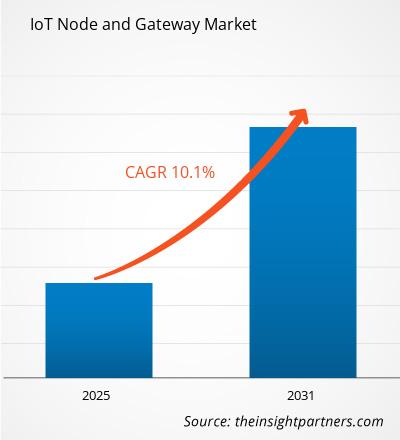
Segmentation Analysis
Hardware
Hardware holds 59–63% share in 2025 and is projected to grow at 12.7–13.5% CAGR during 2026–2034. The IoT Node and Gateway Market scope encompasses the compute, connectivity, memory, logic, and sensing foundation required for dependable edge operation. Integration reduces board area and power use, while industrial qualification, secure boot, and extended availability increasingly determine supplier selection.
- Processor: Processors anchor local analytics, protocol conversion, and edge AI. Demand favors scalable multicore designs with neural acceleration, low power consumption, deterministic control, and hardware security.
- Connectivity IC: Connectivity ICs enable Wi-Fi, Bluetooth, cellular, Ethernet, and low-power networking. Multiprotocol integration is strategically important because customers require flexible deployment and simplified certification.
- Memory Device: Memory devices support operating systems, buffering, data logging, and AI models. Industrial buyers prioritize endurance, temperature tolerance, supply continuity, and protection against unauthorized access.
- Logic Device: Logic devices provide timing, interface bridging, customization, and real-time control. Their strategic value rises where gateways must connect legacy equipment with modern processors and networks.
- Sensors: Sensors convert physical conditions into actionable data. Demand spans motion, pressure, temperature, position, imaging, and environmental monitoring, with calibration and low-power performance shaping design wins.
Application
Application revenue is projected to advance at 14.1–14.9% CAGR during 2026–2034 as organizations convert connected data into operational outcomes. Industries represent the largest and fastest-growing application, while consumer electronics supplies device volume. Building automation and retail create recurring opportunities for managed gateways that coordinate diverse sensors, enforce local policies, and connect installed systems with cloud applications.
- Consumer Electronics: Consumer electronics generate high node volumes through smart-home devices, appliances, wearables, and entertainment systems. Competition centers on cost, energy efficiency, interoperability, privacy, and seamless onboarding.
- Building Automation: Building automation connects HVAC, lighting, access, safety, and occupancy systems. Gateways are strategically important for energy optimization, protocol translation, tenant services, and compliance reporting.
- Industries: Industries account for 31–35% share in 2025 and are projected to grow at 15.0–16.0% CAGR. Predictive maintenance, machine vision, robotics, and asset tracking require resilient edge intelligence.
- Retail: Retail adoption spans inventory visibility, electronic labels, cold-chain monitoring, cameras, and checkout systems. Value depends on fleet management, cybersecurity, reliable connectivity, and measurable store-level productivity.
Opportunity Snapshot
| Application | Revenue Contribution | Trend Tag | Adoption Stage |
| Consumer Electronics | High | Matter Devices | Mature |
| Building Automation | Medium | Energy Orchestration | Scaling |
| Industries | High | Edge AI | Scaling |
| Retail | Medium | Store Intelligence | Scaling |
IoT Node and Gateway Market Growth Drivers and Impact Analysis
Edge Processing Becomes Operational Infrastructure
Telemetry processing near the machine has become more prevalent among businesses owing to the possibility of latencies, cost associated with bandwidth, and dependence on wide area connections in centralized systems. Nowadays, anomaly detection, protocol translation, data compression, and policy enforcement operations are done on gateways within the edge infrastructure. Purchasing trends are shifting towards the procurement of more valuable systems, which include multi-core processing, accelerators, secure memory, and robust networking. The real-world effects of these developments have been felt most in industries such as manufacturing facilities, utility companies, transportation companies, and other remote devices where time is critical. This is attributed to the increasing number of connected devices – 21.1 billion IoT devices in 2025.
Industrial Modernization Expands Connected Asset Coverage
Equipment manufacturers are integrating their controllers, motors, robots, cameras, and quality inspection systems into an interconnected system to optimize equipment use and maintenance scheduling. While the installed base is still diverse, there is continued need for gateways that provide interconnectivity for field buses, serial communications, industrial Ethernet, wireless communications, and cloud connectivity. There is much more economic impact than simply selling equipment because each piece of equipment will create opportunities for sensor equipment, connectivity ICs, memory, cybersecurity software, and service. Modernization projects frequently involve brownfield upgrades instead of replacing plants entirely; therefore, gateway technology with modular I/O capabilities and containerized functionality is preferred.
Connectivity and Security Converge at the Edge
Connectivity alone is not enough since 5G, Wi-Fi, Ethernet, Bluetooth, and low-power wide-area networks increase addressable use cases, but they also increase the surface of attacks and add to management complexity. Hence, the buyers demand gateways that include security features like secure boot, identity, encrypted storage, network segmentation, zero trust remote access, and signed updates built into the hardware-software stack. 5G coverage became available for more than half of the world population by 2025, making mobile and remote deployments more likely. This market impact is evident in the increased specification demands, accelerated replacement of unmanaged devices, and higher software attachment. The vendors can protect their margins by helping their clients mitigate operational risks.
IoT Node and Gateway Market Future Trends
Agentic Edge Systems Move from Detection to Action
IoT Node and Gateway Market trends will increasingly reflect gateways that coordinate sensing, reasoning, and actuation rather than merely forward data. Compact language and vision models will run locally, allowing systems to diagnose faults, prioritize alerts, and recommend or execute bounded responses. Adoption will depend on deterministic safeguards, explainable outputs, and human override mechanisms. Hardware road maps will emphasize neural processing, larger memory pools, and energy-efficient inference, while software vendors develop orchestration frameworks for mixed processor fleets. Successful platforms will combine model deployment, observability, policy control, and rollback, enabling industrial and building operators to scale autonomous functions without surrendering operational governance.
Software-Defined Connectivity Simplifies Heterogeneous Fleets
The future generation of gateways will be able to provide abstraction of the physical interfaces through centrally managed software profiles, which will make it possible to modify configuration for routing, segmentation, protocol services, and workload of applications without hardware modification. Such an approach will be valuable for multinational estates, where plants, shops, and buildings are operating through different carriers and legacy infrastructure. eSIM, 5G RedCap, Satellite IoT, and private convergent networks will make it possible to diversify connectivity solutions. The rivalry among suppliers will center around automation of policy management, telemetry, and integration into monitoring systems of enterprises. From a long-term perspective, standardization of APIs and portability of containers will become beneficial.
IoT Node and Gateway Market Opportunities
Build Vertical Gateway Blueprints for Brownfield Sites
Vendors can accelerate revenue by developing validated blueprints for high-friction environments such as legacy factories, substations, cold chains, and multivendor buildings. Each blueprint should combine specified sensors, processors, connectivity, protocol mappings, security controls, cloud connectors, and deployment services. The investment case is strongest when suppliers quantify installation time, avoided downtime, bandwidth savings, and maintenance outcomes. Channel certification and reusable configuration templates can turn one successful site into a repeatable multicountry program. Manufacturers should prioritize open APIs and replaceable communication modules so customers can modernize incrementally. Recurring revenue can follow through fleet management, security updates, analytics subscriptions, and lifecycle support contracts.
Localize Secure Hardware for High-Growth Regions
Asia Pacific, the Middle East, and selected African markets offer expansion potential for suppliers willing to localize certification, connectivity, environmental design, and support. Investment should focus on rugged gateways with flexible cellular bands, low-power operation, remote provisioning, and optional satellite backhaul. Regional assembly and second-source component strategies can shorten lead times and address public procurement preferences. Partnerships with telecom operators, utilities, automation distributors, and smart-infrastructure contractors provide access to projects that require integrated delivery. A tiered portfolio spanning basic protocol conversion to edge AI allows vendors to match purchasing power without fragmenting software. Local developer programs can further improve application relevance and customer retention.
Recent Developments
- April 2026: Milesight has launched the EG71 Building IoT Gateway, a new solution designed to simplify the integration of diverse building systems by bringing multiple wired and wireless communication protocols together in a single device. Smart buildings often rely on different systems that use protocols such as BACnet, Modbus, KNX, M-Bus, I/O, and LoRaWAN. Managing these separate technologies can require multiple gateways and protocol converters, adding complexity to system design and deployment.
- August 2026: PUSR has introduced six new industrial IoT products aimed at strengthening wireless communication, edge computing, long-range connectivity, and industrial data acquisition. The new portfolio is designed for applications ranging from factory automation and energy monitoring to mobile robotics, smart warehousing, and connected equipment.
- January 2025: SparkFun Electronics and Digi International have partnered to make the development and deployment of LoRaWAN-based IoT devices easier for engineers, developers, and system designers. The collaboration introduces the SparkFun IoT Node for LoRaWAN development board along with two regional SparkFun Digi X-ON Kits for LoRaWAN, designed for North American and European applications. The solutions aim to reduce the configuration and development effort typically associated with building connected LoRaWAN end devices.
Frequently Asked Questions

- Comprehensive Market Sizing and Forecast Analysis
- Detailed Segmentation Analysis
- In-Depth Market Dynamics Assessment
- Regional and Country-Level Insights
- Competitive Landscape and Company Benchmarking
- Strategic Business Intelligence
Recent Reports
Testimonials

The Insight Partners' SCADA System Market report is comprehensive, with valuable insights on current trends and future forecasts. The team was highly professional, responsive, and supportive throughout. We are very satisfied and highly recommend their services.
RAN KEDEM Partner, Reali Technologies LTDs
I requested a report on a very specific software market and the team produced the report in a few days. The information was very relevant and well presented. I then requested some changes and additions to the report. The team was again very responsive and I got the final report in less than a week.
JEAN-HERVE JENN Chairman, Future Analytica
We worked with The Insight Partners for an important market study and forecast. They gave us clear insights into opportunities and risks, which helped shape our plans. Their research was easy to use and based on solid data. It helped us make smart, confident decisions. We highly recommend them.
PIYUSH NAGPAL Sr. Vice President, High Beam Global
The Insight Partners delivered insightful, well-structured market research with strong domain expertise. Their team was professional and responsive throughout. The user-friendly website made accessing industry reports seamless. We highly recommend them for reliable, high-quality research services
YUKIHIKO ADACHI CEO, Deep Blue, LLC.
This is the first time I have purchased a market report from The Insight Partners.While I was unsure at first, I visited their web site and felt more comfortable to take the risk and purchase a market report.I am completely satisfied with the quality of the report and customer service. I had several questions and comments with the initial report, but after a couple of dialogs over email with their analyst I believe I have a report that I can use as input to our strategic planning process.Thank you so much for taking the extra time and making this a positive experience.I will definitely recommend your service to others and you will be my first call when we need further market data.
JOHN SUZUKI President and Chief Executive Officer, Board Director, BK Technologies
I wish to appreciate your support and the professionalism you displayed in the course of attending to my request for information regarding to infectious disease IVD market in Nigeria. I appreciate your patience, your guidance, and the fact that you were willing to offer a discount, which eventually made it possible for us to close a deal. I look forward to engaging The Insight Partners in the future, all thanks to the impression you have created in me as a result of this first encounter.
DR CHIJIOKE ONYIA MANAGING DIRECTOR, PineCrest Healthcare Ltd.Reason to Buy
- Informed Decision-Making
- Understanding Market Dynamics
- Competitive Analysis
- Identifying Emerging Markets
- Customer Insights
- Market Forecasts
- Risk Mitigation
- Boosting Operational Efficiency
- Strategic Planning
- Investment Justification
- Tracking Industry Innovations
- Aligning with Regulatory Trends





 Get Free Sample for