
Linear Motor Market Size, Share & Forecast by 2034
Coverage: by Axis (Single-axis, Multi-axis); Design (Flat-bed, Cylindrical, U-Channel); Application (Industrial, Non-industrial); Industry Vertical (Aerospace and Defense, Agriculture, Automotive, Building and Construction, Electrical and Electronics, Food and Beverage, Textile, Others) , and Geography (North America, Europe, Asia Pacific, and South and Central America)
- Status : Data Released
- Report Code : TIPRE00005433
- Category : Electronics and Semiconductor
- No. of Pages : 150
- Available Report Formats :


- Last update date : September 29, 2026


2025 Market Size
US$ 1.85 Bn
Base year value
2034 Forecast
US$ 2.48 Bn
Projected by 2034
CAGR 2026-2034
3.74 %
Growth rate
Addressable Market
US$ 20.10 Bn
(2026-2034)
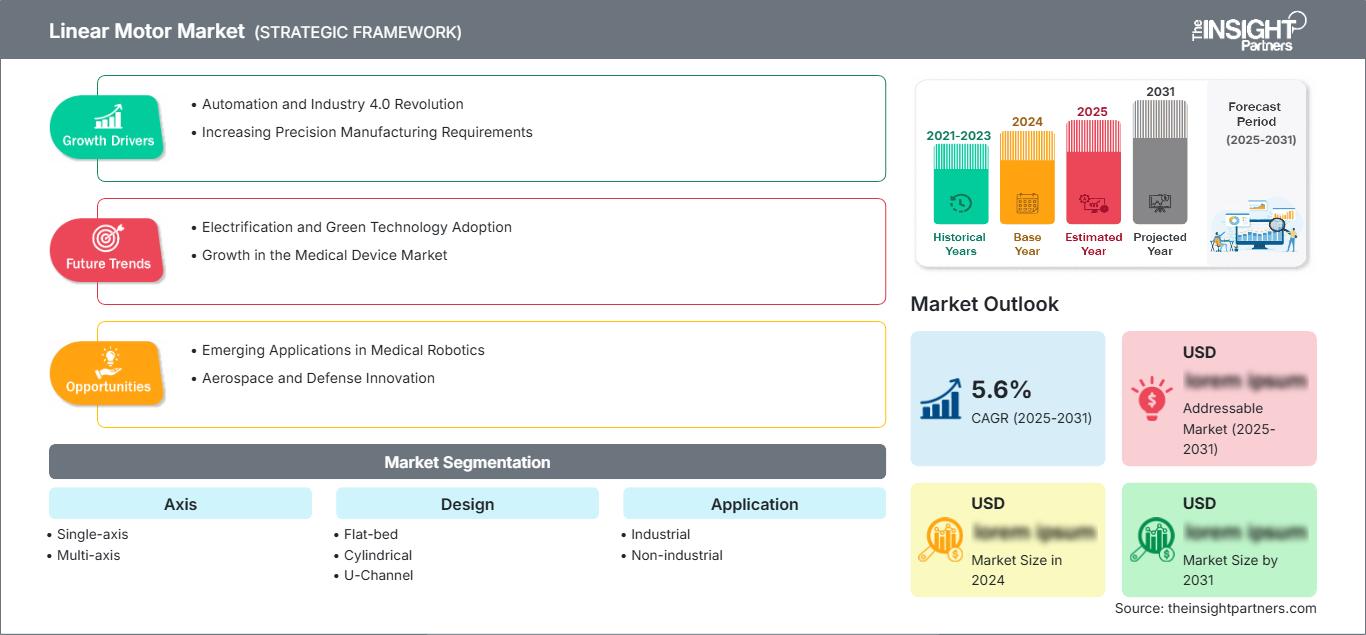
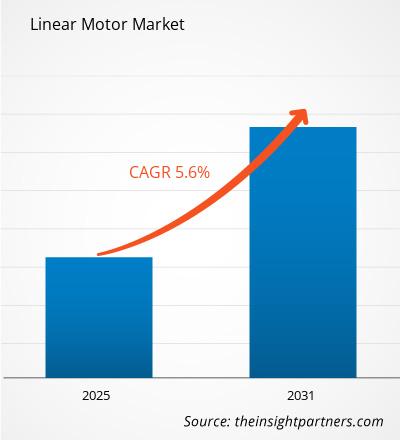
The linear motor market size was valued at US$ 1.85 Billion in 2025 and is projected to reach US$ 2.48 Billion by 2034, registering a CAGR of 3.74% during 2026–2034. The industry is shaped by increasing requirements for direct-drive motion, precise positioning, high acceleration, and repeatable automation across manufacturing, electronics, automotive, aerospace, and other industrial environments.
North America is supported by advanced automation infrastructure, semiconductor manufacturing, aerospace production, and continued investment in high-precision equipment. Demand is also reinforced by modernization of machine tools and robotics, while manufacturers increasingly evaluate direct-drive architectures to reduce mechanical transmission components and improve positioning performance in demanding production environments.
Linear Motor Market Assessment and Insights
- North America: North America represented an estimated 28–32% linear motor market share in 2025 and is expected to expand at a 4.20–4.60% CAGR during 2026–2034, supported by aerospace automation, semiconductor equipment, robotics, and advanced machine-tool investment.
- US: The US accounted for approximately 54–58% of North America in 2025 and is projected to grow at a 4.30–4.70% CAGR during 2026–2034, led by automation-intensive manufacturing and precision engineering.
- Europe: Europe held an estimated 24–28% share in 2025, with a 3.50–3.90% CAGR during 2026–2034. Germany, France, Italy, and the UK remain important contributors because of machine tools, automotive automation, aerospace, and industrial engineering.
- Asia Pacific: Asia Pacific represented approximately 36–40% share in 2025 and is projected to register a 4.00–4.40% CAGR during 2026–2034, supported by China, Japan, South Korea, and India through electronics, automotive, robotics, and factory automation.
- Largest Segment: Industrial application held an estimated 62–66% market share in 2025 and is projected to grow at a 3.90–4.30% CAGR during 2026–2034, reflecting broad deployment in automated production.
- High Growth Segment: Multi-axis systems represented approximately 41–45% share in 2025 and are expected to grow at a 4.40–4.80% CAGR during 2026–2034, supported by complex positioning requirements.
- Key companies analyzed in detail: Aerotech Inc.; Danaher Corporation; ETEL S.A.; FANUC CORPORATION; Mitsubishi Electric Corporation; MOOG INC.; Panasonic Corporation; PiezoMotor; Rockwell Automation, Inc.; YASKAWA ELECTRIC CORPORATION.
Source: The Insight Partners' analysis based on proprietary research, government publications, company annual reports, investor presentations, industry databases, and expert interviews.
Technology in the linear motor market has evolved from specialty precision motion devices to become more integrated with digital control production systems. The direct drive design reduces several components of mechanical transmissions and allows fast acceleration, low backlash, and accurate positioning. Technological advances in magnetic circuit designs, cooling systems, encoders, servo drives, and controllers have extended applicability to machine tools, semiconductor processing equipment, robotics, inspection machines, and automation.
Linear motor market report suggests that there will be increasing use of the technology by manufacturers investing in flexible production, electronics assembly, semiconductor capacity, and inspection automation. The development of manufacturing hubs in India and Southeast Asia also offers opportunities, while the energy efficiency objective makes equipment manufacturers consider losses due to mechanical transmissions. The integration of linear motors with industrial Ethernet, closed loop feedback, predictive maintenance, and coordinated multiple axis control will become increasingly significant in equipment selection.
Linear Motor Market Report Scope
| Report Attribute | Details |
|---|---|
| Market size in 2025 | US$ 1.85 Billion |
| Market Size by 2034 | US$ 2.48 Billion |
| Global CAGR (2026 - 2034) | 3.74% |
| Historical Data | 2021-2024 |
| Forecast period | 2026-2034 |
Linear Motor Market Analysis
Demand in the linear motor market is mainly related to automation systems where there is need for high repeatability, fast acceleration, and accurate positioning. The supply chain comprises motor makers, magnetic component makers, encoders, servo-drive manufacturers, motion control makers, machine makers, systems integrators and OEMs. Clean and accurate motion is highly valued in semiconductor manufacturing equipment and electronics manufacturing industries, while throughput, stiffness and reduction in cycle time is highly valued in automotive and machine tool industries.
The supply side of the linear motor market continues to be driven by the availability of magnets, accuracy of manufacturing process, thermal considerations, and engineering expertise. Differentiation in this market is based not on the hardware aspects of the motor, but on the force density, stroke length, cooling design, encoder capability, and controller integration.
Competitive positioning in the linear motor market report depends on factors such as portfolio, integration of control system, geographic presence, and specialization in engineering. The companies such as Mitsubishi Electric Corporation, FANUC CORPORATION, YASKAWA ELECTRIC CORPORATION, and Rockwell Automation, Inc. have an advantage in their broad automation systems, whereas ETEL S.A., Aerotech Inc., PiezoMotor, and MOOG INC. focus more on specialization in precision motion. Danaher Corporation and Panasonic Corporation provide complementation through their automation and motion technology.
● REPORT CUSTOMIZATION
Tailor This Report To Align With Your Specific Business Requirements
This report can be customized to align precisely with your business objectives, scope, and target markets. Customization options include tailored segmentation, geography, competitive analysis, and strategic insights to support informed decision-making.
Customize This Report →WHAT YOU CAN ADJUST
- ● Segmentations
- ● Geography
- ● Competitive Analysis
- ● Language Preferences
Linear Motor Market: Strategic Insights
Regional Insights
North America linear motor market
North America is estimated to hold 28–32% linear motor market share in 2025 and is projected to grow at a 4.20–4.60% CAGR during 2026–2034. The US remains the principal contributor because semiconductor equipment, aerospace manufacturing, robotics, medical-device production, and advanced machine tools require increasingly accurate linear positioning. Industrial modernization is supporting replacement of mechanical transmission systems with direct-drive architectures.
Contributions from Canada include aerospace, automation, food processing, and advanced manufacturing applications. The trend in the region increasingly links the need for high throughput manufacture and automated inspection. In addition, the need to have compact motion platforms that run well on machines with small footprints while at the same time providing thermal stability and repeatability is increasingly important.
U.S. linear motor market Market
The US represented approximately 54–58% of North America in 2025 and is expected to grow at a 4.30–4.70% CAGR during 2026–2034. Aerospace, defense, semiconductor, electronics, automotive, and precision medical equipment are major application areas. Companies including Aerotech Inc., Danaher Corporation, MOOG INC., Rockwell Automation, Inc., and FANUC CORPORATION maintain relevant technology and automation capabilities.
Application trends are increasingly trending towards multi-axis positioning, rapid scanning, inspection automation, and direct drive machine designs. The development of domestic capacity for semiconductor manufacturing, along with advanced manufacturing equipment, has resulted in the need for equipment with better position control and reduced cycle time capabilities. There is also an experienced ecosystem of machine builders, integrators, controls specialists, and precision engineering firms in the United States.
Europe linear motor market Market
The linear motor market forecast shows that Europe is estimated at 24–28% share in 2025 and is projected to register a 3.50–3.90% CAGR during 2026–2034. Germany leads regional adoption, supported by machine tools, automotive production, industrial robotics, and precision engineering. The UK contributes through aerospace, advanced manufacturing, scientific equipment, and automation applications. France maintains demand from aerospace and industrial machinery, while Italy and Spain provide additional opportunities through automotive, packaging, food processing, and machine-building activities. Regional manufacturers increasingly evaluate energy consumption, machine footprint, and lifecycle efficiency when selecting motion architectures.
APAC linear motor market Market
APAC is estimated to account for 36–40% share in 2025 and is expected to grow at a 4.00–4.40% CAGR during 2026–2034. China leads regional demand, followed by Japan, South Korea, India, and Australia. Electronics, semiconductor equipment, automotive manufacturing, robotics, and factory automation are key applications. Government-backed manufacturing modernization and investment in electronics production are supporting demand for precise motion systems, particularly in high-throughput production environments.
Middle East & Africa linear motor market Market
Middle East and Africa is expected to register a 3.00–3.40% CAGR during 2026–2034, with Saudi Arabia and the UAE representing leading Middle Eastern opportunities and South Africa remaining an important African manufacturing center. Industrial diversification, infrastructure development, and automation investment are gradually expanding the addressable application base.
Energy-intensive industries, logistics, food processing, construction-related equipment, and emerging advanced-manufacturing initiatives provide opportunities. Saudi Arabia and the UAE benefit from investment in industrial modernization and technology-intensive infrastructure, while South Africa provides demand through mining-related equipment, manufacturing, and automated processing.
Segmentation Analysis
Axis
Axis configuration determines how effectively a motion platform can execute coordinated positioning tasks. Single-axis systems remain important for straightforward movement, while multi-axis architectures support synchronized positioning, complex trajectories, and higher equipment functionality. Demand is increasingly influenced by automation complexity, machine footprint, controller compatibility, and requirements for coordinated movement. The Axis segment is projected to expand at a 3.60–4.20% CAGR during 2026–2034.
- Single-axis: Single-axis systems remain important for dedicated positioning, transfer, inspection, and machine-tool functions where straightforward movement supports cost-effective equipment design.
- Multi-axis: Multi-axis configurations address synchronized motion requirements and are strategically important for robotics, semiconductor equipment, advanced machining, inspection, and complex automated production.
Design
Design selection influences force density, cooling, installation footprint, stroke configuration, and integration flexibility. Flat-bed designs serve applications requiring broad travel arrangements, cylindrical designs support compact configurations, and U-Channel architectures provide high force in space-constrained equipment. The Design segment is projected to grow at a 3.50–4.10% CAGR during 2026–2034, reflecting increasing specialization in equipment engineering.
- Flat-bed: Flat-bed designs support extended travel and machine-tool configurations where broad positioning surfaces, straightforward integration, and stable motion characteristics are important.
- Cylindrical: Cylindrical designs provide compact integration and are suitable for equipment where available installation space, controlled motion, and mechanical simplicity influence architecture.
- U-Channel: U-Channel designs provide compact direct-drive configurations with strong force density, making them important for precision positioning, handling, inspection, and space-constrained automation.
Application
Application requirements determine motor specifications because industrial equipment generally prioritizes throughput, durability, and continuous operation, whereas non-industrial equipment can place greater emphasis on compactness, smooth movement, and specialized positioning. The Application segment is expected to expand at a 3.70–4.30% CAGR during 2026–2034, supported by automation adoption across diverse equipment categories.
- Industrial: Industrial applications represent the dominant demand base because machine tools, semiconductor equipment, robotics, packaging, inspection, and automated production require accurate high-speed positioning.
- Non-industrial: Non-industrial applications include specialized laboratory, medical, research, and other equipment where smooth motion, compact design, and highly controlled positioning are strategically important.
Industry Vertical
Industry-specific requirements increasingly determine motor architecture, force capacity, travel, environmental protection, and control integration. Electronics and aerospace applications prioritize precision, while automotive and food processing emphasize throughput and repeatability. The Industry Vertical segment is projected to grow at a 3.80–4.40% CAGR during 2026–2034, supported by automation across production environments.
- Aerospace and Defense: High-precision positioning, inspection, testing, and manufacturing equipment create demand for motion systems capable of repeatable operation under stringent engineering requirements.
- Agriculture: Automation in sorting, processing, packaging, and controlled agricultural equipment creates opportunities for compact positioning systems with reliable repetitive movement.
- Automotive: Automated assembly, inspection, battery manufacturing, machining, and material handling support demand for high-speed and accurately coordinated linear motion.
- Building and Construction: Automated fabrication, cutting, positioning, and material-processing equipment provide opportunities where controlled linear movement improves repeatability and production consistency.
- Electrical and Electronics: Semiconductor, electronics assembly, inspection, and testing equipment require highly precise positioning, supporting strong adoption of advanced linear motion architectures.
- Food and Beverage: Packaging, filling, sorting, inspection, and handling systems increasingly require accurate movement while maintaining hygienic and space-efficient equipment designs.
- Textile: Automated textile processing, cutting, inspection, and material handling create demand for repeatable linear movement and responsive positioning systems.
Opportunity Snapshot
| Industry Vertical | Revenue Contribution (High/Medium/Low) | Trend Tag | Adoption Stage |
| Aerospace and Defense | Medium | Precision Motion | Scaling |
| Agriculture | Low | Smart Handling | Emerging |
| Automotive | High | Battery Automation | Mature |
| Building and Construction | Low | Automated Fabrication | Emerging |
| Electrical and Electronics | High | Precision Assembly | Mature |
| Food and Beverage | Medium | Hygienic Automation | Scaling |
| Textile | Medium | Automated Handling | Scaling |
| Others | Low | Specialized Motion | Emerging |
Linear Motor Market Growth Drivers and Impact Analysis
Industrial automation is increasing requirements for direct-drive precision
Industrial automation is moving toward shorter production cycles, greater machine flexibility, and tighter positioning tolerances. Linear motors directly generate translational movement and therefore remove several mechanical transmission elements that can introduce backlash, wear, or maintenance requirements. Their adoption can improve machine responsiveness where rapid acceleration and deceleration are important. The commercial impact extends beyond motor sales because implementation can influence servo drives, encoders, controllers, cooling systems, and machine architecture. Equipment manufacturers increasingly evaluate total machine performance rather than motor specifications alone. This encourages suppliers to develop integrated motion packages, application-specific configurations, and control compatibility. The result is a broader addressable opportunity across machine tools, robotics, inspection systems, electronics production, packaging, and semiconductor equipment where precision and throughput directly affect production economics.
Semiconductor and electronics manufacturing requires increasingly precise movement
Semiconductor and electronics production depends on positioning systems capable of executing repeatable movement at high speed while controlling vibration and thermal effects. Advanced inspection, wafer processing, packaging, lithography-related equipment, and electronics assembly can require motion architectures that maintain accuracy across repeated cycles. Linear motors are well suited to applications where direct-drive performance can reduce mechanical compliance and support rapid positioning. Increasing electronics manufacturing capacity across Asia, North America, and Europe creates additional equipment demand. The impact is strongest for suppliers that can provide compact motors, high-resolution feedback, thermal-management options, and compatible servo controls. Equipment OEMs also benefit from architecture flexibility because linear systems can be configured around application-specific travel and force requirements. This supports higher-value opportunities in precision equipment rather than only volume-oriented industrial applications.
Advanced robotics is expanding the addressable precision-motion requirement
Robotics is progressing toward higher speed, greater payload efficiency, and more sophisticated coordinated movement. Linear motors can complement rotary robotic architectures in transfer systems, gantry platforms, pick-and-place machines, inspection equipment, and specialized multi-axis cells. Their direct-drive configuration supports rapid movement without relying on conventional screw or belt transmission mechanisms. As manufacturers pursue flexible automation, the ability to synchronize several motion axes becomes increasingly important. This creates opportunities for multi-axis motor systems, high-resolution feedback, and integrated controllers. The impact also extends to system integrators, which can standardize motion platforms across multiple machine configurations. Suppliers capable of combining motors with software, diagnostics, and network connectivity can improve their competitive positioning. Adoption should therefore increasingly be assessed at the complete motion-system level rather than solely through individual motor specifications.
Linear Motor Market Future Trends
AI-assisted motion optimization will reshape system commissioning
AI-assisted motion control is expected to influence how linear systems are commissioned, monitored, and optimized. Instead of relying exclusively on fixed tuning parameters, future controllers can increasingly analyze vibration, load behavior, temperature, acceleration profiles, and positional errors to recommend adjustments. This approach could reduce commissioning time while improving repeatability across changing production conditions. Integration with digital twins may allow equipment designers to simulate motion performance before physical installation. Predictive diagnostics could also identify abnormal force patterns or thermal behavior before failures interrupt production. For suppliers, the competitive focus is likely to shift toward algorithms, sensor integration, software interfaces, and data handling alongside motor hardware. Customers may increasingly evaluate motion platforms according to measurable lifecycle performance, ease of tuning, and adaptability rather than only rated force or speed.
Compact high-force architectures will support machine miniaturization
Equipment designers are expected to pursue smaller machines without sacrificing throughput or positional accuracy. This trend favors linear motors with higher force density, compact magnetic circuits, improved thermal management, and flexible mounting arrangements. U-Channel and other space-efficient architectures are particularly relevant for compact automation, electronics assembly, inspection, laboratory equipment, and material handling. Active cooling and improved magnet utilization can allow manufacturers to increase continuous force within constrained footprints. As factories seek greater production density, machine builders may prioritize modular motion platforms that can be scaled across different equipment sizes. The opportunity extends to customized motor lengths, coil arrangements, magnetic tracks, and feedback configurations. Such customization can help OEMs optimize motion systems around specific machine geometries while avoiding unnecessary mechanical components and preserving access for maintenance.
Linear Motor Market Opportunities
Localized precision-motion supply chains can address regional equipment demand
Regional manufacturing expansion creates opportunities for suppliers to establish application engineering, integration, and service capabilities closer to equipment manufacturers. Asia Pacific remains a major production center, while North America and Europe are increasing investment in semiconductor, aerospace, electronics, and advanced industrial capacity. Local technical support can reduce qualification time and improve responsiveness during machine development. Suppliers can also benefit from regional partnerships with machine builders and system integrators that influence component selection. Investment opportunities include localized assembly, testing facilities, engineering centers, and application laboratories rather than only large-scale motor production. Such facilities can shorten development cycles and support customized force, stroke, cooling, and feedback configurations. Companies that combine global product platforms with region-specific engineering capabilities may be better positioned to capture specialized demand from rapidly developing manufacturing ecosystems.
Customized multi-axis platforms can unlock higher-value OEM applications
OEMs increasingly seek motion architectures tailored to machine geometry, cycle requirements, payload characteristics, and control platforms. Customized multi-axis solutions provide an opportunity to combine motors, encoders, drives, controllers, cooling systems, and software into validated assemblies. This can simplify machine development and reduce integration uncertainty for customers that lack extensive in-house motion engineering capabilities. Suppliers can differentiate through application-specific design, rapid prototyping, simulation, and lifecycle support. Opportunities are particularly relevant in semiconductor equipment, advanced inspection, aerospace manufacturing, photonics, robotics, and specialized medical machinery. Investment in modular engineering platforms can allow manufacturers to customize individual parameters without redesigning an entire product family. This approach may improve margins while strengthening customer relationships because motion performance becomes embedded within the machine architecture rather than treated as a replaceable component.
Frequently Asked Questions

- Comprehensive Market Sizing and Forecast Analysis
- Detailed Segmentation Analysis
- In-Depth Market Dynamics Assessment
- Regional and Country-Level Insights
- Competitive Landscape and Company Benchmarking
- Strategic Business Intelligence
Recent Reports
Testimonials

The Insight Partners provided valuable market intelligence that supported our global go-to-market strategy. Their team was professional, responsive, and attentive to our feedback, providing thoughtful analysis and helpful methodological clarifications throughout the project.
Junmo Kim Chief Financial Officer (CFO), Enertech Co., Ltd.
The Insight Partners' SCADA System Market report is comprehensive, with valuable insights on current trends and future forecasts. The team was highly professional, responsive, and supportive throughout. We are very satisfied and highly recommend their services.
RAN KEDEM Partner, Reali Technologies LTDs
I requested a report on a very specific software market and the team produced the report in a few days. The information was very relevant and well presented. I then requested some changes and additions to the report. The team was again very responsive and I got the final report in less than a week.
JEAN-HERVE JENN Chairman, Future Analytica
We worked with The Insight Partners for an important market study and forecast. They gave us clear insights into opportunities and risks, which helped shape our plans. Their research was easy to use and based on solid data. It helped us make smart, confident decisions. We highly recommend them.
PIYUSH NAGPAL Sr. Vice President, High Beam Global
The Insight Partners delivered insightful, well-structured market research with strong domain expertise. Their team was professional and responsive throughout. The user-friendly website made accessing industry reports seamless. We highly recommend them for reliable, high-quality research services
YUKIHIKO ADACHI CEO, Deep Blue, LLC.
This is the first time I have purchased a market report from The Insight Partners.While I was unsure at first, I visited their web site and felt more comfortable to take the risk and purchase a market report.I am completely satisfied with the quality of the report and customer service. I had several questions and comments with the initial report, but after a couple of dialogs over email with their analyst I believe I have a report that I can use as input to our strategic planning process.Thank you so much for taking the extra time and making this a positive experience.I will definitely recommend your service to others and you will be my first call when we need further market data.
JOHN SUZUKI President and Chief Executive Officer, Board Director, BK Technologies
I wish to appreciate your support and the professionalism you displayed in the course of attending to my request for information regarding to infectious disease IVD market in Nigeria. I appreciate your patience, your guidance, and the fact that you were willing to offer a discount, which eventually made it possible for us to close a deal. I look forward to engaging The Insight Partners in the future, all thanks to the impression you have created in me as a result of this first encounter.
DR CHIJIOKE ONYIA MANAGING DIRECTOR, PineCrest Healthcare Ltd.Reason to Buy
- Informed Decision-Making
- Understanding Market Dynamics
- Competitive Analysis
- Identifying Emerging Markets
- Customer Insights
- Market Forecasts
- Risk Mitigation
- Boosting Operational Efficiency
- Strategic Planning
- Investment Justification
- Tracking Industry Innovations
- Aligning with Regulatory Trends





 Get Free Sample for