
RF Test Equipment Market Size, Share & Demand by 2034
Coverage: By Type (Oscilloscopes, Spectrum Analyzers, Signal Connectors, Network Analyzers, and Others), Form (Rackmount, Benchtop, Portable, and Modular), Frequency Range (More than 6 GHz, 1 to 6 GHz, and Less than 1 GHz), End-user (Consumer Electronics, IT & Telecommunications, Industrial, Automotive, Research and Development, Aerospace and Defense, and Healthcare), and Geography
- Status : Data Released
- Report Code : TIPRE00003157
- Category : Electronics and Semiconductor
- No. of Pages : 150
- Available Report Formats :


- Last update date : September 17, 2026


2025 Market Size
US$ 3.33 Bn
Base year value
2034 Forecast
US$ 6.64 Bn
Projected by 2034
CAGR 2026-2034
7.97 %
Growth rate
Addressable Market
US$ 44.84 Bn
(2026-2034)
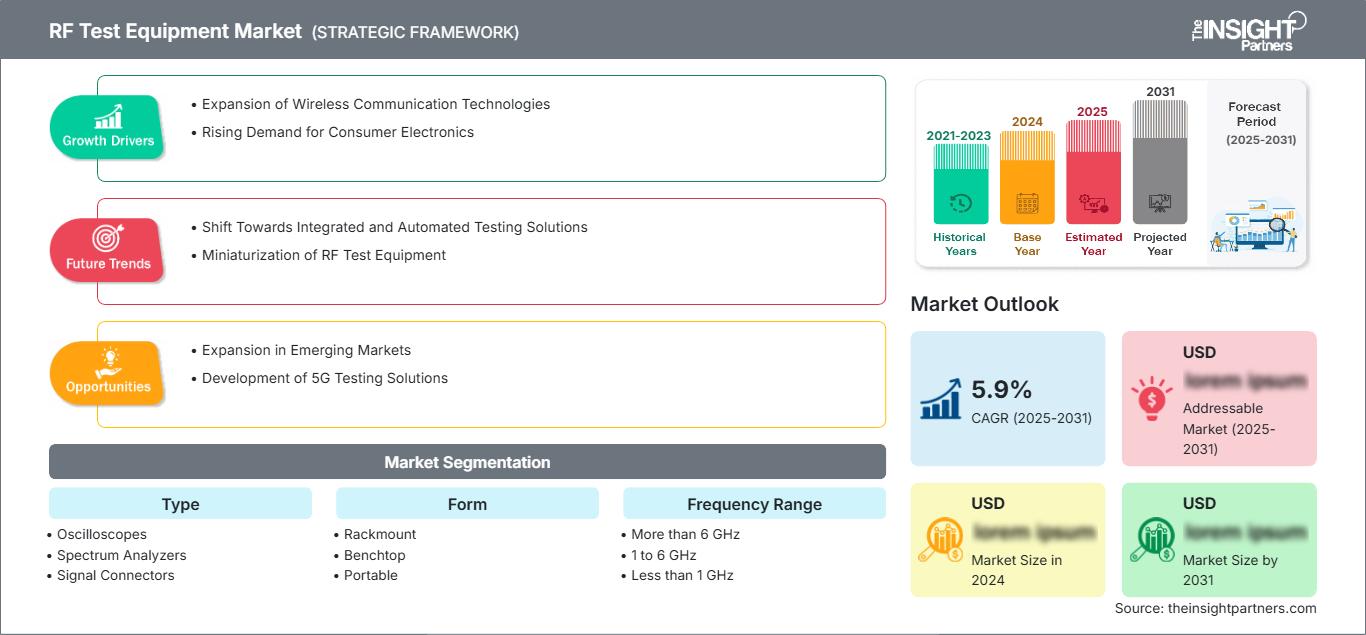
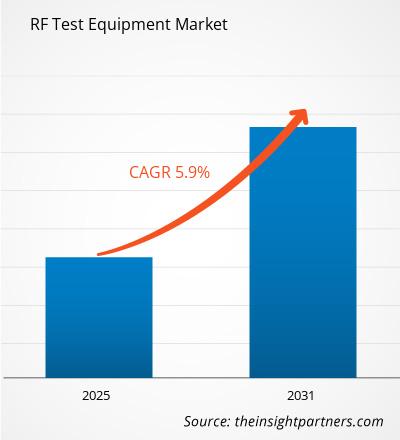
The rf test equipment market is positioned at the intersection of wireless connectivity, semiconductor validation, automotive electronics, industrial automation, and aerospace systems. The market is valued at US$ 3.33 Billion in 2025 and is projected to reach US$ 6.64 Billion by 2034, expanding at a CAGR of 7.97% during 2026–2034. Demand is increasingly shaped by wider bandwidths, higher operating frequencies, automated measurement, and more complex electronic architectures.
Across North America, the rf test equipment market size is expected to expand at an estimated CAGR of 7.2–8.1% between 2026–2034. Structural growth is supported by continued semiconductor and aerospace investment, 5G infrastructure modernization, defense electronics programs, and demand for automated validation. The region also benefits from established R&D ecosystems and strong adoption of modular instrumentation for high-frequency and multi-channel testing.
RF Test Equipment Market Assessment and Insights
- North America: The region is estimated to hold a 29–33% share in 2025 and grow at a CAGR of 7.2–8.1% between 2026–2034, supported by semiconductor, defense, telecom, and automotive electronics testing requirements.
- US: The US represents an estimated 78–82% share of North America's 2025 market and is expected to expand at a 7.3–8.2% CAGR through 2034, led by aerospace, semiconductor, and communications testing.
- Europe: Europe is estimated at a 22–26% share in 2025, growing at a 6.7–7.6% CAGR, with Germany, the UK, France, and Italy supported by automotive electronics, industrial automation, aerospace, and communications research.
- Asia Pacific: Asia Pacific is estimated to account for a 31–35% share in 2025 and grow at a 8.3–9.2% CAGR, led by China, Japan, South Korea, Taiwan, and India through electronics manufacturing and telecom expansion.
- Largest Segment: Oscilloscopes are estimated to hold a 30–34% market share in 2025, with a 7.1–8.0% CAGR between 2026–2034, reflecting broad adoption across electronics development and production.
- High Growth Segment: More than 6 GHz frequency equipment is estimated at a 24–28% market share in 2025 and is expected to grow at a 9.0–10.0% CAGR through 2034.
- Key companies analyzed in detail: Schneider Electric SE, Honeywell International Inc., ABB Ltd, Siemens AG, Legrand SA, Ingersoll Rand Inc., Qualcomm Incorporated, AlSense, Near Pte. Ltd., Assisted Living Technologies Inc.
Source: The Insight Partners' analysis based on proprietary research, government publications, company annual reports, investor presentations, industry databases, and expert interviews.
The rf test equipment market has evolved from standalone measurement instruments toward software-connected, high-bandwidth platforms capable of synchronizing multiple measurement functions. Increasingly, oscilloscopes, spectrum analyzers, and network analyzers are incorporating automated functionality, while modular designs are permitting scalable numbers of channels. Direct RF sampling, vector analysis, increased dynamic range, and improved calibration are reshaping laboratories and manufacturing facilities. Such advances permit engineers to analyze more sophisticated wireless, automotive, and semiconductor devices without having to increase test equipment accordingly.
During the forecast period, investments are predicted to be directed at portable and modular equipment, higher frequency analysis, and software-defined measurements. Manufacturing facilities for advanced electronics in India and Southeast Asia should help drive adoption, as well as advanced automotive electronics and satellite communications. Wireless coexistence, electromagnetic compatibility, and safety-critical electronics will add further requirements in regulatory testing.
RF Test Equipment Market Report Scope
| Report Attribute | Details |
|---|---|
| Market size in 2025 | US$ 3.33 Billion |
| Market Size by 2034 | US$ 6.64 Billion |
| Global CAGR (2026 - 2034) | 7.97% |
| Historical Data | 2021-2024 |
| Forecast period | 2026-2034 |
RF Test Equipment Market Analysis
Demand growth is being reinforced by increasing electronic content per vehicle, continued wireless infrastructure upgrades, and shorter semiconductor product cycles. The rf test equipment market growth is particularly influenced by requirements for repeatable measurements across signal integrity, modulation quality, spectrum occupancy, power, and network parameters. The supply chain includes instrumentation vendors, calibration houses, software firms, semiconductor firms, contract manufacturing houses, telcos, universities, and certification laboratories.
Supply chain factors are increasingly moving toward platforms that integrate hardware and measurement software/automation. Benchtop instruments continue to be relevant for use in engineering laboratories, but modular systems are becoming relevant where synchronization among multiple channels and programmed test sequences is needed. Availability of components, precision RF connectors, calibration standards, frequency standards, and high-speed converters continues to be relevant. Instrument vendors increasingly compete on the basis of performance, software, and services apart from hardware specifications.
Competitive positioning is fragmented across broad industrial automation groups, specialized electronics suppliers, and communications technology companies. The rf test equipment market analysis indicates that suppliers with software expertise can strengthen customer retention by integrating instruments with automated characterization and production workflows. Schneider Electric SE, Honeywell International Inc., ABB Ltd, and Siemens AG bring extensive industrial relationships, while Qualcomm Incorporated contributes deep wireless technology expertise.
Strategic investment is also moving toward higher-frequency instrumentation, automated testing, and application-specific platforms. Legrand SA and Ingersoll Rand Inc. have broader industrial portfolios, while AlSense, Near Pte. Ltd., and Assisted Living Technologies Inc. represent more specialized or adjacent technology exposure. The competitive landscape therefore remains diverse, with differentiation depending heavily on application relevance, engineering support, calibration capability, software integration, and geographic service coverage.
● REPORT CUSTOMIZATION
Tailor This Report To Align With Your Specific Business Requirements
This report can be customized to align precisely with your business objectives, scope, and target markets. Customization options include tailored segmentation, geography, competitive analysis, and strategic insights to support informed decision-making.
Customize This Report →WHAT YOU CAN ADJUST
- ● Segmentations
- ● Geography
- ● Competitive Analysis
- ● Language Preferences
RF Test Equipment Market: Strategic Insights
Regional Insights
North America rf test equipment market
North America is estimated to represent 29–33% of global rf test equipment market revenue in 2025 and is projected to grow at a 7.2–8.1% CAGR through 2034. The US controls the regional demand due to the fact that there is a need for characterization for semiconductor design, aerospace electronics, defense communication, automotive electronics, and wireless infrastructures. The contribution of Canada is through telecommunications, aerospace, and advanced electronics research. The region has good lab infrastructure to support advanced bench-top and modular systems.
Defense modernization and complexity in wireless systems are also driving the regional demand. Testing at high frequency, automation, electromagnetic compatibility, and validation of semiconductors are still important areas of procurement. The US-based tech firms and research organizations make up a mature customer base for such instrumentation, whereas the manufacturers look forward to systems that can go from lab validation to production test.
U.S. rf test equipment Market
The US is estimated to represent 78–82% of North America's 2025 rf test equipment market revenue and is expected to grow at a 7.3–8.2% CAGR through 2034. Demand is concentrated in semiconductor design, telecommunications, aerospace and defense, automotive electronics, and advanced research. Major technology ecosystems support continuous procurement of spectrum analyzers, oscilloscopes, network analyzers, signal generators, and modular platforms.
Application trends increasingly emphasize automated wireless validation, high-speed electronics, radar, satellite communications, and semiconductor characterization. Companies with broad industrial or electronics portfolios can participate through integrated solutions, although specialist instrumentation remains essential for precision measurements. The US also benefits from substantial university and government research activity, which supports demand for flexible laboratory equipment and higher-frequency measurement capabilities.
Europe rf test equipment market
Europe is estimated to hold a 22–26% of the rf test equipment market share in 2025 and is projected to expand at a 6.7–7.6% CAGR through 2034. Germany is the leading country, supported by automotive electronics, industrial automation, semiconductor research, and advanced manufacturing. The UK contributes through aerospace, defense, telecommunications, and university research, while France benefits from aerospace, defense electronics, and communications engineering.
German demand will be highly associated with radar technology applications, connected cars, industrial control, and semiconductor development. German companies have become more demanding when it comes to fast interface measurements, wireless systems, and quality assurance in the production process. The highly developed industrial base of the country makes demands for calibration, automated test systems, and modular instruments repeatable.
Additional sources of demand can come from France, Italy, and Spain via aerospace, automotive, industrial electronics, telecommunication, and research organizations. The increasingly growing impact on European procurement is due to energy saving, security, interoperability, and compliance issues. The market should stay diverse with Germany remaining a leader, while the UK will retain its strategic significance for aerospace, defense, and communications applications.
APAC rf test equipment market
APAC is estimated to account for 31–35% of 2025 rf test equipment market revenue and is expected to grow at an 8.3–9.2% CAGR through 2034. China leads regional demand, followed by Japan and South Korea. India and Australia add growth through telecom, defense, electronics manufacturing, semiconductor initiatives, and research programs. Expanding manufacturing capacity supports sustained instrumentation deployment.
China's electronics ecosystem creates substantial demand for production and validation equipment, while Japan and South Korea emphasize semiconductor, automotive, and communications applications. India is developing semiconductor and electronics capabilities, while Australia contributes through defense, telecommunications, and research. Industrial policy, localization programs, and 5G and advanced connectivity investment should reinforce regional demand.
Middle East & Africa rf test equipment Market
The Middle East and Africa rf test equipment market represents a smaller regional opportunity but is expected to expand at a 5.8–6.8% CAGR through 2034. Saudi Arabia leads regional demand, followed by the UAE and South Africa. Telecom modernization, smart infrastructure, defense electronics, energy digitization, and industrial automation create recurring testing requirements across communications and electronic systems.
Saudi Arabia and the UAE are investing in digital infrastructure and advanced communications, while South Africa provides a stronger research and industrial base. The rest of MEA remains dependent on telecom deployment, utilities, and infrastructure modernization. Demand should increasingly favor portable and automated systems that can support field validation alongside centralized laboratory testing.
Segmentation Analysis
Type
The Type segment is expected to expand at a 7.1–8.0% CAGR from 2026–2034. Oscilloscopes remain fundamental for time-domain and mixed-signal measurements, while spectrum and network analyzers address increasingly sophisticated RF characterization. Integration of software, automation, and wider bandwidths should support continued replacement and upgrade cycles across laboratories and manufacturing facilities. The RF test equipment market continues to benefit from rising demand for advanced measurement and validation solutions across wireless communications, aerospace, defense, semiconductor, and electronics manufacturing applications.
- Oscilloscopes: Widely deployed for waveform, timing, signal integrity, and mixed-signal analysis, oscilloscopes remain strategically important across electronics development, automotive systems, semiconductor validation, and production troubleshooting.
- Spectrum Analyzers: Increasing wireless complexity strengthens demand for instruments capable of detecting interference, measuring emissions, analyzing modulation, and characterizing wideband signals across advanced communication systems.
- Signal Connectors: Precision connectivity remains essential for maintaining measurement integrity, particularly where high-frequency signals, repeated test cycles, and stringent calibration requirements increase sensitivity to insertion loss and mechanical variation.
- Network Analyzers: Vector network analyzers are increasingly important for characterizing antennas, filters, RF front ends, and microwave components as engineers move toward higher frequencies and wider operating bandwidths.
Form
The Form segment is forecast to grow at a 7.4–8.3% CAGR during 2026–2034. Benchtop instruments retain strong laboratory relevance, while modular and portable architectures address automated production, field deployment, and space-constrained environments. Form-factor selection increasingly depends on channel density, portability, software integration, synchronization, and measurement throughput. The RF test equipment market is benefiting from growing demand for flexible and application-specific instrument architectures across research, manufacturing, and field-testing environments.
- Rackmount: Rackmount systems remain important for production environments requiring standardized installation, centralized control, thermal management, and repeatable integration with automated manufacturing infrastructure.
- Benchtop: Benchtop equipment continues to anchor engineering laboratories because it combines measurement capability, accessibility, and configuration flexibility for development, troubleshooting, characterization, and compliance testing.
- Portable: Portable systems serve field engineers and maintenance teams requiring spectrum, interference, and wireless measurements outside controlled laboratories, particularly across telecom infrastructure and distributed industrial installations.
- Modular: Modular systems provide scalable channel configurations, synchronization, and software control, making them strategically relevant for automated test environments and complex multi-device characterization.
Frequency Range
The Frequency Range segment is projected to expand at a 8.2–9.1% CAGR during 2026–2034. Demand is shifting toward broader bandwidths and higher-frequency measurements as wireless, radar, satellite, and automotive applications become more sophisticated. Instruments supporting scalable frequency extensions can address multiple development cycles and reduce equipment replacement pressure.
- More than 6 GHz: High-frequency equipment benefits from 5G expansion, radar development, satellite communications, Wi-Fi evolution, and emerging 6G research requiring broader bandwidth and increasingly precise RF characterization.
- 1 to 6 GHz: This range remains central to mainstream cellular, WLAN, industrial wireless, and consumer electronics testing, supporting substantial installed-base demand across development, certification, and manufacturing applications.
- Less than 1 GHz: Sub-GHz equipment remains relevant for industrial wireless, IoT, broadcast, utility communications, and low-frequency applications where long-range propagation and spectrum compliance are important.
End-user
The End-user segment is estimated to grow at a 7.5–8.5% CAGR through 2034. Consumer electronics and IT and telecommunications remain major users, while automotive, aerospace and defense, industrial applications, and research increasingly require advanced RF characterization. The rf test equipment market scope is therefore broadening as electronics become embedded across more physical systems.
- Consumer Electronics: Smartphone, wearable, WLAN, Bluetooth, and connected-device development requires repeatable RF validation, interoperability testing, and production characterization across compact device architectures.
- IT & Telecommunications: Network infrastructure, wireless devices, data connectivity, and emerging non-terrestrial systems require spectrum, signal, and protocol-related measurements across development and deployment stages.
- Industrial: Industrial automation, connected machinery, sensors, and private wireless networks create demand for reliable RF characterization and field validation in increasingly connected production environments.
- Automotive: Connected vehicles, radar, V2X, infotainment, and electronic control systems increase the need for RF validation throughout vehicle development and component qualification.
- Research and Development: Universities, laboratories, and corporate research centers require flexible instrumentation capable of supporting experimental architectures, new frequencies, and advanced communication research.
- Aerospace and Defense: Radar, electronic warfare, satellite communications, avionics, and secure communications require precision testing across challenging frequency ranges and demanding environmental conditions.
- Healthcare: Wireless medical devices, monitoring equipment, imaging systems, and connected healthcare infrastructure require controlled RF testing to support reliability, interoperability, and regulatory compliance.
Opportunity Snapshot
| End-user | Revenue Contribution (High/Medium/Low) | Trend Tag (MAX 2 words) | Adoption Stage |
| Consumer Electronics | High | Wireless Validation | Mature |
| IT & Telecommunications | High | 5G Testing | Mature |
| Industrial | Medium | Private Wireless | Scaling |
| Automotive | High | Radar Validation | Scaling |
| Research and Development | Medium | 6G Research | Scaling |
| Aerospace and Defense | Medium | Radar Testing | Scaling |
| Healthcare | Low | Medical Wireless | Emerging |
RF Test Equipment Market Growth Drivers and Impact Analysis
Expansion of High-Bandwidth Wireless Technologies
Increased bandwidth usage as well as the complexity of the modulated signal, are making higher demands on measurement equipment. Engineers have to make measurements of signal quality, error vector magnitude, phase noise, spurious emissions, and coexistence at larger bandwidths. This translates to increased need for spectrum analyzers, oscilloscopes and vector measuring equipment that is able to deal with higher frequencies and amounts of data. Wi-Fi advancements, next-generation cellular, radar and satellite communications are adding to the scope of applications where advanced RF testing becomes necessary. The result of this is the increasing trend towards instruments with faster acquisition capabilities, enhanced analysis features and automation of procedures. Instruments that combine hardware and software tailored for a specific application become more important as they allow faster and repeatable measurements.
Rising Electronic Content in Automotive Platforms
Vehicle architectures are moving towards the incorporation of connectivity, radar, wireless diagnostics, infotainment, V2X communications, and several electronic control systems. Each system presents validation challenges on electromagnetic compatibility, RF performance, signal integrity, and interoperability issues. The consequence is an expanded testing requirement not only at the engineering stage but also for system integration and quality assurance during manufacturing. Vehicle makers and suppliers need tools that provide consistent testing through different development stages without causing disconnected testing cycles. This factor drives the use of automated test fixtures, instrument controls through software, and synchronized measurement. As vehicle platforms are becoming more software-defined, it becomes necessary to capture, correlate, and store the test data through different lifecycle phases.
Increasing Semiconductor and Electronic Manufacturing Complexity
New generations of semiconductor technology require more complex characterization due to the greater density of transistors, higher speeds, heterogeneous integration, and radio frequencies that become sources of additional performance variations. Semiconductor producers and electronic device manufacturers need to ensure validation of devices through temperature, voltage, frequency, and signal measurements while still achieving throughput on the production line. There is thus a need for automated test systems that will be characterized by accuracy, repeatability of measurements, and a scalable number of channels. The implications are seen throughout the process of choosing test systems because manufacturers not only consider price but also time spent on testing, software compatibility, calibration, and maintenance. Increased complexity leads to better cooperation between producers of measuring instruments, semiconductor designers, and manufacturing companies.
RF Test Equipment Market Future Trends
Software-Defined and AI-Assisted Measurement Workflows
The rf test equipment market trends increasingly point toward software-defined instrumentation in which measurement hardware becomes a configurable foundation for multiple applications. Anomalies can be detected with machine learning in future systems, which would automate measurements, classify signals, and analyze results. Rather than using separate measuring equipment, engineers can use software environments to manage the synchronization of the measurement processes. Engineers can also create digital twins and virtual test environments to save physical trials as well, since the engineers will be able to design the expected behavior before testing in the laboratory environment. This process should lead to efficient usage of expensive measuring equipment and a reduction of repetitive manual tasks. AI-driven processes may prove very helpful in production when engineers need to spot deviations, but still require human decision-making.
Higher-Frequency Instrumentation for Emerging Connectivity
Future demand will increasingly extend beyond conventional cellular frequencies as 6G research, advanced radar, satellite communications, sensing, and high-speed interconnects move toward higher-frequency operation. Measurement platforms will therefore require broader instantaneous bandwidth, lower phase noise, improved dynamic range, and more sophisticated calibration methods. Frequency extension technologies can allow existing instrument architectures to cover new bands without complete equipment replacement. This supports investment flexibility for research organizations and manufacturers operating across multiple technology generations. The transition also increases the importance of high-quality probes, connectors, cables, and reference standards because measurement uncertainty becomes more difficult to control at higher frequencies. Suppliers capable of offering complete measurement ecosystems should therefore gain greater relevance as customers seek consistent performance from signal generation through final characterization.
RF Test Equipment Market Opportunities
Expansion of Test Infrastructure in Emerging Electronics Hubs
Emerging electronics manufacturing centers create an opportunity for suppliers to establish localized application engineering, calibration, and service capabilities. India, Southeast Asia, and selected Middle Eastern economies are increasing electronics production and digital infrastructure investment, creating new requirements for development and production validation. Suppliers can address these markets through modular systems, portable instruments, training programs, and regional service centers rather than relying solely on high-cost centralized laboratory deployments. The rf test equipment market Forecasts indicate that geographically distributed electronics production will encourage customers to standardize test platforms across multiple facilities. Vendors that provide common software environments and interchangeable instrumentation can simplify workforce training and data comparison. Such strategies can also support recurring revenue from calibration, software upgrades, maintenance, and application-specific modules.
Integrated Test Platforms for Automotive and Defense Electronics
A second opportunity lies in integrated platforms that combine RF, digital, power, and environmental measurements within coordinated test workflows. Automotive radar, connected vehicles, aerospace systems, and defense electronics increasingly contain multiple interacting technologies, making isolated measurement processes inefficient. Equipment suppliers can develop synchronized architectures that reduce fixture changes, automate measurement sequencing, and maintain traceable results across engineering teams. The opportunity is particularly relevant for organizations seeking shorter development cycles while preserving stringent quality controls. Platforms that support both laboratory characterization and production deployment can strengthen customer relationships because measurement methods remain consistent as products move toward commercialization. Integration with enterprise data systems can further improve traceability, enabling manufacturers to connect test results with quality management, failure analysis, and lifecycle engineering processes.
Frequently Asked Questions

- Comprehensive Market Sizing and Forecast Analysis
- Detailed Segmentation Analysis
- In-Depth Market Dynamics Assessment
- Regional and Country-Level Insights
- Competitive Landscape and Company Benchmarking
- Strategic Business Intelligence
Recent Reports
Testimonials

The Insight Partners' SCADA System Market report is comprehensive, with valuable insights on current trends and future forecasts. The team was highly professional, responsive, and supportive throughout. We are very satisfied and highly recommend their services.
RAN KEDEM Partner, Reali Technologies LTDs
I requested a report on a very specific software market and the team produced the report in a few days. The information was very relevant and well presented. I then requested some changes and additions to the report. The team was again very responsive and I got the final report in less than a week.
JEAN-HERVE JENN Chairman, Future Analytica
We worked with The Insight Partners for an important market study and forecast. They gave us clear insights into opportunities and risks, which helped shape our plans. Their research was easy to use and based on solid data. It helped us make smart, confident decisions. We highly recommend them.
PIYUSH NAGPAL Sr. Vice President, High Beam Global
The Insight Partners delivered insightful, well-structured market research with strong domain expertise. Their team was professional and responsive throughout. The user-friendly website made accessing industry reports seamless. We highly recommend them for reliable, high-quality research services
YUKIHIKO ADACHI CEO, Deep Blue, LLC.
This is the first time I have purchased a market report from The Insight Partners.While I was unsure at first, I visited their web site and felt more comfortable to take the risk and purchase a market report.I am completely satisfied with the quality of the report and customer service. I had several questions and comments with the initial report, but after a couple of dialogs over email with their analyst I believe I have a report that I can use as input to our strategic planning process.Thank you so much for taking the extra time and making this a positive experience.I will definitely recommend your service to others and you will be my first call when we need further market data.
JOHN SUZUKI President and Chief Executive Officer, Board Director, BK Technologies
I wish to appreciate your support and the professionalism you displayed in the course of attending to my request for information regarding to infectious disease IVD market in Nigeria. I appreciate your patience, your guidance, and the fact that you were willing to offer a discount, which eventually made it possible for us to close a deal. I look forward to engaging The Insight Partners in the future, all thanks to the impression you have created in me as a result of this first encounter.
DR CHIJIOKE ONYIA MANAGING DIRECTOR, PineCrest Healthcare Ltd.Reason to Buy
- Informed Decision-Making
- Understanding Market Dynamics
- Competitive Analysis
- Identifying Emerging Markets
- Customer Insights
- Market Forecasts
- Risk Mitigation
- Boosting Operational Efficiency
- Strategic Planning
- Investment Justification
- Tracking Industry Innovations
- Aligning with Regulatory Trends





 Get Free Sample for