
Vacuum Capacitor Market Share, Size & Demand by 2034
Vacuum Capacitor Market Size and Forecasts (2021–2034), Global and Regional Share, Trends, and Growth Opportunity Analysis Report Coverage : By Application (Radio Frequency Applications, Power Electronics, Telecommunications, Medical Equipment, Aerospace), Type (Glass Vacuum Capacitors, Ceramic Vacuum Capacitors, Metal Vacuum Capacitors, Polymer Vacuum Capacitors), Voltage Rating (Low Voltage, Medium Voltage, High Voltage, Ultra High Voltage), End Use Industry (Telecommunication, Aerospace, Defense, Medical, Industrial)
- Status : Data Released
- Report Code : TIPRE00039666
- Category : Electronics and Semiconductor
- No. of Pages : 150
- Available Report Formats :


- Last update date : September 15, 2026


2025 Market Size
US$ 759.26 Mn
Base year value
2034 Forecast
US$ 1,089.55 Mn
Projected by 2034
CAGR 2026-2034
4.09 %
Growth rate
Addressable Market
US$ 8,394.63 Mn
(2026-2034)
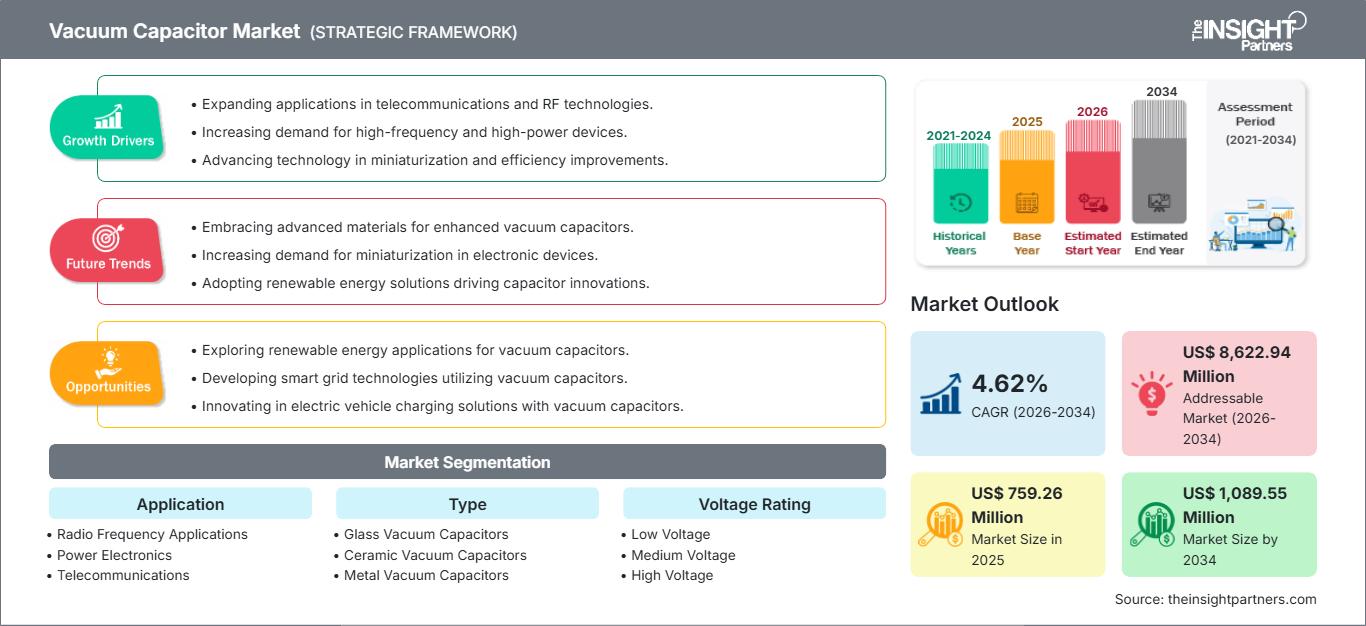
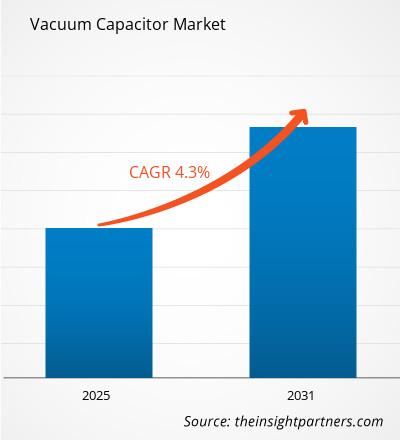
The Vacuum Capacitor market was valued at US$ 759.26 million in 2025 and is expected to reach US$ 1089.55 million by 2034; it is estimated to record a CAGR of 4.09% during 2026-2034.
Vacuum Capacitor Market Assessment and Insights
- North America accounts for an estimated 29–33% share in 2025 and is projected to grow at a CAGR of 4.9–5.6% between 2026–2034, supported by semiconductor equipment, defense electronics, RF infrastructure, and medical technology investments.
- US represents approximately 74–78% of North American demand in 2025 and is expected to grow at a CAGR of 4.8–5.5% during 2026–2034.
- Europe holds an estimated 25–29% share in 2025 and is forecast to expand at a CAGR of 4.2–4.8% through 2034, with Germany, the UK, France, Italy, and Spain supporting industrial and aerospace applications.
- Asia Pacific represents approximately 30–34% of global demand in 2025 and is projected to record a CAGR of 5.0–5.8% during 2026–2034, led by China, Japan, South Korea, and India.
- Largest Segment: is estimated to hold a 34–38% market share in 2025 and expand at a CAGR of 4.8–5.4% through 2034, reflecting the importance of RF applications requiring high-current, low-loss components.
- High Growth Segment: is estimated at a 10–14% share in 2025 and is expected to expand at a CAGR of 6.0–6.8%, driven by aerospace requirements for compact, reliable, high-voltage RF assemblies.
- Key companies analyzed in detail: Vishay Intertechnology, Inc.; Rosenberger Hochfrequenztechnik GmbH & Co. KG; Hammond Power Solutions Inc.; Nippon Chemi-Con Corporation; WIMA GmbH & Co. KG; Cornell Dubilier Electronics, Inc.; KYOCERA AVX Components Corporation; TE Connectivity Ltd.; LCR Electronics, Inc.; Maxwell Technologies, Inc.
Source: The Insight Partners' analysis based on proprietary research, government publications, company annual reports, investor presentations, industry databases, and expert interviews.
From the traditional use in high voltage tuning and broadcasting to the newer roles in RF matching, plasma treatment, semiconductor devices, and power electronics, the industry has moved. The development in ceramic insulation, electrodes, bellows, heat dissipation, and motorized adjustments has resulted in greater reliability at high frequencies and currents. The manufacturing trend is toward application-specific products, while weighing standardized platforms against customized capacitance, voltages, cooling systems, and drives.
In the forecast period, investments will be made for compact design, higher current handling capacity, heat dissipation, and digitally controlled variable capacitors. New semiconductor fabrication centers in Asia, defense electronics projects, and communication infrastructures will enlarge the customer base. Regulatory emphasis on RoHS compliance and equipment efficiency will further encourage manufacturers to optimize materials, production processes, lifecycle reliability, and product documentation, according to the Vacuum Capacitor Market report.
Vacuum Capacitor Market Report Scope
| Report Attribute | Details |
|---|---|
| Market size in 2025 | US$ 759.26 Million |
| Market Size by 2034 | US$ 1,089.55 Million |
| Global CAGR (2026 - 2034) | 4.09% |
| Historical Data | 2021-2024 |
| Forecast period | 2026-2034 |
Vacuum Capacitor Market Analysis
The demand comes from fields where traditional dielectric capacitors exhibit restrictions due to issues associated with dielectric heating, voltage stress, and RF losses. Impedance matching is needed for semiconductor plasma tools, while stable tuning and coupling are important for broadcasting and telecommunication operations. Furthermore, aerospace and military electronics have additional restrictions, such as vibration resistance, consistent electrical performance, and long operational life. This leads to forming a value chain for materials suppliers, machining firms, vacuum processes specialists, capacitor producers, equipment integrators, and users.
Supply dynamics are shaped by specialized manufacturing know-how rather than commodity-scale production. Critical capabilities include vacuum sealing, electrode conditioning, ceramic processing, bellows fabrication, high-voltage testing, and RF characterization. Long qualification cycles can make supplier changes difficult after a component is integrated into equipment. Consequently, customers often evaluate total lifecycle performance, serviceability, dimensional compatibility, and delivery reliability alongside purchase price, creating barriers to entry for manufacturers without established application engineering capabilities, according to the Vacuum Capacitor Market forecast.
Positioning within the industry becomes more dependent upon the breadth of product line and integration of capacitors in RF power-delivery technology. Integrated systems based on the comet design compete against individual components manufacturers, offering a combination of variable capacitors, drives and matching. Within the overall competition field, Vishay Intertechnology, Cornell Dubilier Electronics, KYOCERA AVX Components Corporation, WIMA, TE Connectivity, and Nippon Chemi-Con offer high-performance capacitor know-how, complemented by component suppliers offering customized high voltage solutions.
Investments become more focused on automation, ceramics, cooling and application engineering. Rosenberger Hochfrequenztechnik GmbH & Co. KG can offer interconnection RF know-how, while Hammond Power Solutions Inc. offers power-electronic engineering expertise. LCR Electronics, Inc. and Maxwell Technologies, Inc. offer additional specialist know-how but have broader product lines beyond vacuum components. Thus, differentiation becomes based upon technical specialization, qualification services, geography coverage and customization capabilities without impacting production consistency.
● REPORT CUSTOMIZATION
Tailor This Report To Align With Your Specific Business Requirements
This report can be customized to align precisely with your business objectives, scope, and target markets. Customization options include tailored segmentation, geography, competitive analysis, and strategic insights to support informed decision-making.
Customize This Report →WHAT YOU CAN ADJUST
- ● Segmentations
- ● Geography
- ● Competitive Analysis
- ● Language Preferences
Vacuum Capacitor Market: Strategic Insights
Regional Insights
North America vacuum capacitor market
North America is estimated to hold 29–33% of global vacuum capacitor market demand in 2025 and is projected to expand at a CAGR of 4.9–5.6% during 2026–2034. The United States dominates regional consumption because semiconductor equipment, defense electronics, broadcast systems, and medical imaging require components capable of sustaining demanding RF and high-voltage conditions. Semiconductor fabrication investments are particularly important because plasma etching and deposition equipment use precision matching networks where capacitor stability directly affects process repeatability.
Canadian participation includes contributions in industrial electronics, scientific instruments, and communications facilities, whereas the United States provides most of the region’s engineering capability via manufacturers and distributors. Modernization of defense equipment continues to provide impetus for RF equipment, radar, EW equipment, and high-power transmitters. The replacement market prefers proven, qualified products, whereas new equipment places emphasis on small size, automatic tuning, and thermal considerations. This will enable steady regional growth without necessitating a significant boost in unit quantities.
U.S. vacuum capacitor Market
The US represents approximately 74–78% of North American vacuum capacitor market demand in 2025 and is expected to expand at a CAGR of 4.8–5.5% through 2034. The country's demand base combines semiconductor manufacturing, telecommunications, aerospace, defense, medical equipment, and industrial RF systems.
Future trends in the application include the need for higher frequency matching, motorized tuning, miniature form factors, and more efficient cooling systems. Both local and foreign manufacturers are connected with the equipment makers, enabling their qualification criteria to affect buying decisions. Defense electronics requires high-voltage, high-reliability setups, whereas the semiconductor factories require controlled impedance setups. Medical devices create lesser but technologically complex demands. The industry is thus diverse in its applications, with replacement cycles and equipment programs being supplementary drivers of demand.
Europe vacuum capacitor Market
Europe is estimated to account for 25–29% of global vacuum capacitor market demand in 2025 and is projected to grow at a CAGR of 4.2–4.8% through 2034. Germany leads the pack with industrial electronics, semiconductor equipment, automotive engineering, and manufacturing. The UK provides support from aerospace, defense, communications, and instrumentation industries. France has strong aerospace and defense sectors, while Italy and Spain add with industrial automation, telecommunication, energy systems, and electronics. The focus in Europe on procurement now includes reliability throughout the product life cycle, conformity, energy efficiency, and supplier traceability. In addition, customization of configuration is important in Europe due to relatively low production volumes and high technical demands.
The German industrial base provides precision RF systems, semiconductor equipment, and power electronics. The UK receives a boost from defense and aerospace activities. France relies on its military electronics and aircraft manufacturing, while Italy and Spain provide additional demand in industrial and communication sectors where the equipment must function properly under high frequencies and tough conditions.
APAC vacuum capacitor Market
APAC is estimated to represent 30–34% of the global vacuum capacitor market demand in 2025 and is forecast to grow at a CAGR of 5.0–5.8% through 2034. China is the leading market, followed by Japan, South Korea, India, and Australia. Semiconductor capacity expansion, telecommunications infrastructure, industrial RF heating, and electronics manufacturing support regional consumption.
Manufacturing capacity in China will help increase local demand. Japan focuses on precision semiconductor equipment, South Korea gets the advantage of its advanced electronics manufacturing capability, India is developing its semiconductor and communications capability, and Australia is helping in terms of its defense, scientific, and industrial applications.
Middle East & Africa vacuum capacitor Market
The Middle East and Africa vacuum capacitor market demand is smaller but strategically relevant, with the region expected to record a CAGR of 3.6–4.2% through 2034. Saudi Arabia leads regional requirements through communications, industrial modernization, and infrastructure programs, while the UAE supports aerospace, defense, telecommunications, and advanced technology investments.
South Africa’s contributions come from the form of industrial electronics, mining equipment, communications, and scientific systems. The remaining MEA is fragmented and is driven by demand for infrastructure development, broadcast services, energy systems, and military procurement. Investments in digital connectivity and industrial diversification form a steady demand foundation for high-voltage and RF components despite the specialized manufacturing taking place elsewhere.
Segmentation Analysis
Application
Application is projected to expand at a CAGR of 4.6–5.2% during 2026–2034. Demand remains concentrated in RF-intensive equipment where low-loss performance and stable capacitance are essential. Semiconductor manufacturing, telecommunications, medical systems, and aerospace equipment broaden the addressable base, while specialized power electronics applications create incremental opportunities for high-voltage configurations and customized designs, reflecting key Vacuum Capacitor Market trends.
- Radio Frequency Applications: Remain strategically important because tuning, impedance matching, filtering, and RF power delivery require low-loss components capable of handling elevated currents and frequency-dependent stresses.
- Power Electronics: Demand is linked to high-voltage conversion, industrial heating, and power-conditioning architectures where component reliability and thermal stability influence system performance.
- Telecommunications: Adoption is supported by RF transmission equipment, broadcast systems, network infrastructure, and modernization programs requiring stable high-frequency electrical characteristics.
- Medical Equipment: Specialized imaging and therapeutic systems use high-voltage and RF components where reliability, repeatability, and low-loss operation are important.
- Aerospace: Aerospace electronics emphasize compactness, vibration tolerance, high-voltage capability, and predictable performance across demanding operating environments.
Type
Type is expected to register a CAGR of 4.3–5.0% during 2026–2034. Product selection depends on voltage, frequency, thermal conditions, mechanical requirements, and required capacitance adjustment. Ceramic-based construction is gaining technical importance because it supports compact, robust structures, while metal and polymer approaches serve specialized designs and system architectures within the Vacuum Capacitor Market.
- Glass Vacuum Capacitors: Support applications requiring established high-voltage insulation and proven vacuum construction, particularly in specialized RF and legacy equipment.
- Ceramic Vacuum Capacitors: Gain strategic importance where compact dimensions, thermal resistance, mechanical strength, and high-voltage performance must be combined.
- Metal Vacuum Capacitors: Address rugged RF environments where conductive electrode structures and mechanical durability are critical to long-term operation.
- Polymer Vacuum Capacitors: Serve niche configurations requiring specialized construction, insulation characteristics, and packaging flexibility within selected high-performance systems.
Voltage Rating
Voltage Rating is forecast to grow at a CAGR of 4.7–5.3% during 2026–2034. Demand is shifting toward higher ratings as RF generators, defense systems, industrial equipment, and specialized medical platforms operate at greater electrical stresses. Manufacturers must balance insulation strength with compact dimensions and thermal performance, contributing significantly to the Vacuum Capacitor Market share.
- Low Voltage: Supports compact electronic and RF configurations where moderate electrical stress allows smaller form factors and simpler system integration.
- Medium Voltage: Serves industrial and telecommunications equipment requiring higher voltage tolerance without the physical requirements associated with extreme high-voltage assemblies.
- High Voltage: Remains important for RF power systems, industrial heating, medical equipment, and defense electronics requiring dependable insulation and current handling.
- Ultra High Voltage: Represents specialized demand associated with demanding RF, scientific, aerospace, and high-energy applications where electrical reliability is prioritized over component cost.
End Use Industry
End Use Industry is projected to expand at a CAGR of 4.8–5.4% through 2034. Telecommunications and industrial users provide broad demand, while aerospace, defense, and medical sectors create technically demanding applications. Qualification requirements, lifecycle expectations, and customization needs strongly influence supplier selection.
- Telecommunication: Requires stable RF tuning, coupling, and transmission components as networks modernize and high-frequency infrastructure expands.
- Aerospace: Prioritizes compact, lightweight, high-reliability components capable of maintaining electrical performance under vibration and environmental stress.
- Defense: Uses specialized high-voltage and RF components in radar, communications, electronic warfare, and other mission-critical systems.
- Medical: Requires predictable high-voltage and RF behavior in imaging, treatment, and diagnostic equipment where component failure can interrupt system availability.
- Industrial: Covers RF heating, semiconductor equipment, plasma processing, power systems, and other manufacturing applications requiring robust electrical components.
Opportunity Snapshot
| End Use Industry | Revenue Contribution (High/Medium/Low) | Trend Tag (MAX 2 words) | Adoption Stage (Emerging/Scaling/Mature) |
| Telecommunication | High | RF Modernization | Mature |
| Aerospace | Medium | Avionics RF | Scaling |
| Defense | High | Radar Systems | Scaling |
| Medical | Medium | Imaging RF | Mature |
| Industrial | High | Plasma Processing | Scaling |
Vacuum Capacitor Market Growth Drivers and Impact Analysis
Semiconductor fabrication capacity expansion
The increase in advanced semiconductor manufacturing capacity results in an expansion of RF plasma processing equipment installations, thus generating a continuous need for matching components that can withstand repeated cycles. Etch, deposition, and other processes depend on a regulated RF power supply and thus require capacitor stability. Since there are increasing demands on the width of the process window for semiconductor manufacturers, there is an incentive for equipment manufacturers to develop faster matching, better heat management, and extended component life, which leads to a preference for capacitors designed for repeated tuning in high-current and high-frequency environments. It affects not only the procurement but also maintenance, replacement parts, engineering services, and qualification of the installed systems, which may result in a long-term relationship with suppliers whose products can provide both electrical characteristics and reliable logistics and engineering services.
Growth in high-frequency communications infrastructure
The modern communication network still needs RF systems that require more bandwidth, efficiency, and frequency stability. RF systems such as broadcast transmitters, satellite communications, special wireless communication systems, and military communication systems involve matching and tuning circuits in which loss reduction will lead to an improvement in electrical characteristics. Higher frequency will result in higher sensitivity to parasitic inductance, heat dissipation, and mechanical tolerance. Vacuum capacitor makers can cater to these challenges through optimized electrode configurations, compact designs, automatic tuning, and cooling. The commercial benefit will be applicable especially to equipment makers that want to lengthen the time interval between their maintenance and the predictability in tuning. There is still much room for replacement since the communications systems usually work for long periods.
Defense and aerospace electronics modernization
The need for components that can withstand various stresses comes from military/aerospace applications. Military/aerospace radar transmitters, high-power communication, electronic warfare systems, and specific navigation systems may use high-voltage RF components that should have controlled properties. Qualification history, availability, traceability, and failure prevention are normally given preference over the lowest acquisition cost in the procurement of such components. This provides good opportunities for established component manufacturers who have proven manufacturing control systems. Miniaturization will be encouraged by military/aerospace applications since the designers of equipment keep searching for a reduction in weight and size. So, vacuum capacitor manufacturers who enhance their components with respect to power density, heat rejection, and mechanical strength can be involved in system designs of high value.
Vacuum Capacitor Market Future Trends
Digitally controlled variable capacitor architectures
The digital approach is anticipated to play a larger role within variable capacitors as impedance matching requires quicker and more accurate performance. With the motorized approach, one is able to associate the process of impedance tuning with the computer control software of the equipment itself. This development is especially significant in semiconductor processing, where process reproducibility and rapid adaptation of equipment impact productivity. It appears that future developments in the field would include small drives, position sensing, mechanical accuracy, and standard interface communication. Digital integration in this context will help decrease the commissioning process of the system as well as provide equipment manufacturers with a flexible architecture of RF power delivery systems. Companies that have the capability of offering all components, including application engineering, will have the competitive edge since the designer will be able to reduce the complexity of the interface.
Advanced thermal management and compact power density
Future product development is expected to focus strongly on thermal management as RF equipment operates at higher power densities within increasingly compact equipment footprints. Conventional air cooling may be supplemented or replaced by hybrid approaches that combine conductive structures, airflow, and liquid cooling where appropriate. Better thermal control can reduce electrical drift, extend component life, and allow equipment designers to achieve higher output within fixed enclosure dimensions. Ceramic materials with strong thermal resistance and low dielectric loss are likely to receive greater engineering attention. Manufacturers may also optimize electrode geometry and internal inductance to reduce losses before heat is generated. These changes will favor suppliers capable of integrating materials engineering, vacuum processing, mechanical design, and RF testing. The result should be more application-specific products designed around complete equipment thermal constraints.
Vacuum Capacitor Market Opportunities
Localized manufacturing for Asian semiconductor ecosystems
Asia Pacific provides an attractive investment opportunity because semiconductor manufacturing, display production, electronics assembly, and RF equipment development are expanding across multiple countries. Localized production or regional technical centers can shorten delivery times, improve application support, and reduce qualification friction for equipment manufacturers. China, Japan, South Korea, and India present different demand profiles, allowing suppliers to balance mature semiconductor customers with emerging manufacturing programs. Investment priorities should include precision vacuum processing, ceramic fabrication, automated testing, and local engineering capabilities. Partnerships with equipment manufacturers can further accelerate qualification because application-specific capacitance, current, voltage, and drive requirements are often established during system development. Companies entering the region can also differentiate through maintenance support and rapid replacement programs, which become increasingly valuable as installed equipment bases grow and production downtime becomes more expensive.
Customized high-voltage solutions for specialized equipment
Customization offers a distinct opportunity because aerospace, defense, medical, scientific, and industrial equipment often operates outside standardized electrical specifications. Buyers may require unusual capacitance ranges, voltage ratings, mechanical dimensions, cooling arrangements, or drive configurations. Suppliers capable of translating system requirements into validated capacitor designs can command stronger customer relationships and reduce substitution risk. Investment in simulation, rapid prototyping, automated high-voltage testing, and modular manufacturing can shorten development cycles while preserving quality. The opportunity is particularly relevant for smaller production programs where standard catalog products may not satisfy equipment constraints. Over time, modular platforms can allow manufacturers to reuse validated subassemblies across several customer programs, improving production economics. This approach can also support aerospace and defense procurement where traceability, configuration control, and long-term product availability are important.
Frequently Asked Questions

- Comprehensive Market Sizing and Forecast Analysis
- Detailed Segmentation Analysis
- In-Depth Market Dynamics Assessment
- Regional and Country-Level Insights
- Competitive Landscape and Company Benchmarking
- Strategic Business Intelligence
Recent Reports
Testimonials

The Insight Partners provided valuable market intelligence that supported our global go-to-market strategy. Their team was professional, responsive, and attentive to our feedback, providing thoughtful analysis and helpful methodological clarifications throughout the project.
Junmo Kim Chief Financial Officer (CFO), Enertech Co., Ltd.
The Insight Partners' SCADA System Market report is comprehensive, with valuable insights on current trends and future forecasts. The team was highly professional, responsive, and supportive throughout. We are very satisfied and highly recommend their services.
RAN KEDEM Partner, Reali Technologies LTDs
I requested a report on a very specific software market and the team produced the report in a few days. The information was very relevant and well presented. I then requested some changes and additions to the report. The team was again very responsive and I got the final report in less than a week.
JEAN-HERVE JENN Chairman, Future Analytica
We worked with The Insight Partners for an important market study and forecast. They gave us clear insights into opportunities and risks, which helped shape our plans. Their research was easy to use and based on solid data. It helped us make smart, confident decisions. We highly recommend them.
PIYUSH NAGPAL Sr. Vice President, High Beam Global
The Insight Partners delivered insightful, well-structured market research with strong domain expertise. Their team was professional and responsive throughout. The user-friendly website made accessing industry reports seamless. We highly recommend them for reliable, high-quality research services
YUKIHIKO ADACHI CEO, Deep Blue, LLC.
This is the first time I have purchased a market report from The Insight Partners.While I was unsure at first, I visited their web site and felt more comfortable to take the risk and purchase a market report.I am completely satisfied with the quality of the report and customer service. I had several questions and comments with the initial report, but after a couple of dialogs over email with their analyst I believe I have a report that I can use as input to our strategic planning process.Thank you so much for taking the extra time and making this a positive experience.I will definitely recommend your service to others and you will be my first call when we need further market data.
JOHN SUZUKI President and Chief Executive Officer, Board Director, BK Technologies
I wish to appreciate your support and the professionalism you displayed in the course of attending to my request for information regarding to infectious disease IVD market in Nigeria. I appreciate your patience, your guidance, and the fact that you were willing to offer a discount, which eventually made it possible for us to close a deal. I look forward to engaging The Insight Partners in the future, all thanks to the impression you have created in me as a result of this first encounter.
DR CHIJIOKE ONYIA MANAGING DIRECTOR, PineCrest Healthcare Ltd.Reason to Buy
- Informed Decision-Making
- Understanding Market Dynamics
- Competitive Analysis
- Identifying Emerging Markets
- Customer Insights
- Market Forecasts
- Risk Mitigation
- Boosting Operational Efficiency
- Strategic Planning
- Investment Justification
- Tracking Industry Innovations
- Aligning with Regulatory Trends





 Get Free Sample for