
Vacuum Interrupter Market Trends, Size & Forecast by 2034
Coverage: By Rated Voltage (0-15 kV, 15-30 kV, Above 30 kV); Application (Contactor, Circuit Breaker, Load Break Switch, Recloser, Tap Changer, Others); End User (Oil and Gas, Transportation, Mining, Utilities, Others) , and Geography (North America, Europe, Asia Pacific, and South and Central America)
- Status : Data Released
- Report Code : TIPRE00006138
- Category : Electronics and Semiconductor
- No. of Pages : 150
- Available Report Formats :


- Last update date : September 15, 2026


2025 Market Size
US$ 2.47 Bn
Base year value
2034 Forecast
US$ 3.6 Bn
Projected by 2034
CAGR 2026-2034
4.27 %
Growth rate
Addressable Market
US$ 27.56 Bn
(2026-2034)
The global Vacuum Interrupter market was valued at US$ 2.47 billion in 2025 and is expected to reach US$ 3.6 billion by 2034; it is estimated to record a CAGR of 4.27% during 2026-2034.
Vacuum Interrupter Market Assessment and Insights
- North America: The region is estimated to hold 24–27% share in 2025 and grow at a CAGR of 4.4–4.9% during 2026–2034, supported by utility automation and resilience spending.
- U.S.: The U.S. accounts for 78–82% of North American demand in 2025, with a projected CAGR of 4.5–5.0% due to distribution-grid replacement and industrial electrification.
- Europe: Europe is estimated at 22–25% share in 2025, growing at 4.1–4.7%, led by Germany, the UK, France, Italy, and Spain as SF6-reduction policies influence switchgear procurement.
- Asia Pacific: Asia Pacific holds 33–37% share in 2025 and is expected to grow at 5.0–5.6%, led by China, India, Japan, and South Korea.
- Largest Segment: Circuit breaker applications represent 38–42% market share in 2025, growing at 4.7–5.2% as medium-voltage panels remain the primary deployment channel.
- High Growth Segment: Reclosers represent 9–12% market share in 2025, growing at 5.4–6.0% as utilities automate feeder protection and outage restoration.
- Key companies analyzed in detail: ABB Ltd., CG Power and Industrial Solutions Limited, Chengdu Xuguang Electronics Co., Ltd., Eaton Corporation plc, Meidensha Corporation, Mitsubishi Electric Corporation, Shaanxi Baoguang Vacuum Electric Device Co., Ltd., Siemens AG, Toshiba Corporation, and Wuhan Feite Electric Co., Ltd.
Source: The Insight Partners' analysis based on proprietary research, government publications, company annual reports, investor presentations, industry databases, and expert interviews.
The market has evolved from conventional mechanical switching toward compact, sealed-for-life vacuum devices that support higher interruption reliability and lower maintenance in medium-voltage networks. Manufacturers are improving contact materials, embedded pole designs, and monitoring capabilities to extend service intervals. Vacuum interrupter market growth is closely tied to switchgear modernization, distributed generation connections, and safer switching requirements in dense urban and industrial environments.
Forward demand is expected to strengthen across emerging power systems where utilities are building new substations, replacing obsolete feeders, and integrating solar and wind capacity. Investments in metro rail, renewable energy evacuation, mining electrification, and data center campuses create recurring demand for compact interrupter-based switching equipment. Regulatory pressure on greenhouse-gas-intensive switchgear also improves the long-term outlook for vacuum-based alternatives.
Vacuum Interrupter Market Report Scope
| Report Attribute | Details |
|---|---|
| Market size in 2025 | US$ 2.47 Billion |
| Market Size by 2034 | US$ 3.6 Billion |
| Global CAGR (2026 - 2034) | 4.27% |
| Historical Data | 2021-2024 |
| Forecast period | 2026-2034 |
Vacuum Interrupter Market Analysis
Demand is driven by the need for dependable interruption of medium-voltage electrical faults across utilities, industrial plants, public infrastructure, and transport networks. Vacuum interrupters reduce arcing duration inside sealed chambers, which supports safer equipment operation and longer maintenance intervals. The value chain includes ceramic envelopes, copper-chromium contacts, bellows, embedded poles, actuators, and complete switchgear assemblies supplied to OEMs, panel builders, utilities, and EPC contractors.
Supply dynamics are shaped by specialized manufacturing capabilities, metallurgical know-how, vacuum sealing quality, and qualification under IEC, ANSI, and regional standards. Vacuum interrupter market analysis shows that suppliers with integrated component production and proven type-tested platforms are better positioned to serve utilities that require lifecycle reliability, service support, and compatibility with digital monitoring systems.
The competitive landscape includes diversified electrification groups and specialist component manufacturers. ABB Ltd., Siemens AG, Eaton Corporation plc, Mitsubishi Electric Corporation, Meidensha Corporation, Toshiba Corporation, CG Power and Industrial Solutions Limited, Chengdu Xuguang Electronics Co., Ltd., Shaanxi Baoguang Vacuum Electric Device Co., Ltd., and Wuhan Feite Electric Co., Ltd. compete on voltage range, mechanical endurance, switching duty, cost, and OEM relationships.
Investment trends show manufacturers expanding localized production, digital condition monitoring, and environmentally preferable switching portfolios. As highlighted in the Vacuum Interrupter market report, strategic positioning increasingly depends on supplying both stand-alone vacuum interrupters and embedded pole assemblies that reduce panel size, simplify installation, and improve insulation performance. Utilities and industrial buyers are favoring vendors that can demonstrate field reliability across harsh climates and repetitive switching applications.
● REPORT CUSTOMIZATION
Tailor This Report To Align With Your Specific Business Requirements
This report can be customized to align precisely with your business objectives, scope, and target markets. Customization options include tailored segmentation, geography, competitive analysis, and strategic insights to support informed decision-making.
Customize This Report →WHAT YOU CAN ADJUST
- ● Segmentations
- ● Geography
- ● Competitive Analysis
- ● Language Preferences
Vacuum Interrupter Market: Strategic Insights
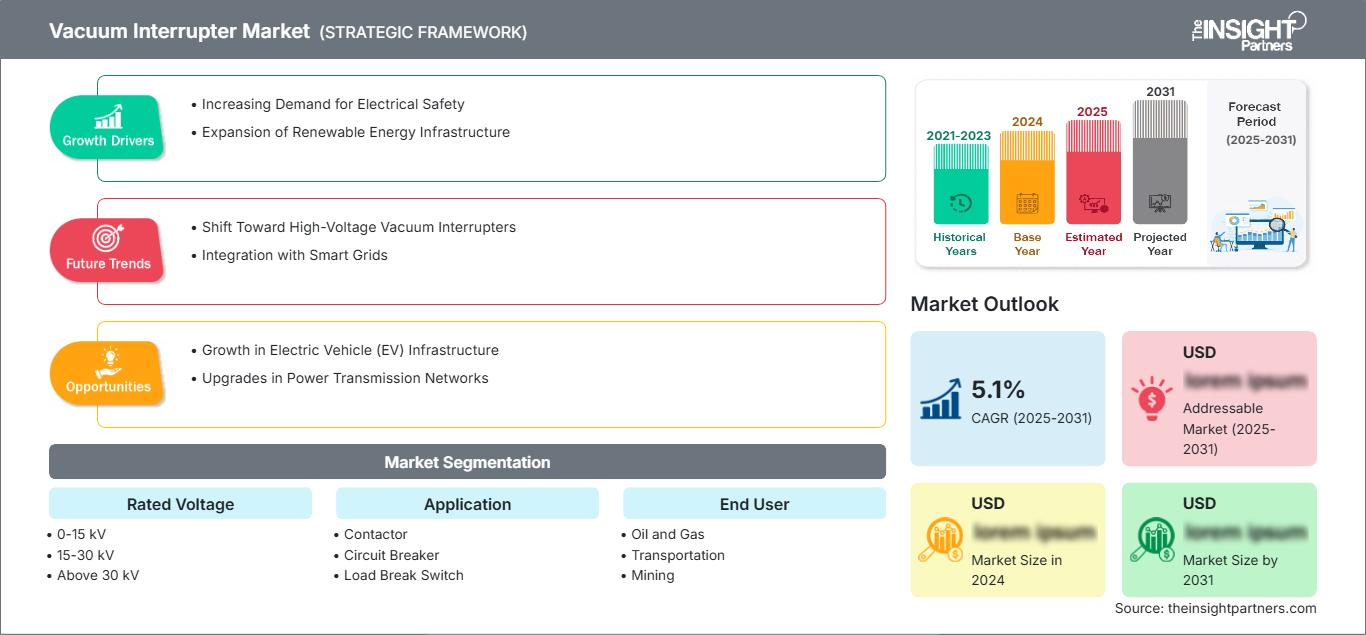
Regional Insights
North America vacuum interrupter market
North America holds an estimated 24–27% vacuum interrupter market share in 2025 and is expected to grow at a 4.4–4.9% CAGR through 2034. Grid hardening, wildfire mitigation efforts, automated feeders, and expansion of data centers will boost the demand for circuit breakers, reclosers, and load break switches. Utilities are leaning towards devices that allow better outage isolation and less maintenance of medium voltage distribution systems.
The United States is the leading market in the region and Canada ensures constant replacement in industrial and utility networks. Buyers of switchgear devices favor smaller sizes, remote monitoring ability, and safe operation. Growth is also associated with renewable energy connections, electrification of transportation corridors, and industrial sites needing dependable switching solutions.
U.S. vacuum interrupter Market
The U.S. represents 78–82% of the North American Vacuum interrupter market demand in 2025 and is expected to grow at a 4.5–5.0% CAGR during 2026–2034. Upgrades in utility distribution systems, capital investments by manufacturers, and the power infrastructure of data centers are driving the market for medium voltage vacuum circuit breakers and reclosers. Purchasing at home is facilitated by manufacturers' concern regarding localized production and grid resilience initiatives.
Trends within application include high use of circuit breakers, reclosers, and load break switches that are deployed for feeder protection, substation upgrading, and industrial service entrance applications. The leading technology providers are ABB Ltd., Eaton Corporation plc, Siemens AG, and Mitsubishi Electric Corporation.
Europe vacuum interrupter Market
Europe accounts for an estimated 22–25% share of the Vacuum interrupter market in 2025 and is forecast to grow at 4.1–4.7% during 2026–2034. German leadership in the region results from industrial electrification, grid reinforcement, and state-of-the-art development of medium voltage switchgear technology. The UK is reinforcing its networks in connection with offshore wind generation, grid expansion, and transport electrification.
Vacuum-switching equipment is being adopted in France, Italy, and Spain due to low environmental impact and enhanced performance reliability as key procurement criteria. European policy guidance on fluorinated gases encourages a wider transition to environmentally friendly switchgear solutions, especially for medium and selected high voltages.
APAC vacuum interrupter Market
APAC Vacuum interrupter market holds the largest estimated share of 33–37% in 2025 and is expected to grow at 5.0–5.6% through 2034. China is the top player owing to the large distribution network, domestic manufacturing of switchgear, and renewable energy interfacing capability. India fuels high growth by means of grid upgrade, metro rail projects, industrial corridors, and utility losses reduction projects.
Japan and South Korea focus on highly reliable equipment used in dense urban networks, manufacturing facilities, and rail networks. Australia adds demand in the region due to the electrification of mines and the interfacing of renewable energy sources. The region enjoys the advantage of in-depth local manufacturing and competitively priced components.
Middle East & Africa vacuum interrupter Market
The Middle East and Africa are expected to grow at 4.3–4.8% during 2026–2034 as power infrastructure expands across utilities, oil and gas facilities, mining sites, and transport systems. In Saudi Arabia and the UAE, demand arises due to grid strengthening, industrial estates, and diversification initiatives; however, in South Africa, demand arises through replacement initiatives in aged distribution systems.
In utility procurement, the emphasis is on equipment that can last well in high temperatures and dusty environments. With vacuum interrupters increasingly adopted in circuit breakers and load break switches, it makes operations safer. This kind of demand is still cyclic but strategically important for suppliers to harsh environment projects.
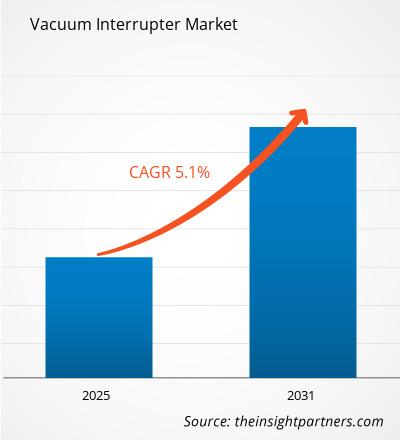
Segmentation Analysis
Rated Voltage
The rated voltage segment is expected to grow at a 4.6–5.1% CAGR during 2026–2034. Vacuum interrupter market scope is strongest in medium-voltage distribution, where switching reliability, compact insulation design, and maintenance reduction matter most. Higher voltage use is expanding gradually as clean-air and vacuum systems move into broader grid applications.
- 0-15 kV: This range serves compact distribution panels, commercial substations, industrial feeders, and building power systems where space, cost, and reliable interruption are central buying factors.
- 15-30 kV: This range remains strategically important for utility feeders, renewable interconnections, mining systems, and transportation electrification because it balances capacity, equipment size, and switching duty.
- Above 30 kV: Higher voltage adoption is selective but rising in primary distribution and specialized infrastructure, where utilities require durable switching with lower environmental impact.
Application
The application segment is expected to grow at a 4.8–5.3% CAGR during 2026–2034. Circuit breakers dominate due to their central role in fault interruption, while reclosers grow faster as utilities automate distribution networks. Contactors, load break switches, and tap changers support industrial control, feeder sectionalizing, and transformer regulation.
- Contactor: Contactors are used in motor control, capacitor switching, and industrial loads where frequent operations require reliable interruption and lower maintenance.
- Circuit Breaker: Circuit breakers remain the largest application because every medium-voltage network needs fault protection, isolation, and safe restoration after abnormal electrical conditions.
- Load Break Switch: Load break switches support feeder sectionalizing and ring-main units where utilities need simple, compact, and safe load interruption.
- Recloser: Reclosers are gaining importance as utilities deploy automated feeder protection to reduce outage duration and improve service reliability.
- Tap Changer: Tap changers use vacuum switching to improve transformer voltage regulation reliability and reduce arcing-related wear in demanding operating cycles.
End User
The end user segment is expected to grow at a 4.5–5.0% CAGR during 2026–2034. Utilities represent the largest demand base because vacuum switching fits grid modernization and feeder automation. Oil and gas, transportation, and mining users deploy interrupters where safety, uptime, and low maintenance are critical in harsh electrical environments.
- Oil and Gas: Oil and gas facilities require rugged switching equipment for upstream, midstream, and processing sites where electrical reliability and hazardous-area safety are priorities.
- Transportation: Rail, metro, airport, and charging infrastructure projects use vacuum-based protection to manage traction power, substations, and high-utilization electrical loads.
- Mining: Mining users value compact, robust switchgear for underground and surface operations where dust, vibration, and remote maintenance constraints affect equipment selection.
- Utilities: Utilities remain the dominant end user as distribution automation, renewable integration, and substation replacement programs increase demand for vacuum circuit breakers and reclosers.
Opportunity Snapshot
| Application | Revenue Contribution | Trend Tag | Adoption Stage |
| Contactor | Medium | Motor Control | Mature |
| Circuit Breaker | High | Grid Protection | Mature |
| Load Break Switch | Medium | Feeder Sectioning | Scaling |
| Recloser | Medium | Feeder Automation | Scaling |
| Tap Changer | Low | Voltage Regulation | Emerging |
| Others | Low | Special Switching | Emerging |
Vacuum Interrupter Market Growth Drivers and Impact Analysis
Grid modernization and feeder automation accelerate replacement demand
The grid operators are switching from old systems that rely on oil or mechanical operations to vacuum technology circuit breakers, reclosers, and load break switches for increased reliability and fault isolation. The renewable energy generation, distributed generation, and increased peak demands necessitate the need for switching technologies that offer safe operation even under high duty cycles. This is enabled by vacuum interrupters because they reduce arc energy, maintenance, and outage restoration. The effects will be most felt in the utility companies due to the preference for switchgear with remote monitoring and standardized panels.
Environmental pressure supports alternatives to gas-insulated switching
Increasing regulatory scrutiny on greenhouse-gas-intensive electrical apparatus is affecting the switchgear specification process, especially in Europe and the advanced utility market sector. The use of vacuum technology in combination with solid insulation or clean air technology provides another route to medium voltage without using SF6 interrupters. This driver increases supplier focus on poles that are embedded, closed chambers, and digital monitoring devices. On the buyer’s side, this allows the move away from environmental liability while retaining the same switching capabilities.
Industrial electrification expands demand beyond traditional utilities
Electrification of industry is giving rise to increased requirements for medium voltage protection in sectors such as mining, oil & gas, manufacturing, railway and data centers. Such sectors require small-sized devices with high operational reliability, which are particularly critical in case of disturbances leading to production losses or hazards. Vacuum interrupters are an ideal choice due to their high mechanical longevity and excellent fault interruption capability, along with minimal maintenance requirements.
Vacuum Interrupter Market Future Trends
Digital condition monitoring becomes standard in premium switchgear
Vacuum interrupter market trends increasingly point toward sensors, analytics, and remote diagnostics becoming standard features in premium circuit breaker platforms. Monitoring contact wear, temperature, spring charging, operating speed, and interruption history helps utilities plan maintenance before failures occur. This trend will favor suppliers that integrate interrupters with embedded poles, actuators, and software-enabled asset management. Over the forecast period, digital readiness is likely to become a differentiator in utility tenders and high-uptime industrial installations.
Clean-air and vacuum combinations move into higher voltage applications
Vacuum switching technology is extending itself into non-traditional areas like higher voltages for which vacuum switches have traditionally not been suitable, as suppliers experiment with air/vacuum combination switchgear. Such efforts are being driven by the need to reduce the use of fluorinated gases in favor of better reliability of the transmission and substation network. While commercial adoption will be a slow process, success in pilot projects may boost confidence in vacuum systems.
Vacuum Interrupter Market Opportunities
Localized manufacturing for fast-growing grid investment markets
Vacuum Interrupter Market forecasts indicate that local production and regional assembly can create strong opportunities in India, Southeast Asia, the Middle East, and Africa. Utilities and infrastructure developers are becoming more interested in reducing lead times, localized certification, and accessibility. By localizing embedded poles, interrupters, and switchgear integration, manufacturers can avoid risks associated with higher costs and increase their competitiveness. Such an advantage becomes very significant in cases when the government expands its distribution network and promotes local industries.
Retrofit solutions for aging medium-voltage equipment bases
There exists an installed base of aging medium-voltage switchgear equipment, thus creating chances for retrofit where a vendor may be able to offer compatible assemblies of vacuum interrupters, breakers, and replacement modules. Most utilities and industries would prefer a phased upgrade over the replacement of substations due to reduced downtime and low capital expenditure. A vendor who offers engineering expertise, tested types of products and services may benefit from recurring sales from the market. The best market for this strategy is a mature one with aging infrastructure.
Frequently Asked Questions

- Comprehensive Market Sizing and Forecast Analysis
- Detailed Segmentation Analysis
- In-Depth Market Dynamics Assessment
- Regional and Country-Level Insights
- Competitive Landscape and Company Benchmarking
- Strategic Business Intelligence
Recent Reports
Testimonials

The Insight Partners' SCADA System Market report is comprehensive, with valuable insights on current trends and future forecasts. The team was highly professional, responsive, and supportive throughout. We are very satisfied and highly recommend their services.
RAN KEDEM Partner, Reali Technologies LTDs
I requested a report on a very specific software market and the team produced the report in a few days. The information was very relevant and well presented. I then requested some changes and additions to the report. The team was again very responsive and I got the final report in less than a week.
JEAN-HERVE JENN Chairman, Future Analytica
We worked with The Insight Partners for an important market study and forecast. They gave us clear insights into opportunities and risks, which helped shape our plans. Their research was easy to use and based on solid data. It helped us make smart, confident decisions. We highly recommend them.
PIYUSH NAGPAL Sr. Vice President, High Beam Global
The Insight Partners delivered insightful, well-structured market research with strong domain expertise. Their team was professional and responsive throughout. The user-friendly website made accessing industry reports seamless. We highly recommend them for reliable, high-quality research services
YUKIHIKO ADACHI CEO, Deep Blue, LLC.
This is the first time I have purchased a market report from The Insight Partners.While I was unsure at first, I visited their web site and felt more comfortable to take the risk and purchase a market report.I am completely satisfied with the quality of the report and customer service. I had several questions and comments with the initial report, but after a couple of dialogs over email with their analyst I believe I have a report that I can use as input to our strategic planning process.Thank you so much for taking the extra time and making this a positive experience.I will definitely recommend your service to others and you will be my first call when we need further market data.
JOHN SUZUKI President and Chief Executive Officer, Board Director, BK Technologies
I wish to appreciate your support and the professionalism you displayed in the course of attending to my request for information regarding to infectious disease IVD market in Nigeria. I appreciate your patience, your guidance, and the fact that you were willing to offer a discount, which eventually made it possible for us to close a deal. I look forward to engaging The Insight Partners in the future, all thanks to the impression you have created in me as a result of this first encounter.
DR CHIJIOKE ONYIA MANAGING DIRECTOR, PineCrest Healthcare Ltd.Reason to Buy
- Informed Decision-Making
- Understanding Market Dynamics
- Competitive Analysis
- Identifying Emerging Markets
- Customer Insights
- Market Forecasts
- Risk Mitigation
- Boosting Operational Efficiency
- Strategic Planning
- Investment Justification
- Tracking Industry Innovations
- Aligning with Regulatory Trends





 Get Free Sample for