
Wafer Fab Equipment Market Share, Growth & Demand by 2034
Coverage: By Node Size (7 nm and below, 10-22 nm, 32-45 nm, 65 nm and above); Fabrication Method (Front-end-of-line Processing, Back-end-of-line Processing); Application (Foundry, Memory, Integrated Device Manufacturer) , and Geography (North America, Europe, Asia Pacific, and South and Central America)
- Status : Data Released
- Report Code : TIPRE00026911
- Category : Electronics and Semiconductor
- No. of Pages : 150
- Available Report Formats :


- Last update date : September 28, 2026


2025 Market Size
US$ 104.11 Bn
Base year value
2034 Forecast
US$ 183.13 Bn
Projected by 2034
CAGR 2026-2034
6.48 %
Growth rate
Addressable Market
US$ 1,299.47 Bn
(2026-2034)
The wafer fab equipment market is projected to grow from US$ 104.11 Billion in 2025 to US$ 183.13 Billion by 2034, registering a CAGR of 6.48% during 2026–2034. Demand is supported by sustained investment in leading-edge logic, DRAM, high-bandwidth memory, and mature-node capacity. Equipment intensity is rising as chipmakers adopt more complex lithography, deposition, etch, cleaning, metrology, and inspection workflows.
North America is expected to remain a strategically important region as domestic semiconductor manufacturing incentives, advanced logic capacity additions, and equipment localization programs strengthen fab investment. The wafer fab equipment market size in the region is supported by AI accelerator production, foundry expansion, and memory manufacturing upgrades, with regional growth expected to stay within a mid-single-digit to high-single-digit CAGR range through 2034.
Wafer Fab Equipment Market Assessment and Insights
- North America: The region accounted for an estimated 12–15% share in 2025 and is projected to grow at a CAGR of 6.0–7.2% between 2026–2034, supported by fab localization and advanced-node capacity.
- U.S.: The U.S. represented nearly 78–82% of North American demand in 2025 and is expected to grow at a CAGR of 6.2–7.4% during 2026–2034.
- Europe: Europe held an estimated 8–11% share in 2025 and is forecast to expand at a CAGR of 5.5–6.6%, led by Germany, France, Italy, and the Netherlands.
- Asia Pacific: Asia Pacific captured an estimated 70–75% share in 2025 and is expected to grow at a CAGR of 6.7–7.8%, led by Taiwan, South Korea, China, and Japan.
- Largest Segment: Front-end-of-line processing held an estimated 68–72% market share in 2025, growing at a CAGR of 6.4–7.1% as leading-edge process steps become more equipment intensive.
- High Growth Segment: 7 nm and below nodes held an estimated 26–30% share in 2025 and are projected to grow at a CAGR of 7.5–8.6% through 2034.
- Key companies analyzed in detail: Applied Materials, Inc., Advantest Corporation, ASML Holding N.V., SCREEN Holdings Co., Ltd., Kokusai Electric Corporation, KLA Corporation, Lam Research Corporation, Nikon Corporation, Taiwan Semiconductor Manufacturing Company Limited, and Tokyo Electron Limited.
Source: The Insight Partners' analysis based on proprietary research, government publications, company annual reports, investor presentations, industry databases, and expert interviews.
Process technology has moved from capacity-led investment cycles toward architecture-led capital intensity. The wafer fab equipment market growth is increasingly linked to gate-all-around transistors, EUV lithography, advanced deposition stacks, tighter overlay control, and greater inspection density. Foundries and memory manufacturers are also adding tools to improve yield learning, reduce defectivity, and support hybrid manufacturing strategies across advanced and mature nodes.
Future demand will be shaped by regional supply chain resilience, semiconductor sovereignty programs, and customer commitments to AI infrastructure. Advanced logic fabs in the U.S., Taiwan, South Korea, Japan, and Europe are expected to absorb a higher proportion of high-value equipment spending. At the same time, memory upgrades and specialty semiconductor capacity will support incremental demand outside the most advanced nodes, according to the Wafer Fab Equipment Market report.
Wafer Fab Equipment Market Report Scope
| Report Attribute | Details |
|---|---|
| Market size in 2025 | US$ 104.11 Billion |
| Market Size by 2034 | US$ 183.13 Billion |
| Global CAGR (2026 - 2034) | 6.48% |
| Historical Data | 2021-2024 |
| Forecast period | 2026-2034 |
Wafer Fab Equipment Market Analysis
The wafer fab equipment market analysis indicates that demand is being driven by AI compute, automotive electronics, 5G infrastructure, industrial automation, and cloud data center investments. Equipment manufacturers gain from the increased processes per wafer due to node migration in the areas of processing, patterning, cleaning, and inspection. Sub-systems, material handling, vacuum, optics, precise motion, and process control through software are also needed by the ecosystem.
The dynamics of supply are concentrated due to the long qualification cycle and the impact of tool performance on yield. Customers usually select equipment on the basis of reliability, throughput, process consistency, total cost of ownership, and compatibility with the roadmap. There is a significant barrier to entry, especially for EUV lithography, advanced etch, atomic layer deposition, and process control in sub-10 nm fabrication.
The competitive positioning is determined by application depth and not by wide manufacturing scale. The company ASML Holding N.V. continues to be very important for lithography applications. Applied Materials, Inc., Lam Research Corporation, Tokyo Electron Limited, and KLA Corporation have very strong market positions in deposition, etch, clean, and inspection. Nikon Corporation, SCREEN Holdings Co., Ltd., Advantest Corporation, Kokusai Electric Corporation, and Taiwan Semiconductor Manufacturing Company Limited shape adoption with specialized equipment, testing, or manufacturing roadmaps.
Investment is focused on high investment per wafer start. Factories are focused on increasing automation, digital twin, APC and predictive maintenance to lower the downtime. Toolmakers are responding with service models, installed-base upgrades, and integrated software capabilities that improve fab productivity while extending equipment relevance across multiple technology generations, as highlighted in the Wafer Fab Equipment Market forecast.
● REPORT CUSTOMIZATION
Tailor This Report To Align With Your Specific Business Requirements
This report can be customized to align precisely with your business objectives, scope, and target markets. Customization options include tailored segmentation, geography, competitive analysis, and strategic insights to support informed decision-making.
Customize This Report →WHAT YOU CAN ADJUST
- ● Segmentations
- ● Geography
- ● Competitive Analysis
- ● Language Preferences
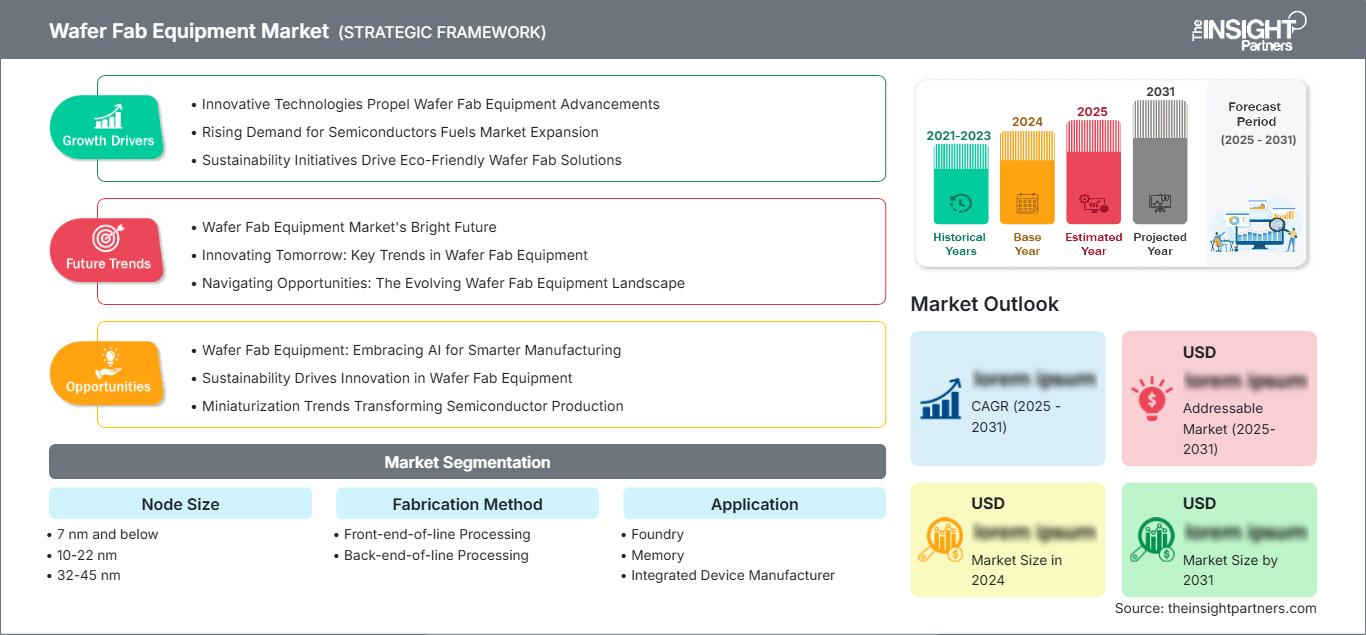
Wafer Fab Equipment Market: Strategic Insights
Regional Insights
North America wafer fab equipment market
North America is expected to account for a 12–15% wafer fab equipment market share in 2025, with a CAGR of 6.0–7.2% during 2026–2034. The growth can be attributed to domestic fab incentive policies, AI chips, and leading-edge logic, specialty semiconductor, and memory capacity investment.
Furthermore, the growth in the region is connected with equipment localization, workforce training, and supply chain security. The construction of large fabs involves the delivery coordination of various pieces of equipment, including lithography, deposition, etch, clean, inspection, metrology, and automation equipment.
U.S. wafer fab equipment Market
The U.S. represented an estimated 78–82% of North American demand in 2025 and is projected to grow at a CAGR of 6.2–7.4% through 2034. Advantages that accrue to the country include sophisticated logic fabs, government-funded support, and an increasing equipment ecosystem surrounding Arizona, Texas, Oregon, Ohio, and New York.
Application demand is mostly for foundry, IDM, and memory devices. The country is also home to Applied Materials, Inc., Lam Research Corporation, and KLA Corporation, which improve the interaction between domestic suppliers, processes, and field services.
Europe wafer fab equipment Market
Europe is estimated to hold an 8–11% share in 2025 and grow at a CAGR of 5.5–6.6% during 2026–2034. Germany drives the regional demand via capacities for automobiles, power semiconductors, and logic applications, whereas France, Italy, and Spain drive the development of specialty processes and industrial semiconductors.
The Netherlands is critical due to ASML Holding N.V. being key for lithography production. Regional semiconductor policy, electrification of cars, industrial automation, and power devices production stimulate growth; however, Europe has less market share than Asia Pacific due to the lack of mega-fabs.
APAC wafer fab equipment Market
Asia Pacific is projected to account for 70–75% share in 2025 and expand at a CAGR of 6.7–7.8% through 2034. Demand from Taiwan, South Korea, China, and Japan continues to be the strongest due to factors such as foundry capacity, memory dominance, localization-oriented policies, and technology migration.
China powers the demand in mature nodes and localization-focused products; Taiwan is a leading buyer of advanced foundry equipment; South Korea is an important source of DRAM and NAND-related spending; Japan is still important in materials, equipment and semiconductor manufacturing revival. India and Australia are growing sources of smaller but developing demand due to policy-led electronics manufacturing ecosystems.
Middle East & Africa wafer fab equipment Market
The Middle East & Africa region is expected to grow at a CAGR of 4.8–5.9% during 2026–2034 from a limited base. Semiconductor clusters in Saudi Arabia and the UAE revolve around digital infrastructure, sovereign technology policies, and R&D collaborations, whereas South Africa is concentrating its efforts towards electronics and industrial needs.
Future demand in the region is expected to be selective in nature and will include pilot facilities, packaging infrastructure, and technology investments. Growth of these semiconductor regions depends upon the availability of a skilled labor force, utilities, clean room infrastructure, and collaboration with equipment makers and semiconductor producers.
Segmentation Analysis
Node Size
Node Size segmentation defines wafer fab equipment market scope by the complexity of process technology. This segment is expected to grow at a CAGR of 6.6–7.4% during 2026–2034 as demand shifts toward finer geometries, tighter overlay, and more advanced process control.
- 7 nm and below: This sub-segment is strategically important for AI accelerators, advanced processors, and high-performance computing, requiring EUV lithography, advanced deposition, tighter inspection, and increasingly complex yield management.
- 10–22 nm: Demand remains steady across mobile, networking, and automotive processors, where performance, power efficiency, and cost balance support continued investment in scalable fab capacity.
- 32–45 nm: This range supports embedded, analog, RF, and mixed-signal applications, creating stable demand for mature but highly reliable process tools.
- 65 nm and above: The segment remains important for power devices, microcontrollers, sensors, and industrial electronics, where product longevity and proven manufacturing flows matter more than aggressive scaling.
Fabrication Method
Fabrication Method is projected to grow at a CAGR of 6.3–7.0% during 2026–2034. Front-end tools dominate spending because wafer patterning, thin-film formation, etching, cleaning, and inspection determine device performance and manufacturing yield.
- Front-end-of-line Processing: This sub-segment contributes the largest revenue base because transistor formation, lithography, deposition, and etching require expensive, precision equipment across every advanced and mature node.
- Back-end-of-line Processing: Demand is supported by interconnect complexity, low-k materials, metallization, planarization, and inspection needs as chip architectures require denser routing and improved signal integrity.
Application
Application is expected to grow at a CAGR of 6.5–7.3% during 2026–2034 as foundries, memory suppliers, and IDMs invest in distinct technology roadmaps. Foundry demand is most visible, but memory and IDM spending remain critical to balanced market expansion.
- Foundry: Foundries require broad tool portfolios for advanced logic, specialty processes, and customer-specific ramps, making them the largest and most roadmap-sensitive equipment buyers.
- Memory: Memory manufacturers invest in DRAM, NAND, and HBM upgrades, where layer counts, aspect ratios, and test intensity increase equipment needs.
- Integrated Device Manufacturer: IDMs sustain demand through vertically integrated manufacturing, automotive chips, power devices, processors, and specialty semiconductor production requiring long-term tool support.
Opportunity Snapshot
| Application | Revenue Contribution | Trend Tag | Adoption Stage |
| Foundry | High | AI Logic | Scaling |
| Memory | High | HBM Expansion | Scaling |
| Integrated Device Manufacturer | Medium | Specialty Nodes | Mature |
Wafer Fab Equipment Market Growth Drivers and Impact Analysis
AI Compute and High-Bandwidth Memory Capacity Expansion
The increasing use of AI technology to build the AI ecosystem has led to an increased need for high-end processors and accelerators, along with increased high-bandwidth memory usage, which will have an effect on the demand for equipment within both logic and memory fabs. The more complicated the design of the chip is, the more lithography, deposition, etch, cleaning, and inspection will be required, making the intensity of equipment higher per wafer. Both new fabs and existing fabs stand to gain from this driver.
Technology Migration Toward Smaller Nodes and 3D Architectures
The move to 7 nm and below technologies requires gate-all-around design, high-aspect ratio etching, and 3D memory design, making the manufacturing process complex. Semiconductor companies will have to buy more accurate equipment to handle the challenges of overlay control, defect inspection, film thickness uniformity, and yield learning. This is manifested in increased capital expenditures, longer equipment qualification times, and the increased need for better systems. As such, equipment companies that have demonstrated depth of technology get more bargaining power and cooperation with the industry leaders.
Regional Semiconductor Sovereignty and Fab Localization
The government is promoting the construction of fabs within their countries to limit the supply chain dependency and safeguard their critical industries. The incentive programs in the U.S., Europe, Japan, South Korea, India, and China will drive the setup of new fabs, technological alliances, and ecosystem creation. It will create a need for the installation and service of these fabs throughout their operational lifespan. The effect on the market goes beyond just the delivery of equipment due to the following reasons:
Wafer Fab Equipment Market Future Trends
High-NA EUV and Advanced Patterning Adoption
The Wafer fab equipment market trends indicate rising interest in High-NA EUV, advanced overlay control, computational lithography, and multi-patterning reduction. With smaller geometries and backside power delivery becoming the norm for manufacturers, the importance of patterning to capital intensity will grow. The initial use will be by logic manufacturers, but it will impact neighboring technologies such as inspection, metrology, and process control. This transition will benefit long-term equipment roadmaps and foster collaboration between lithography providers, material suppliers, and high-volume semiconductor producers.
Software-Defined Fab Productivity
In future fabs, automation, process analysis, prediction of maintenance, and equipment intelligence will play an increasingly prominent role. The evaluation of equipment performance would not just include the speed of the process, but also availability, yield impact, transferability of recipes, and integration with overall fab software systems. The suppliers who are able to integrate accurate hardware control systems will have significant value in the coming era.
Wafer Fab Equipment Market Opportunities
Installed-Base Upgrades and Service Revenue Expansion
Equipment for wafer fabrication facilities. The service business is expected to grow from areas such as service, refurbishment, chamber upgrade, automation retrofit and productivity software. With extended life cycles of tools at fabs, equipment providers will be able to earn recurrent revenues while assisting customers to increase throughput and control defects. This provides an excellent opportunity in the case of mature node fabs, where the replacement cycle is slower, but the utilization is higher.
Advanced Packaging and Heterogeneous Integration Equipment
Chiplet architectures, HBM, hybrid bonding, 2.5D integration, and 3D stacking are generating demand in the shadow of conventional wafer processing. While not all packaging tools reside within the front-end facilities, the lines between the two are becoming increasingly blurred. Tools that focus on bonding, metrology, cleaning, inspection, and wafer handling have the opportunity to leverage rapidly growing markets. The greatest opportunity lies where AI accelerators and memory stacks require faster throughput and interconnect reliability.
Frequently Asked Questions

- Comprehensive Market Sizing and Forecast Analysis
- Detailed Segmentation Analysis
- In-Depth Market Dynamics Assessment
- Regional and Country-Level Insights
- Competitive Landscape and Company Benchmarking
- Strategic Business Intelligence
Recent Reports
Testimonials

The Insight Partners provided valuable market intelligence that supported our global go-to-market strategy. Their team was professional, responsive, and attentive to our feedback, providing thoughtful analysis and helpful methodological clarifications throughout the project.
Junmo Kim Chief Financial Officer (CFO), Enertech Co., Ltd.
The Insight Partners' SCADA System Market report is comprehensive, with valuable insights on current trends and future forecasts. The team was highly professional, responsive, and supportive throughout. We are very satisfied and highly recommend their services.
RAN KEDEM Partner, Reali Technologies LTDs
I requested a report on a very specific software market and the team produced the report in a few days. The information was very relevant and well presented. I then requested some changes and additions to the report. The team was again very responsive and I got the final report in less than a week.
JEAN-HERVE JENN Chairman, Future Analytica
We worked with The Insight Partners for an important market study and forecast. They gave us clear insights into opportunities and risks, which helped shape our plans. Their research was easy to use and based on solid data. It helped us make smart, confident decisions. We highly recommend them.
PIYUSH NAGPAL Sr. Vice President, High Beam Global
The Insight Partners delivered insightful, well-structured market research with strong domain expertise. Their team was professional and responsive throughout. The user-friendly website made accessing industry reports seamless. We highly recommend them for reliable, high-quality research services
YUKIHIKO ADACHI CEO, Deep Blue, LLC.
This is the first time I have purchased a market report from The Insight Partners.While I was unsure at first, I visited their web site and felt more comfortable to take the risk and purchase a market report.I am completely satisfied with the quality of the report and customer service. I had several questions and comments with the initial report, but after a couple of dialogs over email with their analyst I believe I have a report that I can use as input to our strategic planning process.Thank you so much for taking the extra time and making this a positive experience.I will definitely recommend your service to others and you will be my first call when we need further market data.
JOHN SUZUKI President and Chief Executive Officer, Board Director, BK Technologies
I wish to appreciate your support and the professionalism you displayed in the course of attending to my request for information regarding to infectious disease IVD market in Nigeria. I appreciate your patience, your guidance, and the fact that you were willing to offer a discount, which eventually made it possible for us to close a deal. I look forward to engaging The Insight Partners in the future, all thanks to the impression you have created in me as a result of this first encounter.
DR CHIJIOKE ONYIA MANAGING DIRECTOR, PineCrest Healthcare Ltd.Reason to Buy
- Informed Decision-Making
- Understanding Market Dynamics
- Competitive Analysis
- Identifying Emerging Markets
- Customer Insights
- Market Forecasts
- Risk Mitigation
- Boosting Operational Efficiency
- Strategic Planning
- Investment Justification
- Tracking Industry Innovations
- Aligning with Regulatory Trends





 Get Free Sample for