
Wavelength Division Multiplexer Market Growth, Size & Forecast by 2034
Coverage: By Type (CWDM, DWDM); End Use Industry (IT and Telecommunications, Energy, Financial Services, Healthcare, Others) , and Geography (North America, Europe, Asia Pacific, and South and Central America)
- Status : Data Released
- Report Code : TIPRE00027025
- Category : Electronics and Semiconductor
- No. of Pages : 150
- Available Report Formats :


- Last update date : September 28, 2026


2025 Market Size
US$ 3.44 Bn
Base year value
2034 Forecast
US$ 5.17 Bn
Projected by 2034
CAGR 2026-2034
4.63 %
Growth rate
Addressable Market
US$ 39.09 Bn
(2026-2034)
The Wavelength Division Multiplexer market was valued at US$ 3.44 billion in 2025 and is expected to reach US$ 5.17 billion by 2034; it is estimated to record a CAGR of 4.63% during 2026-2034.
Wavelength Division Multiplexer Market Assessment and Insights
- North America: The region accounted for an estimated 29–32% share in 2025 and is expected to grow at a CAGR of 4.9–5.5% during 2026–2034, driven by cloud interconnect, 5G transport, and fiber backbone upgrades.
- U.S.: The U.S. represented nearly 72–76% of North America demand in 2025, expanding at a CAGR of 5.0–5.6% as carriers and data center operators densify optical routes.
- Europe: Europe held an estimated 22–25% share in 2025 and is projected to grow at 4.6–5.2% CAGR, led by Germany, the UK, France, Italy, and Spain.
- Asia Pacific: Asia Pacific accounted for 34–38% share in 2025 and is expected to grow at 5.7–6.4% CAGR, supported by China, Japan, South Korea, India, and Australia.
- Largest Segment: DWDM led the type category with a 58–63% market share in 2025 and is expected to grow at a CAGR of 5.4–6.0% due to backbone and metro capacity demand.
- High Growth Segment: Healthcare is expected to expand from a 7–10% share in 2025 at a CAGR of 6.0–6.8%, supported by telemedicine, imaging data exchange, and connected hospital networks.
- Key companies analyzed in detail: ADTRAN Holdings, Inc., Adtran Networks SE, Ciena Corporation, Cisco Systems, Inc., Infinera Corporation, Huawei Technologies Co., Ltd., ZTE Corporation, Aliathon Technology Ltd, Nokia Corporation, and Fujitsu Optical Components Limited.
Source: The Insight Partners' analysis based on proprietary research, government publications, company annual reports, investor presentations, industry databases, and expert interviews.
The market has developed from merely offering aggregation of fibers into software-driven optical transport solutions, wherein the channel density, efficiency, and programmability of the networks affect purchasing decisions. The market growth depends on the development of DWDM systems for metropolitan and long-haul applications, while CWDM plays an important role in affordable access, campus, and enterprise connections.
Future investments will be directed at scalable optical platforms providing coherent transport, automated configuration, and reduced energy consumption per bit. Emerging geographies are expected to increase adoption as national broadband programs, private 5G campuses, financial transaction networks, and healthcare digitization create demand for reliable high-capacity fiber systems, according to the Wavelength Division Multiplexer Market report.
Wavelength Division Multiplexer Market Report Scope
| Report Attribute | Details |
|---|---|
| Market size in 2025 | US$ 3.44 Billion |
| Market Size by 2034 | US$ 5.17 Billion |
| Global CAGR (2026 - 2034) | 4.63% |
| Historical Data | 2021-2024 |
| Forecast period | 2026-2034 |
Wavelength Division Multiplexer Market Analysis
Market drivers consist of the increasing mismatch between demand for bandwidth and the cost of laying down new fibers. The use of WDM technology allows service providers to greatly improve their bandwidth through existing fiber networks by transmitting multiple wavelengths at the same time, thus saving costs associated with trenching and network expansions. This business opportunity is highly evident in dense urban areas, long-haul network backbones, data center interconnects, and high-bandwidth telecom backhaul paths where bandwidth usage keeps increasing. The rise in cloud computing, video streaming services, enterprise connectivity, and 5G deployments contributes to this demand.
The supply side is affected by factors such as the availability of optical components, advancements in transceiver technology, photonics integration, and system integration ability. Equipment providers today are competing on efficiency in terms of spectrum use, scalability, power usage, ease of operation, and compliance with open optical network systems architecture. Firms operating in industries like finance, healthcare, public sector, and energy are implementing WDM technology in situations where their latency-sensitive applications, business continuity considerations, and need for secure private connections warrant the use of specialized optical network infrastructure.
The market analysis suggests that there is a high level of competition in the market among optical networking experts and telecommunications equipment suppliers. Ciena Corporation, Cisco Systems, Inc., Infinera Corporation, Huawei Technologies Co., Ltd., Nokia Corporation, ADTRAN Holdings, Inc., Adtran Networks SE, and ZTE Corporation differentiate their offerings based on the use of coherent optics, packet-optical transport systems, software-defined networking solutions, and carrier-grade service assurance capabilities. Competitive differentiation in the industry is focused on network automation, transmission efficiency, interoperability, and the ability to deliver hyperscale and carrier requirements for metro, regional, and long-haul networks.
There are investments in the industry in the areas of data-center interconnects, metro aggregation, edge network evolution, and capacity upgrades due to the increase in traffic related to cloud computing and artificial intelligence. The vendors position their offerings based on the use of modular architectures, software-defined control plane, and optical networking platforms since the customers want to have scalable systems which can be used not only at the access links but also at the multi-terabit transport network without replacing the whole optical layer.
● REPORT CUSTOMIZATION
Tailor This Report To Align With Your Specific Business Requirements
This report can be customized to align precisely with your business objectives, scope, and target markets. Customization options include tailored segmentation, geography, competitive analysis, and strategic insights to support informed decision-making.
Customize This Report →WHAT YOU CAN ADJUST
- ● Segmentations
- ● Geography
- ● Competitive Analysis
- ● Language Preferences
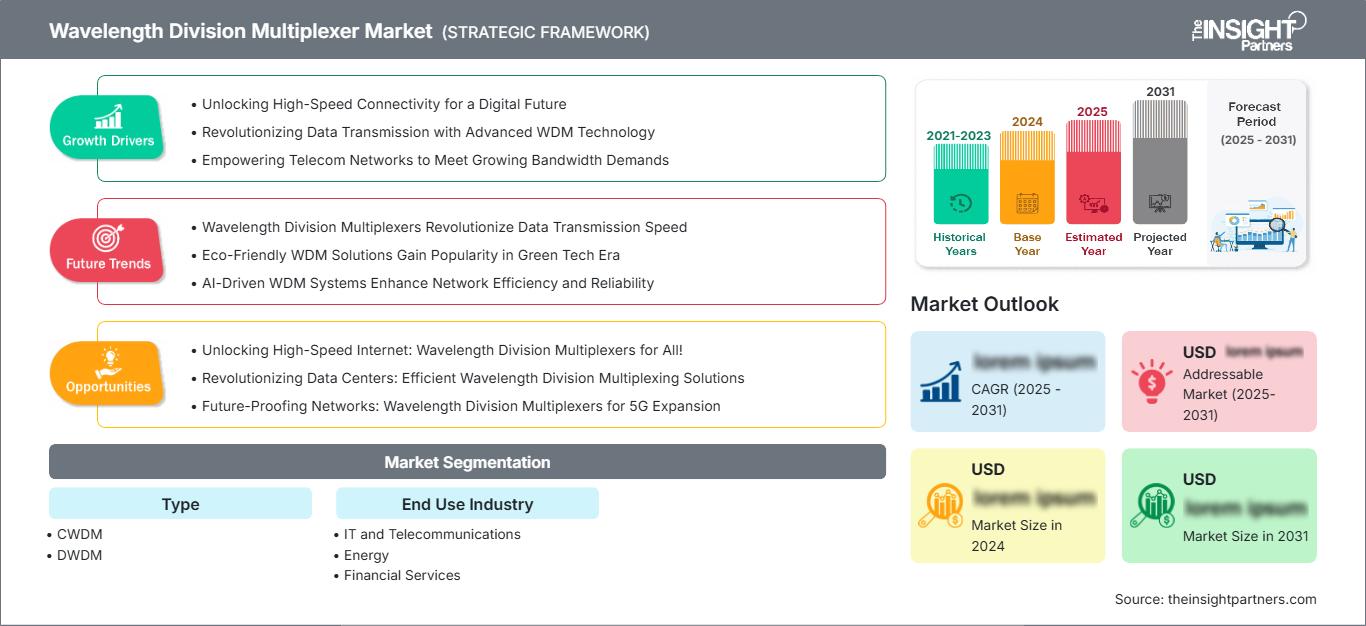
Wavelength Division Multiplexer Market: Strategic Insights
Regional Insights
North America wavelength division multiplexer market
North America represented an estimated 29–32% wavelength division multiplexer market share in 2025, supported by cloud computing clusters, long-haul carrier routes, and extensive enterprise fiber networks. Regional CAGR is expected at 4.9–5.5% through 2034, with hyperscale data center interconnect remaining a major adoption driver.
Carrier consolidation and metro fiber densification are increasing demand for platforms that support flexible channel planning and simplified operations. The region is also seeing stronger adoption in healthcare networks, bank data replication, and energy utility communications, where high availability and secure optical transport are procurement priorities.
U.S. wavelength division multiplexer Market
The U.S. accounted for about 72–76% of North America's demand in 2025 and is projected to grow at a CAGR of 5.0–5.6%. Deployment is concentrated across cloud corridors, 5G transport networks, and enterprise campuses requiring predictable bandwidth expansion.
Companies such as Ciena Corporation, Cisco Systems, Inc., Infinera Corporation, ADTRAN Holdings, Inc., and Nokia Corporation maintain strong relevance in the country through optical transport portfolios, carrier relationships, and data center connectivity solutions. Adoption is strongest where operators need capacity gains without lengthy right-of-way approvals.
Europe wavelength division multiplexer Market
Europe held an estimated 22–25% share in 2025, with CAGR expected at 4.6–5.2% during 2026–2034. Germany and the UK lead due to dense enterprise networking needs, while France, Italy, and Spain contribute through broadband modernization and cloud region expansion.
Regulatory emphasis on digital infrastructure resilience and energy efficiency is shaping procurement decisions. Operators are prioritizing equipment that supports long asset life and reduced power per transmitted bit, making wavelength optimization important for both cost management and sustainability objectives.
APAC wavelength division multiplexer Market
Asia Pacific accounted for an estimated 34–38% share in 2025 and is expected to grow at 5.7–6.4% CAGR. China remains the largest demand base, while Japan, South Korea, India, and Australia support expansion through 5G, data center, and national fiber programs.
Regional growth is strengthened by dense mobile traffic, digital public infrastructure, and cross-border subsea connectivity. Huawei Technologies Co., Ltd., ZTE Corporation, Fujitsu Optical Components Limited, and global optical vendors compete across carrier, cloud, and enterprise deployments.
Middle East & Africa wavelength division multiplexer Market
The Middle East & Africa is expected to grow at 4.8–5.6% CAGR during 2026–2034, led by Saudi Arabia, the UAE, and South Africa. Demand is linked to data center investments, smart city infrastructure, energy sector communications, and regional backbone upgrades.
Network operators in the region increasingly use WDM to improve capacity across long-distance routes and urban aggregation rings. Adoption remains selective but strategically important where fiber availability, latency, and reliability influence digital infrastructure planning.
Segmentation Analysis
Type
Type is expected to grow at a CAGR of 5.2–5.9% during 2026–2034. The market scope across type is defined by the trade-off between capacity, cost, distance, and operational complexity. DWDM dominates high-capacity backbone, metro, and data center interconnect networks, while CWDM continues to serve enterprise, access, and short-reach deployments.
- CWDM: CWDM is favored for cost-sensitive metro access, campus, and enterprise networks where moderate capacity, simple deployment, and lower power requirements are more important than maximum channel density.
- DWDM: DWDM is the leading technology for long-haul, metro core, and data center interconnect applications because it enables high channel density, scalable capacity, and efficient use of scarce fiber assets.
End Use Industry
End Use Industry is projected to expand at a CAGR of 5.1–5.8% during 2026–2034. IT and telecommunications represent the primary demand base, while energy, financial services, and healthcare adopt WDM for secure, high-capacity, low-latency optical connectivity across mission-critical operations.
- IT and Telecommunications: This segment leads adoption as carriers, cloud providers, and internet exchanges use WDM to scale bandwidth, connect data centers, and support mobile backhaul traffic.
- Energy: Energy users deploy WDM for grid monitoring, offshore communications, pipeline control, and utility backbone networks where reliability and distance coverage are critical.
- Financial Services: Financial institutions use WDM to support secure data replication, trading connectivity, disaster recovery links, and low-latency transport between branches and data centers.
- Healthcare: Healthcare adoption is rising as hospitals, laboratories, and imaging centers exchange large diagnostic files and support telemedicine, connected devices, and secure clinical networks.
Opportunity Snapshot
| End Use Industry | Revenue Contribution | Trend Tag | Adoption Stage |
| IT and Telecommunications | High | 5G Backhaul | Mature |
| Energy | Medium | Grid Fiber | Scaling |
| Financial Services | Medium | Low Latency | Mature |
| Healthcare | Low | Clinical Data | Scaling |
Wavelength Division Multiplexer Market Growth Drivers and Impact Analysis
Rapid Expansion of Bandwidth-Intensive Networks
The usage of cloud applications, video services, artificial intelligence, and 5G transport is boosting the amount of traffic carried via the metro and long-haul fiber. With the help of WDM, telecom companies will be able to boost capacity on their fiber lines without adding extra lines due to the capability of sending many wavelengths at once. This will eliminate the need for civil works and will decrease the cycle time of the upgrades.
The effect will be seen most of all where the lack of fibers, permitting issues, or expensive trenching are a problem.
Data Center Interconnect and Edge Computing Demand
Data center providers need high-bandwidth, low-latency connectivity between data centers to facilitate replication, load balancing, disaster recovery, and cloud computing. WDM technology provides the ability to increase the bandwidth of interconnects step-by-step and maintain control of latency and route economics. The additional demand from edge computing requires the connection of small data centers to regional data centers. This creates new possibilities for the development of flexible systems capable of functioning in metro rings, campuses, and long-haul networks.
Modernization of Telecom and Enterprise Fiber Infrastructure
Telecommunications companies and large businesses are upgrading their fiber-optic networks to enable faster deployment of services, greater reliability, and predictable operating expenses. Traditional optical connections are being enhanced with DWDM and CWDM technology, which improves efficiency and allows for better capacity planning. The implications go beyond the telecommunications sector to areas such as financial services, health care, and energy transmission networks, where outages would interfere with vital activities.
Wavelength Division Multiplexer Market Future Trends
Software-Defined Optical Capacity Planning
The wavelength division multiplexer market trends are increasingly shaped by software-defined optical networking, where operators use analytics and automation to allocate wavelength capacity more dynamically. This trend reduces manual planning, improves bandwidth utilization, and helps operators respond faster to traffic spikes. Future systems are expected to combine optical performance monitoring, open line system compatibility, and programmable provisioning. Buyers will favor platforms that simplify lifecycle management and integrate with broader network orchestration tools.
Energy-Efficient High-Density Optical Platforms
Energy use is becoming a procurement factor as operators scale optical networks. Future WDM platforms will be assessed not only on capacity and reach but also on watts consumed per transmitted bit. Vendors are expected to emphasize coherent optics, compact modules, and improved thermal design to support dense deployments. This trend will be particularly important in data centers and carrier hotels, where power and space constraints directly affect operating economics.
Wavelength Division Multiplexer Market Opportunities
Healthcare Network Modernization
Healthcare providers are generating larger volumes of imaging, laboratory, patient monitoring, and telemedicine data. WDM can help hospital systems connect campuses, diagnostic centers, and cloud environments through high-capacity private optical links. The opportunity is strongest where healthcare networks must meet security, uptime, and rapid file transfer requirements. Vendors can address this demand with scalable, managed optical solutions that reduce latency and support clinical workflow continuity across distributed facilities.
Optical Upgrades for Energy and Utility Networks
Energy companies and utilities need robust connectivity for grid automation, renewable integration, pipeline monitoring, and remote asset control. WDM provides a way to expand bandwidth across existing fiber routes while maintaining dedicated channels for operational traffic. The wavelength division multiplexer market forecasts point to rising demand from public utilities and energy operators as grid digitalization progresses. Suppliers that offer ruggedized, reliable, and manageable optical systems can capture opportunities in this infrastructure segment.
Frequently Asked Questions

- Comprehensive Market Sizing and Forecast Analysis
- Detailed Segmentation Analysis
- In-Depth Market Dynamics Assessment
- Regional and Country-Level Insights
- Competitive Landscape and Company Benchmarking
- Strategic Business Intelligence
Recent Reports
Testimonials

The Insight Partners' SCADA System Market report is comprehensive, with valuable insights on current trends and future forecasts. The team was highly professional, responsive, and supportive throughout. We are very satisfied and highly recommend their services.
RAN KEDEM Partner, Reali Technologies LTDs
I requested a report on a very specific software market and the team produced the report in a few days. The information was very relevant and well presented. I then requested some changes and additions to the report. The team was again very responsive and I got the final report in less than a week.
JEAN-HERVE JENN Chairman, Future Analytica
We worked with The Insight Partners for an important market study and forecast. They gave us clear insights into opportunities and risks, which helped shape our plans. Their research was easy to use and based on solid data. It helped us make smart, confident decisions. We highly recommend them.
PIYUSH NAGPAL Sr. Vice President, High Beam Global
The Insight Partners delivered insightful, well-structured market research with strong domain expertise. Their team was professional and responsive throughout. The user-friendly website made accessing industry reports seamless. We highly recommend them for reliable, high-quality research services
YUKIHIKO ADACHI CEO, Deep Blue, LLC.
This is the first time I have purchased a market report from The Insight Partners.While I was unsure at first, I visited their web site and felt more comfortable to take the risk and purchase a market report.I am completely satisfied with the quality of the report and customer service. I had several questions and comments with the initial report, but after a couple of dialogs over email with their analyst I believe I have a report that I can use as input to our strategic planning process.Thank you so much for taking the extra time and making this a positive experience.I will definitely recommend your service to others and you will be my first call when we need further market data.
JOHN SUZUKI President and Chief Executive Officer, Board Director, BK Technologies
I wish to appreciate your support and the professionalism you displayed in the course of attending to my request for information regarding to infectious disease IVD market in Nigeria. I appreciate your patience, your guidance, and the fact that you were willing to offer a discount, which eventually made it possible for us to close a deal. I look forward to engaging The Insight Partners in the future, all thanks to the impression you have created in me as a result of this first encounter.
DR CHIJIOKE ONYIA MANAGING DIRECTOR, PineCrest Healthcare Ltd.Reason to Buy
- Informed Decision-Making
- Understanding Market Dynamics
- Competitive Analysis
- Identifying Emerging Markets
- Customer Insights
- Market Forecasts
- Risk Mitigation
- Boosting Operational Efficiency
- Strategic Planning
- Investment Justification
- Tracking Industry Innovations
- Aligning with Regulatory Trends





 Get Free Sample for