
Welding Power Supplies Market Trends, Size & Forecast by 2034
Coverage: by Technology(Single-phase Electromechanical, Three-phase Electromechanical, Single-phase Inverter, Three-phase Inverter, and Three-phase Traditional Electronic); Process (MMA, TIG DC HF, TIG AC/DC HF, MIG/MAG, Synergic Pulsed MIG/MAG, Synergic MIG/MAG, Submerged Arc, ARC-AIR, and Plasma Cutting); and End-User (Transportation, Building & Construction, Heavy Industries, and Others), and Geography (North America, Europe, Asia Pacific, and South and Central America)
- Status : Data Released
- Report Code : TIPEL00002693
- Category : Electronics and Semiconductor
- No. of Pages : 150
- Available Report Formats :


- Last update date : September 28, 2026


2025 Market Size
US$ 56.76 Bn
Base year value
2034 Forecast
US$ 124.68 Bn
Projected by 2034
CAGR 2026-2034
9.14 %
Growth rate
Addressable Market
US$ 811.37 Bn
(2026-2034)
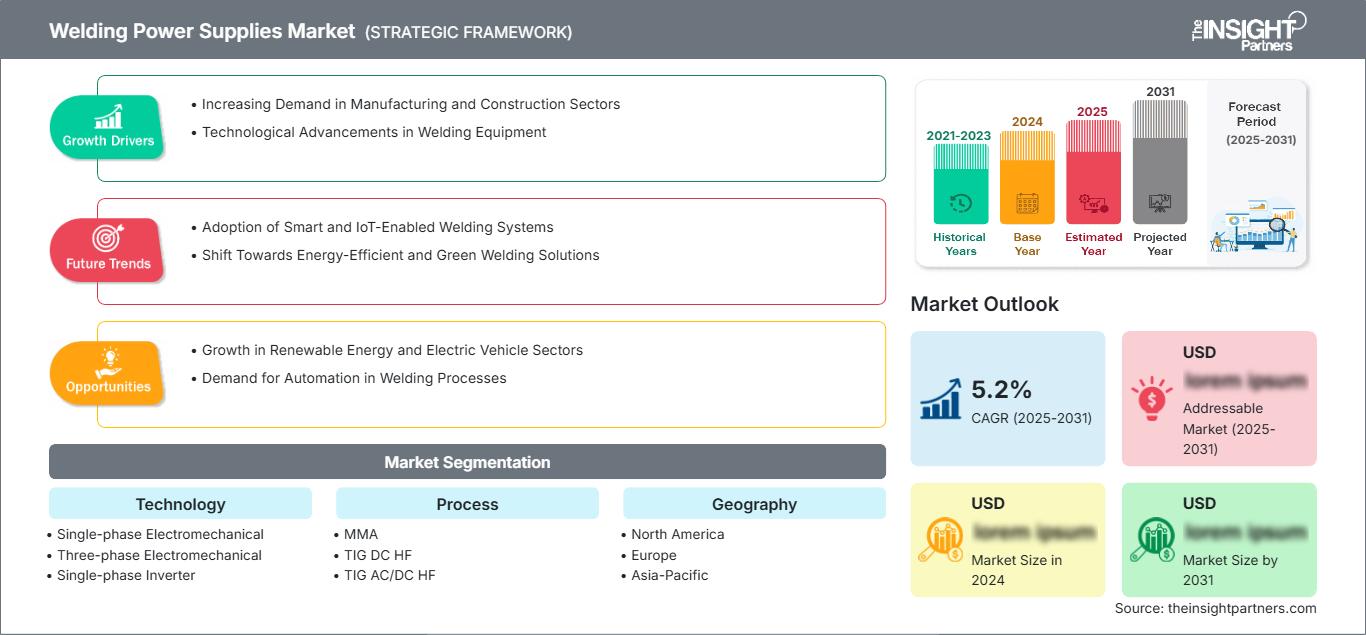
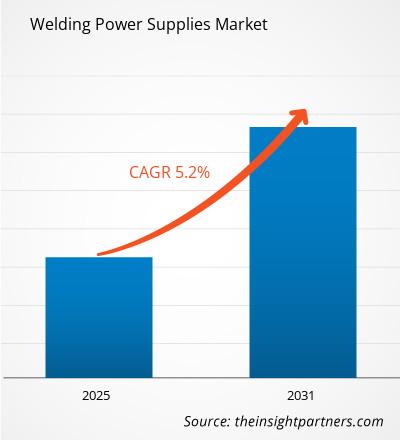
The welding power supplies market was valued at US$ 56.76 Billion in 2025 and is projected to reach US$ 124.68 Billion by 2034, registering a CAGR of 9.14% during 2026–2034. Expansion is supported by industrial automation, increasing fabrication requirements, replacement of conventional equipment, and adoption of electronically controlled power sources across transportation, construction, energy, heavy engineering, and general manufacturing applications.
Across North America, the welding power supplies market size is expected to expand at an estimated 7.8–8.6% CAGR between 2026–2034. Structural drivers include the reshoring of manufacturing capacity, modernization of fabrication facilities, demand for automated welding cells, infrastructure investment, and replacement of aging power equipment with digitally controlled, energy-efficient systems.
Welding Power Supplies Market Assessment and Insights
- North America accounted for an estimated 24–28% share in 2025 and is expected to grow at a CAGR of 7.8–8.6% between 2026–2034, supported by manufacturing investment, infrastructure programs, automation, and equipment modernization across fabrication-intensive industries.
- US represented approximately 65–69% of the North American market in 2025 and is projected to grow at a CAGR of 7.4–8.2% during 2026–2034, led by industrial reshoring and automation.
- Europe held an estimated 22–26% share in 2025 and is anticipated to register a CAGR of 6.8–7.7% through 2034, with Germany, Italy, France, the UK, and Spain supporting demand through automotive, machinery, energy, and metal fabrication activities.
- Asia Pacific represented approximately 39–43% of global demand in 2025 and is expected to record a CAGR of 10.2–11.1% between 2026–2034. China, Japan, South Korea, and India remain important production centers for automotive, electronics, machinery, shipbuilding, and infrastructure.
- Largest Segment: Three-phase Inverter accounted for an estimated 34–38% share in 2025 and is projected to grow at a CAGR of 10.0–10.8%, benefiting from high-duty industrial applications, controllability, and energy-efficient operation.
- High Growth Segment: Synergic Pulsed MIG/MAG represented approximately 9–13% share in 2025 and is expected to grow at a CAGR of 11.8–13.0%, driven by robotic welding, thin-gauge fabrication, repeatability requirements, and reduced rework.
- Key companies analyzed in detail: INE S.p.A.; DAIHEN Corporation; The Lincoln Electric Company; Colfax Corporation; Fronius International GmbH; Obara Corporation; Rofin-Sinar Technologies, Inc.; Nelson Stud Welding, Inc.; Arcon Welding Equipment; Panasonic Corporation; ESAB Corporation; Kemppi Oy.
Source: The Insight Partners' analysis based on proprietary research, government publications, company annual reports, investor presentations, industry databases, and expert interviews.
The market is evolving from transformer-dominated equipment toward inverter-based architectures capable of precise current control, programmable welding parameters, digital monitoring, and integration with automated production systems. Three-phase inverter platforms are gaining importance where high duty cycles, lower energy losses, compact equipment footprints, and process repeatability influence procurement decisions. Demand is also shifting toward multiprocess systems that support several welding methods without requiring separate power units.
Over the forecast period, investment is expected to increasingly favor connected power sources, robotic interfaces, advanced cooling, energy monitoring, and software-enabled process control. Emerging manufacturing hubs in South and Southeast Asia are likely to increase equipment consumption as fabrication capacity expands. The Welding Power Supplies Market report highlights that regulatory emphasis on worker safety, energy efficiency, traceability, and productivity will further encourage replacement of basic equipment with electronically controlled systems, while infrastructure and energy projects should sustain heavy-duty applications.
Welding Power Supplies Market Report Scope
| Report Attribute | Details |
|---|---|
| Market size in 2025 | US$ 56.76 Billion |
| Market Size by 2034 | US$ 124.68 Billion |
| Global CAGR (2026 - 2034) | 9.14% |
| Historical Data | 2021-2024 |
| Forecast period | 2026-2034 |
Welding Power Supplies Market Analysis
Demand is closely connected with the volume and complexity of metal joining across automotive, construction equipment, shipbuilding, pipelines, structural steel, general engineering, and energy infrastructure. The welding power supplies market growth is strengthened when manufacturers increase automation because power sources must provide stable output, communication capability, and repeatable process parameters. Inverter architectures also support lighter equipment and more responsive control.
These include power-source suppliers, semiconductor suppliers and suppliers of control components, welding consumables suppliers, automation system integrators, robot suppliers, distributors, service providers, and end users. Supply dynamics are becoming increasingly impacted by semiconductor availability, cost of copper and electronics components, transformer materials, and regional manufacturing capabilities. End-users are trying to weigh acquisition cost with energy efficiency, serviceability, duty cycle, compatibility, and life of the equipment.
Product competitive positioning is becoming increasingly about process specialization and the capability of integration of hardware with software, sensors, automation, and application engineering. The study reveals that companies with broader process capabilities will be able to meet diverse industrial demands, whereas companies with specialization will be able to differentiate themselves with high-precision applications. Some of the companies with differentiated product positioning include The Lincoln Electric Company, DAIHEN Corporation, Fronius International GmbH, ESAB Corporation, and Panasonic Corporation.
Investment strategies are also moving beyond standalone equipment toward integrated welding cells and connected production environments. Fronius International GmbH emphasizes digitalized welding and automation, while DAIHEN Corporation combines welding equipment with robotics and factory automation capabilities. The broader competitive field includes INE S.p.A., Kemppi Oy, Obara Corporation, Nelson Stud Welding, Inc., Arcon Welding Equipment, Colfax Corporation, and Rofin-Sinar Technologies, Inc., with differentiation varying by process and geography. According to the Welding Power Supplies Market forecast, competitive positioning will increasingly depend on automation integration, digital connectivity, energy-efficient power management, and the ability to support customers with advanced process control and productivity-enhancement solutions.
● REPORT CUSTOMIZATION
Tailor This Report To Align With Your Specific Business Requirements
This report can be customized to align precisely with your business objectives, scope, and target markets. Customization options include tailored segmentation, geography, competitive analysis, and strategic insights to support informed decision-making.
Customize This Report →WHAT YOU CAN ADJUST
- ● Segmentations
- ● Geography
- ● Competitive Analysis
- ● Language Preferences
Welding Power Supplies Market: Strategic Insights
Regional Insights
North America welding power supplies market
North America is expected to maintain a substantial position, representing 24–28% of the global Welding Power Supplies Market demand in 2025 and expanding at a CAGR of 7.8–8.6% through 2034. These factors, such as reshoring of manufacturing, infrastructure revitalization, transportation equipment manufacture, and industrial automation, are also driving the purchase of sophisticated power supplies. The demand is especially robust for equipment used in structural assembly, heavy machinery, automotive parts, energy infrastructure, and maintenance activities.
The United States accounts for a dominant share in the regional market, followed by Canada and Mexico in terms of machinery, energy, automotive, and fabricated metals manufacturing. The buyers now prefer the features of inverter technology, remote monitoring capabilities, multiprocess capability, and robotic system suitability. The labor availability is another structural driver since the manufacturers require equipment that enhances the efficiency of operators without affecting the welding performance.
U.S. welding power supplies Market
The US is estimated to account for 65–69% of North American Welding Power Supplies Market demand in 2025 and is projected to grow at a CAGR of 7.4–8.2% through 2034. Applications within automotive, aerospace, construction machinery, defense, energy, and general fabrications continue to be important uses of these products. Increased manufacturing investment means that there is an increased need for electric power that can be digitally controlled and able to interface with robots and production software.
Total cost of ownership becomes increasingly more important when purchasing large amounts of machinery for the industries involved. Energy efficiency, uptime, availability of service, suitability of electrodes/wires used, and data capture play a role in making purchases. The involvement of companies like The Lincoln Electric Company, ESAB Corporation, Fronius International GmbH, and others adds to the regional environment. Demand is further boosted by small fabricators wanting multiprocess systems.
Europe welding power supplies Market
Europe represented an estimated 22–26% of the Welding Power Supplies Market share in 2025 and is expected to register a CAGR of 6.8–7.7% through 2034. Germany is still the leader among markets in terms of demand due to its development of machinery, automotive industry, industrial equipment, and precision engineering. Italy possesses good resources in terms of machinery production and specialized fabrication shops, while France gets support from the aerospace, transport, energy, and infrastructure sectors.
The United Kingdom maintains demand as a result of the construction, energy, military, transport, and engineering sectors. Germany is especially significant in terms of advanced power sources as a result of automated production and high-quality joining needs. There are good prospects for multiprocess equipment, automation cells, and specialized welding machines in France and Italy, while Spain gets advantages of the automotive industry, infrastructure, renewable-energy equipment, and shipbuilding.
APAC welding power supplies Market
Asia Pacific is expected to remain the leading regional Welding Power Supplies Market, with an estimated 39–43% share in 2025 and a CAGR of 10.2–11.1% through 2034. China dominates the region in terms of consumption with support from machinery, shipbuilding, electric vehicles, infrastructure, and manufacturing industries. Japan and South Korea both have robust demand for precision and automation technologies.
India will become more important due to the growing manufacturing capabilities in transportation, construction equipment, energy, and engineering applications. Australia is contributing through mining, infrastructure, maintenance, and heavy fabrication. Automation and electrification of industry are making the addressable market for inverters larger. The electricity-hungry manufacturing industries of China make them important for APAC, whereas India's growing industrial electricity demand is helping invest in production machines.
Middle East & Africa welding power supplies Market
The Middle East and Africa Welding Power Supplies Market demand is projected to expand at a CAGR of 8.0–9.2% through 2034, supported by energy infrastructure, construction, transportation projects, and industrial diversification. Saudi Arabia and the UAE have emerged as key demand centers due to the need for structural and pipe fabrication for large-scale projects in both countries. South Africa's contribution is in terms of mining, metals, engineering and maintenance works.
As far as the rest of the region is concerned, the equipment demand is related to oil and gas infrastructures, power plants, water works, constructions and industry. The buyers focus on durability, service, repairability and suitability to operate in tough conditions. In some Gulf countries, a growing trend of diversification from hydrocarbons would increase demand for machinery, logistics, manufacturing, and renewable energy infrastructure.
Segmentation Analysis
Technology
Technology is divided into Single-phase Electromechanical, Three-phase Electromechanical, Single-phase Inverter, Three-phase Inverter, and Three-phase Traditional Electronic. The segment is projected to expand at a CAGR of 8.9–10.0% during 2026–2034 as users progressively replace conventional equipment with controllable, efficient, compact power electronics. Current Welding Power Supplies Market trends highlight accelerating adoption of inverter-based technologies driven by energy efficiency, improved process control, reduced equipment size, and greater compatibility with automation and digitally connected manufacturing environments.
- Single-phase Electromechanical remains relevant among small fabricators, maintenance users, workshops, and cost-sensitive operators requiring straightforward equipment. Its established service ecosystem supports replacement demand, although advanced applications increasingly favor electronic alternatives.
- Three-phase Electromechanical serves heavy-duty operations requiring robust power delivery and familiar operating characteristics. Its installed base remains important across industrial fabrication, but equipment modernization increasingly shifts purchasing toward inverter architectures.
- Single-phase Inverter supports portable and compact welding applications where flexibility, lower equipment weight, and controllable output are valued. It is strategically important for workshops, field maintenance, construction, and small-scale fabrication.
- Three-phase inverters represent the dominant technology category because high-duty industrial operations require precise control, efficient power conversion, multiprocess capability, and compatibility with automation and digitally monitored production environments.
- Three-phase Traditional Electronic occupies applications requiring electronically controlled operation without the full architecture of newer inverter platforms. Demand persists in established industrial installations where reliability and compatibility with existing processes remain priorities.
Process
Process comprises MMA, TIG DC HF, TIG AC/DC HF, MIG/MAG, Synergic Pulsed MIG/MAG, Synergic MIG/MAG, Submerged Arc, ARC-AIR, and Plasma Cutting. The segment is expected to grow at a CAGR of 9.3–10.3% through 2034 as manufacturers require increasingly specialized and controllable joining processes. The Welding Power Supplies Market is being shaped by rising demand for advanced welding processes that offer improved precision, productivity, automation compatibility, and consistent weld quality across diverse industrial applications.
- MMA remains strategically important for construction, repair, field maintenance, and heavy fabrication because equipment is portable, electrode selection is flexible, and operation remains practical in variable working environments.
- TIG DC HF is favored where controlled heat input, clean weld appearance, and precision joining are important. Industrial maintenance, stainless-steel fabrication, and specialized components sustain its relevance.
- TIG AC/DC HF serves applications involving both ferrous and nonferrous materials, particularly aluminum. Aerospace, precision fabrication, repair, and high-quality component manufacturing support demand for flexible current control.
- MIG/MAG remains a high-volume process for production welding because continuous wire feeding supports productivity, automation, and relatively high deposition rates across diverse industrial applications.
- Synergic Pulsed MIG/MAG is increasingly important for robotic and precision applications requiring stable transfer, reduced spatter, controlled heat input, and repeatable results across changing material thicknesses.
- Synergic MIG/MAG supports operators seeking simplified parameter selection and consistent production results. Its strategic value increases where manufacturers need productivity improvements without extensive manual adjustment.
- Submerged Arc serves heavy fabrication involving long welds and high deposition requirements. Shipbuilding, pressure equipment, structural fabrication, and large-scale industrial projects provide a stable application base.
- ARC-AIR remains relevant for gouging, repair, weld removal, and preparation activities. Heavy fabrication and maintenance operations require dependable high-current systems capable of sustained industrial use.
- Plasma Cutting benefits from precise cutting requirements, fabrication automation, and integrated cutting-welding workflows. Demand is supported by manufacturers seeking improved material utilization and process consistency.
Opportunity Snapshot
| Process | Revenue Contribution | Trend Tag | Adoption Stage |
| MMA | Medium | Field Repair | Mature |
| TIG DC HF | Medium | Precision Welding | Mature |
| TIG AC/DC HF | Medium | Aluminum Joining | Scaling |
| MIG/MAG | High | High Deposition | Mature |
| Synergic Pulsed MIG/MAG | Medium | Robotic Pulsing | Scaling |
| Synergic MIG/MAG | Medium | Digital Control | Scaling |
| Submerged Arc | Medium | Heavy Fabrication | Mature |
| ARC-AIR | Low | Weld Removal | Mature |
| Plasma Cutting | Medium | Integrated Cutting | Scaling |
Welding Power Supplies Market Growth Drivers and Impact Analysis
Expansion of automated and robotic fabrication
This is driving an increase in the technical specifications of welding power source systems due to the requirements for robotic process control, such as stability of current characteristics, repeatability, communication, and quick response to process changes. The effect is not limited to the automotive industry but affects other areas such as machinery, construction machines, ships, and fabricated metal products. The opportunity for power-source system suppliers lies in the integration of sensors, monitoring, software, and automation rather than sales of power sources per se. The economic driver for the manufacturer is connected to the increased utilization and decreased rework, quality, and operator efficiency. This trend is beneficial to inverter systems due to their electronic control system, which is easy to adapt to robotic movements and process control.
Industrial electrification and energy-efficiency priorities
Industrial electrification is strengthening the strategic importance of equipment efficiency, particularly as manufacturers evaluate electricity consumption alongside productivity and operating costs. The IEA reports that industry accounted for nearly 40% of global final energy consumption in 2024, reinforcing the importance of efficient industrial processes. Modern inverter systems can improve controllability and reduce unnecessary energy use compared with legacy architectures. The commercial impact is strongest where equipment operates for long shifts and across multiple production lines. Buyers are increasingly evaluating power factor, standby consumption, cooling requirements, duty cycle, and process efficiency when comparing systems. Suppliers that quantify energy performance and integrate monitoring capabilities can strengthen their position in modernization projects. This driver is particularly relevant in regions where industrial electricity costs and decarbonization objectives influence capital expenditure decisions.
Skilled-welder shortages and productivity requirements
Persistent shortages of experienced welding personnel are encouraging manufacturers to invest in equipment that simplifies parameter selection and supports consistent results. Digital interfaces, synergic control, guided settings, sensing, and automation can reduce the dependence on highly experienced operators for repeatable production work. The market impact is evident in applications where manufacturers must maintain output while managing an aging workforce and training new personnel. Equipment that shortens setup time, improves weld consistency, and provides process feedback can support faster operator qualification. This dynamic also expands the addressable opportunity for multiprocess systems because a single platform can accommodate different joining requirements across production and maintenance activities. Suppliers increasingly compete on ease of use and process intelligence alongside conventional measures such as current capacity, duty cycle, durability, and price.
Welding Power Supplies Market Future Trends
Connected power sources and data-enabled welding
Connected welding systems are expected to evolve from simple parameter displays into production data platforms capable of recording current, voltage, wire-feed conditions, fault events, operating time, and process deviations. Such capabilities can support preventive maintenance, quality documentation, operator training, and production optimization. Over time, cloud connectivity and industrial software interfaces may enable centralized monitoring of distributed welding equipment across multiple facilities. The strongest adoption is likely among automotive, aerospace, heavy equipment, and contract manufacturers, where traceability has commercial importance. Smaller fabricators may adopt simplified connectivity as equipment prices decline and software becomes easier to configure. Suppliers that combine hardware, sensors, cybersecurity, and application software should be positioned to capture recurring service opportunities while improving equipment utilization and process transparency.
Adaptive welding and energy-aware process control
Future systems are likely to use increasingly adaptive control strategies that automatically respond to joint geometry, material conditions, torch movement, and process feedback. Rather than relying entirely on fixed parameter schedules, power sources will increasingly support closed-loop adjustments intended to stabilize arc behavior and minimize defects. Energy-aware control may also optimize current and voltage profiles according to required penetration and deposition, helping reduce unnecessary consumption without sacrificing weld quality. These developments can become particularly valuable in robotic production, where cycle time and repeatability directly affect manufacturing economics. Integration with machine vision, seam tracking, wire sensing, and digital twins should gradually expand the role of the power source from an energy provider into an active process-control component.
Welding Power Supplies Market Opportunities
Localized manufacturing and service ecosystems
Manufacturers can pursue growth by establishing regional production, application engineering, training, and service capabilities in emerging industrial economies. Localized support can reduce downtime, shorten spare-parts lead times, and improve equipment configuration for regional materials and standards. India, Southeast Asia, Mexico, Brazil, and Gulf economies offer opportunities because industrial capacity is expanding across automotive components, machinery, energy, construction, and infrastructure. Suppliers can strengthen customer relationships through application laboratories, technical training, rental programs, refurbishment services, and digital diagnostics. A localized approach also helps companies manage tariff exposure and supply-chain disruptions while adapting product portfolios to regional voltage configurations and process preferences. Strategic partnerships with automation integrators and distributors can accelerate market entry without requiring immediate full-scale manufacturing investment.
Integrated multiprocess platforms for flexible production
Flexible manufacturing is creating opportunities for suppliers that combine several joining and cutting capabilities within integrated equipment platforms. A single digitally controlled power source supporting multiple processes can reduce floor-space requirements, simplify operator training, and improve asset utilization for manufacturers handling varied production schedules. The opportunity is particularly relevant to small and medium-sized fabricators that cannot economically dedicate separate equipment to every process. Advanced interfaces can allow users to save application-specific programs, monitor operating parameters, and transfer settings between production teams. Suppliers can further differentiate through modular accessories, remote diagnostics, automation compatibility, and consumable optimization. Such platforms provide an attractive route for upgrading legacy equipment while preserving flexibility across construction, repair, machinery, transportation, and general fabrication applications.
Frequently Asked Questions

- Comprehensive Market Sizing and Forecast Analysis
- Detailed Segmentation Analysis
- In-Depth Market Dynamics Assessment
- Regional and Country-Level Insights
- Competitive Landscape and Company Benchmarking
- Strategic Business Intelligence
Recent Reports
Testimonials

The Insight Partners' SCADA System Market report is comprehensive, with valuable insights on current trends and future forecasts. The team was highly professional, responsive, and supportive throughout. We are very satisfied and highly recommend their services.
RAN KEDEM Partner, Reali Technologies LTDs
I requested a report on a very specific software market and the team produced the report in a few days. The information was very relevant and well presented. I then requested some changes and additions to the report. The team was again very responsive and I got the final report in less than a week.
JEAN-HERVE JENN Chairman, Future Analytica
We worked with The Insight Partners for an important market study and forecast. They gave us clear insights into opportunities and risks, which helped shape our plans. Their research was easy to use and based on solid data. It helped us make smart, confident decisions. We highly recommend them.
PIYUSH NAGPAL Sr. Vice President, High Beam Global
The Insight Partners delivered insightful, well-structured market research with strong domain expertise. Their team was professional and responsive throughout. The user-friendly website made accessing industry reports seamless. We highly recommend them for reliable, high-quality research services
YUKIHIKO ADACHI CEO, Deep Blue, LLC.
This is the first time I have purchased a market report from The Insight Partners.While I was unsure at first, I visited their web site and felt more comfortable to take the risk and purchase a market report.I am completely satisfied with the quality of the report and customer service. I had several questions and comments with the initial report, but after a couple of dialogs over email with their analyst I believe I have a report that I can use as input to our strategic planning process.Thank you so much for taking the extra time and making this a positive experience.I will definitely recommend your service to others and you will be my first call when we need further market data.
JOHN SUZUKI President and Chief Executive Officer, Board Director, BK Technologies
I wish to appreciate your support and the professionalism you displayed in the course of attending to my request for information regarding to infectious disease IVD market in Nigeria. I appreciate your patience, your guidance, and the fact that you were willing to offer a discount, which eventually made it possible for us to close a deal. I look forward to engaging The Insight Partners in the future, all thanks to the impression you have created in me as a result of this first encounter.
DR CHIJIOKE ONYIA MANAGING DIRECTOR, PineCrest Healthcare Ltd.Reason to Buy
- Informed Decision-Making
- Understanding Market Dynamics
- Competitive Analysis
- Identifying Emerging Markets
- Customer Insights
- Market Forecasts
- Risk Mitigation
- Boosting Operational Efficiency
- Strategic Planning
- Investment Justification
- Tracking Industry Innovations
- Aligning with Regulatory Trends





 Get Free Sample for