
Wireless Power Transmission Market Trends, Share & Demand by 2034
Coverage: by Technology (Near-Field, Far-Field); Implementation (Integrated, Aftermarket); Application (EV Charging, Smartphones, Wearable Electronics, Industrial, Others) , and Geography (North America, Europe, Asia Pacific, and South and Central America)
- Status : Data Released
- Report Code : TIPRE00008416
- Category : Electronics and Semiconductor
- No. of Pages : 150
- Available Report Formats :


- Last update date : September 28, 2026


2025 Market Size
US$ 17.8 Bn
Base year value
2034 Forecast
US$ 44.28 Bn
Projected by 2034
CAGR 2026-2034
10.65 %
Growth rate
Addressable Market
US$ 274.88 Bn
(2026-2034)
The wireless power transmission market is expanding as contactless energy delivery moves from consumer charging pads into electric mobility, industrial automation, connected devices, and infrastructure applications. The market is valued at US$ 17.8 Billion in 2025 and is projected to reach US$ 44.28 Billion by 2034, registering a CAGR of 10.65% during 2026–2034. Adoption is being supported by advances in resonant coupling, power electronics, alignment systems, receiver miniaturization, and increasingly integrated charging architectures.
North America remains a strategically important market, with the wireless power transmission market size supported by EV infrastructure deployment, consumer electronics innovation, robotics, and industrial IoT adoption. A modeled 9.2–10.1% CAGR during 2026–2034 reflects increasing investment in automated charging, battery-free sensing, and interoperable wireless power systems, while regulatory work around electromagnetic compatibility and vehicle charging standards strengthens commercialization.
Wireless Power Transmission Market Assessment and Insights
- North America: North America is expected to account for a 29–33% wireless power transmission market share in 2025 and grow at a 9.2–10.1% CAGR between 2026–2034, supported by EV charging, industrial automation, consumer electronics, and established technology ecosystems.
- US: The US is estimated to represent 67–71% of North America's 2025 market and expand at an 8.8–9.7% CAGR during 2026–2034, driven by EV fleets, IoT, and enterprise deployments.
- Europe: Europe is projected to hold a 24–28% share in 2025 and expand at a 10.0–10.8% CAGR during 2026–2034, led by Germany, the UK, France, Italy, and Spain, where electrification and efficiency policies support adoption.
- Asia Pacific: Asia Pacific is estimated at a 32–36% share in 2025 and is expected to register an 11.4–12.3% CAGR through 2034, with China, Japan, South Korea, and India benefiting from electronics manufacturing and EV expansion.
- Largest Segment: Near-Field technology is estimated to hold a 78–82% market share in 2025 and expand at a 9.4–10.2% CAGR through 2034, supported by mature consumer and automotive applications.
- High Growth Segment: EV Charging is estimated at a 26–30% share in 2025 and is expected to grow at a 14.0–15.2% CAGR, reflecting accelerating vehicle electrification and automated charging demand.
- Key companies analyzed in detail: ConvenientPower HK Limited, Energous Corporation, Humavox Ltd., NuCurrent, Ossia Inc., Powermat Technologies Ltd., TDK Corporation, WiBotic Inc., Wi-Charge Ltd., and WiTricity Corporation.
Source: The Insight Partners' analysis based on proprietary research, government publications, company annual reports, investor presentations, industry databases, and expert interviews.
The wireless power transmission market growth has seen a movement from individual device charging to interoperable energy solutions. Inductive and resonant near field configurations are still prevalent in applications that are established; meanwhile, radio frequency far-field solutions cater to battery-less sensors and IoT nodes. Manufacturers are increasingly focusing on thermal considerations, miniaturized receivers, alignment tolerance, efficiency of power conversion, foreign object detection, and interoperability. The economics of manufacturing have become increasingly positive due to reduced components through integration of semiconductors resulting in reduced transmitter-receiver modules.
Going forward, wireless power transmission solutions are likely to become more geographically diverse, as charging facilities, smart factories, and connected devices become common outside technology hotbeds. Funding is directed towards high-power automobile applications, automated fleet charging, battery-less sensing, and power management platforms. Market expansion will be affected by regulation, requirements related to electromagnetic compatibility, and interoperability standards. Most promising business cases are those where wireless power transmission eliminates regular labor cost, costs related to maintaining connectors or batteries.
Wireless Power Transmission Market Report Scope
| Report Attribute | Details |
|---|---|
| Market size in 2025 | US$ 17.8 Billion |
| Market Size by 2034 | US$ 44.28 Billion |
| Global CAGR (2026 - 2034) | 10.65% |
| Historical Data | 2021-2024 |
| Forecast period | 2026-2034 |
Wireless Power Transmission Market Analysis
The wireless power transmission market forecast shows that convenience, automation, and operational efficiencies are driving demands as compared to just the novelty factor. In consumer electronics, the contact-less feature eliminates the connector and allows for sealed products. In mobility, automated charging reduces driver intervention and even allows charging in scheduled dwell times. The industrial applications increase the demand since the wireless charging can charge equipment in wet, dusty, sterile, and mechanically constrained environments. So, the demand for wireless power transfer market is application specific rather than following any technology route.
The ecosystem consists of semiconductor companies, manufacturers of coils and antennas, power electronics companies, companies working with transmitters and receivers, device Original Equipment Manufacturers, charging infrastructure players, software players, and standard organizations. The supply side dynamics are tilting towards the suppliers that can offer high power efficiency along with sensing capabilities, communication features, and thermal management capability. The automotive solutions have very long qualification time and extensive interoperability testing, whereas consumer products need to be compact and low-cost.
Positioning in the wireless power transmission market report is moving towards intellectual property, interoperability, efficiency of the system, application engineering, and commercialization capabilities. WiTricity Corporation concentrates on magnetic resonance charging for mobility, whereas WiBotic Inc. is concentrating strongly on autonomous and industrial systems. Energous Corporation and Ossia Inc. concentrate on over-the-air power transmission, especially for distributed sensing and connected environments. Component capability and power electronics are provided by TDK Corporation, whereas NuCurrent and Powermat Technologies Ltd. are participating in charging architectures and integration ecosystems.
There are some indications that investment is increasingly moving to be application-driven. There is an emphasis on automotive qualification, charging interoperability, receiver integration, and enterprise IoT deployments rather than merely laboratory demonstrations. ConvenientPower HK Limited, Humavox Ltd., and Wi-Charge Ltd. are specialists in various wireless delivery architectures, with ecosystem partnerships assisting in overcoming commercialization challenges. The wireless power transmission market report shows a competitive landscape where technological differentiation needs to be increasingly combined with manufacturability, certification, and customer-specific integration.
● REPORT CUSTOMIZATION
Tailor This Report To Align With Your Specific Business Requirements
This report can be customized to align precisely with your business objectives, scope, and target markets. Customization options include tailored segmentation, geography, competitive analysis, and strategic insights to support informed decision-making.
Customize This Report →WHAT YOU CAN ADJUST
- ● Segmentations
- ● Geography
- ● Competitive Analysis
- ● Language Preferences
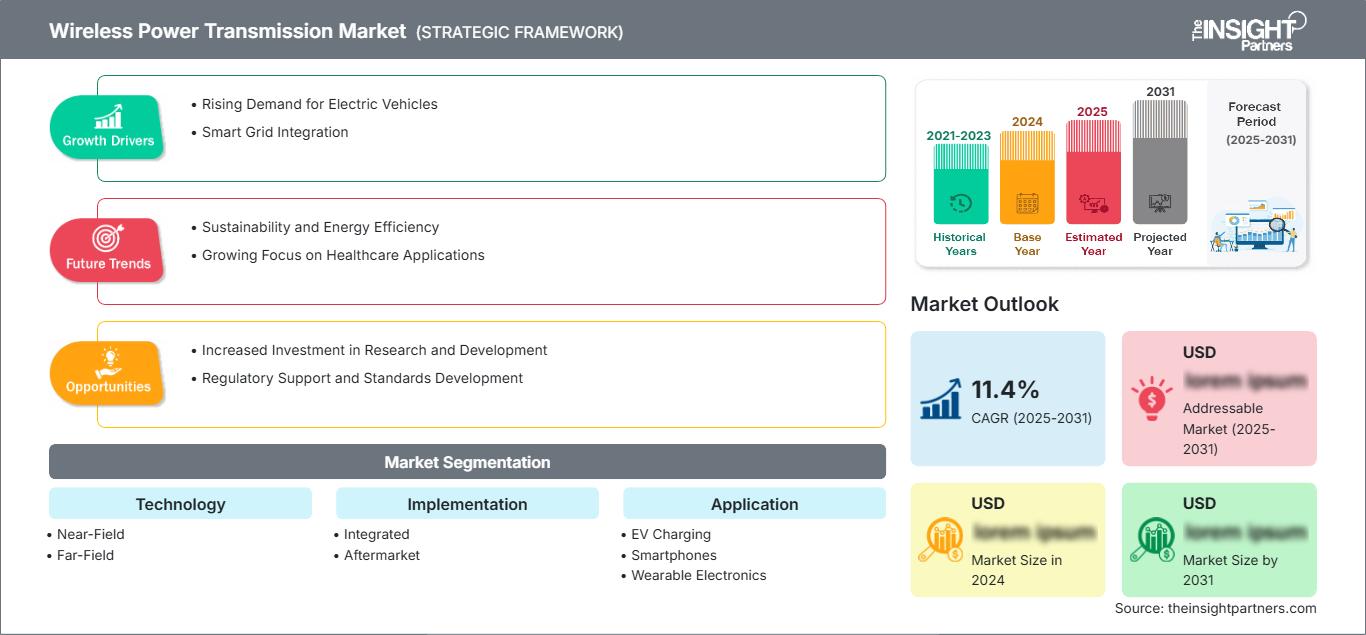
Wireless Power Transmission Market: Strategic Insights
Regional Insights
North America wireless power transmission market
North America is estimated to represent 29–33% of global demand in 2025 and is modeled to expand at a 9.2–10.1% CAGR through 2034. There are existing semiconductor technologies, advanced automotive systems, enterprise IoT applications, and investments made in automated charging infrastructure. The U.S. is the major market contributor, but Canada brings in new opportunities such as electric mobility, industrial automation, logistics, and connected infrastructure. Wireless charging is especially applicable to fleets as automated energy transfer helps avoid manual processes and increases utilization of the vehicle.
Wireless charging application is moving further away from smartphones and wearables. Automakers and fleet managers are exploring wireless charging for passenger cars, buses, logistics infrastructure, and autonomous vehicles, while industry consumers use wireless power for robots and sensors. Far-field testing infrastructure for battery-less devices is also part of the local tech ecosystem. Compliance with regulations, electromagnetic compatibility, and interoperability are the key purchasing factors for wireless power solutions.
U.S. wireless power transmission market
The U.S. is estimated to account for 67–71% of North America's 2025 value and is projected to grow at an 8.8–9.7% CAGR through 2034. There are factors driving the demand from EV deployment, consumer electronics, robotics, warehouse automation, and IoT for enterprises. There are high investments and a large existing inventory of connected devices which need a reliable source of energy.
The industry is seeing the rise of applications such as automated vehicle charging, robots for industry, equipment in healthcare and logistics, and sensors without batteries. The major companies in the industry include Energous Corporation, WiBotic Inc., Ossia Inc., and WiTricity Corporation, and each company has a unique way to deliver over-the-air charging, autonomous charging, or magnetic resonance solutions. The ease of integration with the receiver and ownership costs become key decision criteria for purchasing.
Europe wireless power transmission market
Europe is estimated to hold a 24–28% share in 2025 and is modeled to grow at a 10.0–10.8% CAGR through 2034. The country with the most developed industrial application is Germany, driven by automotive engineering, manufacturing automation, and energy-saving policies. In the UK, there are opportunities for development in terms of connected infrastructure, EVs, and advanced services. France is driven by automotive and industrial electrification projects, while Italy and Spain offer opportunities in mobility, consumer electronics, logistics, and smart infrastructure solutions. Regional demand increasingly depends on seamless charging and efficiency.
In Germany, automotive engineering creates a large pool of applications for magnetic-resonance charging, especially if automated charging is involved for both passenger cars and commercial vehicles. The UK is a place to develop fleet electrification and smart mobility infrastructure solutions. In France, automotive manufacturing is supplemented with industrial automation. Opportunities in Italy and Spain include expansion of applications in mobility, logistics, hospitality, and consumer electronics. The regional CAGR of 10.0–10.8% reflects expanding application breadth rather than dependence on one end market.
APAC wireless power transmission market
APAC is estimated to represent 32–36% of 2025 demand and is projected to grow at an 11.4–12.3% CAGR through 2034, making it the leading regional growth market. China is at the forefront, driven by its manufacturing capability, electric vehicles, and automation. The contributions from Japan and South Korea come in the form of electronics and automotive capabilities, while those from India and Australia come in the form of new opportunities.
The manufacturing prowess of China helps to accelerate component integration and cost reductions. While Japan focuses on precision electronics, robotics, and mobility, South Korea has the advantage of advanced consumer electronics and automotive supply chains. India offers potential through electric vehicle adoption, digital infrastructure, and industrial upgrading, whereas Australia offers potential through mining, logistics, and fleet electrification.
Middle East & Africa wireless power transmission market
Middle East and Africa is modeled to expand at an 8.1–9.0% CAGR through 2034. Saudi Arabia leads regional opportunities through smart-city development, EV infrastructure, and large-scale technology programs. The UAE follows with strong adoption potential in airports, logistics, hospitality, and connected infrastructure. South Africa provides opportunities in industrial automation, mining, and electric mobility.
The region's energy and infrastructure context favors technologies that can reduce maintenance and automate equipment operation. Wireless systems can support fleet depots, industrial vehicles, sensors, and public-facing charging environments where connector reliability is important. Rest-of-MEA markets remain earlier-stage but offer opportunities as infrastructure modernization accelerates. Deployment will depend on certification, local integration capabilities, equipment durability, and economics relative to conventional wired systems.
Segmentation Analysis
Technology
Technology is divided into Near-Field and Far-Field, with the overall technology segment modeled to grow at a 10.0–10.9% CAGR during 2026–2034. Near-field architectures remain commercially established, while far-field systems are expanding through battery-free sensing and distributed IoT applications. Technology selection increasingly depends on range, power requirement, efficiency, alignment tolerance, regulatory conditions, and device form factor.
- Near-Field: Near-Field systems remain central to smartphones, wearable electronics, EV charging, and industrial equipment because short-range coupling supports relatively high efficiency, predictable power delivery, compact receiver designs, and established interoperability practices.
- Far-Field: Far-Field approaches address applications requiring power without physical alignment, particularly low-power sensors and ambient IoT devices. Their strategic value increases where battery replacement, wiring, or maintenance creates recurring operational costs.
Implementation
Implementation includes Integrated and Aftermarket, with the segment projected to expand at a 9.8–10.7% CAGR during 2026–2034. Integrated systems benefit from OEM-level design optimization, whereas aftermarket solutions broaden the addressable installed base and provide retrofit pathways for existing equipment.
- Integrated: Integrated solutions are embedded during product design, allowing optimized coils, thermal management, power electronics, and enclosure architecture. Automotive and consumer-electronics OEMs favor this approach where seamless user experience and system-level efficiency are priorities.
- Aftermarket: Aftermarket solutions enable existing vehicles, industrial machines, and electronic devices to gain wireless charging capabilities without complete replacement. Retrofit flexibility is strategically important for fleet operators seeking staged electrification and lower initial capital requirements.
Application
Application comprises EV Charging, Smartphones, Wearable Electronics, Industrial, and Others, with the application segment modeled to grow at a 12.1–13.0% CAGR during 2026–2034. EV charging provides the strongest expansion pathway as automation and electrification converge, while industrial use cases benefit from continuous equipment operation.
- EV Charging: EV Charging is becoming strategically important for automated fleets, passenger vehicles, buses, and logistics equipment. Park-and-charge architectures can reduce manual intervention while enabling frequent opportunity charging during predictable dwell periods.
- Smartphones: Smartphones remain a mature volume application supported by consumer familiarity, widespread charging accessories, and increasingly integrated receiver hardware. Competitive emphasis is shifting toward faster charging, thermal control, and multi-device convenience.
- Wearable Electronics: Wearable Electronics benefit from compact receiver designs and sealed enclosures. Wireless charging supports smartwatches, fitness devices, medical wearables, and emerging augmented-reality products where connector elimination can improve durability and user experience.
- Industrial: Industrial applications include robots, autonomous equipment, sensors, material-handling systems, and specialized machinery. Wireless power can reduce connector failures, enable charging in constrained environments, and support unattended operation.
Opportunity Snapshot
| Application | Revenue Contribution (High/Medium/Low) | Trend Tag | Adoption Stage |
|---|---|---|---|
| EV Charging | High | Automated Charging | Scaling |
| Smartphones | High | Fast Charging | Mature |
| Wearable Electronics | Medium | Sealed Devices | Scaling |
| Industrial | Medium | Autonomous Power | Scaling |
| Others | Low | Ambient Power | Emerging |
Wireless Power Transmission Market Growth Drivers and Impact Analysis
Automated EV charging and fleet electrification
Electric mobility is creating a new demand pathway because vehicles require charging infrastructure that can operate with minimal human intervention. The International Energy Agency reported that global electric car sales exceeded 20 million units in 2025, with electric vehicles representing about one-quarter of new car sales. This enlarges the potential addressable base for automated charging systems. Fleet operators have an additional incentive because vehicles can charge during scheduled stops without drivers handling connectors. Over time, automated charging can support higher vehicle utilization, standardized depot layouts, and autonomous operations. The resulting impact extends beyond passenger cars to buses, logistics vehicles, airport equipment, and industrial fleets, strengthening the commercial case for high-power wireless systems.
Expansion of battery-free industrial IoT ecosystems
Industrial organizations increasingly require continuous asset visibility across warehouses, production areas, cold-chain environments, and logistics networks. Battery-powered sensors can create maintenance obligations because devices require periodic replacement, inspection, or recharging. Wireless power provides an alternative by supplying energy directly to low-power sensors or enabling hybrid energy-harvesting architectures. This changes the economics of connected infrastructure by reducing service interventions and supporting more densely distributed sensing. The impact is particularly relevant in environments where thousands of devices may be deployed across difficult-to-access locations. As industrial companies pursue predictive maintenance and real-time inventory visibility, the combination of wireless energy, sensing, connectivity, and cloud analytics can create recurring infrastructure demand rather than one-time hardware purchases.
Interoperability and power-electronics integration
Improved interoperability is reducing one of the major barriers to wider deployment: uncertainty over whether transmitters and receivers will function across different equipment platforms. Standardized interfaces, improved foreign-object detection, better alignment tolerance, and more efficient power conversion are increasing system reliability. Semiconductor integration is also reducing module size and simplifying thermal management. These improvements matter commercially because wireless systems compete not only against one another but also against conventional connectors and cables. When installation, maintenance, and operating costs are considered together, better system integration can strengthen the total-cost proposition. The impact is likely to be strongest in applications requiring repeated charging cycles, rugged operation, or sealed equipment, where connector wear and manual handling create measurable operational costs.
Wireless Power Transmission Market Future Trends
Intelligent multi-device energy management
Future wireless systems are likely to move beyond one transmitter serving one receiver toward intelligent platforms capable of managing several devices according to power demand, priority, battery state, and operating schedules. Such architectures could dynamically allocate energy across smartphones, wearables, sensors, robots, and vehicles while communicating device status to enterprise software. This trend will require stronger sensing, embedded control, authentication, and thermal-management capabilities. The wireless power transmission market trends are therefore likely to converge with edge computing and device-management technologies. In commercial environments, energy allocation could become software-defined, allowing operators to prioritize mission-critical equipment while reducing unnecessary charging. This model may create new recurring revenue opportunities around energy-management software, monitoring services, analytics, and fleet optimization.
Dynamic charging for autonomous mobility
A longer-term development is the integration of wireless power with autonomous mobility, where charging must occur without human intervention. Static charging pads are the immediate pathway, but future deployments may incorporate charging into dedicated lanes, depots, taxi stands, warehouse routes, and other controlled environments. Dynamic or semi-dynamic charging could reduce the need for large stationary batteries by enabling vehicles to receive energy during operations or scheduled stops. Progress will depend on power levels, alignment, thermal performance, infrastructure cost, interoperability, and regulatory approvals. As autonomous shuttles, delivery vehicles, industrial robots, and specialized fleets become more capable, wireless energy delivery can become part of the vehicle operating architecture rather than a standalone charging accessory.
Wireless Power Transmission Market Opportunities
Retrofit charging for existing electric fleets
A substantial opportunity exists in retrofitting existing electric fleets rather than waiting for wireless capability to become standard equipment. Commercial operators often manage vehicles with long service lives, creating a gap between current assets and newer charging architectures. Retrofit receivers and charging pads can allow fleet owners to introduce automated charging incrementally while retaining existing vehicles. This model can be attractive for airports, warehouses, ports, golf facilities, municipal fleets, and delivery operations where vehicles return to predictable locations. Suppliers can strengthen the opportunity by offering installation services, financing, maintenance contracts, and fleet-management integration. The resulting business model shifts wireless charging from a component sale toward an infrastructure solution with recurring service potential.
Battery-free sensing and ambient IoT infrastructure
Battery-free sensing offers another investment opportunity because enterprises increasingly want persistent visibility without creating large maintenance programs. Wireless power networks can support sensors that monitor temperature, location, inventory movement, equipment status, or environmental conditions. The opportunity is especially relevant to warehouses, retail facilities, manufacturing plants, logistics centers, and cold-chain operations. Suppliers that combine transmitters, sensors, communications, cloud management, and analytics can address the complete deployment rather than selling power hardware alone. Investors and technology developers should prioritize applications where battery replacement is expensive or operationally disruptive. The strongest opportunities are likely to emerge from large-scale deployments in which small improvements in maintenance frequency, inventory accuracy, or asset utilization create measurable economic benefits.
Frequently Asked Questions

- Comprehensive Market Sizing and Forecast Analysis
- Detailed Segmentation Analysis
- In-Depth Market Dynamics Assessment
- Regional and Country-Level Insights
- Competitive Landscape and Company Benchmarking
- Strategic Business Intelligence
Recent Reports
Testimonials

The Insight Partners' SCADA System Market report is comprehensive, with valuable insights on current trends and future forecasts. The team was highly professional, responsive, and supportive throughout. We are very satisfied and highly recommend their services.
RAN KEDEM Partner, Reali Technologies LTDs
I requested a report on a very specific software market and the team produced the report in a few days. The information was very relevant and well presented. I then requested some changes and additions to the report. The team was again very responsive and I got the final report in less than a week.
JEAN-HERVE JENN Chairman, Future Analytica
We worked with The Insight Partners for an important market study and forecast. They gave us clear insights into opportunities and risks, which helped shape our plans. Their research was easy to use and based on solid data. It helped us make smart, confident decisions. We highly recommend them.
PIYUSH NAGPAL Sr. Vice President, High Beam Global
The Insight Partners delivered insightful, well-structured market research with strong domain expertise. Their team was professional and responsive throughout. The user-friendly website made accessing industry reports seamless. We highly recommend them for reliable, high-quality research services
YUKIHIKO ADACHI CEO, Deep Blue, LLC.
This is the first time I have purchased a market report from The Insight Partners.While I was unsure at first, I visited their web site and felt more comfortable to take the risk and purchase a market report.I am completely satisfied with the quality of the report and customer service. I had several questions and comments with the initial report, but after a couple of dialogs over email with their analyst I believe I have a report that I can use as input to our strategic planning process.Thank you so much for taking the extra time and making this a positive experience.I will definitely recommend your service to others and you will be my first call when we need further market data.
JOHN SUZUKI President and Chief Executive Officer, Board Director, BK Technologies
I wish to appreciate your support and the professionalism you displayed in the course of attending to my request for information regarding to infectious disease IVD market in Nigeria. I appreciate your patience, your guidance, and the fact that you were willing to offer a discount, which eventually made it possible for us to close a deal. I look forward to engaging The Insight Partners in the future, all thanks to the impression you have created in me as a result of this first encounter.
DR CHIJIOKE ONYIA MANAGING DIRECTOR, PineCrest Healthcare Ltd.Reason to Buy
- Informed Decision-Making
- Understanding Market Dynamics
- Competitive Analysis
- Identifying Emerging Markets
- Customer Insights
- Market Forecasts
- Risk Mitigation
- Boosting Operational Efficiency
- Strategic Planning
- Investment Justification
- Tracking Industry Innovations
- Aligning with Regulatory Trends





 Get Free Sample for