
Zinc Air Battery Market Size, Trends & Growth by 2034
Zinc Air Battery Market Size and Forecasts (2021–2034), Global and Regional Share, Trends, and Growth Opportunity Analysis Report Coverage : By Application (Consumer Electronics, Medical Devices, Military & Defense, Automotive, Aerospace, Industrial), Form Factor (Button Cells, Coin Cells, Cylindrical Cells, Pouch Cells, Prismatic Cells), Capacity Range ( 100 mAh, 100-500 mAh, 500-1000 mAh, 1000-2000 mAh, > 2000 mAh), Electrode Material (Zinc-Manganese Dioxide, Zinc-Iron Oxide, Zinc-Nickel Oxide, Zinc-Silver Oxide, Other Advanced Electrodes)
- Status : Data Released
- Report Code : TIPRE00039685
- Category : Electronics and Semiconductor
- No. of Pages : 150
- Available Report Formats :


- Last update date : September 28, 2026


2025 Market Size
US$ 464.49 Mn
Base year value
2034 Forecast
US$ 685.17 Mn
Projected by 2034
CAGR 2026-2034
4.41 %
Growth rate
Addressable Market
US$ 5,219.42 Mn
(2026-2034)
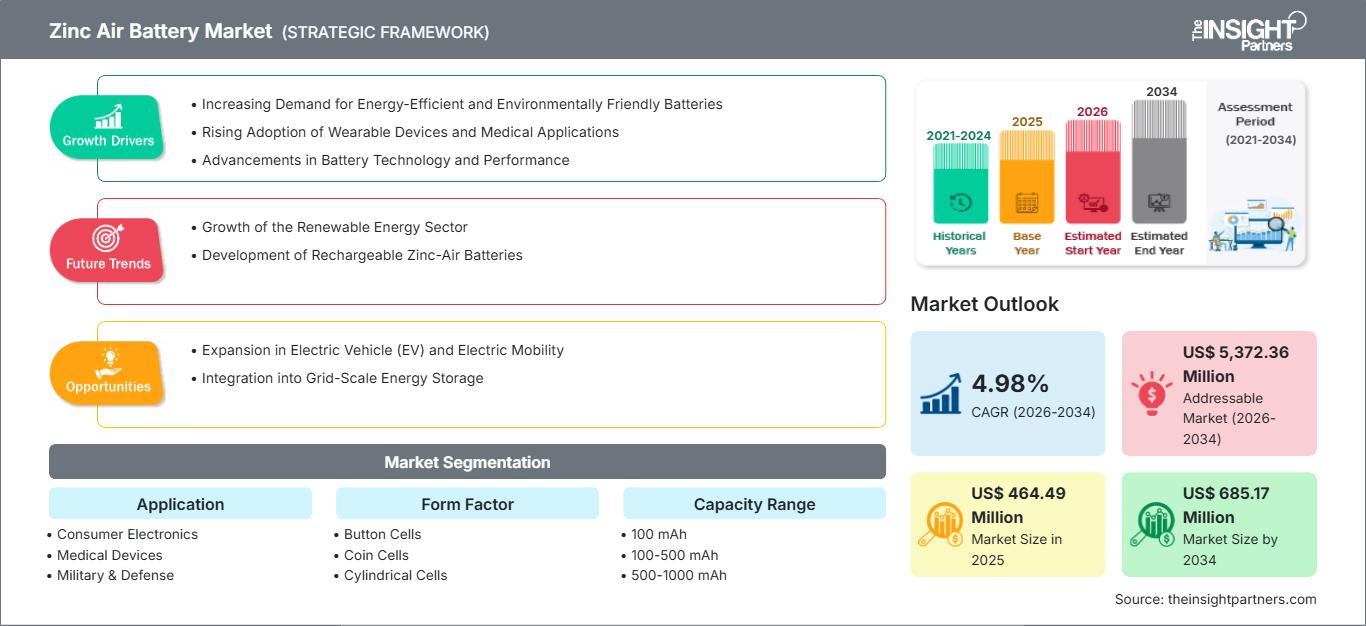
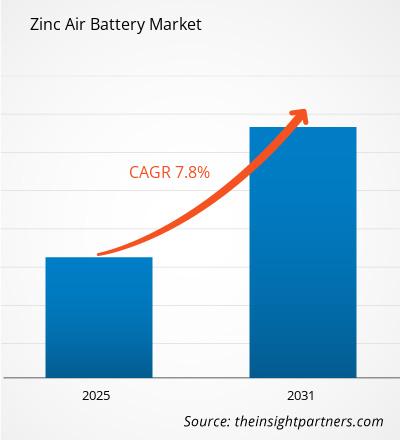
The Zinc Air Battery market was valued at US$ 464.49 million in 2025 and is expected to reach US$ 685.17 million by 2034; it is estimated to record a CAGR of 4.41% during 2026-2034.
Zinc Air Battery Market Assessment and Insights
- North America: North America is expected to retain a leading position, representing approximately 42–47% zinc air battery market share in 2025 and growing at a CAGR of 5.2–6.0% between 2026–2034. Demand combines mature medical applications with emerging stationary-storage programs.
- U.S.: The U.S. is estimated to represent 82–87% of North American demand in 2025, supported by healthcare electronics, defense programs, backup power requirements, and research funding, with a 5.3–6.1% CAGR through 2034.
- Europe: Europe is estimated at 20–24% share in 2025 and is projected to grow at 4.7–5.5% CAGR through 2034. Germany, the UK, France, Italy, and Spain provide diverse demand across medical, industrial, mobility, and energy-storage applications.
- Asia Pacific: Asia Pacific is estimated at 22–27% share in 2025 and is expected to record a 6.0–7.0% CAGR through 2034. China, Japan, South Korea, India, and Australia support regional expansion through electronics manufacturing, battery research, healthcare devices, and energy-transition investment.
- Largest Segment: Consumer Electronics is estimated to hold a 31–36% market share in 2025 and expand at a 4.5–5.3% CAGR during 2026–2034, supported by compact, lightweight primary cells.
- High Growth Segment: Industrial applications are estimated at 12–16% share in 2025 and are projected to advance at a 6.5–7.5% CAGR during 2026–2034 as long-duration storage demonstrations expand.
- Key companies analyzed in detail: Innolith GmbH; Zinc8 Energy Solutions Inc.; Impact Clean Power Technology S.A.; Phinergy Ltd.; XALT Energy LLC; Powercast Corporation; Enevate Corporation; Wrightspeed, Inc.; Nano One Materials Corp.; Blue Ocean Battery.
Source: The Insight Partners' analysis based on proprietary research, government publications, company annual reports, investor presentations, industry databases, and expert interviews.
Zinc-air technology is transitioning from an established primary cell chemistry into more diverse rechargeable and stationary options. Advances in oxygen catalyst technology, zinc anode handling, corrosion management, electrolyte stability, air cathode design, and gas diffusion layers are overcoming established performance limitations. Cost economics are becoming more supportive of inexpensive and abundant zinc feedstocks, in addition to aqueous processes, though cycle life, power density, water management, and electrode lifetime continue to be key to commercial success.
Looking ahead, zinc air battery market prospects are increasingly linked to regions that wish to develop safe energy storage systems and diversified battery materials. Market drivers in North America, environment in Europe, and production capabilities in Asia all provide a complementary path. Incentives for safe stationary storage, local supply chain, and robust infrastructure will encourage pilot projects, while certification requirements will keep focusing on the niche applications where safety, longevity, weight, or material considerations have a higher priority than current lithium-ion technologies.
Zinc Air Battery Market Report Scope
| Report Attribute | Details |
|---|---|
| Market size in 2025 | US$ 464.49 Million |
| Market Size by 2034 | US$ 685.17 Million |
| Global CAGR (2026 - 2034) | 4.41% |
| Historical Data | 2021-2024 |
| Forecast period | 2026-2034 |
Zinc Air Battery Market Analysis
The zinc air battery market forecast is backed up by a few interlinked sources of demand. Apart from hearing aids and other small medical devices due to their high practical density and performance in low-power environments, there are potential uses for recharging zinc-air batteries as backups for microgrids, industries, vehicles, among others. The supply chain covers zinc production, electrode production, catalysts, electrolytes, membranes, cell production, testing, and recycling.
The supply side in the zinc air battery market is becoming increasingly technology-driven. Although the zinc is relatively plentiful, rechargeable batteries have to be engineered with certain morphology, corrosion resistance, stable interfaces, as well as reliable oxygen transport. Thus, companies compete in the development of electrodes instead of availability of resources. The recent academic research highlights dendrite formation, passivation, corrosion, parasitic hydrogen evolution, and slow oxygen reactions as main obstacles.
Positioning in the market for zinc air batteries is still fragmented owing to the fact that primary cell manufacturers exist alongside technology players in pursuit of rechargeable cells and systems with longer durations. Some of these companies include Innolith GmbH, Zinc8 Energy Solutions Inc., Impact Clean Power Technology S.A., Phinergy Ltd., and XALT Energy LLC. The companies position themselves according to their different technologies and applications while Powercast Corporation and Enevate Corporation offer adjacent power electronics or advanced cell technologies. Wrightspeed Inc. positions itself through heavy-duty electrification expertise while Nano One Materials Corp. offers material development capability.
The investment criteria for the market for zinc air batteries are increasingly focusing on technologies that can demonstrate their manufacturability instead of just performance in the laboratory. Programs for commercialization have focused on pilot-scale manufacturing, repeatable cycling, modularity, safety validation, and total cost of ownership. Strategic differentiation is now all about proving one's ability to integrate the various system components such as the electrodes, electrolyte, air management, control, and balance of systems.
● REPORT CUSTOMIZATION
Tailor This Report To Align With Your Specific Business Requirements
This report can be customized to align precisely with your business objectives, scope, and target markets. Customization options include tailored segmentation, geography, competitive analysis, and strategic insights to support informed decision-making.
Customize This Report →WHAT YOU CAN ADJUST
- ● Segmentations
- ● Geography
- ● Competitive Analysis
- ● Language Preferences
Zinc Air Battery Market: Strategic Insights
Regional Insights
North America zinc air battery market
The zinc air battery market report shows that North America is estimated to account for 42–47% of 2025 demand, making it the leading regional market. The estimated 5.2–6.0% CAGR through 2034 reflects established hearing-aid consumption, defense requirements, resilient backup systems, and growing interest in long-duration storage. The U.S. dominates regional activity because research institutions, technology developers, utilities, and federal and state programs provide a comparatively mature commercialization ecosystem.
Canada's contributions include availability of zinc resources, cleantech innovations, and advancements in long-duration energy storage. Regional procurements now consider safety, duration, recyclability, and domestically produced systems in addition to levelized costs. This is especially pertinent when discussing demonstration projects, where the zinc-air battery architecture will allow the decoupling of power and energy in some configurations, allowing the duration to be extended without increasing power conversion systems.
U.S. zinc air battery market Market
According to the zinc air battery market forecast, the U.S. represents approximately 82–87% of North American zinc-air demand in 2025. Its estimated 5.3–6.1% CAGR is supported by medical-device consumption, defense applications, industrial backup requirements, and public funding for alternative storage technologies. Domestic developers are increasingly targeting systems where extended discharge duration and safety can compensate for the lower maturity of rechargeable zinc-air platforms.
The U.S. application effort ranges from hearing aids to emergency power, telecommunications, industrial applications, and distributed renewables. The efforts of such firms as Zinc8 Energy Solutions Inc. and Phinergy Ltd. and other zinc-chemistry developers have created the ecosystem for development in this area. Commercial qualification is focusing more on cycle stability, manufacturability, robustness, and cost predictability rather than energy-density potential.
Europe zinc air battery market Market
Europe is estimated to hold 20–24% of global demand in 2025 and is projected to grow at 4.7–5.5% CAGR through 2034. Germany is at the forefront due to its industrial battery value chain and automotive engineering expertise. The UK is focused on innovations in stationary storage, while France, Italy, and Spain contribute via their healthcare electronics, industrial electrification, renewables and resilience needs.
Germany is combining the knowledge in battery chemistry, automotive engineering, industrial automation and renewables into a supportive ecosystem for advanced batteries. The UK has strengths in grid flexibility and technology commercialization, while France profits from its aerospace, defense, and energy infrastructure know-how. Italy and Spain have strengths related to distributed generation, industrial backup and renewables balancing. Generally across the region, sustainability criteria and battery circularity policies are encouraging evaluation of batteries made from more abundant and recyclable materials.
APAC zinc air battery market Market
APAC represents approximately 22–27% of global demand in 2025 and is projected to expand at 6.0–7.0% CAGR. China leads regional manufacturing scale, while Japan and South Korea contribute advanced materials research. India is developing battery-technology capabilities, and Australia provides resources and renewable-energy applications. Industrial electrification, electronics production, healthcare devices, and energy-storage policy support regional adoption.
Middle East & Africa zinc air battery market Market
Middle East and Africa demand is comparatively smaller but strategically relevant for resilient power. The region is projected to grow at approximately 4.0–5.0% CAGR, led by Saudi Arabia and the UAE, where energy diversification and infrastructure investment support alternative storage. South Africa contributes through industrial applications and grid-resilience needs.
Segmentation Analysis
Application
Application is expected to expand at a 4.8–5.8% CAGR during 2026–2034. Demand is diversified across compact medical devices and electronics, defense systems, transportation, aerospace, and industrial storage. Primary cells retain a strong installed base, while rechargeable architectures are creating incremental opportunities in applications requiring longer operating duration, safer chemistry, or reduced dependence on conventional lithium-ion systems.
- Consumer Electronics: Compact devices remain strategically important because zinc-air cells provide high energy density for low-power products. Wearables, sensors, and specialized electronics can benefit where thin form factors and extended operating periods matter.
- Medical Devices: Hearing aids remain a core use case, while monitoring and specialized medical electronics offer additional demand. Reliability, compact dimensions, predictable discharge characteristics, and established supply channels support continued adoption.
- Military & Defense: Defense applications value safe, lightweight power sources for communications, sensors, surveillance, and portable electronics. Qualification requirements are stringent, making reliability and environmental tolerance more important than nominal energy density.
- Automotive: Automotive adoption remains developmental, with interest concentrated on range-extension concepts, auxiliary power, and alternative storage. Commercial prospects depend on rechargeability, power output, thermal behavior, and integration with existing electric drivetrains.
- Aerospace: Aerospace applications prioritize weight, safety, reliability, and mission duration. Zinc-air concepts may serve specialized low-power systems, but qualification cycles and stringent operating requirements constrain near-term penetration.
- Industrial: Industrial demand is gaining strategic relevance as companies evaluate zinc-based systems for backup, renewable integration, communications infrastructure, and long-duration storage where safety and duration are key purchasing considerations.
Form Factor
Form Factor is projected to grow at a 4.6–5.6% CAGR during 2026–2034. Cell architecture determines manufacturability, packaging efficiency, thermal and gas-management requirements, and suitability for particular loads. Established small-cell geometries remain dominant, while pouch and prismatic designs are attracting development attention for rechargeable and higher-capacity systems.
- Button Cells: Button cells remain closely associated with hearing aids and other compact electronics. Their established manufacturing ecosystem and predictable low-current performance make them strategically important for primary zinc-air demand.
- Coin Cells: Coin configurations address compact electronics requiring small footprints and moderate energy. Adoption depends on leakage control, shelf life, activation characteristics, and compatibility with standardized device housings.
- Cylindrical Cells: Cylindrical cells offer mechanical consistency and compatibility with established production approaches. They are increasingly relevant to rechargeable research where controlled electrode stacking and repeatable manufacturing are required.
- Pouch Cells: Pouch designs provide packaging flexibility and potentially high material utilization. Their strategic importance is greatest for lightweight electronics, sensors, and emerging rechargeable systems requiring customized dimensions.
- Prismatic Cells: Prismatic formats can support higher-capacity systems and efficient module packaging. Adoption is tied to improved air management, electrode durability, sealing, and scalable manufacturing processes.
Capacity Range
Capacity Range is expected to grow at a 5.0–6.0% CAGR during 2026–2034. Demand varies substantially by application, with low-capacity cells serving compact devices and larger formats supporting industrial and emerging storage concepts. Improvements in electrode utilization and system architecture are broadening the addressable capacity range.
- 100 mAh: Low-capacity products primarily support compact medical, sensing, and consumer applications. Their established use cases make this range commercially accessible and relatively less exposed to rechargeable-technology uncertainties.
- 100–500 mAh: This range serves compact electronics and specialized medical devices requiring longer operating periods. It offers a practical balance between physical size, energy availability, and device integration requirements.
- 500–1000 mAh: Mid-capacity cells address applications requiring greater endurance without moving to large battery architectures. Their relevance increases as portable electronics and industrial sensors demand longer service intervals.
- 1000–2000 mAh: Higher-capacity cells are increasingly relevant to specialized portable equipment and developmental rechargeable systems. Their strategic value depends on improved electrode stability and efficient oxygen-management designs.
- > 2000 mAh: Large-capacity formats are associated with industrial, backup, and emerging stationary applications. Commercialization depends heavily on cycle life, power conversion, recharge efficiency, and system-level economics.
Electrode Material
Electrode Material is forecast to advance at a 5.4–6.4% CAGR during 2026–2034. Electrode innovation is central to commercialization because oxygen-reaction kinetics, zinc utilization, corrosion resistance, and interfacial stability directly affect performance. Research is increasingly focused on reducing dependence on expensive catalysts while improving durability.
- Zinc-Manganese Dioxide: This chemistry benefits from familiar material supply chains and established battery-processing knowledge. It remains strategically relevant where cost, availability, and straightforward manufacturing are prioritized.
- Zinc-Iron Oxide: Iron-based approaches attract interest because iron is abundant and relatively inexpensive. Their importance is linked to efforts to reduce material costs while maintaining adequate electrochemical performance.
- Zinc-Nickel Oxide: Nickel-containing electrodes can provide useful electrochemical characteristics but face cost considerations. Their strategic role is strongest in applications where performance requirements justify higher material expenditure.
- Zinc-Silver Oxide: Silver-based systems offer strong electrochemical performance but remain constrained by material cost. They are therefore better suited to specialized applications where reliability and power characteristics outweigh cost sensitivity.
Other Advanced Electrodes
Advanced electrode approaches are expected to influence future development through improved oxygen reduction and evolution kinetics. Carbon-based catalysts, transition-metal compounds, metal-organic frameworks, and hybrid architectures are being evaluated to improve efficiency, durability, and cost.
Opportunity Snapshot
| Application | Revenue Contribution (High/Medium/Low) | Trend Tag | Adoption Stage |
| Consumer Electronics | High | Wearable Power | Mature |
| Medical Devices | High | Hearing Aid | Mature |
| Military & Defense | Medium | Mission Power | Scaling |
| Automotive | Medium | Range Extension | Emerging |
| Aerospace | Low | Lightweight Power | Emerging |
| Industrial | High | Long Duration | Scaling |
Zinc Air Battery Market Growth Drivers and Impact Analysis
Expansion of Long-Duration Storage Requirements
Storage for longer durations provides a differentiation opportunity for zinc-air systems since energy capacity can be potentially scaled cheaper compared to power systems with short durations. In energy grids with high penetration rates of renewables, storage must be able to provide solutions for mismatches of hours and long durations between generation and demand. This means that zinc-air companies are focusing on markets for storage that include microgrids, renewable deployment, backup power, and industrial resiliency. While zinc-air systems are not currently comparable in scale to lithium-ion systems that are well established, the operational basis of zinc-air allows it to achieve longer durations with abundant material. Evaluation of zinc-air systems would now shift from energy density to factors like duration, safety, siteability, degradation, maintenance, and cost over life-cycle.
Material Availability and Battery Supply Diversification
There is a trend to look for alternative materials in the battery industry to become less dependent on raw materials whose sources may be limited and sensitive from the geopolitical point of view. Zinc is widely available worldwide as it is used in galvanization, alloys, batteries, and industrial applications. Availability of such a resource will not prevent supply chain problems, but it will lessen dependence on the combination of lithium, nickel, cobalt, and graphite. It will be important for the zinc-air battery developers only if there are manufacturing technologies which will not use expensive catalysts and allow the reuse of batteries. At the same time, the procurement departments will start evaluating the availability of materials along with the safety, energy density, cycle life, and total cost of ownership.
Advances in Electrochemical Interface Engineering
The development of electrochemical interfaces through engineering is enhancing the viability of rechargeable zinc-air batteries by overcoming multiple failure mechanisms that act in combination. These include dendrites formation, passivation, corrosion and hydrogen evolution at the zinc electrode and sluggish reaction kinetics and catalyst deactivation at the air electrode. Developments in bifunctional catalysts, porous materials, protection layers, electrolytes and gas diffusion membranes are aimed at stabilizing these reactions. Not only will this development have an effect on efficiency but it will lead to a reduction in maintenance costs and extended lifetimes as well as better manufacturing consistency. New studies are pointing towards increased attention on solid state designs and practical cylindrical or pouch batteries. If these developments prove to be successful at a large scale, this would shift the market from specialized primary applications to more common rechargeable applications for portable devices, backup power, range extension and stationary energy storage.
Zinc Air Battery Market Future Trends
Integration of Solid-State Zinc-Air Architectures
The zinc air battery market trends landscape is likely to increasingly emphasize solid-state electrolytes and protected interfaces as developers seek higher cycle stability and safer rechargeable operation. Solid-state arrangements would help mitigate any undesired chemical reactions that could take place among the zinc, the electrolyte, and the air electrodes while enabling more efficient cell construction. In terms of research progress, the next step would be the transition from individual electrode trials to practical cylindrical and pouch cells with consideration for ampere-hour-level cells, repeatability in testing, interface compatibility, and manufacturing methods. The next step will most probably include standard performance tests using real-world currents, humidity levels, temperatures, and multiple cycles. The commercial potential of such technology lies in its ability to keep the cost benefits of zinc while providing enough power output.
Catalyst Systems Designed Around Abundant Materials
Future developments will increasingly be oriented toward oxygen catalysts with enhanced catalytic efficiency and reduced use of platinum-group metals. Research is ongoing for transition metal oxides, carbon-based materials, metal-organic frameworks, sulfides, phosphides, and composite systems to perform bifunctional catalysis for oxygen reduction and evolution. The key focus of this approach is not merely to achieve maximum efficiency in the laboratory setting but to retain it in repeated charge–discharge operations without corrosion or degradation. Catalyst loading, porosity design, electrical conductivity, interaction with electrolytes, and process repeatability will increasingly come into play. The developers will also be looking at waste-derived and abundant-earth materials in an effort to alleviate their negative environmental and economic impact. As new materials move towards the practical electrode implementation, competition could increasingly pivot from the chemistry to life cycle and performance in standard operational modes.
Zinc Air Battery Market Opportunities
Distributed Resilience for Critical Infrastructure
The zinc air battery Forecasts indicate an emerging opportunity in distributed resilience where facilities require backup power for longer periods than conventional uninterruptible power systems typically provide. Telecommunications sites, healthcare facilities, industrial plants, data infrastructure, remote monitoring installations, and community microgrids can benefit from storage technologies designed around extended discharge. The opportunity is strongest where diesel replacement, renewable integration, or constrained grid connections justify a higher initial technology risk. Developers should prioritize modular systems, remote monitoring, predictable maintenance, and integration with existing power-conversion equipment. Partnerships with utilities, infrastructure operators, engineering firms, and renewable developers can provide operating data and accelerate qualification. Commercial strategies should focus on applications where duration and safety have measurable financial value rather than competing directly with lithium-ion systems across every stationary-storage category.
Localized Manufacturing and Component Ecosystems
Another opportunity lies in building localized manufacturing ecosystems around zinc electrodes, air cathodes, electrolytes, separators, and system components. Regional production can reduce logistics exposure, improve quality control, and support government objectives related to battery supply resilience. The opportunity is particularly relevant in markets with zinc-processing capabilities, established electronics manufacturing, or growing renewable-storage demand. Investors can target specialized component suppliers rather than attempting immediate full-system manufacturing, allowing technical risk to be distributed across the value chain. Contract manufacturing partnerships can also provide access to mature coating, forming, assembly, and testing equipment. Over time, standardized cell designs could enable economies of scale across several applications. The strongest business cases will likely combine proprietary materials or process advantages with manufacturing compatibility, documented reliability, and clearly defined qualification pathways.
Frequently Asked Questions

- Comprehensive Market Sizing and Forecast Analysis
- Detailed Segmentation Analysis
- In-Depth Market Dynamics Assessment
- Regional and Country-Level Insights
- Competitive Landscape and Company Benchmarking
- Strategic Business Intelligence
Recent Reports
Testimonials

The Insight Partners' SCADA System Market report is comprehensive, with valuable insights on current trends and future forecasts. The team was highly professional, responsive, and supportive throughout. We are very satisfied and highly recommend their services.
RAN KEDEM Partner, Reali Technologies LTDs
I requested a report on a very specific software market and the team produced the report in a few days. The information was very relevant and well presented. I then requested some changes and additions to the report. The team was again very responsive and I got the final report in less than a week.
JEAN-HERVE JENN Chairman, Future Analytica
We worked with The Insight Partners for an important market study and forecast. They gave us clear insights into opportunities and risks, which helped shape our plans. Their research was easy to use and based on solid data. It helped us make smart, confident decisions. We highly recommend them.
PIYUSH NAGPAL Sr. Vice President, High Beam Global
The Insight Partners delivered insightful, well-structured market research with strong domain expertise. Their team was professional and responsive throughout. The user-friendly website made accessing industry reports seamless. We highly recommend them for reliable, high-quality research services
YUKIHIKO ADACHI CEO, Deep Blue, LLC.
This is the first time I have purchased a market report from The Insight Partners.While I was unsure at first, I visited their web site and felt more comfortable to take the risk and purchase a market report.I am completely satisfied with the quality of the report and customer service. I had several questions and comments with the initial report, but after a couple of dialogs over email with their analyst I believe I have a report that I can use as input to our strategic planning process.Thank you so much for taking the extra time and making this a positive experience.I will definitely recommend your service to others and you will be my first call when we need further market data.
JOHN SUZUKI President and Chief Executive Officer, Board Director, BK Technologies
I wish to appreciate your support and the professionalism you displayed in the course of attending to my request for information regarding to infectious disease IVD market in Nigeria. I appreciate your patience, your guidance, and the fact that you were willing to offer a discount, which eventually made it possible for us to close a deal. I look forward to engaging The Insight Partners in the future, all thanks to the impression you have created in me as a result of this first encounter.
DR CHIJIOKE ONYIA MANAGING DIRECTOR, PineCrest Healthcare Ltd.Reason to Buy
- Informed Decision-Making
- Understanding Market Dynamics
- Competitive Analysis
- Identifying Emerging Markets
- Customer Insights
- Market Forecasts
- Risk Mitigation
- Boosting Operational Efficiency
- Strategic Planning
- Investment Justification
- Tracking Industry Innovations
- Aligning with Regulatory Trends





 Get Free Sample for