
Zinc Battery Market Trends, Demand & Growth by 2034
Zinc Battery Market Size and Forecasts (2021 - 2034), Global and Regional Share, Trends, and Growth Opportunity Analysis Report Coverage : By Battery Type (Zinc-air, Nickel-zinc, Zinc-ion, Zinc-bromine), Rechargeability (Primary & Secondary), Application (Medical, Utilities, Automotive & Transportation, Industrial, Consumer Devices)
- Status : Data Released
- Report Code : TIPRE00039686
- Category : Electronics and Semiconductor
- No. of Pages : 150
- Available Report Formats :


- Last update date : September 30, 2026


2025 Market Size
US$ 1.13 Bn
Base year value
2034 Forecast
US$ 1.66 Bn
Projected by 2034
CAGR 2026-2034
4.41 %
Growth rate
Addressable Market
US$ 12.70 Bn
(2026-2034)
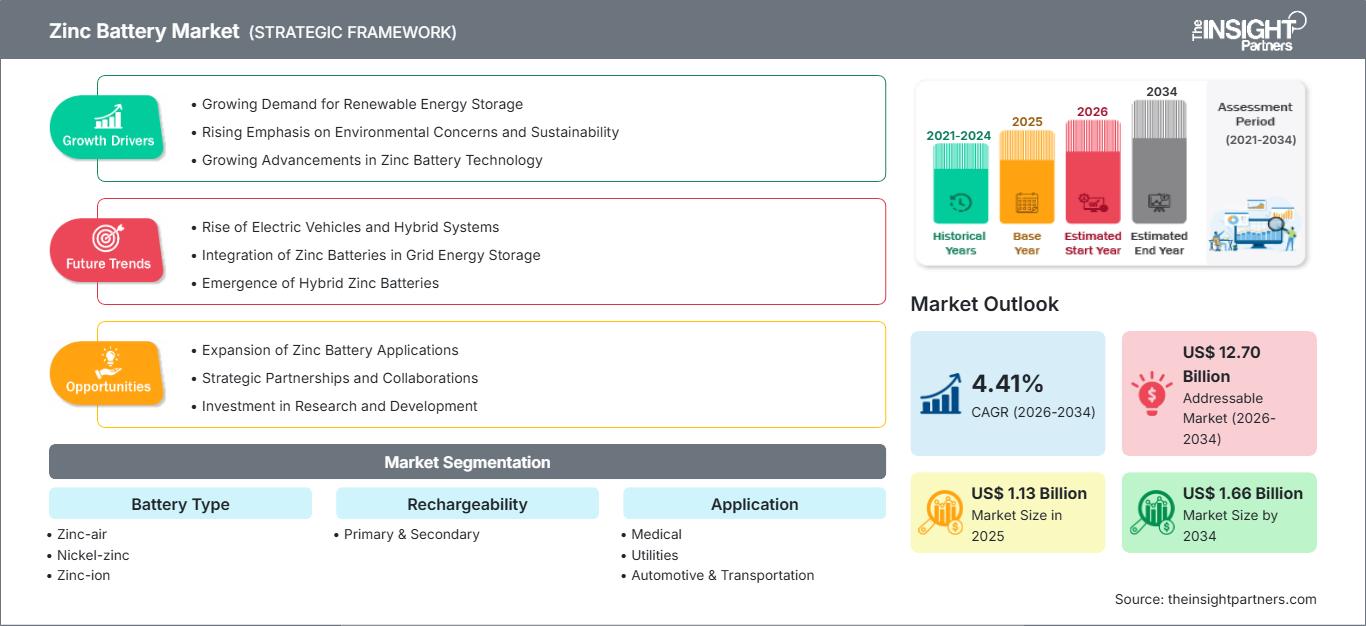
The zinc battery market is valued at US$ 1.13 Billion in 2025 and is projected to reach US$ 1.66 Billion by 2034, registering a CAGR of 4.41% during 2026–2034. The market encompasses zinc-air, nickel-zinc, zinc-ion, and zinc-bromine chemistries across primary and secondary formats and medical, utilities, automotive and transportation, industrial, and consumer device applications. Its outlook reflects established primary cells alongside emerging rechargeable systems.
North America is positioned for measured expansion as grid resilience programs, data-center backup requirements, and domestic battery manufacturing incentives strengthen demand for zinc-based systems. The zinc battery market size in the region is supported by utility procurement, critical-infrastructure resilience, and interest in chemistries that can reduce thermal-management requirements while diversifying battery supply chains.
Zinc Battery Market Assessment and Insights
- North America: North America is expected to hold a 34–38% zinc battery market share in 2025 and expand at a 5–7% CAGR between 2026–2034, supported by grid resilience, domestic manufacturing, and long-duration storage investment.
- US: The US is expected to represent 78–82% of North American revenue in 2025 and grow at a 5–7% CAGR between 2026–2034, led by utilities, defense, and data centers.
- Europe: Europe is estimated at a 25–29% share in 2025 and a 4–6% CAGR between 2026–2034, with Germany, the UK, France, Italy, and Spain supporting adoption through storage policy, industrial electrification, and battery sustainability requirements.
- Asia Pacific: Asia Pacific is estimated at a 27–31% share in 2025 and a 5–7% CAGR between 2026–2034, with China, Japan, South Korea, India, and Australia combining manufacturing depth with expanding energy-storage and electronics demand.
- Largest Segment: Secondary batteries are estimated to hold a 52–58% market share in 2025 and grow at a 5–7% CAGR between 2026–2034, reflecting expanding rechargeable storage applications.
- High Growth Segment: Zinc-bromine is estimated at a 14–18% market share in 2025 and a 7–9% CAGR between 2026–2034, supported by long-duration stationary storage deployments.
- Key companies analyzed in detail: Duracell Inc.; Eastman Kodak Company; Energizer Holdings, Inc.; Panasonic Energy Co., Ltd.; GP Industries Limited; ABOUND Energy Inc.; Enerpoly AB; Imprint Energy, Inc.; Phinergy Ltd.; Renata SA; Eos Energy Enterprises, Inc.; VARTA AG.
Source: The Insight Partners' analysis based on proprietary research, government publications, company annual reports, investor presentations, industry databases, and expert interviews.
The zinc batteries industry is moving from primarily relying on primary cell types to having more diversity in the form of various rechargeable zinc batteries. Zinc-air continues to hold its place in hearing aid form factor, while zinc-bromine and zinc-ion batteries continue to make progress in the stationary storage segment. Nickel-zinc batteries are used for high-power applications, where safety and energy provision are critical factors. Current trends within the industry include an increased focus on electrode development, electrolyte chemistry, corrosion protection, automation of assembly process, and local sourcing of materials.
Moving forward, the adoption of batteries in the zinc battery market will likely be focused on areas where safety considerations, source diversity, and duration needs surpass those of lithium-ion batteries in terms of performance. North American and European battery developers are investing in localized manufacturing and validation capabilities, while Asian players maintain their scale advantages in primary cells and electronics. With regulations focusing on traceability, recycling, responsible material usage, and fire safety, this should encourage the qualification of other battery chemistries.
Zinc Battery Market Report Scope
| Report Attribute | Details |
|---|---|
| Market size in 2025 | US$ 1.13 Billion |
| Market Size by 2034 | US$ 1.66 Billion |
| Global CAGR (2026 - 2034) | 4.41% |
| Historical Data | 2021-2024 |
| Forecast period | 2026-2034 |
Zinc Battery Market Analysis
Demand will be driven by two separate ecosystems. Primary zinc batteries are used in hearing aids, consumer electronics, alarms, and other products where a small and reliable power source is required, whereas secondary battery types will cater to the needs of backup power, industrial applications, and grid-scale storage. Therefore, the market growth for zinc batteries will be influenced by both replacement needs and new installations. Zinc sources are geographically diverse, and aqueous electrolytes help mitigate fire hazard risk in stationary applications.
According to the zinc battery market report, there are several raw materials required at various stages of value chain including purified zinc, manganese compounds, carbon-based components, catalysts, membranes, separators, current collectors, electrolytes, and manufacturing equipment. For cell producers, it will be necessary to strike the right balance between energy density and cycle life on the one hand, and corrosion resistance and charge efficiency on the other. Finally, the system integrators will include power electronics, environmental controls, battery management systems, and software.
The competitive intensity varies between the incumbent consumer-battery firms and the technology companies. The Panasonic Energy Co., Ltd., Energizer Holdings, Inc., Duracell Inc., GP Industries Limited, Renata SA, and VARTA AG are at an advantage with the existing marketing channels and knowledge about primary cells. On the other hand, ABOUND Energy Inc., Enerpoly AB, Imprint Energy, Inc., Phinergy Ltd., and Eos Energy Enterprises, Inc. have specialized in technology commercialization or storage.
Investment now favors pilot runs, intellectual property, certification, and partnerships geared towards particular applications more so than indiscriminate capacity. US-based manufacturing and software integration characterize Eos Energy Enterprises, Inc., while ABOUND Energy Inc. develops its Zaeras system. Panasonic Energy Co., Ltd. offers zinc-air and zinc-carbon batteries. Zinc Battery Forecast will thus be characterized by a two-tiered market whereby established primary batteries create income that is reliable, whereas secondary batteries vie for viability and consistent production.
● REPORT CUSTOMIZATION
Tailor This Report To Align With Your Specific Business Requirements
This report can be customized to align precisely with your business objectives, scope, and target markets. Customization options include tailored segmentation, geography, competitive analysis, and strategic insights to support informed decision-making.
Customize This Report →WHAT YOU CAN ADJUST
- ● Segmentations
- ● Geography
- ● Competitive Analysis
- ● Language Preferences
Zinc Battery Market: Strategic Insights
Regional Insights
North America zinc battery market
North America is estimated to account for 34–38% of global revenue in 2025, with a 5–7% CAGR through 2034. Grid modernization, resilience to critical loads, and increased attention to fire safety in energy storage all help this area. The US support for domestic production for non-lithium-based batteries, utilizing abundant zinc, is favorable to the economics of the technology.
Energy storage is the most obvious opportunity incrementally, along with data centers, telecom back-up, defense and industrial microgrids. Canada is a partner in developing technologies and applications related to clean energy, while Mexico adds manufacturing and electronics linkages. Choices made on procurement increasingly take into account the total cost of installation, duration, licensing, insurance, and supply chain issues in addition to the cost of cells.
U.S. zinc battery market
The U.S. represents an estimated 78–82% of North American revenue in 2025 and is expected to grow at a 5–7% CAGR. Federal and state programs aimed at encouraging domestic production of batteries, grid security, and clean-energy infrastructure enhance the commercialization opportunities for zinc storage and backup solutions.
According to the zinc battery market forecast, demand covers utilities, data centers, defense, industrial sites, and some healthcare and consumer segments. Eos Energy Enterprises, Inc. already holds the reputation of having an established US manufacturing presence, whereas Imprint Energy, Inc. and other companies focus on specific rechargeable solutions. The purchasing decision is made more and more often depending on the certification of the products, domestic sourcing, system lifetime, and maintainability.
Europe zinc battery market
Europe is estimated to hold a 25–29% share in 2025 and register a 4–6% CAGR. Germany remains the leader due to industrial energy management, distributed storage and high-performance battery engineering. The UK also matters owing to requirements in grid balancing and long-term storage projects which can be done using zinc-based batteries.
France, Italy, and Spain provide additional demand for batteries owing to their renewables integration and industrial electrification efforts. Battery regulations in Europe, transparency in the lifecycle, recycling and the absence of environmentally harmful substances encourage manufacturers to show proper resource management. Therefore, Europe provides an opportunity for technologies combining safety and sustainability of supply chain, with local players and battery vendors competing for partnerships with utilities and industrial customers.
APAC zinc battery market
Asia Pacific is estimated to represent 27–31% of revenue in 2025 and expand at a 5–7% CAGR. China controls regional activities via manufacturing efficiency, while Japan and South Korea contribute with battery technology and application. India and Australia provide demand through electronics, distributed generation, mining, and grid modernization.
The policy support provided for renewable integration, domestic manufacturing, and energy security gives a huge platform. While traditional zinc batteries remain relevant for consumer electronics, the zinc-ion batteries and zinc-bromide rechargeable batteries are explored for stationary applications. The competition in the region will be based on efficiency and manufacturing costs.
Middle East & Africa zinc battery market
Middle East and Africa is expected to expand at a 3–5% CAGR. Saudi Arabia and the UAE offer high commercial value by leveraging energy diversification, intelligent infrastructures, and resilience investments, with South Africa offering demand by virtue of industrial and power system limitations.
The zinc battery system is ideal in applications that require backup and long-term energy solutions with safety and operational ease being key. Mining, telecommunications, remote infrastructures, and microgrids are other opportunities for this application. The business case for such projects is still dependent on financing, imports of equipment, technical expertise, and local service capacity.

Segmentation Analysis
Battery Type
The Battery Type segment is expected to expand at a 5–7% CAGR during 2026–2034. Technology choice depends on energy density, power delivery, rechargeability, operating environment, and application requirements. The zinc battery market scope spans mature zinc-air formats and newer nickel-zinc, zinc-ion, and zinc-bromine platforms, with each chemistry progressing at a different commercialization pace.
- Zinc-air: Established in compact primary applications, especially hearing aids, zinc-air benefits from high theoretical energy density and low weight. Rechargeable variants require improvements in air-electrode durability and environmental tolerance.
- Nickel-zinc: Nickel-zinc is positioned for applications needing high power, robust cycling, and improved safety. Its strongest strategic fit is backup and industrial equipment requiring dependable peak-power delivery.
- Zinc-ion: Zinc-ion attracts development attention for aqueous rechargeable storage because zinc is abundant and the chemistry can use nonflammable electrolytes. Commercial priorities include cycle life, dendrite control, and energy density.
- Zinc-bromine: Zinc-bromine is suited to stationary storage where longer discharge duration, scalability, and safety justify system-level investment. Flow and hybrid architectures allow power and energy requirements to be configured separately.
Rechargeability
The Rechargeability segment is projected to grow at a 5–7% CAGR during 2026–2034. Primary products retain strong positions where low upfront cost, long shelf life, and simple replacement are decisive, while secondary systems gain relevance as storage customers seek repeatable cycling and longer asset utilization.
- Primary: Primary batteries remain essential for hearing aids, household devices, alarms, and other low-power equipment. Mature supply chains, standardized formats, and predictable replacement cycles support stable demand across established consumer markets.
- Secondary: Secondary batteries are increasingly evaluated for backup, industrial, utility, and microgrid applications. Their strategic value rises when customers prioritize cycling capability, safety, duration, and reduced dependence on single-use power sources.
Application
The Application segment is projected to advance at a 4–6% CAGR during 2026–2034. Adoption differs by duty cycle, power requirement, environmental conditions, and certification needs. Medical and consumer applications emphasize compactness and reliability, whereas utilities and industrial users prioritize duration, safety, serviceability, and lifecycle economics.
- Medical: Medical applications value predictable voltage, compact form factors, and dependable operation. Hearing aids remain a key use case, while specialized devices create opportunities for high-reliability zinc-based cells.
- Utilities: Utility applications focus on stationary storage, renewable integration, peak management, and resilience. Zinc-bromine and other rechargeable architectures are relevant where longer-duration service and safety influence site economics.
- Automotive & Transportation: Automotive and transportation opportunities center on auxiliary power, specialty systems, and applications where safety and high power are important. Adoption depends on certification, packaging, cycle requirements, and competition from established lithium technologies.
- Industrial: Industrial demand includes backup power, controls, telecom infrastructure, and equipment requiring dependable energy under demanding conditions. Zinc chemistries can gain share where thermal safety and maintenance simplicity are valued.
- Consumer Devices: Consumer devices provide a mature replacement market spanning portable electronics, household equipment, and hearing products. Brand trust, leakage resistance, shelf life, retail availability, and standardized formats remain important purchasing criteria.
Opportunity Snapshot
| Application | Revenue Contribution (High/Medium/Low) | Trend Tag (MAX 2 words) | Adoption Stage (Emerging/Scaling/Mature) |
| Medical | Medium | Hearing Aids | Mature |
| Utilities | High | Grid Storage | Scaling |
| Automotive & Transportation | Medium | Auxiliary Power | Emerging |
| Industrial | High | Backup Power | Scaling |
| Consumer Devices | High | Primary Cells | Mature |
Zinc Battery Market Growth Drivers and Impact Analysis
Expansion of Long-Duration Storage Procurement
Procurement for long duration energy storage is developing into a distinct pathway for rechargeable zinc solutions since buyers consider duration, safety, location, and economics together. Zinc bromine and zinc air systems will be suitable for multiple hours of applications especially in situations where storage systems have to work in conjunction with renewables after short peaks. This will be most prevalent in utility-scale, microgrid, and critical infrastructure deployments where addressing the risk of fire can ease permitting and insurance. As procurement becomes increasingly agnostic about technologies, the advantage for zinc providers is that they will have to compete based on the value proposition of their systems as opposed to the specific energy of their cells.
Demand for Safer Battery Chemistry in Critical Infrastructure
Safety considerations have moved beyond the scope of consumer electronics and are now expanding into data centers, telecommunications infrastructures, military facilities, hospitals, and manufacturing plants. Chemistry involving zinc, especially aqueous chemistry, could decrease the risks of thermal runaway that characterize dense energy storage deployments. This does not negate the necessity of rigorous testing, certification, monitoring, and enclosure design, but it represents a shift in the criteria considered by infrastructure owners. Infrastructure projects with limited space or significant penalties arising from thermal risks would be able to attach greater importance to safer designs. As a result, vendors could target higher-value projects that emphasize safety over energy density.
Diversification of Battery Material Supply Chains
Battery buyers and policymakers are placing greater emphasis on material availability, geographic concentration, recycling, and domestic manufacturing. Zinc is widely traded and supported by established industrial supply chains, giving manufacturers an alternative feedstock profile to chemistries dependent on more concentrated critical-mineral networks. This driver supports localization strategies in North America, Europe, and Asia, where governments and industrial customers seek greater control over strategic energy technologies. The effect extends beyond raw materials because localized production can simplify qualification, after-sales support, recycling coordination, and compliance documentation. Companies combining zinc chemistry with scalable manufacturing processes can therefore position products around supply resilience as well as technical performance. Procurement teams may increasingly treat diversified sourcing as a risk-management attribute.
Zinc Battery Market Future Trends
Software-Defined Zinc Storage Systems
zinc battery market trends are likely to increasingly include software-defined controls that optimize charging, discharge scheduling, degradation management, and asset availability. As rechargeable installations become larger, software can become a competitive layer rather than an accessory. Digital monitoring can identify electrolyte, temperature, voltage, and current anomalies before they affect system availability, while predictive algorithms can coordinate storage with renewable generation and grid signals. Developers are also likely to integrate fleet-level analytics across geographically dispersed assets. This shift should favor suppliers capable of combining chemistry, power electronics, controls, cybersecurity, and lifecycle service. The result will be stronger emphasis on system performance guarantees and data-backed operating models, making software capability an important differentiator alongside cell chemistry.
Application-Specific Chemistry Optimization
Future product development is likely to move away from one chemistry serving every use case. Zinc-air can remain optimized for compact primary applications, nickel-zinc for high-power backup, zinc-ion for modular rechargeable systems, and zinc-bromine for longer-duration stationary storage. This specialization can improve engineering efficiency because electrode design, electrolyte formulation, packaging, and controls can be tuned to defined duty cycles. Manufacturers may increasingly use application data to refine warranty conditions, service intervals, and operating windows. Such specialization also enables partnerships with equipment manufacturers requiring precise electrical and mechanical characteristics. Over time, competitive advantage may shift from possessing a zinc chemistry alone toward demonstrating a complete application architecture with validated performance, manufacturability, and service economics.
Zinc Battery Market Opportunities
Localized Manufacturing and Qualification Hubs
Manufacturers have an opportunity to establish regional qualification hubs combining pilot production, certification, customer testing, and technical service. Such facilities can reduce the distance between product development and commercial deployment, especially for utilities and industrial customers requiring extensive validation before approving new chemistry. In North America and Europe, localized production can support procurement objectives tied to supply resilience and domestic manufacturing. In Asia Pacific, regional hubs can leverage established electronics and battery manufacturing ecosystems. The opportunity is not simply to build factories, but to create repeatable qualification pathways that shorten customer adoption cycles. Companies pairing local engineering with standardized modules, transparent quality metrics, and reliable after-sales support can improve conversion from pilot projects to recurring orders.
Integrated Recycling and Circular Material Services
A second opportunity lies in integrating collection, recycling, material recovery, and replacement services into battery offerings. Primary zinc cells already move through mature retail channels, while secondary systems will create future streams of larger modules, electrolytes, electrodes, and balance-of-system components. Suppliers can design contracts including take-back provisions, refurbishment where technically feasible, and material recovery partnerships. Such services can strengthen compliance with evolving battery rules while reducing customer uncertainty about end-of-life management. They can also create secondary revenue opportunities through recovered materials and service agreements. For large industrial and utility buyers, a documented circular pathway may become part of supplier qualification, making recycling capability a commercial differentiator rather than a purely environmental initiative.
Frequently Asked Questions

- Comprehensive Market Sizing and Forecast Analysis
- Detailed Segmentation Analysis
- In-Depth Market Dynamics Assessment
- Regional and Country-Level Insights
- Competitive Landscape and Company Benchmarking
- Strategic Business Intelligence
Recent Reports
Testimonials

The Insight Partners provided valuable market intelligence that supported our global go-to-market strategy. Their team was professional, responsive, and attentive to our feedback, providing thoughtful analysis and helpful methodological clarifications throughout the project.
Junmo Kim Chief Financial Officer (CFO), Enertech Co., Ltd.
The Insight Partners' SCADA System Market report is comprehensive, with valuable insights on current trends and future forecasts. The team was highly professional, responsive, and supportive throughout. We are very satisfied and highly recommend their services.
RAN KEDEM Partner, Reali Technologies LTDs
I requested a report on a very specific software market and the team produced the report in a few days. The information was very relevant and well presented. I then requested some changes and additions to the report. The team was again very responsive and I got the final report in less than a week.
JEAN-HERVE JENN Chairman, Future Analytica
We worked with The Insight Partners for an important market study and forecast. They gave us clear insights into opportunities and risks, which helped shape our plans. Their research was easy to use and based on solid data. It helped us make smart, confident decisions. We highly recommend them.
PIYUSH NAGPAL Sr. Vice President, High Beam Global
The Insight Partners delivered insightful, well-structured market research with strong domain expertise. Their team was professional and responsive throughout. The user-friendly website made accessing industry reports seamless. We highly recommend them for reliable, high-quality research services
YUKIHIKO ADACHI CEO, Deep Blue, LLC.
This is the first time I have purchased a market report from The Insight Partners.While I was unsure at first, I visited their web site and felt more comfortable to take the risk and purchase a market report.I am completely satisfied with the quality of the report and customer service. I had several questions and comments with the initial report, but after a couple of dialogs over email with their analyst I believe I have a report that I can use as input to our strategic planning process.Thank you so much for taking the extra time and making this a positive experience.I will definitely recommend your service to others and you will be my first call when we need further market data.
JOHN SUZUKI President and Chief Executive Officer, Board Director, BK Technologies
I wish to appreciate your support and the professionalism you displayed in the course of attending to my request for information regarding to infectious disease IVD market in Nigeria. I appreciate your patience, your guidance, and the fact that you were willing to offer a discount, which eventually made it possible for us to close a deal. I look forward to engaging The Insight Partners in the future, all thanks to the impression you have created in me as a result of this first encounter.
DR CHIJIOKE ONYIA MANAGING DIRECTOR, PineCrest Healthcare Ltd.Reason to Buy
- Informed Decision-Making
- Understanding Market Dynamics
- Competitive Analysis
- Identifying Emerging Markets
- Customer Insights
- Market Forecasts
- Risk Mitigation
- Boosting Operational Efficiency
- Strategic Planning
- Investment Justification
- Tracking Industry Innovations
- Aligning with Regulatory Trends





 Get Free Sample for