
Fiber Channel Networking Market Growth, Size & Forecast by 2034
Coverage: By Component (Hardware, Software, Services); Vertical (Telecommunication, BFSI, Retail and E-Commerce, Government, Education, Healthcare, Others) , and Geography (North America, Europe, Asia Pacific, and South and Central America)
- Status : Data Released
- Report Code : TIPRE00021384
- Category : Electronics and Semiconductor
- No. of Pages : 150
- Available Report Formats :


- Last update date : September 09, 2026


2025 Market Size
US$ 2.48 Bn
Base year value
2034 Forecast
US$ 4.09 Bn
Projected by 2034
CAGR 2026-2034
5.73 %
Growth rate
Addressable Market
US$ 29.80 Bn
(2026-2034)
Fiber Channel Networking Market was valued at US$ 2.48 Billion in 2025 and is projected to reach US$ 4.09 Billion by 2034, expanding at a CAGR of 5.73% during 2026–2034. The market covers hardware, software, and services supporting high-performance storage connectivity across telecommunications, BFSI, retail and e-commerce, government, education, and healthcare environments, with Fibre Channel continuing to serve latency-sensitive and mission-critical storage architectures.
North America remains a structurally important market because of its mature enterprise storage base, extensive data-center infrastructure, and continued modernization of mission-critical workloads. The Fiber Channel Networking Market size is also influenced by replacement of legacy SAN equipment, adoption of 64G Fibre Channel platforms, and increasing requirements for predictable performance, security, and availability across large enterprise environments.
Fiber Channel Networking Market Assessment and Insights
- North America: North America held a 40–42% Fiber Channel Networking Market share in 2025 and is projected to grow at a 5.2–5.8% CAGR between 2026–2034, supported by mature SAN infrastructure, enterprise storage investment, and ongoing network modernization.
- US: The US represented 88–91% of North America's 2025 market and is expected to expand at a 5.0–5.6% CAGR between 2026–2034, supported by data-center expansion and storage refresh programs.
- Europe: Europe accounted for 24–26% share in 2025 and is projected to expand at a 5.0–5.5% CAGR between 2026–2034, led by the UK, Germany, France, Italy, and Spain through enterprise modernization and regulatory-driven resilience.
- Asia Pacific: Asia Pacific represented 22–24% share in 2025 and is forecast to grow at a 7.0–7.8% CAGR between 2026–2034, led by China, Japan, South Korea, India, and Australia as data-center capacity and digital infrastructure expand.
- Largest Segment: Hardware held a 52–56% market share in 2025, with a 5.0–5.6% CAGR from 2026–2034, reflecting continued demand for switches and host bus adapters.
- High Growth Segment: Software represented a 20–24% market share in 2025 and is expected to grow at a 7.0–7.8% CAGR from 2026–2034, supported by automation and analytics.
- Key companies analyzed in detail: ATTO Technology, Inc., Broadcom Inc., Marvell Technology, Inc., International Business Machines Corporation, Cisco Systems, Inc., NetApp, Inc., Dell Inc., Hewlett Packard Enterprise Development LP, Lenovo Group Limited, Juniper Networks, Inc.
Source: The Insight Partners' analysis based on proprietary research, government publications, company annual reports, investor presentations, industry databases, and expert interviews.
The Fiber Channel Networking Market forecast indicates that the market has moved from specialized SAN connections to high-speed, software-enabled storage networks capable of handling flash, virtualization, and more complex data loads. Gen 7 64G, NVMe over Fibre Channel, diagnostic automation, and telemetry are redefining product specifications. Hardware is still central, although software becomes increasingly critical to the process of provisioning, monitoring, securing, and optimizing complex storage fabrics.
Investment interests in the Fiber Channel Networking Market are moving from simple port scaling towards secure, automated, and power-efficient infrastructure. New data center segments in Asia Pacific are becoming targets of storage network investments, while enterprises in North America and Europe are concentrating on modernizing their lifecycle. Compliance with regulatory needs for cyber-resilience and continuity will drive stronger encryption, access controls, and manageable networking architectures.
Fiber Channel Networking Market Report Scope
| Report Attribute | Details |
|---|---|
| Market size in 2025 | US$ 2.48 Billion |
| Market Size by 2034 | US$ 4.09 Billion |
| Global CAGR (2026 - 2034) | 5.73% |
| Historical Data | 2021-2024 |
| Forecast period | 2026-2034 |
Fiber Channel Networking Market Analysis
The factors driving Fiber Channel Networking Market include the increase in the volume of enterprise data, the need for consistent storage performance, and the modernization of the aging SAN infrastructure. The value chain includes switch vendors, HBA vendors, storage vendors, optical components manufacturers, software providers, systems integrators, and customer support services. According to FCIA, "Fibre Channel (FC) is a dedicated technology that provides storage networking capabilities for SCSI, NVMe, and FICON."
The supply chain is affected by the availability of silicon, optical transceivers, switch ASICS, HBA controllers, firmware, and specific management software. Suppliers make efforts to create backward-compatible systems for customers to be able to increase speed without changing the whole storage infrastructure. This helps avoid risks related to migrating to another system and saves customers' investments in servers, arrays, cables, and experience.
The competitive landscape of Fiber Channel Networking Market is characterized by the competition in such areas as switching, HBAs, storage connectivity, security and management. Broadcom Inc. is positioned as a market leader due to the presence of Brocade SAN switches and Emulex HBAs; Cisco Systems, Inc. and Hewlett Packard Enterprise Development LP are also present in the market through enterprise storage networking portfolio. Dell Inc., Lenovo Group Limited, and International Business Machines Corporation provide FC infrastructure for a wider server and storage ecosystems.
Current trends in investment include the focus on the creation of faster fabrics, automation of processes, cybersecurity, and integration with flash and NVMe infrastructure. ATTO Technology, Inc. focuses on specialized connectivity, while Marvell Technology, Inc. is involved through storage connectivity technologies. NetApp, Inc. and Juniper Networks, Inc. provide complementary storage and networking solutions.
● REPORT CUSTOMIZATION
Tailor This Report To Align With Your Specific Business Requirements
This report can be customized to align precisely with your business objectives, scope, and target markets. Customization options include tailored segmentation, geography, competitive analysis, and strategic insights to support informed decision-making.
Customize This Report →WHAT YOU CAN ADJUST
- ● Segmentations
- ● Geography
- ● Competitive Analysis
- ● Language Preferences
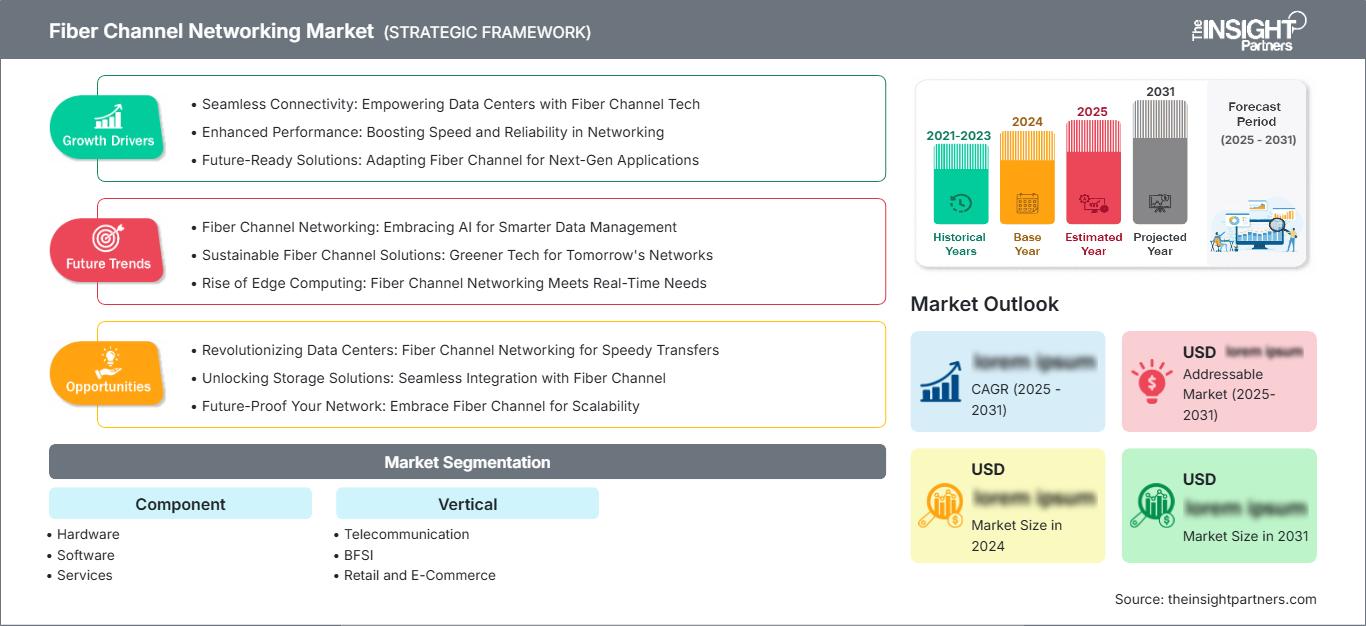
Fiber Channel Networking Market: Strategic Insights
Regional Insights
North America Fiber Channel Networking Market
North America accounted for a 40–42% share in 2025 and is projected to grow at a 5.2–5.8% CAGR during 2026–2034. The area sees an advantage in terms of an established base of enterprise SAN deployments, significant data center space, and mature purchasing routes for storage solutions. Legacy replacement continues to be a key focus for the area, with demand also coming from high-performance computing, virtualization, finance applications, and health care systems. The United States leads the way in regional revenues, thanks to a solid cloud and colocation offering.
The Canadian contribution comes from finance services, public sector renewal, digital health, and enterprise data management. There is a growing preference for 64G FC, NVMe over FC, automation of fabric monitoring, and security within regional customers. The presence of infrastructure providers such as Broadcom Inc., Cisco Systems, Inc., Dell Inc., Hewlett Packard Enterprise Development LP, and others ensures a broad environment of certified hardware, software, services, and integration.
U.S. Fiber Channel Networking Market
The US represented 88–91% of North America's 2025 revenue and is expected to expand at a 5.0–5.6% CAGR during 2026–2034. The demand for the product is largely in big enterprises, hyperscale-proximate infrastructures, financial institutions, health care organizations, governmental systems, and technology-driven organizations. The country has the benefit of existing skills in SAN and an extensive number of installations that require upgrades rather than a complete overhaul of the architecture. Broadcom Inc., Cisco Systems Inc., Dell Inc., and Hewlett Packard Enterprise Development LP have significant market presence.
Application needs are focused on high performance database applications, virtualization, backups, disaster recovery, and flash storage. The demand for predictability of latency and control of the storage traffic make Fibre Channel necessary for applications which would cause severe disruptions to business if they are interrupted. Needs for security make their way into considerations when buying new infrastructure.
Europe Fiber Channel Networking Market
Europe held a 24–26% share in 2025 and is forecast to grow at a 5.0–5.5% CAGR during 2026–2034. The UK continues to be a leader, enabled by financial services, government computing, healthcare, and enterprise data centers that are well-established. Germany comes next due to its industrial digitization and enterprise IT infrastructures. France, Italy, and Spain generate further demand for storage networks due to their telecommunications, banking, infrastructure, and data center modernization initiatives.
The matured financial services ecosystem in the UK generates demand for storage networks that need high availability and consistent performance, whereas the German industrial companies focus on resilience of their data infrastructures. France brings together the demands of public sector modernization and its telecommunications and financial sectors. Italy and Spain have been reaping benefits of growing cloud, colocation, and digital service infrastructures.
APAC Fiber Channel Networking Market
APAC held a 22–24% share in 2025 and is expected to record a 7.0–7.8% CAGR during 2026–2034. China is the dominant market, while Japan, South Korea, India, and Australia follow it. Data centers’ growth, enterprise digital transformation, the adoption of clouds, financial services’ technology, and government digital transformation are driving a need for resilient storage connectivity. India and Southeast Asia present further opportunities for market expansion.
Digitization in industry and government-supported digital infrastructure initiatives are boosting investment in data centers. Japan and South Korea focus on fast enterprise solutions, while China and India represent opportunities for new capacities. Mature cloud and enterprise infrastructure are present in Australia. Market trends point toward higher speeds for switching, storage fabrics with NVMe capabilities, and software monitoring.
Middle East & Africa Fiber Channel Networking Market
Middle East and Africa is projected to grow at a 6.0–6.8% CAGR during 2026–2034, with Saudi Arabia and the UAE leading regional development. South Africa remains an established enterprise technology market, while the rest of MEA offers opportunities through banking, telecommunications, government digitization, and data-center expansion. The UAE benefits from its role as a regional cloud and connectivity hub.
Energy access and infrastructure development have an impact on the location and viability of data centers in the Gulf region. Digital transformation efforts in Saudi Arabia have been helping develop enterprise infrastructures, whereas those of UAE have ensured robust computing infrastructures. South Africa is providing a developed environment for implementation of storage networking solutions. For the rest of the region, FC solutions make sense to enterprises needing predictable connections to mission-critical systems.
Segmentation Analysis
Component
Component remains central to deployment economics because hardware establishes the physical storage fabric while software and services determine manageability, lifecycle efficiency, and operational support. Hardware retains the largest position, while software is gaining strategic importance as enterprises automate monitoring and provisioning. The segment is projected to grow at a 5.4–6.0% CAGR during 2026–2034, supported by infrastructure refresh and management requirements.
- Hardware: Hardware forms the physical fabric through switches, HBAs, controllers, optics, and related connectivity equipment. Demand remains closely linked to SAN expansion, generation upgrades, port additions, and replacement cycles.
- Software: Software supports provisioning, diagnostics, monitoring, analytics, security, and fabric management. Its strategic importance is increasing as enterprises seek automation, visibility, and lower administrative overhead across complex storage environments.
- Services: Services encompass implementation, consulting, integration, maintenance, and technical support. Demand remains relevant where enterprises require specialized SAN expertise, migration assistance, lifecycle management, and high-availability operational support.
Vertical
Vertical requirements differ according to workload criticality, data volumes, compliance obligations, and availability expectations. BFSI and telecommunications maintain strong demand because downtime can directly affect transactions and services, while healthcare and government increasingly require resilient data infrastructure. The vertical segment is expected to grow at a 5.6–6.2% CAGR during 2026–2034, supported by digitization and storage-intensive workloads.
- Telecommunication: Telecommunications providers require resilient storage connectivity for subscriber systems, network operations, billing, analytics, and service platforms. High availability and predictable throughput support continued FC relevance.
- BFSI: BFSI organizations rely on highly available storage for transaction processing, databases, analytics, backup, and regulatory retention. Security and operational continuity make controlled SAN environments strategically important.
- Retail and E-Commerce: Retailers and e-commerce platforms generate substantial transactional and customer data. Storage networks support databases, analytics, inventory systems, digital commerce, and resilient backup environments.
- Government: Government agencies require secure and dependable storage for administrative systems, citizen services, records, and sensitive information. Long infrastructure lifecycles make compatibility and upgradeability particularly important.
- Education: Universities and educational institutions use storage infrastructure for research computing, learning systems, digital archives, and administrative applications. Cost-conscious modernization favors scalable technologies with manageable lifecycle requirements.
- Healthcare: Healthcare organizations require reliable storage for clinical applications, imaging, electronic records, and analytics. Availability, security, and controlled data access influence storage-network procurement decisions.
Opportunity Snapshot
| Vertical | Revenue Contribution (High/Medium/Low) | Trend Tag | Adoption Stage |
| Telecommunication | High | Network Storage | Mature |
| BFSI | High | Transaction Storage | Mature |
| Retail and E-Commerce | Medium | Commerce Data | Scaling |
| Government | Medium | Secure Storage | Scaling |
| Education | Low | Research Storage | Scaling |
| Healthcare | High | Clinical Data | Scaling |
Fiber Channel Networking Market Growth Drivers and Impact Analysis
Growth of Mission-Critical Enterprise Data Workloads
Storage technologies that support enterprise applications include those that provide predictable latency, availability, and throughput. Storage solutions for databases, virtualization, financial, health-care applications, and analytics often have continuous I/O requirements that necessitate the use of a dedicated storage fabric. This driver influences purchasing considerations since it means Fibre Channel can be upgraded in phases without the need for an architectural change while still being relevant. Enterprises that have already invested in SANs can upgrade gradually by using faster switches, host bus adapters, optics, and management tools. The business implication of this trend is that it touches equipment manufacturers, system integrators, and service providers since every new cycle of upgrades includes many layers of infrastructure.
Enterprise Cybersecurity and Storage Resilience Requirements
Cybersecurity considerations are becoming increasingly important in storage-network procurement as organizations seek stronger controls over data movement between servers and storage. Fibre Channel's dedicated fabric architecture, zoning capabilities, controlled access, and evolving security standards provide a foundation for protecting mission-critical traffic. The INCITS T11 standards group keeps developing specifications around security, switching, protocols, and interoperability, and vendors keep adding hardware-accelerated encryption and zero trust to their offerings. This impacts the buying criteria of enterprises in that it shifts the focus from being a management add-on to a fundamental element of infrastructure. It matters especially for BFSI, healthcare, governmental organizations, and telecommunication companies, as there could be regulatory and operational repercussions to any security breach.
Modernization of Flash and NVMe Storage Architectures
There are higher demands being made on storage networks with regards to the shift towards flash-optimized storage and NVMe-based storage. The faster storage mediums will reveal the weaknesses in the older switching and adapter architecture and will result in customers upgrading their fabrics alongside the storage arrays. NVMe-over-Fibre channel is available in Fibre Channel, allowing customers to start using NVMe-enabled workloads with existing knowledge regarding the operation of the SAN environment. Therefore, there is a path for enterprises that need more performance and yet don’t want to change their practices such as zoning, multipathing, and centralized management. From the commercial side, it creates an opportunity for the replacement of not only arrays but also the rest of the storage network components including switches, HBAs, optics, software, and even professional services.
Fiber Channel Networking Market Future Trends
Greater Adoption of Autonomous SAN Operations
The Fiber Channel Networking Market trends show that autonomous storage-network operations are expected to become more prominent as enterprises seek to reduce manual intervention across increasingly complex environments. Future platforms will combine telemetry, machine-assisted diagnostics, predictive analytics, policy-based provisioning, and automated remediation to identify congestion, failing components, and configuration inconsistencies before they affect applications. Management software will increasingly provide fabric-wide visibility rather than requiring administrators to inspect individual switches and adapters. Integration with broader data-center orchestration platforms can further connect storage-network events with server, virtualization, and application workflows. The trend will shift competitive differentiation toward software intelligence and operational outcomes rather than raw port speed alone. Vendors that deliver reliable automation while preserving administrator control are likely to gain preference among enterprises seeking lower operational risk, faster troubleshooting, and more consistent performance across distributed storage infrastructures.
Security Embedded Across Storage Connectivity
Security is likely to move deeper into the architecture of storage connectivity, with encryption, trusted firmware, authentication, secure boot, and policy enforcement increasingly implemented within adapters and switching platforms. Hardware-assisted protection can reduce performance penalties associated with software-only encryption while simplifying deployment across existing SAN environments. Future management systems are also expected to provide centralized compliance reporting, security-event visibility, and automated policy validation. This direction aligns storage networking more closely with enterprise zero-trust strategies and evolving requirements for operational resilience. As organizations face increasingly sophisticated ransomware and supply-chain risks, procurement teams will evaluate infrastructure according to both performance and verifiable security characteristics. The resulting market opportunity extends beyond dedicated security products because vendors can embed protection into switches, HBAs, controllers, and management software while maintaining interoperability with established enterprise storage architectures.
Fiber Channel Networking Market Opportunities
Expansion Across Emerging Data-Center Economies
Emerging data-center economies provide opportunities for vendors that can offer scalable storage connectivity without excessive deployment complexity. India, Southeast Asia, the Middle East, and selected Latin American markets are expanding enterprise and colocation infrastructure as cloud services, digital payments, government platforms, and online commerce mature. Investors can target customers requiring predictable storage performance for databases and regulated workloads while emphasizing phased deployment models. Local partnerships with system integrators and infrastructure providers can reduce procurement barriers and improve technical support. Vendors should also consider modular switching, backward compatibility, and simplified management for organizations building SAN expertise. Opportunity selection should prioritize markets with growing enterprise data volumes, reliable power infrastructure, expanding data-center capacity, and strong demand for high-availability applications. These conditions can support new deployments alongside modernization of established storage environments.
Secure Connectivity for Regulated Workloads
Regulated industries in the Fiber Channel Networking Market offer an attractive opportunity for storage-network vendors that combine high performance with embedded security and compliance capabilities. BFSI, healthcare, government, and telecommunications organizations increasingly require infrastructure that can protect sensitive information while maintaining continuous access to applications. Suppliers can differentiate through secure HBAs, encrypted storage traffic, trusted firmware, automated policy controls, and centralized audit capabilities. Investment decisions should focus on workloads where service interruption or data compromise carries measurable financial or regulatory consequences. Integration with existing storage arrays and management platforms is equally important because regulated organizations often operate long-lived infrastructure with strict change-control procedures. Vendors that provide upgrade paths instead of disruptive replacements can improve adoption prospects. The opportunity therefore extends across hardware, software, and services, creating a broader addressable investment pool around secure storage modernization.
Recent Developments
- May 2026: Point Broadband and Clearwave Fiber completed their merger, creating one of the largest independent fiber operators in the US. The combined company reached more than 500,000 homes and businesses at launch and is targeting more than 1 million locations, supported by committed growth capital and an expanded operating footprint.
- May 2026: Zayo completed its acquisition of Crown Castle’s Fiber Solutions business in a transaction valued at US$8.5 billion for Crown Castle’s fiber and small-cell businesses combined. The acquisition added approximately 90,000 metro-dense route miles and expanded Zayo’s network to 224,000 route miles across North America, strengthening its position in enterprise and AI-related connectivity.
- August 2025: BCE completed its acquisition of Ziply Fiber, creating a new US operating segment and accelerating BCE’s fiber expansion strategy. Ziply’s network and operations were incorporated into BCE’s Bell CTS US business, supporting continued fiber-to-the-home deployment across Ziply’s existing footprint.
Frequently Asked Questions

- Comprehensive Market Sizing and Forecast Analysis
- Detailed Segmentation Analysis
- In-Depth Market Dynamics Assessment
- Regional and Country-Level Insights
- Competitive Landscape and Company Benchmarking
- Strategic Business Intelligence
Recent Reports
Testimonials

The Insight Partners' SCADA System Market report is comprehensive, with valuable insights on current trends and future forecasts. The team was highly professional, responsive, and supportive throughout. We are very satisfied and highly recommend their services.
RAN KEDEM Partner, Reali Technologies LTDs
I requested a report on a very specific software market and the team produced the report in a few days. The information was very relevant and well presented. I then requested some changes and additions to the report. The team was again very responsive and I got the final report in less than a week.
JEAN-HERVE JENN Chairman, Future Analytica
We worked with The Insight Partners for an important market study and forecast. They gave us clear insights into opportunities and risks, which helped shape our plans. Their research was easy to use and based on solid data. It helped us make smart, confident decisions. We highly recommend them.
PIYUSH NAGPAL Sr. Vice President, High Beam Global
The Insight Partners delivered insightful, well-structured market research with strong domain expertise. Their team was professional and responsive throughout. The user-friendly website made accessing industry reports seamless. We highly recommend them for reliable, high-quality research services
YUKIHIKO ADACHI CEO, Deep Blue, LLC.
This is the first time I have purchased a market report from The Insight Partners.While I was unsure at first, I visited their web site and felt more comfortable to take the risk and purchase a market report.I am completely satisfied with the quality of the report and customer service. I had several questions and comments with the initial report, but after a couple of dialogs over email with their analyst I believe I have a report that I can use as input to our strategic planning process.Thank you so much for taking the extra time and making this a positive experience.I will definitely recommend your service to others and you will be my first call when we need further market data.
JOHN SUZUKI President and Chief Executive Officer, Board Director, BK Technologies
I wish to appreciate your support and the professionalism you displayed in the course of attending to my request for information regarding to infectious disease IVD market in Nigeria. I appreciate your patience, your guidance, and the fact that you were willing to offer a discount, which eventually made it possible for us to close a deal. I look forward to engaging The Insight Partners in the future, all thanks to the impression you have created in me as a result of this first encounter.
DR CHIJIOKE ONYIA MANAGING DIRECTOR, PineCrest Healthcare Ltd.Reason to Buy
- Informed Decision-Making
- Understanding Market Dynamics
- Competitive Analysis
- Identifying Emerging Markets
- Customer Insights
- Market Forecasts
- Risk Mitigation
- Boosting Operational Efficiency
- Strategic Planning
- Investment Justification
- Tracking Industry Innovations
- Aligning with Regulatory Trends





 Get Free Sample for