
Flash-Based Array Market Size, Demand & Growth by 2034
Coverage: by Type (All-flash Array, Hybrid Flash Array); Storage Capacity (Below 100 TB, 100 TB to 500 TB, 500 TB to 1 PB, Above 1 PB); Enterprise Size (Small and Medium-Size Enterprises, Large Enterprises); End-user (BFSI, IT and Telecom, Healthcare, Media and Entertainment, Retail, Government, Manufacturing, Others) , and Geography (North America, Europe, Asia Pacific, and South and Central America)
- Status : Data Released
- Report Code : TIPRE00011809
- Category : Electronics and Semiconductor
- No. of Pages : 150
- Available Report Formats :


- Last update date : September 09, 2026


2025 Market Size
US$ 26.38 Bn
Base year value
2034 Forecast
US$ 47.24 Bn
Projected by 2034
CAGR 2026-2034
6.69 %
Growth rate
Addressable Market
US$ 332.80 Bn
(2026-2034)
The Flash-Based Array Market is expanding as enterprises modernize storage infrastructure for artificial intelligence, analytics, virtualization, cloud-native workloads, and cyber-resilience. The market is valued at US$ 26.38 Billion in 2025 and is projected to reach US$ 47.24 Billion by 2034, registering a CAGR of 6.69% during 2026–2034. Demand is increasingly shaped by higher performance requirements, scalable capacity, data-intensive applications, and pressure to improve storage efficiency.
North America remains a major adoption center, supported by hyperscale data centers, enterprise cloud migration, AI infrastructure investment, and mature storage ecosystems. The Flash-Based Array Market size is also influenced by modernization of databases, high-performance computing, backup environments, and virtualized workloads. Increasing deployment of NVMe architectures and software-defined storage further strengthens demand for scalable flash-based infrastructure across large enterprises and service providers.
Flash-Based Array Market Assessment and Insights
- North America: North America represented approximately 37–39% Flash-Based Array Market share in 2025 and is projected to grow at a 6.4–7.2% CAGR between 2026–2034, supported by hyperscale infrastructure, AI investment, enterprise modernization, and strong vendor ecosystems.
- US: The US accounted for approximately 70–74% of North American revenue in 2025, with growth of 6.5–7.3% CAGR between 2026–2034, driven by cloud, AI, cybersecurity, and data-center expansion.
- Europe: Europe held approximately 25–27% share in 2025 and is expected to expand at 6.0–6.8% CAGR between 2026–2034, led by Germany, the UK, France, Italy, and Spain, where data sovereignty and modernization support adoption.
- Asia Pacific: Asia Pacific represented approximately 28–30% share in 2025 and is forecast to register 7.2–8.0% CAGR between 2026–2034, led by China, Japan, South Korea, and India through cloud, telecom, manufacturing, and digital infrastructure investments.
- Largest Segment: All-flash arrays held approximately 68–72% market share in 2025 and are expected to grow at 6.9–7.7% CAGR during 2026–2034, reflecting latency-sensitive enterprise workloads.
- High Growth Segment: Above 1 PB capacity represented approximately 12–16% market share in 2025 and is projected to expand at 8.5–9.5% CAGR during 2026–2034, supported by AI and hyperscale deployments.
- Key companies analyzed in detail: Dell Inc., Fujitsu Limited, Hewlett Packard Enterprise Development LP, Hitachi Ltd., Huawei Technologies Co., Ltd., IBM Corporation, Kaminario, NetApp, Inc., Oracle Corporation, and Pure Storage, Inc.
Source: The Insight Partners' analysis based on proprietary research, government publications, company annual reports, investor presentations, industry databases, and expert interviews.
The Flash-Based Array Market has moved from performance-oriented flash arrays to intelligent storage systems featuring NVMe, data reduction, automation, analytics, and cyber resiliency. The declining cost per usable capacity of flash and improved QLC economics has increased the potential use cases, and all-flash systems are now being used to handle databases, virtualization, analytics, and mixed enterprise workloads, besides high-performance workloads.
Future proofing through adoption in the Flash-Based Array Market is increasingly tied to AI infrastructure, sovereign clouds, edge computing, and data center efficiency. Regulations around data protection and resiliency are driving companies to upgrade their storage infrastructures, while investments in regional cloud capacity are opening up new avenues beyond North American deployments. Storage vendors are therefore focusing on scalable architectures, pay-per-use models, and software features that increase the longevity of the installed base.
Flash-Based Array Market Report Scope
| Report Attribute | Details |
|---|---|
| Market size in 2025 | US$ 26.38 Billion |
| Market Size by 2034 | US$ 47.24 Billion |
| Global CAGR (2026 - 2034) | 6.69% |
| Historical Data | 2021-2024 |
| Forecast period | 2026-2034 |
Flash-Based Array Market Analysis
The Flash-Based Array Market development is driven by rising amounts of data, performance demands of applications, and transition from traditional disk-based environments. The enterprises need predictable latency and high I/O performance for their databases, virtual desktop infrastructure, analytics, and artificial intelligence workloads. The market participants include NAND vendors, controller makers, storage systems manufacturers, software providers, channel partners, cloud services providers, and end-users. Innovations in NAND technology density and controller technology increase vendor ability to provide higher usable capacity without proportional growth in physical capacity.
Current dynamics of supply in the Flash-Based Array Market is characterized by increasing importance of enterprise SSD demand, pricing, availability of components, and adoption of advanced interfaces. NVMe and NVMe-over-Fabrics enable array architecture to offer new levels of performance while the technologies of data reduction increase the effective capacity. The vendors develop solutions that combine hardware with proprietary operating environment, automation, replication, snapshots, and ransomware recovery.
The Flash-Based Array Market report reveals the current trend towards increasing concentration of competition as the vendors offering infrastructure compete with those providing flash storage. Such general enterprise solution vendors as Dell Inc., Hewlett Packard Enterprise Development LP, NetApp, Inc., IBM Corporation, and Pure Storage, Inc. have broad portfolio while Fujitsu Limited, Hitachi Ltd., Huawei Technologies Co., Ltd., and Oracle Corporation address specialized infrastructure requirements. Kaminario offers software-defined and cloud storage solutions.
Investments in the Flash-Based Array Market are made into storage solutions that are ready for AI applications, have high flash density, use disaggregation, and follow consumption-based model of procurement. The vendors position their solutions strategically with integration of compute and storage, cybersecurity and specific workload optimizations. The performance per watt, effective capacity, automation, resilience and lifecycle become critical differentiators rather than raw capacity.
● REPORT CUSTOMIZATION
Tailor This Report To Align With Your Specific Business Requirements
This report can be customized to align precisely with your business objectives, scope, and target markets. Customization options include tailored segmentation, geography, competitive analysis, and strategic insights to support informed decision-making.
Customize This Report →WHAT YOU CAN ADJUST
- ● Segmentations
- ● Geography
- ● Competitive Analysis
- ● Language Preferences
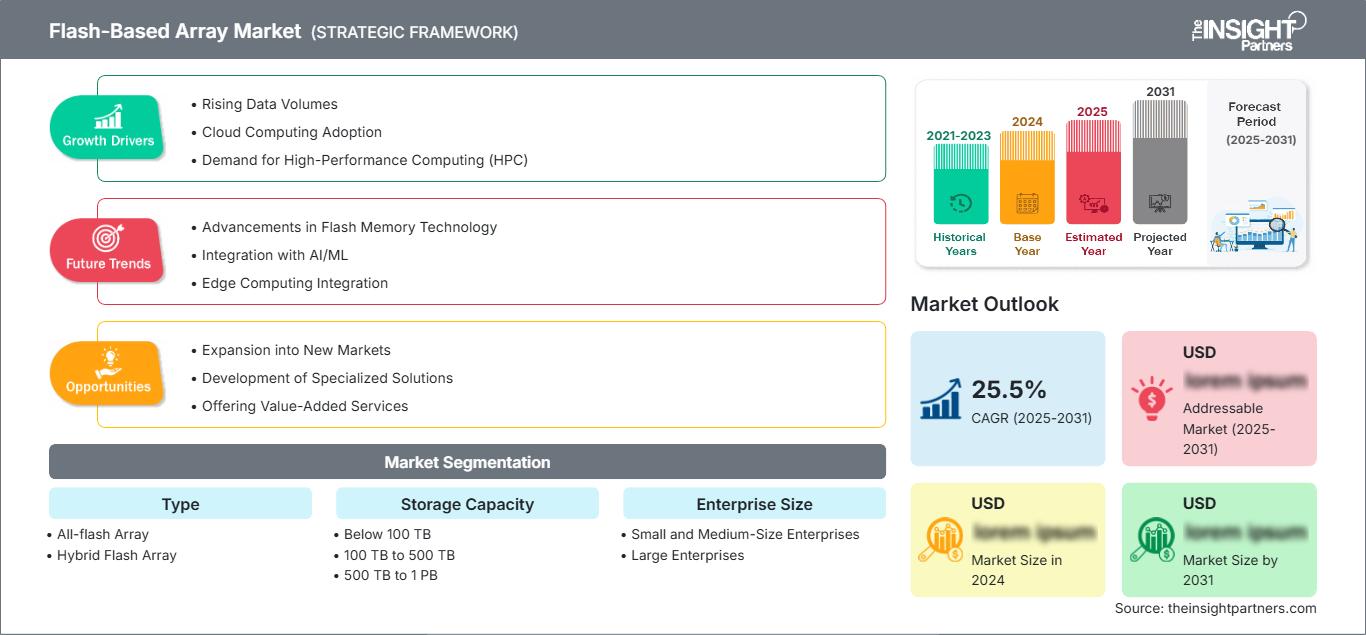
Flash-Based Array Market: Strategic Insights
Regional Insights
North America Flash-Based Array Market
North America accounted for approximately 37–39% share in 2025 and is expected to expand at 6.4–7.2% CAGR through 2034. The area enjoys the advantages of considerable hyperscale data center capability, solid enterprise IT expenditure, virtualization adoption, and investments in AI infrastructure. The US continues to be the primary source of demand, bolstered by cloud vendors, banks, healthcare organizations, telcos, and tech businesses.
Storage transformation becomes increasingly tied up with security, ransomware recovery, and resilience. Businesses are swapping out old arrays for newer solutions that support NVMe, automation, and denser flash storage. Canada supports its demand by way of finance and government digitization along with cloud adoption, while demand in the region is also boosted by investments in data centers and HPC.
U.S. Flash-Based Array Market
The US represented approximately 70–74% of North American Flash-Based Array Market revenue in 2025 and is projected to grow at 6.5–7.3% CAGR through 2034. This placement is based on hyperscale deployment, enterprise cloud migration, artificial intelligence, and significant expenditure in data center transformation. Dell Technologies, Hewlett Packard Enterprise, NetApp, IBM, Pure Storage, and Oracle have important connections with enterprises.
The financial sector needs low latency solutions for transaction processing, while the health care sector needs reliable storage solutions for imaging, records and analysis. Media organizations have an increasing need for storage solutions to accommodate high throughput, while manufacturing organizations prefer flash storage solutions for their industrial analytics. Security, resilience and control of data are of utmost importance in government and defense sectors.
Europe Flash-Based Array Market
Europe held approximately 25–27% share in 2025 and is forecast to grow at 6.0–6.8% CAGR through 2034, with Germany representing the leading national market. Adoption of flash storage solutions is driven by needs for data sovereignty, hybrid-cloud growth, cybersecurity, and efficiency in terms of energy.
In the UK, there is high adoption demand among the financial sector, tech firms, and cloud computing providers, while Germany is helped by its manufacturing industry’s digitization and analytics. In France, Italy, and Spain, adoption is growing owing to digitalization of government institutions, telecommunications, health care, and enterprise clouds. Organizations in Europe assess flash storage in light of considerations on power efficiency, resilience, regulation, and economics of the entire lifecycle.
APAC Flash-Based Array Market
APAC accounted for approximately 28–30% share in 2025 and is projected to achieve 7.2–8.0% CAGR through 2034, making it the fastest-growing major region. China is leading the regional demand thanks to the development of cloud infrastructure, telecom, digitized manufacturing, and the growth of data center capacity. The technology ecosystems for enterprises in Japan and South Korea are strong.
India is growing through digital services, fintech, government portals, and hyperscale investments, whereas Australia is benefiting due to cloud modernization and regulated industry demand. The regional adoption of storage is increasingly being driven by digitalization strategies in the nations, semiconductor ecosystems, investments in AI, and industrial automation.
Middle East & Africa Flash-Based Array Market
Middle East and Africa demand is developing from a smaller installed base, with growth estimated at 6.2–7.2% CAGR through 2034. Saudi Arabia and the UAE are leading regional adoption through sovereign cloud, smart-city programs, AI infrastructure, telecommunications expansion, and data-center investment. South Africa remains an important enterprise and financial-services market.
Energy-sector digitization creates additional demand for analytics and operational data storage, while government modernization supports secure infrastructure. The Rest of MEA is progressing more gradually as cloud adoption, connectivity, and enterprise IT budgets develop. Increasing regional emphasis on data localization and digital sovereignty should encourage investment in locally hosted storage infrastructure, creating opportunities for vendors offering efficient, resilient, and scalable flash architectures.
Segmentation Analysis
Type
Type segmentation is led by all-flash architectures because latency-sensitive applications increasingly require consistent performance and predictable quality of service. The segment is estimated to expand at 6.9–7.7% CAGR during 2026–2034. Hybrid configurations remain relevant where organizations balance performance requirements with capacity economics and existing infrastructure investments.
- All-flash Array: Represents the dominant architecture for databases, virtualization, analytics, AI inference, and other workloads requiring consistently low latency. Its strategic importance increases as higher-density NAND and data-reduction technologies improve effective capacity economics.
- Hybrid Flash Array: Maintains relevance for mixed workloads where frequently accessed data requires flash performance while less-active information benefits from lower-cost storage tiers. Adoption remains important among cost-sensitive and capacity-oriented enterprises.
Storage Capacity
Storage capacity is becoming increasingly important as AI datasets, analytics repositories, digital content, and enterprise databases expand. The segment is expected to register 6.8–8.0% CAGR during 2026–2034, with larger configurations gaining strategic relevance as data-center density increases and organizations consolidate workloads.
- Below 1 TB: Primarily serves smaller deployments, localized workloads, and specialized environments where limited datasets and constrained infrastructure requirements make compact storage configurations appropriate.
- 1 TB to 5 TB: Supports departmental applications, smaller databases, and mid-sized enterprise environments. Demand remains steady where organizations require higher performance without investing in large centralized storage architectures.
- 5 TB to 1 PB: Addresses mainstream enterprise consolidation, virtualization, analytics, and private-cloud workloads. Its broad applicability makes this capacity range important for organizations modernizing established data-center environments.
- Above 1 PB: Supports hyperscale, AI, high-performance analytics, media repositories, and large databases. These systems are strategically important for consolidating high-volume workloads while improving rack utilization and operational efficiency.
Enterprise Size
Enterprise size influences procurement priorities, deployment scale, and financing models. The segment is projected to grow at 6.5–7.5% CAGR during 2026–2034, with large enterprises maintaining higher spending because of complex workloads, broader data estates, and stringent resilience requirements.
- Small and Medium-Size Enterprises: Adoption is shaped by managed infrastructure, cloud-connected solutions, simplified administration, and predictable costs. Flexible procurement models can lower barriers to enterprise-grade storage for organizations with limited internal IT resources.
- Large Enterprises: Represent the principal demand base because of extensive databases, virtualization estates, analytics workloads, and geographically distributed operations. Buyers prioritize performance, resilience, security, automation, and integration with hybrid-cloud architectures.
End-User
End-user adoption is projected to grow at 6.7–7.8% CAGR during 2026–2034, reflecting divergent workload characteristics across regulated, digital, and industrial sectors. High-performance processing, cyber-resilience, and growing data volumes remain common procurement considerations.
- BFSI: Requires low-latency transaction processing, high availability, regulatory compliance, and resilient recovery. Flash infrastructure supports databases, analytics, fraud detection, and digital banking workloads.
- IT and Telecom: Uses flash arrays for cloud platforms, virtualization, network workloads, AI services, and large-scale data processing. Demand benefits from increasing service complexity and distributed infrastructure.
- Healthcare: Requires reliable, high-performance storage for medical imaging, electronic health records, research datasets, and AI-assisted diagnostics while maintaining stringent availability and data-protection requirements.
- Media and Entertainment: Depends on high-throughput storage for video production, rendering, content libraries, streaming workflows, and digital asset management, making performance and scalable capacity central procurement priorities.
- Retail: Uses storage for customer analytics, omnichannel platforms, inventory systems, personalization, and transaction processing. Flash adoption supports faster access to operational and analytical datasets.
- Government: Prioritizes secure, resilient, and policy-compliant infrastructure for citizen services, public databases, defense-related workloads, and digital government platforms.
- Manufacturing: Applies flash storage to industrial analytics, automation, digital twins, product lifecycle systems, and predictive maintenance, where rapid data access can support operational decision-making.
Opportunity Snapshot
| End-User | Revenue Contribution (High/Medium/Low) | Trend Tag | Adoption Stage |
|---|---|---|---|
| BFSI | High | Real-Time Banking | Mature |
| IT and Telecom | High | AI Infrastructure | Scaling |
| Healthcare | Medium | Medical Analytics | Scaling |
| Media and Entertainment | Medium | Content Workflows | Scaling |
| Retail | Medium | Omnichannel Analytics | Scaling |
| Government | Medium | Sovereign Storage | Scaling |
| Manufacturing | Medium | Industrial Analytics | Scaling |
Flash-Based Array Market Growth Drivers and Impact Analysis
AI Workloads Increase High-Performance Storage Requirements
The usage of AI technology in organizations is causing a shift in the needs of enterprise storage due to an increase in the amount, speed, and availability of the data required for machine learning, inference, indexing, and analytics. In order to deliver data without significant bottlenecks from the compute side to the storage layer, enterprises would need high throughput storage systems with NVMe interfaces, increased capacities, and effective data management capabilities. This trend goes beyond hyperscaler adoption because companies from BFSI, healthcare, manufacturing, retail, and media sectors have AI applications.
Data-Center Efficiency Strengthens the Case for Flash Infrastructure
The operators of data centers have been focusing more and more on issues related to power, cooling, rack efficiency, and operational efficiency with an increase in density of infrastructure. Flash arrays have the capability of providing far better performance in relation to the physical footprint as compared to disk storage systems. The result is extremely important in scenarios where power prices and limited capacity of the data center hinder expansion. Increase in density of NAND, data reduction, and efficient placement of workloads could help improve the capacity even further without the same proportionate increase in physical infrastructure.
Cyber-Resilience Requirements Raise Demand for Intelligent Storage
The need for ransomware protection, operational disruption, and more stringent requirements for business continuity has led to the growing importance of resilient storage architectures. Organizations want immutable snapshots, fast recovery, isolation of backup systems, automated anomalies detection, and policy-driven replication, which all belong to the cyber-resilient strategy. Today flash storage systems offer such features natively in their operating environments without requiring extra layers of infrastructure. The commercial impact is considerable since the security requirements might speed up the process of replacing old storage arrays due to the absence of recovery features. Vendors offering not only high performance but also resilience may enhance their product differentiators, while their customers will gain shorter recovery goals and simplified management.
Flash-Based Array Market Future Trends
AI-Optimized Storage Fabrics Become More Programmable
The Flash-Based Array Market trends are increasingly moving toward programmable storage fabrics that dynamically allocate resources according to workload behavior. The AI-driven environment needs some storage that can adapt to varying access patterns, need for checkpointing, metadata management, and inferences pipeline without any manual intervention continuously. The next-generation storage solutions would use NVMe over fabrics, smart cache, prediction of workload, and software-based orchestration. It is possible to disaggregate the system to enable the company to independently scale up storage and compute. In addition, it is also possible for the storage infrastructure to incorporate some observability and AI-driven operations so that they predict the problems like capacity limitation, performance limitation, and hardware failure.
Consumption-Based Models Expand Across Enterprise Storage Procurement
Enterprise buyers are increasingly evaluating infrastructure through consumption, subscription, and flexible capacity models rather than traditional upfront hardware purchases. This trend can reduce procurement friction, align storage expenditure with workload expansion, and provide access to technology refreshes without repeated capital-intensive replacement cycles. Vendors are therefore likely to strengthen evergreen architectures, cloud-connected management, and usage-based capacity services. The model is particularly relevant for organizations facing unpredictable AI and analytics growth, because capacity requirements can change faster than conventional procurement cycles. Over time, consumption-based purchasing may increase competition around service quality, upgrade flexibility, data mobility, and contractual transparency, while encouraging vendors to maintain stronger long-term customer relationships.
Flash-Based Array Market Opportunities
High-Density Storage for AI and Hyperscale Environments
The Flash-Based Array Market Forecasts indicate an opportunity to target high-density configurations designed for AI, analytics, and hyperscale environments where conventional capacity planning can create bottlenecks. Vendors can differentiate through dense NAND integration, efficient cooling, advanced data reduction, and scalable architectures that accommodate rapidly expanding datasets. Opportunities extend to storage systems optimized for GPU clusters, vector databases, model repositories, and inference workloads. Strategic investment in high-capacity configurations can also address growing demand for reduced rack footprint and improved energy efficiency. Suppliers that combine high density with predictable performance and strong data-protection capabilities are positioned to address increasingly sophisticated procurement requirements among cloud operators and large enterprises.
Regional Data Sovereignty Creates Local Infrastructure Opportunities
Data localization policies and sovereign-cloud initiatives are creating opportunities for storage vendors to expand in markets where organizations prefer locally controlled infrastructure. Governments, financial institutions, healthcare providers, and critical industries increasingly require greater visibility over where sensitive data is stored and processed. Vendors can address this opportunity through regional partnerships, local service ecosystems, compliant architectures, and secure lifecycle management. Europe, the Middle East, and Asia Pacific offer particularly relevant expansion pathways as public-sector digitalization and cloud infrastructure investment accelerate. Strategic positioning around compliance, resilience, and energy efficiency can help suppliers compete beyond hardware specifications and develop stronger relationships with organizations building nationally or regionally controlled data environments.
Recent Developments
- February 2026: Pure Storage, the company revolutionizing storage and data management, announced its new name: Everpure. This change reflects the company’s greater impact from reshaping storage to defining the future of data management. The company also announced it has entered into a definitive agreement to acquire 1touch, an innovator in data intelligence and orchestration that provides a comprehensive, unified view of an enterprise’s information. With 1touch, Everpure furthers its commitment to data management innovation, making data secure, accessible, intelligent, and ready to perform.
- June 2025: Hewlett Packard Enterprise Development LP announced new AI factory solutions built with NVIDIA, including HPE Alletra Storage MP X10000, positioning storage as an integrated component of scalable AI infrastructure for enterprises, service providers, sovereign entities, and model builders. The announcement strengthened HPE’s focus on AI-ready storage and data infrastructure.
- September 2025: Dell Inc. highlighted its continued leadership in all-flash storage vendor revenue and emphasized PowerStore as part of its flash-storage portfolio. The company linked its storage strategy with enterprise modernization and differentiated performance, efficiency, and infrastructure choice across flash and hybrid environments.
Frequently Asked Questions

- Comprehensive Market Sizing and Forecast Analysis
- Detailed Segmentation Analysis
- In-Depth Market Dynamics Assessment
- Regional and Country-Level Insights
- Competitive Landscape and Company Benchmarking
- Strategic Business Intelligence
Recent Reports
Testimonials

The Insight Partners' SCADA System Market report is comprehensive, with valuable insights on current trends and future forecasts. The team was highly professional, responsive, and supportive throughout. We are very satisfied and highly recommend their services.
RAN KEDEM Partner, Reali Technologies LTDs
I requested a report on a very specific software market and the team produced the report in a few days. The information was very relevant and well presented. I then requested some changes and additions to the report. The team was again very responsive and I got the final report in less than a week.
JEAN-HERVE JENN Chairman, Future Analytica
We worked with The Insight Partners for an important market study and forecast. They gave us clear insights into opportunities and risks, which helped shape our plans. Their research was easy to use and based on solid data. It helped us make smart, confident decisions. We highly recommend them.
PIYUSH NAGPAL Sr. Vice President, High Beam Global
The Insight Partners delivered insightful, well-structured market research with strong domain expertise. Their team was professional and responsive throughout. The user-friendly website made accessing industry reports seamless. We highly recommend them for reliable, high-quality research services
YUKIHIKO ADACHI CEO, Deep Blue, LLC.
This is the first time I have purchased a market report from The Insight Partners.While I was unsure at first, I visited their web site and felt more comfortable to take the risk and purchase a market report.I am completely satisfied with the quality of the report and customer service. I had several questions and comments with the initial report, but after a couple of dialogs over email with their analyst I believe I have a report that I can use as input to our strategic planning process.Thank you so much for taking the extra time and making this a positive experience.I will definitely recommend your service to others and you will be my first call when we need further market data.
JOHN SUZUKI President and Chief Executive Officer, Board Director, BK Technologies
I wish to appreciate your support and the professionalism you displayed in the course of attending to my request for information regarding to infectious disease IVD market in Nigeria. I appreciate your patience, your guidance, and the fact that you were willing to offer a discount, which eventually made it possible for us to close a deal. I look forward to engaging The Insight Partners in the future, all thanks to the impression you have created in me as a result of this first encounter.
DR CHIJIOKE ONYIA MANAGING DIRECTOR, PineCrest Healthcare Ltd.Reason to Buy
- Informed Decision-Making
- Understanding Market Dynamics
- Competitive Analysis
- Identifying Emerging Markets
- Customer Insights
- Market Forecasts
- Risk Mitigation
- Boosting Operational Efficiency
- Strategic Planning
- Investment Justification
- Tracking Industry Innovations
- Aligning with Regulatory Trends





 Get Free Sample for