
High-Voltage Circuit Breakers Market Size, Share & Growth by 2034
Coverage: By Product Type (High-voltage vacuum circuit breaker, Sulfur hexafluoride circuit breakers, Air high voltage circuit breaker, Oil high voltage circuit breaker, Others); Application (Construction, Transportation, Power generation, Others) , and Geography (North America, Europe, Asia Pacific, and South and Central America)
- Status : Data Released
- Report Code : TIPRE00022919
- Category : Electronics and Semiconductor
- No. of Pages : 150
- Available Report Formats :


- Last update date : September 10, 2026


2025 Market Size
US$ 15.22 Bn
Base year value
2034 Forecast
US$ 29.2 Bn
Projected by 2034
CAGR 2026-2034
8.49 %
Growth rate
Addressable Market
US$ 210.46 Bn
(2026-2034)
The High-Voltage Circuit Breakers Market revenue was valued at US$ 15.22 Billion in 2025 and is projected to reach US$ 29.2 Billion by 2034, expanding at a CAGR of 8.49% during 2026–2034. The market covers high-voltage vacuum circuit breakers, sulfur hexafluoride circuit breakers, air high-voltage circuit breakers, and oil high-voltage circuit breakers used across construction, transportation, and power-generation applications.
Across North America, the High-Voltage Circuit Breakers Market size is expected to advance at 7.6–8.2% through 2034. Utility replacement cycles, new transmission connections, data-center load growth, and renewable interconnection programs require higher interrupting ratings and dependable asset monitoring. Domestic manufacturing incentives and resilience spending also support local capacity, while lengthy permitting and transformer and switchgear lead times moderate project conversion.
High-Voltage Circuit Breakers Market Assessment and Insights
- North America: Held 27–30% share in 2025 and should grow at 7.6–8.2% CAGR between 2026–2034, supported by grid replacement, data-center loads, renewable connections, and resilience investment.
- US: Represented 79–83% of North American demand in 2025 and is projected to expand at 7.8–8.4% CAGR between 2026–2034.
- Europe: Accounted for 23–26% share in 2025 and is forecast to grow at 7.2–7.8% CAGR between 2026–2034, led by Germany, the UK, France, Italy, and Spain.
- Asia Pacific: Captured 38–42% share in 2025 and is anticipated to register 9.2–9.8% CAGR between 2026–2034, with China, India, Japan, and South Korea leading investment.
- Largest Segment: Sulfur hexafluoride circuit breakers held 52–56% market share in 2025 and are expected to record 6.6–7.2% CAGR between 2026–2034.
- High Growth Segment: High-voltage vacuum circuit breakers represented 19–23% share in 2025 and are forecast to post 10.7–11.5% CAGR between 2026–2034.
- Key companies analyzed in detail: ABB Ltd, GE Vernova Inc., Schneider Electric SE, Mitsubishi Electric Corporation, Siemens Energy AG, Toshiba Energy Systems & Solutions Corporation, Hitachi Energy Ltd., TE Connectivity plc, Zhejiang Zhegui Electric Co., Ltd. (ZHIYUE GROUP), and Mitsubishi Electric Power Products, Inc.
Source: The Insight Partners' analysis based on proprietary research, government publications, company annual reports, investor presentations, industry databases, and expert interviews.
High-voltage interruption has evolved from labor-intensive oil and air solutions to SF6 technology, digital solution and vacuum solution. Assembly automation, sealing automation, type testing and sensing have contributed to higher quality and consistency, as utilities are sourcing entire bay solutions rather than stand-alone circuit breakers. Production is limited by castings, interrupters, operating mechanisms and high-voltage testing capability, making it prudent for multiyear framework contracts and factory expansions on regional basis.
Investment between now and 2034 will be made in F-gas free technologies, condition-based maintenance, HVDC protection and local manufacturing. Asia Pacific will see the highest addition in number of units, but North American and European purchases will be guided by environment concerns, cyber security and life cycle. Prohibitions on high global warming potential gases, as well as investments in transmission and renewable energy connections, will provide tailwinds, but the qualification processes, permit delays and shortage of engineering talent will be key determinants.
High-Voltage Circuit Breakers Market Report Scope
| Report Attribute | Details |
|---|---|
| Market size in 2025 | US$ 15.22 Billion |
| Market Size by 2034 | US$ 29.2 Billion |
| Global CAGR (2026 - 2034) | 8.49% |
| Historical Data | 2021-2024 |
| Forecast period | 2026-2034 |
High-Voltage Circuit Breakers Market Analysis
The High-Voltage Circuit Breakers Market growth will be underpinned by developments in transmission networks. The IEA estimated that global transmission investment had climbed to US$ 140 billion in 2023, up 10%, while more than 1,650 GW of innovative solar and wind capacity remained awaiting transmission connection in 2024. Each additional line, transformer bays, generator tie, or interconnector needs fault clearing apparatus calibrated for voltage, current, and duty cycle.
The value chain includes conductors, insulators made of porcelain or composite material, vacuum circuit breakers or gas-filled circuits, mechanism, sensors, controllers, and testing. The suppliers create these components into live tank, dead tank, and gas-insulated systems. Buyers should be qualified, supply chain, and field experienced, because the failure of circuit breaker would affect the entire substation. Castings, instrument transformers, and testing equipment deficiencies create a competitive advantage for vertically integrated suppliers.
High Voltage Circuit Breakers Market is a concentrated premium level competition. Hitachi Energy Ltd., Siemens Energy AG, GE Vernova Inc., ABB Ltd., and Mitsubishi Electric Corporation compete in the market in high voltage levels via installation base, engineering, and services. Schneider Electric SE is a leader in adjacent distribution markets and digital technologies, while Toshiba Energy Systems & Solutions Corporation and Mitsubishi Electric Power Products, Inc. have strategic ties to utilities.
The funds flow in favor of F-gas-free switchgear, increased manufacturing capacities, remote monitoring, and regional maintenance centers. GE Vernova Inc. boosts its manufacturing capacities for US high-voltage switchgear; Siemens Energy AG and Hitachi Energy Ltd. grow their range of products to provide clean air solutions and eco-solutions. TE Connectivity plc is involved in the segment of protection and connectivity, whereas Zhejiang Zhegui Electric Co., Ltd. enters the market with competitive products due to lower costs.
● REPORT CUSTOMIZATION
Tailor This Report To Align With Your Specific Business Requirements
This report can be customized to align precisely with your business objectives, scope, and target markets. Customization options include tailored segmentation, geography, competitive analysis, and strategic insights to support informed decision-making.
Customize This Report →WHAT YOU CAN ADJUST
- ● Segmentations
- ● Geography
- ● Competitive Analysis
- ● Language Preferences
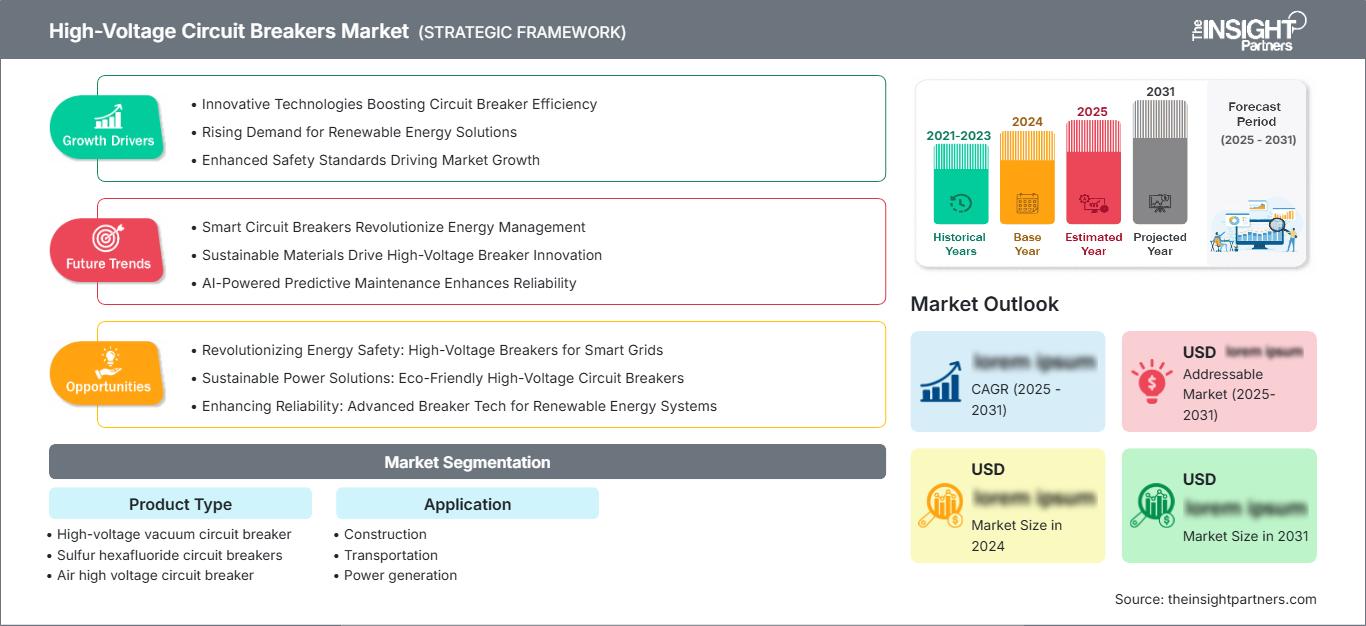
High-Voltage Circuit Breakers Market: Strategic Insights
Regional Insights
North America High-Voltage Circuit Breakers Market
The North American region had a market share of 27-30% for the High-Voltage Circuit Breakers market share in 2025 and is expected to exhibit a compound annual growth rate of 7.6-8.2% from 2025 to 2034. The replacement of existing breakers, integration of renewable energy sources, expansion of data centers, and resilience initiatives drive orders for dead tank, live tank, and gas-insulated circuit breakers.
The supply of breakers is becoming more regional because of the long lead times on large pieces of equipment and how it exposes construction schedules. The leading players in the High Voltage Circuit Breakers market include GE Vernova Inc., ABB Ltd., Hitachi Energy Ltd., Siemens Energy AG, and Mitsubishi Electric Power Products, Inc. They provide localized design expertise and field service along with an extensive global supply network. Canada has hydroelectricity projects, interconnect projects, and mining-related projects. Mexico has industry and renewable energy projects.
U.S. High-Voltage Circuit Breakers Market
North America was served by the U.S. market in 79-83% in 2025 and is predicted to grow at CAGR of 7.8-8.4% between 2026-2034. Department of Energy provided $8 million funding for HVDC breakers. While national grid needs are defined by utility-scale renewable energy production, data centers, manufacturing facilities, and network strengthening. Such application areas demand fast clearing of faults, short-circuit strength and interoperability of protection systems.
GE Vernova Inc., ABB Ltd, Hitachi Energy Ltd., Mitsubishi Electric Power Products, Inc., and Siemens Energy AG have significant commercial or manufacturing footprint. Power generation application continues to lead; however, increased electrification of transportation sector and big construction projects contribute to the growth of substations. Buyer preference toward the standardization of breaker platforms in their fleets makes the demand easier to meet. Local sourcing preferences enhance opportunities for domestic production; nevertheless, environmental permitting and specialized workforce can cause delays before energizing.
Europe High-Voltage Circuit Breakers Market
Europe’s share of worldwide revenue was 23-26% in 2025 and is expected to experience growth at a rate of 7.2-7.8% CAGR until 2034. Germany dominates due to network reinforcement, connections of offshore wind energy, electrification of industries, and engineering for suppliers. The United Kingdom relies on interconnectors, offshore networks, and asset replacement, where the focus of utilities is on the lifetime emissions and reliability of the infrastructure.
France invests in nuclear fleet, electrification of rails, and renewables integration. Italy needs substation reinforcement in areas of solar farms, industries, and inter-regional flows, whereas Spain is known for renewable evacuation and cross-border capacity. The major competitors such as Siemens Energy AG, Hitachi Energy Ltd., GE Vernova Inc., ABB Ltd and Schneider Electric SE compete through the absence of F-gases in technology and services, and digital substations.
APAC High-Voltage Circuit Breakers Market
Asia Pacific holds market share of 38-42% in 2025 and forecasted to capture 9.2-9.8% CAGR until 2034. China leads by virtue of large transmission system, renewable capacity, city substations, and manufacturing capability. India with its interstate transmission lines and generation interconnections; Japan with its compact and SF6 free technology; South Korea with its help for industrial grids.
Australia with its renewable region, mining, and interconnectivity initiatives. National grid strategy, electrification, and localization will fuel the demand. Mitsubishi Electric Corporation, Toshiba Energy Systems & Solutions Corporation, and Hitachi Energy Ltd. have a strong presence in the region but there will be pricing-based competition with standardized ratings.
Middle East & Africa High-Voltage Circuit Breakers Market
MEA will witness CAGR of 7.0% to 7.6% from 2026 to 2034. Saudi Arabia excels in generation, reinforcement of grid, renewable energy and diversification of industry; whereas UAE supplies solar energy, data infrastructure and urban substations. South Africa needs equipment replacement, renewable integration and recovery of transmission infrastructure.
In the rest of the MEA region, interconnectors, mining, water and electrification drive selective demand. The procurement is project-driven and import-oriented, which makes desert hardiness, localized service, funding and life-cycle support critical factors. Gas insulated substations assume significance wherever the land availability or environment poses constraints.
Segmentation Analysis
Product Type
The High-Voltage Circuit Breakers Market scope by product type is expected to expand at 8.2–8.8% CAGR during 2026–2034. Selection depends on voltage class, interruption duty, footprint, environmental regulation, maintenance philosophy, and installed-base compatibility. SF6 remains technically mature, while vacuum platforms gain attention as utilities seek lower lifecycle emissions. Air and oil designs persist mainly in specialized, lower-cost, or replacement contexts.
- High-voltage vacuum circuit breaker: Adoption is scaling in F-gas-free substations where low maintenance, long mechanical life, and clean-air insulation support utility decarbonization without sacrificing switching reliability.
- Sulfur hexafluoride circuit breakers: The installed base, compact insulation, proven high-voltage performance, and established service practices preserve leadership, although leakage management and regulatory phase-outs constrain new procurement.
- Air high voltage circuit breaker: Demand concentrates in accessible outdoor systems and legacy replacements where simple insulation, visible clearances, and service familiarity offset larger footprints and weather exposure.
- Oil high voltage circuit breaker: Use is largely replacement-oriented in aging networks, as fire risk, maintenance intensity, fluid handling, and modern environmental expectations favor alternative interruption technologies.
Application
Application demand is forecast to register 8.0–8.6% CAGR through 2034. Power generation and transmission connections account for the highest breaker value because fault levels and reliability requirements are demanding. Construction adds substations for data centers, factories, and urban infrastructure, while transportation requires traction power, rail corridors, ports, and charging ecosystems. Procurement increasingly combines breakers with protection, monitoring, and commissioning services.
- Construction: Data centers, industrial campuses, commercial districts, and infrastructure megaprojects require dependable high-voltage intake substations, compact layouts, coordinated protection, and predictable construction schedules.
- Transportation: Rail electrification, metro systems, ports, airports, and charging hubs create specialized switching demand where vibration, rapid restoration, space constraints, and operational safety are critical.
- Power generation: Conventional plants, renewable projects, storage, and grid interconnections sustain the largest value pool, requiring high fault ratings, synchronization capability, and long-term service assurance.
Opportunity Snapshot
| Application | Revenue Contribution | Trend Tag | Adoption Stage |
| Construction | Medium | Digital Campuses | Scaling |
| Transportation | Medium | Rail Electrification | Scaling |
| Power generation | High | Grid Expansion | Mature |
High-Voltage Circuit Breakers Market Growth Drivers and Impact Analysis
Transmission Expansion and Replacement Spending
Electricity systems need more lines and substations as renewable generation, data centers, industry, cooling, and transport increase demand. The IEA expects global electricity consumption to grow close to 4% annually through 2027 and reported that advanced economies and China accounted for about 80% of transmission investment. Breakers are essential at each bay to isolate faults before equipment damage spreads. Replacement adds a second demand layer because many installed fleets are approaching service or environmental thresholds. The commercial impact is a larger, more predictable pipeline of complete-bay projects, retrofit mechanisms, and service contracts. Suppliers with certified platforms across multiple voltage classes can reuse engineering, shorten qualification, and capture both greenfield and brownfield spending while utilities reduce fleet complexity and outage duration.
F-Gas Regulation Accelerates Technology Substitution
SF6 provides excellent insulation and arc quenching but has a global warming potential 24,300 times that of carbon dioxide. European regulation and utility net-zero programs are therefore redirecting specifications toward vacuum interrupters, clean air, and lower-impact gas mixtures. The transition changes more than the interrupter: sealing, pressure monitoring, dimensions, maintenance procedures, training, and end-of-life handling must also be validated. Manufacturers that demonstrate equivalent fault clearing, cold-weather performance, compactness, and lifecycle economics can secure early framework agreements. Market impact will appear first in replacement-sensitive European and premium utility projects, then broaden as test evidence and installed references accumulate. Conventional SF6 equipment will remain important in parts of the world where regulation, cost, or high-voltage alternatives mature more slowly.
Digital Monitoring Improves Critical Asset Availability
Utilities are moving from calendar-based maintenance toward condition-based strategies using operation counters, coil-current signatures, travel timing, contact wear estimates, gas or pressure sensors, and mechanism diagnostics. A high-voltage breaker may operate infrequently, yet it must respond within milliseconds when a fault occurs. Remote visibility helps identify degraded springs, heaters, seals, batteries, or control circuits before failure. This reduces unnecessary inspections, supports safer maintenance planning, and limits unplanned outages. Digital capability also differentiates suppliers after equipment commissioning, creating recurring revenue from analytics, upgrades, and service agreements. Buyers nevertheless require secure communications, interoperable protocols, reliable sensors, and clear ownership of operational data. Vendors that integrate monitoring without adding excessive commissioning complexity can position breakers as managed reliability assets rather than isolated electromechanical devices.
High-Voltage Circuit Breakers Market Future Trends
Vacuum Interruption Moves into Higher Voltage Classes
High-Voltage Circuit Breakers Market trends will increasingly center on extending vacuum interruption and clean-air insulation beyond established ratings. Siemens Energy AG already offers 145 kV vacuum circuit breakers and is developing 170–245 kV technology, while higher-voltage demonstration programs are building operating evidence. Progress depends on interrupter geometry, dielectric coordination, controlled switching, compact busducts, and qualification under severe environmental conditions. Adoption will first concentrate where regulators and utilities assign explicit value to eliminating F-gases. As volumes rise, standardized mechanisms and modular enclosures should lower cost, simplify training, and let suppliers offer common platforms across air-insulated, hybrid, and gas-insulated substations without compromising utility-specific interfaces.
HVDC Breakers Become a Strategic Grid Category
Multi-terminal HVDC networks require breakers that interrupt direct current without a natural current zero, creating a technically distinct growth path. The U.S. Department of Energy has funded work on standards and lower-cost HVDC breaker designs, while Mitsubishi Electric Corporation and Siemens Energy AG have collaborated on DC switching-station requirements. Future systems will combine ultrafast mechanical switches, power electronics, energy absorption, protection algorithms, and digital controls. Early deployment will target offshore wind hubs, interconnectors, and meshed transmission corridors where selective fault isolation preserves power flow. Commercial scale depends on interoperable standards, lower footprint, reduced losses, and bankable field demonstrations across multiple vendors.
High-Voltage Circuit Breakers Market Opportunities
Build Regional Capacity Around Grid Bottlenecks
High-Voltage Circuit Breakers Market Forecasts indicate an actionable gap in manufacturing, test capacity, and field service near major transmission programs. The IEA notes that grid equipment prices nearly doubled over five years and annual grid investment must rise by about 50% by 2030 from US$ 400 billion. Manufacturers can prioritize interrupter assembly, mechanism production, final testing, and spare-parts hubs in the U.S., India, the Middle East, and selected European markets. Joint qualification with utilities, standardized bay designs, and long-term component agreements can shorten lead times. Investment should target voltage classes with repeat demand rather than isolated megaprojects, while digital commissioning and technician training improve utilization after factory capacity enters service.
Convert Installed Fleets Through Retrofit Programs
A large installed base creates a service opportunity that does not require complete substation replacement. Suppliers can offer mechanism upgrades, monitoring kits, sealing improvements, controlled-switching packages, spare-part remanufacturing, and F-gas-reduction pathways built around planned outages. Retrofit programs appeal to utilities because civil works, bus interfaces, and protection schemes can often be retained. Providers should map installed models, secure legacy drawings, certify interchangeable assemblies, and maintain regional emergency inventory. Lifecycle contracts can bundle inspection, diagnostics, parts, and end-of-life gas handling, producing recurring revenue and supporting customer emissions goals. Success depends on transparent residual-life assessment and clear boundaries between refurbishment, retrofill, and full replacement.
Recent Developments
- May 2026: Hitachi Energy has unveiled a new SF₆-free dead tank circuit breaker designed for ultra-high-voltage transmission systems at the IEEE PES T&D Conference 2026 in Chicago. The new EconiQ technology is rated for 800 kV and 63 kA, representing a major step toward eliminating sulfur hexafluoride (SF₆) from high-voltage grid equipment.
- April 2025: Sensata Technologies has introduced its STPS500 Series PyroFuse, a compact pyrotechnic circuit breaker designed to provide rapid protection for high-voltage electrical systems operating at up to 1,000 V. The device is intended to improve safety in applications such as electric vehicles, charging infrastructure, aerospace and industrial equipment.
- April 2026: Eaton has expanded its Breaktor high-voltage circuit protection portfolio with a new single-pole version, along with a 24-volt control option, enhanced functional safety capabilities and higher short-circuit interruption performance. The technologies were showcased at ACT Expo 2026 in Las Vegas. The new single-pole Breaktor gives electric-vehicle manufacturers and system designers greater flexibility when developing high-voltage battery architectures. It can separate the positive and negative battery poles and can be integrated with components such as latching relays and pyrotechnic disconnects.
Frequently Asked Questions

- Comprehensive Market Sizing and Forecast Analysis
- Detailed Segmentation Analysis
- In-Depth Market Dynamics Assessment
- Regional and Country-Level Insights
- Competitive Landscape and Company Benchmarking
- Strategic Business Intelligence
Recent Reports
Testimonials

The Insight Partners' SCADA System Market report is comprehensive, with valuable insights on current trends and future forecasts. The team was highly professional, responsive, and supportive throughout. We are very satisfied and highly recommend their services.
RAN KEDEM Partner, Reali Technologies LTDs
I requested a report on a very specific software market and the team produced the report in a few days. The information was very relevant and well presented. I then requested some changes and additions to the report. The team was again very responsive and I got the final report in less than a week.
JEAN-HERVE JENN Chairman, Future Analytica
We worked with The Insight Partners for an important market study and forecast. They gave us clear insights into opportunities and risks, which helped shape our plans. Their research was easy to use and based on solid data. It helped us make smart, confident decisions. We highly recommend them.
PIYUSH NAGPAL Sr. Vice President, High Beam Global
The Insight Partners delivered insightful, well-structured market research with strong domain expertise. Their team was professional and responsive throughout. The user-friendly website made accessing industry reports seamless. We highly recommend them for reliable, high-quality research services
YUKIHIKO ADACHI CEO, Deep Blue, LLC.
This is the first time I have purchased a market report from The Insight Partners.While I was unsure at first, I visited their web site and felt more comfortable to take the risk and purchase a market report.I am completely satisfied with the quality of the report and customer service. I had several questions and comments with the initial report, but after a couple of dialogs over email with their analyst I believe I have a report that I can use as input to our strategic planning process.Thank you so much for taking the extra time and making this a positive experience.I will definitely recommend your service to others and you will be my first call when we need further market data.
JOHN SUZUKI President and Chief Executive Officer, Board Director, BK Technologies
I wish to appreciate your support and the professionalism you displayed in the course of attending to my request for information regarding to infectious disease IVD market in Nigeria. I appreciate your patience, your guidance, and the fact that you were willing to offer a discount, which eventually made it possible for us to close a deal. I look forward to engaging The Insight Partners in the future, all thanks to the impression you have created in me as a result of this first encounter.
DR CHIJIOKE ONYIA MANAGING DIRECTOR, PineCrest Healthcare Ltd.Reason to Buy
- Informed Decision-Making
- Understanding Market Dynamics
- Competitive Analysis
- Identifying Emerging Markets
- Customer Insights
- Market Forecasts
- Risk Mitigation
- Boosting Operational Efficiency
- Strategic Planning
- Investment Justification
- Tracking Industry Innovations
- Aligning with Regulatory Trends





 Get Free Sample for