
HVDC Capacitor Market Size, Share & Trends by 2034
Coverage: by Product Type (Plastic Film Capacitors, Aluminum Electrolytic Capacitors, Ceramic Capacitors, Tantalum Wet Capacitors, Reconstituted Mica Paper Capacitors, Glass Capacitors, Others); Technology (Line Commutated Converters (LCC), Voltage-Sourced Converters (VSC)); Installation Type (Open Rack Capacitor Banks, Enclosed Rack Capacitor Banks, Pole Mounted Capacitor Banks); End User (Commercial, Industrial, Energy and Power Sector, Defense, Others) , and Geography (North America, Europe, Asia Pacific, and South and Central America)
- Status : Data Released
- Report Code : TIPRE00012538
- Category : Electronics and Semiconductor
- No. of Pages : 150
- Available Report Formats :


- Last update date : September 15, 2026


2025 Market Size
US$ 3.44 Bn
Base year value
2034 Forecast
US$ 6.62 Bn
Projected by 2034
CAGR 2026-2034
7.54 %
Growth rate
Addressable Market
US$ 45.32 Bn
(2026-2034)
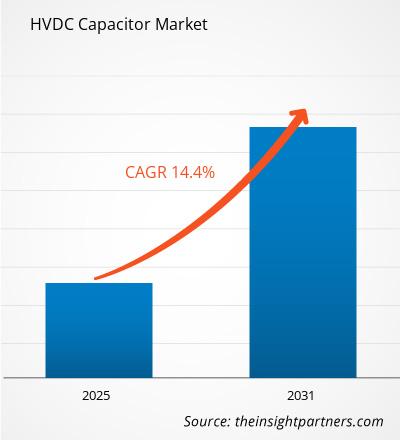
The global HVDC Capacitor market was valued at US$ 3.44 billion in 2025 and is expected to reach US$ 6.62 billion by 2034; it is estimated to record a CAGR of 7.54% during 2026-2034.
HVDC Capacitor Market Assessment and Insights
- North America: North America is estimated to hold 25–29% share in 2025 and is expected to grow at a 7.6–8.3% CAGR between 2026–2034, supported by grid modernization, renewable interconnections, and long-distance transmission investments.
- US: The US represents 74–78% of North American demand in 2025 and is projected to expand at a 7.8–8.5% CAGR between 2026–2034, driven by transmission upgrades and renewable integration.
- Europe: Europe accounts for 29–33% share in 2025 and is projected to grow at a 8.1–8.8% CAGR between 2026–2034, led by Germany, the UK, France, Italy, and Spain.
- Asia Pacific: Asia Pacific represents 34–38% share in 2025 and is projected to grow at a 9.0–9.7% CAGR between 2026–2034, led by China, India, Japan, South Korea, and Australia.
- Largest Segment: Voltage-Sourced Converters represent a 54–58% market share in 2025 and are expected to grow at a 9.0–9.6% CAGR during 2026–2034.
- High Growth Segment: Energy and Power Sector represents a 67–71% market share in 2025 and is expected to grow at a 8.7–9.3% CAGR during 2026–2034.
- Key companies analyzed in detail: ABB Ltd., Eaton Corporation plc, General Atomics, International Capacitors SA (Lifasa), Maxwell Technologies, Inc., Samwha Capacitor Co., Ltd., Siemens AG, Sieyuan Electric Co., Ltd., TDK Corporation, Vishay Intertechnology, Inc.
Source: The Insight Partners' analysis based on proprietary research, government publications, company annual reports, investor presentations, industry databases, and expert interviews.
The HVDC Capacitor Market has evolved from traditional capacitors towards high energy density capacitors that are thermally stable and application specific. With their favorable dielectric strength, low losses, self-healing features, and life cycle, polypropylene film capacitors increasingly meet converter and DC-link applications needs. The production process is also evolving towards higher specialization, involving manufacturing facilities able to withstand high electrical loads and rigorous converter working cycles.
Prospects of future growth in the HVDC Capacitor Market size would depend on the development of transmission corridors, offshore wind power generation, and power exchanges between regions. According to the IEA, the investment in the global grid reached $390 billion in 2024 and is expected to surpass $400 billion in 2025, while the expansion of the transmission and distribution networks should be over 20% by 2030.
HVDC Capacitor Market Report Scope
| Report Attribute | Details |
|---|---|
| Market size in 2025 | US$ 3.44 Billion |
| Market Size by 2034 | US$ 6.62 Billion |
| Global CAGR (2026 - 2034) | 7.54% |
| Historical Data | 2021-2024 |
| Forecast period | 2026-2034 |
HVDC Capacitor Market Analysis
The development of the HVDC Capacitor Market relies on the growth in HVDC transmission capacity, renewable power integration, and converter stabilization. Capacitors have many roles including smoothing, harmonics filtering, energy absorption, voltage stability, and reactive-power management. It involves various market participants such as dielectric material suppliers, capacitor manufacturers, converter OEMs, EPC contractors, transmission companies, testing labs, and maintenance organizations. Reliability and traceability form essential factors for product qualification.
The supply chain is affected by polypropylene films, aluminum foil, metallization, ceramic materials, particular insulating materials, and accurate machines. In large volume converters, engineering coordination is required between manufacturers of capacitors and system integrators because of the necessity to coordinate electrical stresses, thermal behavior, dimensioning, and insulating materials according to the design of the converter. Therefore, prolonged qualification periods will be advantageous to known and experienced manufacturers with proven high voltage technology.
The competitive positioning in the HVDC Capacitor Market Report is determined by technical qualifications, manufacturing scale, product reliability, and support for big projects involving infrastructure development. ABB Ltd. and Siemens AG integrate capacitor features with their skills in producing the entire range of HVDC converter systems, whereas Eaton Corporation plc, General Atomics, and Sieyuan Electric Co., Ltd. operate in high-voltage power equipment.
Specialized producers like International Capacitors SA (Lifasa), Samwha Capacitor Co., Ltd., TDK Corporation, and Vishay Intertechnology, Inc. contribute to developing the market by providing the company with capacitor-related competence. The investments are made in developing film-based designs, more compact products, increased voltage ratings, effective thermal design, and automation of manufacturing processes. Maxwell Technologies, Inc. offers proven competence in developing high-power capacitors, whereas TDK Corporation and Vishay Intertechnology, Inc. work on improving the platforms of high-performance capacitors.
● REPORT CUSTOMIZATION
Tailor This Report To Align With Your Specific Business Requirements
This report can be customized to align precisely with your business objectives, scope, and target markets. Customization options include tailored segmentation, geography, competitive analysis, and strategic insights to support informed decision-making.
Customize This Report →WHAT YOU CAN ADJUST
- ● Segmentations
- ● Geography
- ● Competitive Analysis
- ● Language Preferences
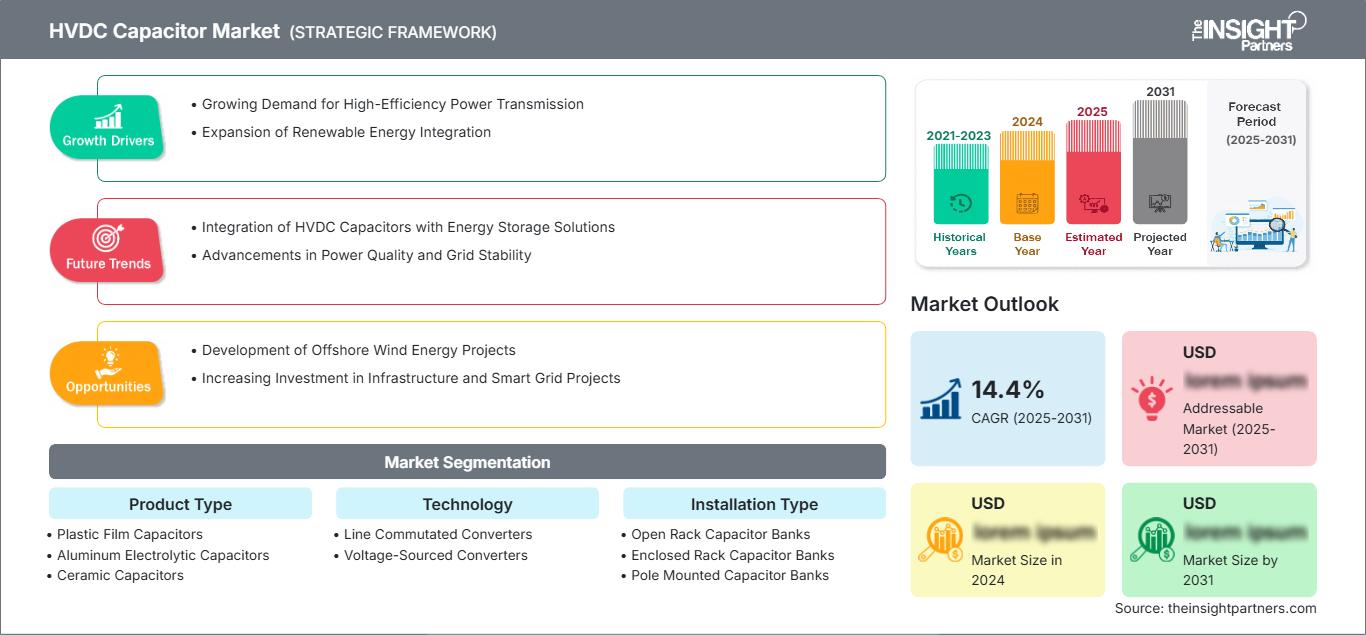
HVDC Capacitor Market: Strategic Insights
Regional Insights
North America HVDC Capacitor Market
It is predicted that North America will hold 25-29% in the HVDC Capacitor market share in 2025, expanding at a CAGR of 7.6-8.3% from 2025 to 2034. United States leads demand in the region, aided by efforts towards transmission modernization, renewables integration, energy storage, and increased electricity demand. Canada makes its contribution to the demand via hydro transmission and cross border power transfers, whereas Mexico boosts demand via industry and grid development projects.
Investments in the region are becoming increasingly inclined towards the development of transmission corridors and connections between new generation and load centers. HVDC is preferred in situations where conventional expansions become difficult due to distance, congestion, or right-of-way restrictions. In addition to this, offshore wind farm developments are also contributing towards the subsea transmission needs which call for converter solutions.
U.S. HVDC Capacitor Market
US is estimated to account for 74–78% of North America’s demand in 2025 and is expected to grow at a rate of 7.8–8.5% CAGR till 2034. Companies operating in this market are ABB Ltd., Eaton Corporation plc, General Atomics, Maxwell Technologies, Inc., Siemens AG, TDK Corporation, and Vishay Intertechnology, Inc., catering to various utility and industrial applications.
Increasing application trends include grid strengthening, renewables integration, transmission from offshore wind farms, and power quality management. According to the IEA, investments in US grids have more than doubled since 2013 till 2024 to almost US$110 billion, depicting the huge infrastructure upgradation trend taking place in the country.
Europe HVDC Capacitor Market
The HVDC Capacitor Market in Europe is estimated to occupy a share of 29-33% of the total market in 2025, growing at a CAGR of 8.1-8.8% through 2034. Germany is the largest in demand, helped by cross border transmission and renewable energy integration. While the UK focuses on building up its transmission capacity to integrate wind power, France, Italy, and Spain have been increasing their grid to cater to renewable energy integration. Germany is also known for its manufacturing expertise in capacitors for specific applications.
APAC HVDC Capacitor Market
APAC represents 34–38% of the HVDC Capacitor Market Share in 2025 and is expected to grow at a 9.0–9.7% CAGR through 2034. China is the leading country, followed by India, Japan, South Korea, and Australia. Large transmission corridors, renewable expansion, industrial electrification, and national grid programs support sustained demand for converter components.
The use of UHVDC technology by China results in a substantial base of applications, whereas India is stepping up investments to link up its renewable energy sources with consumption centers. The focus in Japan and South Korea is on grid stability and power electronics, while Australia needs new transmission lines for its renewable energy-abundant regions.
Middle East & Africa HVDC Capacitor Market
The Middle East and Africa market is projected to grow at a 7.0–7.8% CAGR through 2034. Saudi Arabia is the leading regional opportunity, followed by the UAE and South Africa. Large-scale renewable programs, industrial diversification, interconnection initiatives, and power-system modernization are creating new requirements for high-voltage transmission equipment.
Saurdi Arabia and UAE are developing transmission infrastructure for power along with their renewables and industrial projects, whereas SOUTH AFRICA is emphasizing on building their transmission infrastructure due to constraints in generation and transmission capacity. For ROF MEA, power requirements will continue to be focused towards interconnection, mining, industry, and renewables corridors. The needs of long-distance transmission will facilitate the application of HVDC technology.
Segmentation Analysis
Product Type
The Product Type segment is projected to grow at a 8.0–8.8% CAGR during 2026–2034. Film-based capacitors are increasingly important because converter applications demand high voltage endurance, low dielectric losses, self-healing capability, and reliable thermal behavior. Other technologies remain relevant where application-specific voltage, capacitance, frequency, environmental, or mechanical requirements favor alternative dielectric systems. The HVDC Capacitor Market scope therefore spans multiple technologies rather than a single capacitor architecture.
- Plastic Film Capacitors: Widely suited to high-voltage power applications because of low losses, high insulation resistance, self-healing behavior, and favorable reliability characteristics under demanding converter conditions.
- Aluminum Electrolytic Capacitors: Provide high capacitance density and remain relevant for power-electronics applications where compact energy storage and filtering are required, particularly within supporting converter subsystems.
- Ceramic Capacitors: Offer strong electrical stability, low equivalent series resistance, and compact construction, supporting specialized high-frequency and high-voltage applications requiring robust dielectric performance.
- Tantalum Wet Capacitors: Provide high capacitance density and stable electrical characteristics, serving specialized power-electronics applications where compact construction and controlled operating conditions justify their use.
- Reconstituted Mica Paper Capacitors: Deliver strong insulation performance and dimensional stability, supporting demanding high-voltage applications where long service life and resistance to electrical stress are important.
- Glass Capacitors: Provide high reliability, temperature stability, and strong insulation characteristics, making them strategically relevant for specialized environments where electrical and environmental endurance are prioritized.
- Others: Include application-specific capacitor technologies selected according to voltage, capacitance, thermal, mechanical, and environmental requirements across specialized HVDC equipment.
Technology
The Technology segment is expected to grow at a 8.8–9.5% CAGR during 2026–2034. Voltage-Sourced Converters increasingly support applications requiring independent control of active and reactive power, black-start capability, and connection of weak grids or renewable resources. Line Commutated Converters remain important for high-capacity bulk transmission, especially where established network conditions and economic power transfer favor conventional thyristor-based systems.
- Line Commutated Converters: Remain strategically important for established bulk-transmission applications, particularly long-distance, high-capacity corridors where mature technology and large power ratings influence project selection.
- Voltage-Sourced Converters: Support flexible grid integration, offshore wind, weak-grid connections, and controllable power exchange, making the technology increasingly important for renewable-heavy transmission architectures.
Installation Type
The Installation Type segment is forecast to grow at a 7.7–8.4% CAGR during 2026–2034. Open rack arrangements remain important for large converter stations because they provide accessible layouts and established maintenance practices. Enclosed and pole-mounted configurations serve applications where footprint, environmental protection, modularity, or installation constraints require alternative arrangements. Selection depends on voltage class, station design, climate, safety requirements, and maintenance strategy.
- Open Rack Capacitor Banks: Provide accessible installation and established maintenance practices, making them important for large converter stations with dedicated outdoor equipment areas.
- Enclosed Rack Capacitor Banks: Offer improved protection from environmental exposure and controlled equipment arrangements, supporting installations where safety, footprint, and environmental conditions influence design.
- Pole Mounted Capacitor Banks: Enable space-efficient deployment in suitable transmission configurations and can support applications where compact installation and reduced ground footprint are important.
End User
The End User segment is projected to grow at a 8.2–9.0% CAGR during 2026–2034. Energy and power applications represent the principal demand center because HVDC capacitor systems are directly associated with converter stations and transmission infrastructure. Industrial users also contribute through power-quality applications, while commercial and defense installations generally involve more specialized requirements. Procurement decisions increasingly prioritize reliability, lifecycle cost, serviceability, and system compatibility.
- Commercial: Demand is associated with specialized power-quality and infrastructure applications where reliable capacitor systems support controlled electrical environments and critical facility operations.
- Industrial: Industrial users apply capacitor technologies to power conditioning, converter systems, high-power equipment, and specialized electrical installations requiring dependable voltage and transient management.
- Energy and Power Sector: Represents the central application base because converter stations, renewable interconnections, and long-distance transmission systems require capacitor assemblies for filtering, smoothing, and voltage control.
- Defense: Specialized defense applications prioritize compactness, ruggedization, high reliability, and predictable performance under demanding electrical and environmental operating conditions.
- Others: Include specialized infrastructure and technical applications where high-voltage capacitor assemblies are incorporated into customized power-conversion and transmission-related equipment.
Opportunity Snapshot
| End User | Revenue Contribution | Trend Tag | Adoption Stage |
|---|---|---|---|
| Commercial | Low | Grid Quality | Scaling |
| Industrial | Medium | Power Conditioning | Mature |
| Energy and Power Sector | High | Grid Expansion | Mature |
| Defense | Medium | High Reliability | Scaling |
| Others | Low | Custom Systems | Emerging |
HVDC Capacitor Market Growth Drivers and Impact Analysis
Rapid expansion of transmission infrastructure
Grid expansion is creating direct demand for high-voltage converter infrastructure, particularly where renewable generation is located far from consumption centers. The IEA estimates that annual grid investment needs to rise toward US$600 billion by 2030 to meet energy and climate objectives, compared with roughly US$300 billion currently. HVDC systems can transmit large power volumes efficiently over long distances and across difficult rights-of-way. Each new converter station creates requirements for capacitors used in filtering, smoothing, voltage support, and transient management. The market impact is therefore closely tied to transmission project pipelines rather than only replacement demand. Suppliers with established qualification records are positioned to participate in multi-year infrastructure programs where component reliability is critical to overall system availability.
Renewable integration and offshore transmission requirements
Renewable generation is increasing the need for flexible transmission architectures capable of moving electricity across long distances and balancing geographically dispersed resources. The IEA reports that 1,650 GW of solar and wind capacity was awaiting grid connection globally in 2024, demonstrating the scale of transmission bottlenecks. HVDC provides a practical solution for large renewable corridors and offshore wind connections, where converter stations require specialized capacitor assemblies. Increasing deployment of voltage-sourced converters also broadens application requirements because VSC systems can provide independent control of active and reactive power. For capacitor suppliers, this creates opportunities in new converter projects, retrofit programs, offshore platforms, and grid reinforcement. The resulting demand is more technically differentiated than conventional utility capacitor procurement.
Increasing adoption of voltage-sourced converter architectures
Voltage-sourced converters are becoming increasingly relevant for modern grids because they can support weak networks, facilitate renewable integration, and provide greater controllability than conventional converter architectures. Their use in offshore wind and multi-terminal applications increases the need for high-performance capacitor technologies capable of handling rapid switching, thermal stress, and electrical transients. This driver affects product specifications as well as volumes. Manufacturers must optimize dielectric design, inductance, cooling, insulation coordination, and mechanical packaging to meet converter requirements. The resulting technical complexity raises qualification barriers and favors suppliers with engineering capabilities and established testing infrastructure. Over time, the transition toward more controllable converter systems can support higher-value capacitor assemblies even where unit volumes remain relatively modest.
HVDC Capacitor Market Future Trends
HVDC Capacitor Market trends toward higher-energy-density film technologies
Future capacitor development is likely to prioritize higher energy density, lower losses, improved thermal endurance, and longer operational life. Polypropylene film technologies are positioned strongly because they combine high dielectric strength with self-healing behavior and relatively low dissipation. Advanced metallization and winding techniques can further improve current handling while reducing physical volume. Manufacturers are also likely to develop more application-specific geometries that fit compact modular converter assemblies. Improved monitoring may allow capacitor health to be assessed through temperature, electrical behavior, and operating history, supporting predictive maintenance. These changes could shift procurement toward engineered assemblies rather than standardized components, increasing the importance of qualification testing, application engineering, and lifecycle support in future purchasing decisions.
Digital monitoring and condition-based capacitor maintenance
Digital monitoring is expected to become more prominent as utilities seek better visibility into converter-station health and asset utilization. Future capacitor systems may incorporate sensors or diagnostic interfaces capable of tracking temperature, electrical stress, insulation behavior, and operating history. Data can then be integrated into station-control platforms and maintenance systems to identify abnormal conditions before component failure. Condition-based maintenance could reduce unnecessary replacement while improving planning for scheduled outages. The trend also creates opportunities for suppliers to differentiate through diagnostic software, remote support, and service agreements. As converter stations become more digitally managed, capacitor monitoring can evolve from a maintenance option into an element of broader asset-health management. This transition may strengthen recurring service opportunities.
HVDC Capacitor Market Opportunities
Localized manufacturing for emerging transmission corridors
The HVDC Capacitor Market Forecasts indicate substantial opportunity for suppliers that establish manufacturing, testing, and service capabilities closer to emerging transmission projects. India, Southeast Asia, the Middle East, and parts of Africa are expanding electricity infrastructure and renewable-generation capacity, increasing demand for localized technical support. Regional production can reduce logistics exposure, shorten lead times, and improve responsiveness during commissioning. Investors can prioritize facilities capable of producing film-based assemblies while retaining engineering capacity for project-specific designs. Partnerships with converter manufacturers and transmission EPC contractors can improve access to large projects. Local calibration, testing, and spare-parts capabilities would further strengthen competitiveness by addressing lifecycle requirements rather than limiting participation to initial equipment supply.
Integrated capacitor solutions for modular converter platforms
Suppliers can capture additional value by designing capacitor assemblies specifically for modular converter platforms rather than selling standalone components. Modular architectures impose constraints on footprint, thermal management, electrical connections, insulation, and maintenance access, creating opportunities for engineered integration. Companies with expertise in dielectric materials, mechanical packaging, monitoring, and testing can develop differentiated assemblies for converter OEMs. Strategic investments should focus on high-voltage testing laboratories, accelerated-life testing, thermal characterization, and digital diagnostics. Such capabilities can shorten qualification cycles and support joint development with system integrators. The opportunity is particularly relevant as converter projects become more standardized at system level while still requiring component-level customization to satisfy voltage, power, environmental, and reliability requirements.
Recent Developments
- October 2025: Hitachi Energy marked 25 years of its Xi’an capacitor factory in China, highlighting its expanded role as a global manufacturing and power-quality solutions hub. The facility’s smart manufacturing expansion, including AI-based visual inspection, intelligent conveyor systems and robotic automation, tripled dry-type capacitor production capacity in its first phase, supporting growing demand from renewable energy, HVDC transmission, data centers and other applications.
- June 2025: COSEL launched the DCS1400B, a rugged 1,400W full-brick DC/DC converter designed for high-voltage DC links, battery storage and distributed power architectures. The converter supports a 200–435VDC input range, adjustable output up to 120%, CVCC control, peak efficiency above 96.9% and operation from -40°C to +100°C, while supporting parallel operation of up to 12 units for capacity scaling and N+1 redundancy in mission-critical systems.
- April 2025: BHEL, in consortium with Hitachi Energy India, signed a contract with Rajasthan Part I Power Transmission to design and execute a 6,000 MW, ±800 kV bi-pole and bi-directional LCC HVDC transmission system connecting Bhadla in Rajasthan with Fatehpur in Uttar Pradesh. The project, targeted for completion by 2029, will transmit renewable power over more than 950 km and includes 765/400 kV power evacuation at Fatehpur and 400 kV AC substations at Bhadla, supporting India’s renewable-energy integration and 500 GW renewable-energy target for 2030.
Frequently Asked Questions

- Comprehensive Market Sizing and Forecast Analysis
- Detailed Segmentation Analysis
- In-Depth Market Dynamics Assessment
- Regional and Country-Level Insights
- Competitive Landscape and Company Benchmarking
- Strategic Business Intelligence
Recent Reports
Testimonials

The Insight Partners' SCADA System Market report is comprehensive, with valuable insights on current trends and future forecasts. The team was highly professional, responsive, and supportive throughout. We are very satisfied and highly recommend their services.
RAN KEDEM Partner, Reali Technologies LTDs
I requested a report on a very specific software market and the team produced the report in a few days. The information was very relevant and well presented. I then requested some changes and additions to the report. The team was again very responsive and I got the final report in less than a week.
JEAN-HERVE JENN Chairman, Future Analytica
We worked with The Insight Partners for an important market study and forecast. They gave us clear insights into opportunities and risks, which helped shape our plans. Their research was easy to use and based on solid data. It helped us make smart, confident decisions. We highly recommend them.
PIYUSH NAGPAL Sr. Vice President, High Beam Global
The Insight Partners delivered insightful, well-structured market research with strong domain expertise. Their team was professional and responsive throughout. The user-friendly website made accessing industry reports seamless. We highly recommend them for reliable, high-quality research services
YUKIHIKO ADACHI CEO, Deep Blue, LLC.
This is the first time I have purchased a market report from The Insight Partners.While I was unsure at first, I visited their web site and felt more comfortable to take the risk and purchase a market report.I am completely satisfied with the quality of the report and customer service. I had several questions and comments with the initial report, but after a couple of dialogs over email with their analyst I believe I have a report that I can use as input to our strategic planning process.Thank you so much for taking the extra time and making this a positive experience.I will definitely recommend your service to others and you will be my first call when we need further market data.
JOHN SUZUKI President and Chief Executive Officer, Board Director, BK Technologies
I wish to appreciate your support and the professionalism you displayed in the course of attending to my request for information regarding to infectious disease IVD market in Nigeria. I appreciate your patience, your guidance, and the fact that you were willing to offer a discount, which eventually made it possible for us to close a deal. I look forward to engaging The Insight Partners in the future, all thanks to the impression you have created in me as a result of this first encounter.
DR CHIJIOKE ONYIA MANAGING DIRECTOR, PineCrest Healthcare Ltd.Reason to Buy
- Informed Decision-Making
- Understanding Market Dynamics
- Competitive Analysis
- Identifying Emerging Markets
- Customer Insights
- Market Forecasts
- Risk Mitigation
- Boosting Operational Efficiency
- Strategic Planning
- Investment Justification
- Tracking Industry Innovations
- Aligning with Regulatory Trends





 Get Free Sample for