
HVDC Converter Market Trends, Size & Growth by 2034
Coverage: By Voltage (Below 500 kV, 500-800 kV, Above 800-1000 kV and Below 1000 kV.); Power Rating (Below 3000 MW, 3000-6000 MW, Above 6000-10000 MW and Below 10000 MW.); Configuration (Monopolar, Bipolar, Back to Back , Others); Converter (LCC, VSC, Others) , and Geography (North America, Europe, Asia Pacific, and South and Central America)
- Status : Data Released
- Report Code : TIPRE00027600
- Category : Electronics and Semiconductor
- No. of Pages : 150
- Available Report Formats :


- Last update date : September 15, 2026


2025 Market Size
US$ 12.91 Bn
Base year value
2034 Forecast
US$ 18.43 Bn
Projected by 2034
CAGR 2026-2034
4.03 %
Growth rate
Addressable Market
US$ 142.30 Bn
(2026-2034)
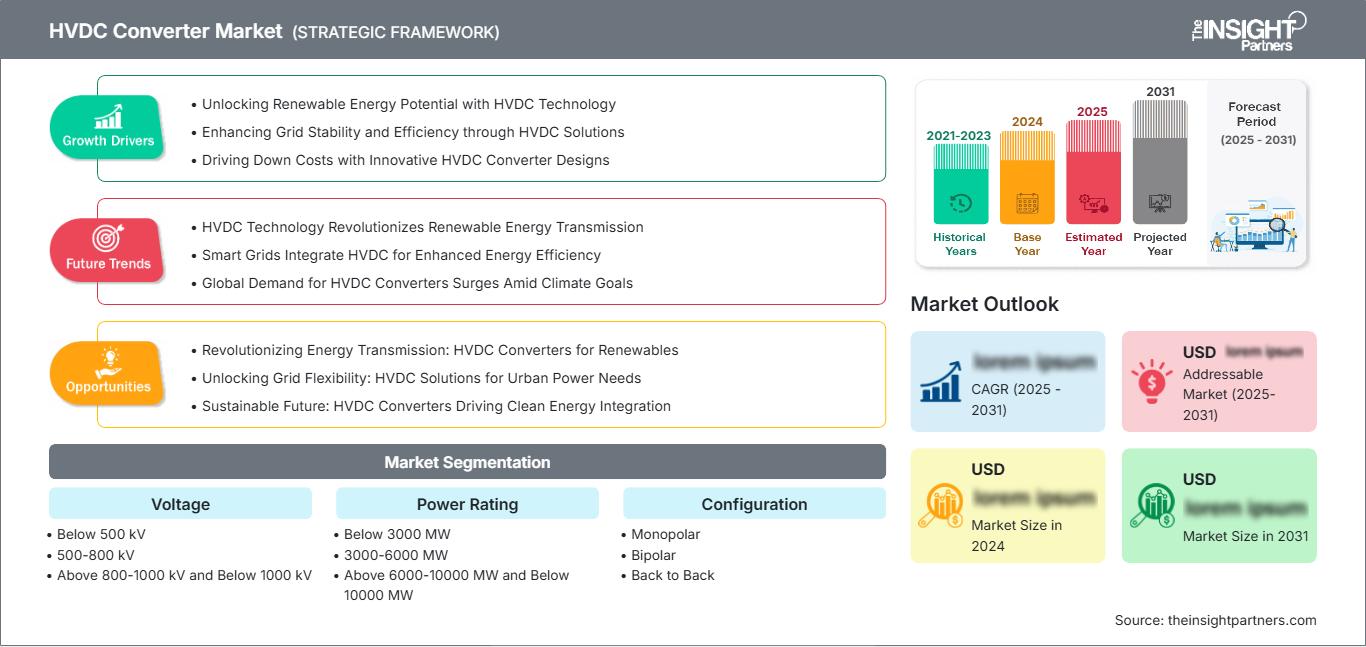
The HVDC Converter market was valued at US$ 12.91 billion in 2025 and is expected to reach US$ 18.43 billion by 2034; it is estimated to record a CAGR of 4.03% during 2026-2034.
HVDC Converter Market Assessment and Insights
- North America: North America is estimated to hold a 21–25% share in 2025 and grow at a 4.1–4.8% CAGR between 2026–2034, supported by transmission replacement, renewable integration, interregional connections, and rising electricity demand.
- US: The US accounts for 82–86% of North American revenue in 2025 and is modeled to grow at a 4.2–4.9% CAGR through 2034, supported by grid modernization and new transmission corridors.
- Europe: Europe represents a 25–29% share in 2025 and is expected to expand at a 4.3–5.0% CAGR during 2026–2034, led by Germany, the UK, France, Italy, and Spain through offshore wind and interconnection projects.
- Asia Pacific: Asia Pacific is estimated at a 38–42% share in 2025 and is projected to grow at a 5.0–5.7% CAGR, with China, India, Japan, South Korea, and Australia supporting large-scale transmission investment.
- Largest Segment: The 500–800 kV category holds a modeled 41–45% market share in 2025 and is expected to expand at a 4.8–5.4% CAGR during 2026–2034.
- High Growth Segment: VSC represents a modeled 38–42% market share in 2025 and is projected to grow at a 6.2–7.0% CAGR during 2026–2034.
- Key companies analyzed in detail: Siemens Energy AG, ABB Ltd, GE Vernova Inc., Mitsubishi Electric Corporation, Toshiba Energy Systems & Solutions Corporation, NR Electric Co., Ltd., C-EPRI, China XD Group Co., Ltd., C-EPRI Power Engineering Company, XJ Electric Co., Ltd., Hyosung Heavy Industries Corporation, LS Electric Co., Ltd.
Source: The Insight Partners' analysis based on proprietary research, government publications, company annual reports, investor presentations, industry databases, and expert interviews.
HVDC Converters has transitioned into more dynamic systems that integrate renewable power and balance grids from bulk transmission projects that have been largely used to date. Technological progress in thyristor valves, insulated-gate bipolar transistors, modular multilevel converters, digital control, and protection systems has allowed for further expansion of converter applications. There is also greater localization of manufacturing, since utilities prefer to source shorter supply chains for transformers, valves, control, and high-voltage equipment.
Investment in the future is expected to be driven by the APAC, North America, and Europe, where renewable energy and electrification will necessitate new transmission investments. The regulatory support of interconnections, offshore wind, grid reliability, and decarbonization can serve to bolster the pipeline. Procurement trends are also evolving in response to long equipment lead times, capacity of engineering, and the coordination of converter stations with cables and sub-stations.
HVDC Converter Market Report Scope
| Report Attribute | Details |
|---|---|
| Market size in 2025 | US$ 12.91 Billion |
| Market Size by 2034 | US$ 18.43 Billion |
| Global CAGR (2026 - 2034) | 4.03% |
| Historical Data | 2021-2024 |
| Forecast period | 2026-2034 |
HVDC Converter Market Analysis
Growth in HVDC Converters Market is highly dependent on the rise in distances between renewable generation locations and electricity consumption centers. Converter plants represent an important link in the value chain, connecting generation sites, transmission lines, offshore wind facilities, and power receivers. According to the International Energy Agency, at least 80 million km of grids should be built or rebuilt until 2040 under the climate and energy targets set nationally, thus stressing the requirement for transmission solutions capable of transferring huge power volumes effectively.
The supply chain covers power semiconductors, converter transformers, thyristor valves, IGBT modules, reactors, filters, cooling systems, protective equipment, control platforms, and engineering services. Supply challenges still exist, mainly related to big transformers and high voltage equipment. The International Energy Agency pointed out in 2025 that cable and large power transformer procurement time was close to doubling since 2021.
HVDC Converter Market Report reveals that the market has a high degree of concentration, where technical competence, installation experience, engineering capabilities, and lifecycle services have a significant bearing on purchasing decisions. Siemens Energy AG, ABB Ltd, GE Vernova Inc., and Mitsubishi Electric Corporation are the key players in all major transmission application areas, whereas Toshiba Energy Systems & Solutions Corporation and Hyosung Heavy Industries Corporation help in building their presence in Asia. NR Electric Co., Ltd., XJ Electric Co., Ltd., and China XD Group Co., Ltd. gain due to China’s robust transmission development environment.
Capital expenditure is moving towards VSC converters, digital controls, refurbishment of converters, and applications at higher voltage levels. IEA estimated worldwide transmission capital expenditures at approximately US$140 billion in 2023, and found rising constraints on the equipment supply chain. Thus, competitive advantage will depend more on integration, execution capabilities, access to semiconductors, and long-term service support.
● REPORT CUSTOMIZATION
Tailor This Report To Align With Your Specific Business Requirements
This report can be customized to align precisely with your business objectives, scope, and target markets. Customization options include tailored segmentation, geography, competitive analysis, and strategic insights to support informed decision-making.
Customize This Report →WHAT YOU CAN ADJUST
- ● Segmentations
- ● Geography
- ● Competitive Analysis
- ● Language Preferences
HVDC Converter Market: Strategic Insights
Regional Insights
North America HVDC Converter Market
North America holds a modeled 21–25% share of global revenue in 2025 and is projected to expand at a 4.1–4.8% CAGR through 2034. Transmission reinforcement is increasingly important as electricity demand rises from data centers, manufacturing, electrification, and renewable generation. Large interregional projects can improve transfer capability between areas with different generation and demand profiles.
The U.S. is the main source of regional demand, while Canada participates in this process by way of hydroelectric power transmission and interconnections. Converter purchases are more and more often related to renewable energy projects, grid reliability, and equipment replacement. The region has already developed a well-established utility infrastructure that allows for conducting procurement processes and maintaining extended service contracts.
U.S. HVDC Converter Market
The U.S. represents approximately 82–86% of North American revenue in 2025 and is modeled to grow at a 4.2–4.9% CAGR through 2034. Data-center expansion, industrial electrification, renewable generation, and transmission congestion are strengthening the case for high-capacity corridors connecting geographically separated resources.
In terms of relevant technological and engineering expertise for transmission, Siemens Energy AG, ABB Ltd, GE Vernova Inc. and Mitsubishi Electric Corp. all have the relevant technological expertise in this regard. U.S. projects are now more focused on system controllability and reliability and integrating variable generation. Additionally, converter upgrades are becoming increasingly strategic as utilities look to increase the life span of their existing HVDC systems and upgrade the control, protection, and valve technology.
Europe HVDC Converter Market
Europe accounts for a modeled 25-29% market share in 2025 and is expected to exhibit 4.3-5.0% CAGR growth from 2025 to 2034 owing to strong demand from Germany. The UK, France, Italy, and Spain will also generate revenue via offshore wind, cross-border connections, renewable integration, and grid upgrade.
In Germany, offshore wind energy development along with cross-border power transmission needs will drive consistent demand for converter stations and related grid equipment. In the UK, investments in the power grid are being made to facilitate the connection of offshore generation and strengthening of regional grids. Interconnection, renewable integration, and infrastructure upgrade needs will create opportunities in France, Italy, and Spain.
APAC HVDC Converter Market
The APAC region is expected to hold a HVDC Converter Market share of 38-42% in 2025 and will be witnessing growth at a CAGR of 5.0-5.7% through 2034. The Chinese market leads the market on account of its transmission corridors while India, Japan, South Korea, and Australia make contributions through renewable integration, interconnections, and industrial electrification.
China’s substantial UHV transmission programs help in the demand of converters while India is building transmission networks for renewable energy evacuation from distant locations. Japan and South Korea focus on grid stability and security while Australia requires transmission capacities for remote renewable resources to be linked with demand centers. Government policy support towards renewable energy production and grid expansion aids the project pipeline while India alone accounted for 83% investment of power sector in clean energy in 2024.
Middle East & Africa HVDC Converter Market
Middle East and Africa are expected to expand at a modeled 3.8–4.6% CAGR through 2034. Saudi Arabia is the leading regional market, followed by the UAE and South Africa. Large renewable projects, industrial diversification, and interregional transmission requirements support gradual adoption.
Both Saudi Arabia and the UAE are investing in power infrastructure in parallel with renewable energy development and industrialization. South Africa needs reinforcing its transmission system to facilitate generation diversification and reliability. The RoMEA region is rather fragmented, with most growth opportunities related to utility-scale generation, long-distance interconnection, and infrastructure upgrade. Demand for converters will likely be project-related, with preference given to larger projects due to generation/consumption separation.
Segmentation Analysis
Voltage
The voltage segment of the HVDC Converter Market scope is led by 500–800 kV systems, modeled to grow at a 4.8–5.4% CAGR from 2026–2034. This range aligns with major long-distance bulk transmission requirements while balancing equipment complexity, insulation demands, and project economics. Higher-voltage systems remain important for ultra-large renewable evacuation corridors.
- Below 500 kV: Below 500 kV systems serve shorter-distance links, back-to-back applications, regional interconnections, and projects where transmission requirements do not justify ultra-high voltage infrastructure. Their flexibility supports diverse utility applications.
- 500-800 kV: 500-800 kV systems occupy the core large-scale transmission category, supporting high-capacity corridors over long distances. Their established deployment base and suitability for renewable evacuation reinforce strategic importance.
- Above 800 kV: Above 800 kV systems address exceptionally large transfer requirements where minimizing transmission losses and maximizing corridor capacity justify higher equipment complexity. They remain concentrated in major utility-scale projects.
- 1000 kV and Below 1000 kV: 1000 kV and Below 1000 kV applications represent specialized ultra-high-voltage configurations. Their importance is tied to very large power transfers and network architectures requiring exceptional capacity.
Power Rating
The power-rating segment is modeled to grow at a 4.3–5.0% CAGR through 2034. Higher-capacity projects are favored where large renewable zones, major generation complexes, or interconnected grids require bulk transfer. Converter design increasingly emphasizes scalability, redundancy, controllability, and efficient thermal management.
- Below 3000 MW: Below 3000 MW systems address moderate-capacity interconnections and specialized transmission projects. Their comparatively flexible project sizing makes them suitable for regional grids and selected renewable connections.
- 3000-6000 MW: 3000-6000 MW systems represent an important large-scale category for renewable evacuation and interregional transmission. They balance high transfer capability with established converter and grid engineering practices.
- Above 6000-10000 MW: Above 6000-10000 MW systems serve exceptionally large transmission requirements. Their strategic importance increases where multiple generation sources feed a shared high-capacity corridor.
- Below 10000 MW: Below 10000 MW systems encompass the broad upper range of high-capacity transmission applications, providing utilities with scalable options for major renewable and interregional transfer projects.
Configuration
Configuration demand is modeled at a 4.4–5.1% CAGR through 2034. Bipolar systems remain important for bulk transmission because they provide high transfer capability and operational flexibility, while monopolar and back-to-back arrangements address more specific network requirements and interconnection architectures.
- Monopolar: Monopolar configurations provide a comparatively straightforward architecture for selected transmission requirements. They can be appropriate where project capacity, redundancy needs, and network conditions support a simpler DC arrangement.
- Bipolar: Bipolar systems provide high transfer capacity and operational flexibility and remain important for major long-distance projects. Their ability to maintain service under selected fault conditions supports utility investment.
- Back to Back: Back to Back configurations connect asynchronous or differently controlled AC networks without requiring a long DC transmission line. They remain valuable for grid interconnection and regional power-flow management.
Converter
The converter segment is projected to expand at a 5.4–6.2% CAGR through 2034. LCC remains established in very-high-capacity bulk transmission, while VSC is gaining strategic importance because of controllability, reactive-power management, black-start potential, and suitability for offshore wind and weaker grids.
- LCC: LCC technology remains central to high-capacity, long-distance transmission where mature thyristor technology, established operating experience, and strong project economics support deployment.
- VSC: VSC technology is increasingly selected for renewable integration, offshore connections, compact installations, and grids requiring independent active and reactive power control. Its flexibility strengthens long-term strategic relevance.
Opportunity Snapshot
| Configuration | Revenue Contribution (High/Medium/Low) | Trend Tag | Adoption Stage |
| Monopolar | Medium | Regional Links | Mature |
| Bipolar | High | Bulk Transfer | Mature |
| Back to Back | Medium | Grid Coupling | Scaling |
HVDC Converter Market Growth Drivers and Impact Analysis
Large-Scale Renewable Power Evacuation
Rapid renewable deployment is increasing the distance between generation sites and major consumption centers. Solar and wind projects are frequently developed where land, resource quality, or grid availability is favorable rather than near cities and industrial clusters. HVDC converters enable efficient transfer of large electricity volumes across long corridors while providing controllable power flow. The commercial impact is strongest for utility-scale renewable zones requiring dedicated transmission infrastructure. Converter suppliers benefit because projects require integrated terminals, transformers, valves, filters, controls, and protection systems. The IEA has identified transmission expansion as a critical prerequisite for integrating renewable generation and meeting electricity-sector decarbonization objectives. This creates a durable pipeline for converter projects as utilities align transmission investment with renewable capacity additions.
Grid Modernization and Interregional Power Transfer
Aging transmission infrastructure is creating a parallel replacement opportunity alongside greenfield development. Utilities increasingly need equipment that can improve controllability, reliability, and transfer capability without constructing entirely new generation assets. HVDC converter stations can connect asynchronous networks, reinforce constrained corridors, and enable targeted power-flow management. The commercial effect is broad because modernization projects can involve converter valves, control systems, protection equipment, transformers, and auxiliary systems. Digital upgrades can also extend asset life while reducing operational risk. The IEA reported that global transmission investment increased to approximately US$140 billion in 2023 and expects grid spending requirements to rise further as electricity demand and renewable connections accelerate. This supports both new-build and refurbishment demand.
Growth in Electricity Demand and Electrification
Rising electricity consumption is increasing pressure on transmission networks and strengthening the need for high-capacity transfer infrastructure. The IEA forecasts global electricity demand growth of 3.3% in 2025 and 3.7% in 2026, driven by industry, cooling, data centers, electric vehicles, appliances, and broader electrification. For converter suppliers, stronger demand creates opportunities where existing transmission capacity cannot efficiently connect generation and load. Data-center clusters and industrial facilities can accelerate local transmission constraints, while electrification creates additional variability in load profiles. HVDC projects can address selected constraints through controlled bulk transfer and interregional balancing. The impact therefore extends beyond renewable generation, supporting transmission investment associated with overall power-system expansion.
HVDC Converter Market Future Trends
Higher-Voltage and Multi-Terminal Architectures
Future HVDC Converter Market Trends are expected to increasingly combine higher voltage ratings with multi-terminal or more flexible network architectures. As renewable generation becomes geographically dispersed, point-to-point links may not always provide the optimal network structure. Multi-terminal configurations can enable several generation and demand nodes to share transmission infrastructure, improving utilization and creating additional routing flexibility. Converter control systems will become more important because multiple terminals require coordinated power-flow management, protection, and fault handling. Higher-voltage designs will also support larger transfer capacities while reducing current requirements for a given power level. The long-term direction is toward more networked DC infrastructure rather than isolated transmission corridors, although protection standards, interoperability, system planning, and project financing will determine the pace of commercial adoption.
Digital Converter Control and Predictive Asset Management
Digitalization is expected to become a defining feature of next-generation converter stations. Advanced monitoring can combine electrical measurements, thermal information, valve performance, transformer condition, and control-system diagnostics to identify developing faults before they cause outages. Digital twins and remote engineering tools may further improve commissioning, maintenance planning, and lifecycle optimization. These capabilities can be particularly valuable for converter stations located offshore, in remote renewable zones, or within strategically important interconnections. Suppliers are likely to differentiate through integrated control platforms, cybersecurity, data interoperability, and analytics rather than hardware specifications alone. As utilities seek longer asset lives, predictive maintenance can also support refurbishment decisions by identifying components that require replacement before failure. This trend creates recurring service opportunities alongside equipment sales.
HVDC Converter Market Opportunities
Localized Manufacturing for Strategic Grid Components
Localized manufacturing represents a significant opportunity for suppliers seeking stronger positions in major transmission markets. Utilities and governments are increasingly concerned about long procurement cycles for transformers, cables, valves, and related equipment. Establishing regional manufacturing or assembly can reduce logistics exposure, improve service responsiveness, and align suppliers with domestic-content requirements. India, China, Europe, and the United States provide particularly relevant opportunities because each combines substantial grid investment with policy interest in resilient supply chains. Suppliers can prioritize converter transformers, semiconductor modules, valve assemblies, control equipment, and service capabilities according to local demand. Partnerships with utilities and engineering companies can further reduce qualification barriers. The strategic objective in the HVDC Converter Market Forecast is not simply lower production cost, but greater delivery certainty for projects where delays can materially affect generation commissioning and network availability.
Refurbishment and Lifecycle Extension of Existing Links
A growing installed base of HVDC systems creates opportunities beyond new converter-station construction. Older links can require replacement of valves, control platforms, protection equipment, converter transformers, cooling systems, and communications infrastructure while retaining major portions of the existing transmission corridor. Refurbishment can therefore provide utilities with additional capacity, improved reliability, and modern control capabilities without developing an entirely new route. Suppliers with historical project knowledge have an advantage because engineering decisions can incorporate existing equipment characteristics and operating records. Digital monitoring can help identify the most critical components before modernization begins. As transmission infrastructure becomes increasingly valuable, lifecycle extension can become an important capital-allocation strategy, particularly where permitting new corridors is difficult. This creates a growing service and retrofit market alongside greenfield HVDC investment.
Recent Developments
- April 2026: Adani Energy Solutions commissioned a 1,000 MW HVDC transmission link between Kudus and Aarey, strengthening Mumbai’s grid resilience and enabling greater integration of renewable power through controlled, high-capacity electricity flows.
- October 2023: Hitachi announced a new development related to its power-grid technology portfolio, supporting the advancement of grid infrastructure and electricity network capabilities.
Frequently Asked Questions

- Comprehensive Market Sizing and Forecast Analysis
- Detailed Segmentation Analysis
- In-Depth Market Dynamics Assessment
- Regional and Country-Level Insights
- Competitive Landscape and Company Benchmarking
- Strategic Business Intelligence
Recent Reports
Testimonials

The Insight Partners' SCADA System Market report is comprehensive, with valuable insights on current trends and future forecasts. The team was highly professional, responsive, and supportive throughout. We are very satisfied and highly recommend their services.
RAN KEDEM Partner, Reali Technologies LTDs
I requested a report on a very specific software market and the team produced the report in a few days. The information was very relevant and well presented. I then requested some changes and additions to the report. The team was again very responsive and I got the final report in less than a week.
JEAN-HERVE JENN Chairman, Future Analytica
We worked with The Insight Partners for an important market study and forecast. They gave us clear insights into opportunities and risks, which helped shape our plans. Their research was easy to use and based on solid data. It helped us make smart, confident decisions. We highly recommend them.
PIYUSH NAGPAL Sr. Vice President, High Beam Global
The Insight Partners delivered insightful, well-structured market research with strong domain expertise. Their team was professional and responsive throughout. The user-friendly website made accessing industry reports seamless. We highly recommend them for reliable, high-quality research services
YUKIHIKO ADACHI CEO, Deep Blue, LLC.
This is the first time I have purchased a market report from The Insight Partners.While I was unsure at first, I visited their web site and felt more comfortable to take the risk and purchase a market report.I am completely satisfied with the quality of the report and customer service. I had several questions and comments with the initial report, but after a couple of dialogs over email with their analyst I believe I have a report that I can use as input to our strategic planning process.Thank you so much for taking the extra time and making this a positive experience.I will definitely recommend your service to others and you will be my first call when we need further market data.
JOHN SUZUKI President and Chief Executive Officer, Board Director, BK Technologies
I wish to appreciate your support and the professionalism you displayed in the course of attending to my request for information regarding to infectious disease IVD market in Nigeria. I appreciate your patience, your guidance, and the fact that you were willing to offer a discount, which eventually made it possible for us to close a deal. I look forward to engaging The Insight Partners in the future, all thanks to the impression you have created in me as a result of this first encounter.
DR CHIJIOKE ONYIA MANAGING DIRECTOR, PineCrest Healthcare Ltd.Reason to Buy
- Informed Decision-Making
- Understanding Market Dynamics
- Competitive Analysis
- Identifying Emerging Markets
- Customer Insights
- Market Forecasts
- Risk Mitigation
- Boosting Operational Efficiency
- Strategic Planning
- Investment Justification
- Tracking Industry Innovations
- Aligning with Regulatory Trends





 Get Free Sample for