
Industrial Electronic Chip Market Trends, Demand & Growth by 2034
Coverage: By Type (Digital Chip, Analog Chip); Application (Automotive, Medical Electronics, Military, Aerospace, Other) , and Geography (North America, Europe, Asia Pacific, and South and Central America)
- Status : Data Released
- Report Code : TIPRE00021276
- Category : Electronics and Semiconductor
- No. of Pages : 150
- Available Report Formats :


- Last update date : September 28, 2026


2025 Market Size
US$ 48.87 Bn
Base year value
2034 Forecast
US$ 114.59 Bn
Projected by 2034
CAGR 2026-2034
9.93 %
Growth rate
Addressable Market
US$ 727.38 Bn
(2026-2034)
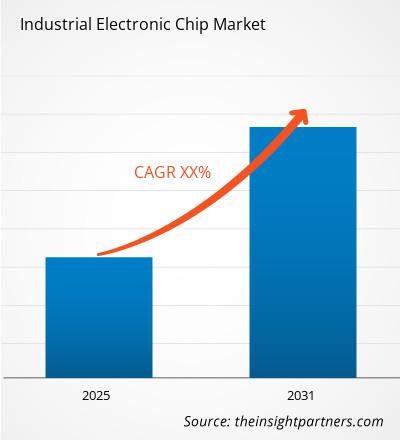
The Industrial Electronic Chips Market size was valued at US$ 48.87 Billion in 2025 and is projected to reach US$ 114.59 Billion by 2034, registering a CAGR of 9.93% during 2026–2034. Expansion is supported by increasing semiconductor content across industrial automation, connected vehicles, medical electronics, aerospace platforms, and defense systems. Greater processing requirements at the edge are also shifting chip architectures toward higher integration, lower power consumption, and real-time intelligence.
North America presents a structurally attractive outlook, supported by domestic semiconductor capacity expansion, reshoring of electronics manufacturing, and sustained spending on automotive electronics and defense modernization. The region also benefits from established design ecosystems, advanced packaging capabilities, and demand for industrial edge computing. These factors support an estimated regional CAGR of 8.8–9.4% through 2034.
Industrial Electronic Chip Market Assessment and Insights
- North America: The region represented a 30–34% Industrial Electronic Chips Market share in 2025 and is projected to grow at a CAGR of 8.8–9.4% between 2026–2034, supported by manufacturing localization and defense electronics investment.
- US: The US accounted for 80–84% of North America's 2025 market and is projected to expand at a CAGR of 8.9–9.5% through 2034, led by industrial automation and automotive electronics.
- Europe: Europe held a 22–26% share in 2025 and is expected to grow at a CAGR of 8.2–8.9%, with Germany, France, Italy, and the UK supporting automotive, industrial, and aerospace demand.
- Asia Pacific: Asia Pacific represented a 34–38% share in 2025 and is forecast to record a CAGR of 10.8–11.6%, led by China, Japan, South Korea, India, and expanding electronics production.
- Largest Segment: Analog Chip held a 54–58% market share in 2025 and is expected to expand at a CAGR of 9.6–10.2%, reflecting broad sensing, power-management, and signal-conditioning requirements.
- High Growth Segment: Medical Electronics held a 13–17% market share in 2025 and is projected to grow at a CAGR of 11.2–12.0%, supported by connected diagnostics and patient-monitoring equipment.
- Key companies analyzed in detail: Intel Corporation, Broadcom Inc., Qualcomm Technologies, Inc., Texas Instruments Incorporated, MediaTek Inc., Toshiba Corporation, Samsung Electronics Co., Ltd., SK hynix Inc., STMicroelectronics, and NXP Semiconductors N.V.
Source: The Insight Partners' analysis based on proprietary research, government publications, company annual reports, investor presentations, industry databases, and expert interviews.
The Industrial Electronic Chips Market has progressed from discrete processing and control elements to high levels of integration where computing, sensing, connectivity, and power management are consolidated into one chip. Trends toward edge AI, software-driven systems, microcontrollers, SoCs, and enhanced analog interfaces are redefining specifications. The manufacturing approach includes the drive towards 300 mm wafers, geographic proximity, advanced packaging, and longer qualification cycles for automotive, aerospace, military, and healthcare applications.
In the future, the Industrial Electronic Chips Market will be aided by geographically diversified manufacturing, incentive measures, and programs on digitization of industries. Manufacturing facilities emerging in India and South East Asia will provide additional geographic diversification, while the policies in Europe and North America favor the growth of semiconductor industries within their regions. Regulations for vehicle safety, reliability of medical devices, cybersecurity, and energy efficiency will create higher demand for qualified and application-specific chips with longer product cycles.
Industrial Electronic Chip Market Report Scope
| Report Attribute | Details |
|---|---|
| Market size in 2025 | US$ 48.87 Billion |
| Market Size by 2034 | US$ 114.59 Billion |
| Global CAGR (2026 - 2034) | 9.93% |
| Historical Data | 2021-2024 |
| Forecast period | 2026-2034 |
Industrial Electronic Chip Market Analysis
The demand for industrial electronics becomes more and more dependent upon the number and level of complexity of the chips installed in machines, vehicles, instrumentation, and controls. Automation systems need to be provided with processors, motor controllers, interface circuitry, power management circuits, connectivity chips, and security. Thus, the supply chain involves semiconductor design, intellectual property licensing, wafer manufacturing, packaging, testing, distribution, OEMs, and system integration, with qualification being highly application-specific.
The supply characteristics of industrial chips continue to be determined by utilization rates, economics of wafer nodes, packaging, and regional concentration. Semiconductor industry overall generated sales of US$ 791.7 billion in 2025, with semiconductor equipment billings totaling US$ 135.1 billion, meaning considerable capacity investment. Industrial chip production tends to emphasize reliability, mature-node economics, long availability, and application qualification over high-end transistor density.
The competitive positioning of companies in the Industrial Electronic Chips Market will be characterized by portfolio breadth, manufacturing capability, application engineering, and customer design wins. Analog and embedded processing is the strength of Texas Instruments Incorporated, while STMicroelectronics and NXP Semiconductors N.V. have a presence in the automotive and industrial systems space. Edge computing technologies are being developed by Intel Corporation and Qualcomm Technologies, Inc., while Broadcom Inc., MediaTek Inc., Toshiba Corporation, Samsung Electronics Co., Ltd., SK hynix Inc., and others focus on specialized processing, connectivity, memory, and embedded chips.
According to the Industrial Electronic Chips Market report, vertical investment strategies are also gaining ground. Leading suppliers are adding internal manufacturing capability, foundry relationships, application software development, and regional customer service capabilities. Investments in connectivity, sensors, embedded software through acquisitions will help companies gain faster entry in the market, while capacity investments will minimize supply risks. Competitive positioning will thus depend on total value rather than chip performance alone, with customers evaluating cost and total value including power efficiency, life cycle considerations, cybersecurity, qualification, and complexity.
● REPORT CUSTOMIZATION
Tailor This Report To Align With Your Specific Business Requirements
This report can be customized to align precisely with your business objectives, scope, and target markets. Customization options include tailored segmentation, geography, competitive analysis, and strategic insights to support informed decision-making.
Customize This Report →WHAT YOU CAN ADJUST
- ● Segmentations
- ● Geography
- ● Competitive Analysis
- ● Language Preferences
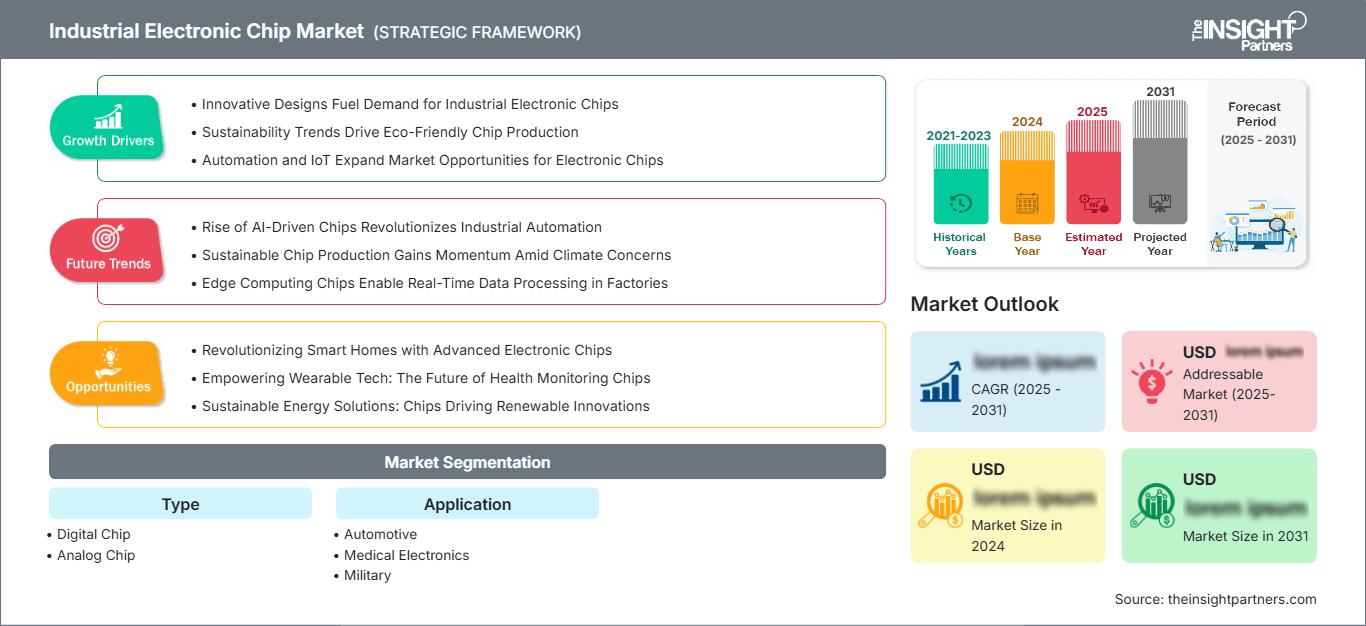
Industrial Electronic Chip Market: Strategic Insights
Regional Insights
North America Industrial Electronic Chips Market
North America represented 30–34% of the Industrial Electronic Chips Market in 2025 and is expected to register an 8.8–9.4% CAGR through 2034. Strengths for this region include semiconductor design density, automotive electrification, industrial automation, military upgrade, and new investments in domestic manufacturing. The government is incentivizing fabrication, packaging, and parts production, thus reinforcing the local supply chain ecosystem.
The United States continues to be the primary regional contributor, thanks to increased semiconductor capability and demand from the aerospace, defense, medical device, robotics, and connected cars sectors. Canada provides support via aerospace, industrial automation, and unique electronics segments. Mexico adds to the demand for manufacturing due to automotive and electronics manufacturing. Increasingly, regional customers are looking for supply chain security, reliable sourcing, and long-term product availability.
U.S. Industrial Electronic Chips Market
The U.S. accounted for 80–84% of North America's Industrial Electronic Chips Market in 2025 and is projected to grow at a CAGR of 8.9–9.5% through 2034. Diversified demand exists through industrial automation, defense electronics, medical equipment, automotive technology, and intensive data handling in edge computing. Domestic investments contribute to the resilience of the semiconductor industry ecosystem.
The Industrial Electronic Chips Market forecast shows that big suppliers have substantial design, production, or customer service operations in the U.S. Demand for application is moving towards intelligent sensors, industrial controllers, vehicle computing systems, power management chips, and secure communication chips. In addition, military acquisition includes radiation-resistant and reliable electronic components. Medical equipment is moving towards smaller processing and communication chips.
Europe Industrial Electronic Chips Market
Europe held a 22–26% share of the Industrial Electronic Chips Market in 2025 and is projected to grow at a CAGR of 8.2–8.9%. Germany continues to lead the market with automotive production, factory automation, industrial products, and embedded technology. The markets of the UK, France, Italy, and Spain have specific demands in aerospace, defense, medical instruments, energy systems, and industrial machinery.
The market of the UK is supported with aerospace, defense electronics, medical instrumentation, and digitalization of industry. The demands include secured processing, long product life span, and highly reliable components. In addition to that, there are specific demands in automotive electronics and technology clusters which require research.
Germany continues to be the leading market in industrial electronics in the region since manufacturers of automobiles and machines increasingly incorporate semiconductors in powertrains, factory technologies, robotics, and control architecture of vehicles.
France, Italy, and Spain provide complementary demand through aerospace, defense, automotive, energy, industrial machinery, and medical electronics. France benefits from aerospace and defense programs, Italy from industrial machinery and automotive supply chains, and Spain from automotive manufacturing and renewable-energy infrastructure. Together, these markets broaden Europe's application base beyond passenger vehicles and general industrial automation.
APAC Industrial Electronic Chips Market
APAC accounted for 34–38% of the Industrial Electronic Chips Market in 2025 and is expected to grow at a CAGR of 10.8–11.6%. China remains the leading country, supported by electronics manufacturing and industrial automation. Japan and South Korea contribute advanced automotive, industrial, and semiconductor ecosystems, while India and Australia add expanding demand.
Industrial digitization, electronics localization, electric mobility, robotics, and semiconductor policies support regional expansion. China remains central to manufacturing demand, Japan to precision equipment, South Korea to memory and electronics, India to emerging manufacturing capacity, and Australia to mining and infrastructure electronics. Regional diversification also increases demand for locally supported components.
Middle East & Africa Industrial Electronic Chips Market
The Middle East & Africa market is projected to expand at a CAGR of 7.1–7.8%. Saudi Arabia leads regional demand, followed by the UAE and South Africa. Energy infrastructure, industrial modernization, smart-city programs, telecommunications, logistics, and mining support chip adoption across control, sensing, connectivity, and power-management applications.
Saudi Arabia and the UAE are investing in automated infrastructure and digitally enabled industrial assets, while South Africa contributes demand from mining, energy, manufacturing, and transportation. Rest of MEA remains smaller but offers opportunities through grid modernization, water infrastructure, and industrial development. Energy-intensive applications create particular demand for efficient control and monitoring electronics.
Segmentation Analysis
Type
Type segmentation distinguishes Digital Chip and Analog Chip applications across industrial electronic systems. Analog Chip is estimated to maintain the larger position, with a 9.6–10.2% CAGR during 2026–2034, because sensing, power regulation, signal conditioning, and physical-world interfaces remain essential even as digital processing becomes more sophisticated.
- Digital Chip: Digital devices support computation, control logic, communications, edge intelligence, and system integration. Demand is increasingly shaped by higher processing requirements, embedded AI, industrial networking, and centralized automotive architectures.
- Analog Chip: Analog devices connect digital systems with physical environments through sensing, amplification, conversion, power management, and signal conditioning. Their broad application base supports resilient demand across automotive, medical, industrial, aerospace, and defense equipment.
Application
Application segmentation covers Automotive, Medical Electronics, Military, and Aerospace. Medical Electronics is positioned as the fastest-growing application, with an estimated 11.2–12.0% CAGR during 2026–2034, reflecting increased electronics content in diagnostics, monitoring, imaging, and connected healthcare equipment.
- Automotive: Automotive electronics increasingly incorporate processors, sensors, power-management devices, connectivity, and safety controllers. Electrification, ADAS, centralized computing, and software-defined architectures increase semiconductor content and strengthen demand for qualified components.
- Medical Electronics: Medical systems require compact, reliable, low-power electronics for patient monitoring, imaging, diagnostics, and connected devices. Digital health adoption and remote monitoring expand chip requirements while demanding stringent reliability and lifecycle support.
- Military: Military electronics prioritize secure processing, ruggedized components, high reliability, and long availability. Demand is supported by modernization of communications, radar, navigation, surveillance, unmanned systems, and mission computing platforms.
- Aerospace: Aerospace applications require high-reliability processing, sensing, communication, and control electronics. Increasing aircraft connectivity, autonomous systems, satellite deployment, and fleet modernization create opportunities for specialized components with rigorous qualification requirements.
Opportunity Snapshot
| Application | Revenue Contribution (High/Medium/Low) | Trend Tag (MAX 2 words) | Adoption Stage (Emerging/Scaling/Mature) |
|---|---|---|---|
| Automotive | High | Vehicle AI | Scaling |
| Medical Electronics | Medium | Remote Monitoring | Scaling |
| Military | Medium | Mission Compute | Mature |
| Aerospace | Medium | Autonomous Flight | Scaling |
Industrial Electronic Chip Market Growth Drivers and Impact Analysis
Rising semiconductor content per industrial system
The number of chips used in the equipment is rising since companies are adopting interconnected control systems which can perform functions such as sensing, diagnostics, predictive maintenance, and optimizations. An automated platform will need various processors, analogs, connectivity components and power management chips thus raising the value of the parts without an increase in the unit numbers in machinery. This raises demand resiliency in that the number of semiconductors used is based on system functionality and not just the number of equipment manufactured. Automobile platforms demonstrate a similar trend due to centralizing computing capabilities, electrifications, and ADAS capabilities making the equipment more electronically complex. The business implication for semiconductor providers is an increased design win in various categories of subsystems.
Industrial automation and edge intelligence deployment
The Industrial Electronic Chips Market trends indicate that factory upgrades involve bringing more intelligence to the machines, which allows for lower latencies, local decisions, and constant monitoring of equipment. Thus, edge processors, microcontrollers, analog components, sensors, and communication ICs become essential in robotics, vision, motor control, warehousing applications, and distributed industrial networking. The effects on the market go beyond the requirement for processors because the edge architecture needs other elements like power conversion, data acquisition, security, and communications as well. There are benefits to using such architecture for the manufacturer as it does not depend on the network when important decisions are made locally. Industrial companies care about efficiency and predictive maintenance and therefore provide an opportunity for chip manufacturers with hardware and development environments to achieve success in repeat designs.
Government-backed semiconductor localization and supply resilience
Initiatives related to semiconductor localization are altering investment considerations in the value chain of electronics. Incentives provided by the public sector will favor fabrications, packaging, research and development, workforce training, and regional procurement, while manufacturers will increasingly be looking for several qualified suppliers for vital parts. This will increase demand for industrial chips manufactured using mature and specialized process technologies that provide cost-effectiveness and long lifecycles. This trend will have a significant impact on industries such as automotive, defense, aerospace, and medical devices where qualification and continuity of supply will be more important than small unit cost differences. Development of regional capacity will also result in greater integration of chip suppliers, original equipment manufacturers, and systems integrators.
Industrial Electronic Chip Market Future Trends
AI-enabled analog and mixed-signal integration
AI functionality will increasingly move into controllers and mixed-signal devices rather than remaining concentrated in standalone processors. Future industrial systems are likely to combine sensing, signal conditioning, local inference, connectivity, and control within smaller device footprints. This architecture can reduce latency, communications overhead, and system complexity while enabling machines to respond to changing conditions locally. Automotive electronics are expected to accelerate the trend because safety and autonomy require real-time processing close to sensors and actuators. Medical devices can similarly benefit from localized analysis where continuous monitoring and low power consumption are priorities. Suppliers that integrate neural processing with established analog or embedded portfolios may gain an advantage because customers can simplify system design while preserving familiar development environments and qualification pathways.
Application-specific chip platforms for intelligent machines
The next stage of industrial electronics development is likely to favor configurable platforms tailored to specific machine classes rather than completely generic processors. Robotics, autonomous vehicles, medical instruments, aerospace systems, and industrial controllers have different latency, safety, power, connectivity, and reliability requirements. Application-specific system-on-chip and microcontroller families can address those differences while retaining common software and development infrastructure. This approach allows manufacturers to scale functionality across product tiers without redesigning the entire electronics architecture. It also strengthens supplier relationships because software libraries, reference designs, safety documentation, and lifecycle commitments become part of the purchasing decision. Over time, platform-level differentiation should become more important than raw processing specifications, particularly where qualification costs and embedded software investments make component substitution difficult.
Industrial Electronic Chip Market Opportunities
Regional manufacturing ecosystems and localized supply
Expansion of semiconductor manufacturing outside traditional hubs creates opportunities for suppliers that can align capacity with regional OEM demand. India, Southeast Asia, North America, and selected European markets are strengthening electronics ecosystems, creating requirements for local distribution, packaging, testing, technical support, and application engineering. Investors can target companies positioned between wafer production and end-equipment manufacturing because these links can capture value from supply-chain localization without requiring full fabrication ownership. Industrial customers also value regional inventory and engineering support when qualification cycles are lengthy. The strongest opportunities are therefore likely to emerge where semiconductor suppliers establish application centers alongside manufacturing or packaging investments. Such models can improve customer responsiveness while supporting broader diversification of production and reducing dependency on single-country sourcing.
Embedded connectivity and intelligent infrastructure
Connected factories, energy systems, transportation networks, and medical infrastructure provide an investment pathway beyond conventional chip volume growth. These systems require secure connectivity, processing, sensing, power management, and increasingly sophisticated edge intelligence. Investors and suppliers can pursue opportunities through integrated reference platforms that combine hardware, software, cybersecurity, and lifecycle support. Connectivity is particularly important because industrial equipment is shifting from isolated operation toward continuous data exchange with enterprise and cloud systems. Vendors that reduce integration complexity can shorten deployment cycles and improve customer retention. The opportunity is strongest where infrastructure operators are modernizing installed assets rather than replacing entire systems, because retrofit electronics can create incremental semiconductor demand across a large existing equipment base while spreading adoption over multiple upgrade cycles.
Recent Developments
- July 2026: Tata Electronics is preparing to begin India’s first semiconductor wafer production at its Dholera, Gujarat facility using 90-nanometer process technology, an older and mature technology than originally planned. The technology is suited to industrial, automotive and other applications where advanced nodes are not essential, while Tata plans to progressively introduce more advanced 28-nanometer chips.
- July 2026: The Government of India approved 12 semiconductor manufacturing projects with a combined investment of around US$17.2 billion, comprising one microchip fabrication plant, two semiconductor component facilities and nine packaging and testing plants. The projects are expected to help establish an end-to-end semiconductor production ecosystem in India while strengthening domestic capabilities in chip manufacturing, equipment, materials, proprietary technologies and resilient supply chains.
- June 2026: Bosch introduced its third-generation Silicon Carbide (SiC) semiconductor chips in India to support the growth of electric mobility, offering approximately 20% higher performance than the previous generation. The chips improve EV power-electronics efficiency by reducing energy losses, enhancing thermal performance and lowering cooling requirements, enabling longer driving ranges, faster charging and better battery utilization without larger batteries.
Frequently Asked Questions

- Comprehensive Market Sizing and Forecast Analysis
- Detailed Segmentation Analysis
- In-Depth Market Dynamics Assessment
- Regional and Country-Level Insights
- Competitive Landscape and Company Benchmarking
- Strategic Business Intelligence
Recent Reports
Testimonials

The Insight Partners' SCADA System Market report is comprehensive, with valuable insights on current trends and future forecasts. The team was highly professional, responsive, and supportive throughout. We are very satisfied and highly recommend their services.
RAN KEDEM Partner, Reali Technologies LTDs
I requested a report on a very specific software market and the team produced the report in a few days. The information was very relevant and well presented. I then requested some changes and additions to the report. The team was again very responsive and I got the final report in less than a week.
JEAN-HERVE JENN Chairman, Future Analytica
We worked with The Insight Partners for an important market study and forecast. They gave us clear insights into opportunities and risks, which helped shape our plans. Their research was easy to use and based on solid data. It helped us make smart, confident decisions. We highly recommend them.
PIYUSH NAGPAL Sr. Vice President, High Beam Global
The Insight Partners delivered insightful, well-structured market research with strong domain expertise. Their team was professional and responsive throughout. The user-friendly website made accessing industry reports seamless. We highly recommend them for reliable, high-quality research services
YUKIHIKO ADACHI CEO, Deep Blue, LLC.
This is the first time I have purchased a market report from The Insight Partners.While I was unsure at first, I visited their web site and felt more comfortable to take the risk and purchase a market report.I am completely satisfied with the quality of the report and customer service. I had several questions and comments with the initial report, but after a couple of dialogs over email with their analyst I believe I have a report that I can use as input to our strategic planning process.Thank you so much for taking the extra time and making this a positive experience.I will definitely recommend your service to others and you will be my first call when we need further market data.
JOHN SUZUKI President and Chief Executive Officer, Board Director, BK Technologies
I wish to appreciate your support and the professionalism you displayed in the course of attending to my request for information regarding to infectious disease IVD market in Nigeria. I appreciate your patience, your guidance, and the fact that you were willing to offer a discount, which eventually made it possible for us to close a deal. I look forward to engaging The Insight Partners in the future, all thanks to the impression you have created in me as a result of this first encounter.
DR CHIJIOKE ONYIA MANAGING DIRECTOR, PineCrest Healthcare Ltd.Reason to Buy
- Informed Decision-Making
- Understanding Market Dynamics
- Competitive Analysis
- Identifying Emerging Markets
- Customer Insights
- Market Forecasts
- Risk Mitigation
- Boosting Operational Efficiency
- Strategic Planning
- Investment Justification
- Tracking Industry Innovations
- Aligning with Regulatory Trends





 Get Free Sample for