
Utility Poles Market Share, Growth & Demand by 2034
Coverage: by Type (Transmission Poles, Distribution Poles); Material Type (Wood, Steel, Concrete, Composites); Pole Size (Below 40ft, 40 to 70ft, Above70ft); Application (Electricity Transmission and Distribution, Telecommunication, Street Lighting, Heavy Power Lines, Sub Transmission Lines, Others) , and Geography (North America, Europe, Asia Pacific, and South and Central America)
- Status : Data Released
- Report Code : TIPRE00009083
- Category : Electronics and Semiconductor
- No. of Pages : 150
- Available Report Formats :


- Last update date : September 17, 2026


2025 Market Size
US$ 61.43 Bn
Base year value
2034 Forecast
US$ 90.99 Bn
Projected by 2034
CAGR 2026-2034
4.46 %
Growth rate
Addressable Market
US$ 692.03 Bn
(2026-2034)
The utility poles market was valued at US$ 61.43 Billion in 2025 and is projected to reach US$ 90.99 Billion by 2034, reflecting a CAGR of 4.46% from 2026 to 2034. Expansion is supported by the replacement of aging overhead infrastructure, grid reinforcement, telecommunications deployment, and investment in transmission and distribution networks. Material selection increasingly balances installed cost, service life, resilience, maintenance requirements, and environmental exposure.
Across North America, the utility poles market size is supported by storm hardening, replacement cycles, electrification, and utility capital programs. An estimated 3.8–4.4% CAGR through 2034 is reasonable as utilities reinforce exposed networks, add capacity for rising electricity loads, and upgrade poles serving broadband and distributed energy assets. Wood remains important, while composite, steel, and concrete solutions gain specification opportunities where resilience or loading requirements are elevated.
Utility Poles Market Assessment and Insights
- North America: North America is estimated to represent a 31–35% share in 2025, growing at a 3.8–4.4% CAGR between 2026–2034, supported by the replacement of aging networks, storm resilience programs, electrification, and broadband infrastructure expansion.
- US: The US accounts for an estimated 72–76% of North American share in 2025, advancing at a 3.9–4.5% CAGR between 2026–2034 as utilities increase grid hardening and capacity investments.
- Europe: Europe is estimated at a 21–25% share in 2025, with a 3.5–4.1% CAGR between 2026–2034. Germany, the UK, France, Italy, and Spain are supported by grid modernization, renewable integration, and replacement of aging distribution assets.
- Asia Pacific: Asia Pacific is estimated at a 34–38% share in 2025, expanding at a 4.9–5.6% CAGR between 2026–2034. China, India, Japan, South Korea, and Australia benefit from urbanization, electrification, transmission expansion, and telecommunications deployment.
- Largest Segment: Electricity Transmission and Distribution is estimated at a 45–49% market share in 2025, with a 4.2–4.7% CAGR between 2026–2034, reflecting its broad installed-base requirement.
- High Growth Segment: Composites are estimated at an 8–12% market share in 2025, with a 7.5–9.0% CAGR between 2026–2034, driven by resilience, lighter handling, and corrosion resistance.
- Key companies analyzed in detail: Baldwin Pole and Piling Co., Inc.; Bell Lumber and Pole; Bridgewell Resources, LLC; Hill and Smith Holdings PLC; Koppers Inc.; Omega Factory; Pelco Structural; Skipper Limited; Stella-Jones; Valmont Industries, Inc.
Source: The Insight Partners' analysis based on proprietary research, government publications, company annual reports, investor presentations, industry databases, and expert interviews.
The utility poles market has evolved from predominantly standardized wood infrastructure toward a more application-specific mix of wood, steel, concrete, and composites. More consideration is being given to the strengths of poles, loading pattern, exposure to fire, corrosion, weight, treatment needs, and estimated lifespan by utilities. Therefore, manufacturing is becoming more sophisticated through pole treatments, galvanizing, creation of composite materials, and structuring.
In terms of future demand, an expansion can be expected into emerging electrical power systems and established replacement markets. There can be an increase in structural need due to renewable energy production, data center load, electric vehicles, telecommunications, and resilience standards without removing conventional poles. The procurement process will also take into account the entire lifetime of the product through logistics, treatments, durability, and installation qualities by the utility companies.
Utility Poles Market Report Scope
| Report Attribute | Details |
|---|---|
| Market size in 2025 | US$ 61.43 Billion |
| Market Size by 2034 | US$ 90.99 Billion |
| Global CAGR (2026 - 2034) | 4.46% |
| Historical Data | 2021-2024 |
| Forecast period | 2026-2034 |
Utility Poles Market Analysis
Electricity distribution remains the principal demand engine because poles are essential to extensive overhead networks and recurring replacement programs. Transmission applications need higher strength capacity, while distribution applications focus on ease of installation and low cost. The telecommunications application adds load considerations due to the use of fiber optic and wireless technology in already constructed towers. Timber suppliers, steel mills, concrete producers, composites, preservatives, pole treating companies, engineering companies, utilities, telecommunication firms, and specialty distributors make up the ecosystem.
The supply chain is quite different across materials and geography. Wood enjoys well-established pole treating facilities as well as well-established utility specifications, but steel and concrete are more dependent on energy, cement production, and logistics. Composites differentiate through low weight, non-rotting, fire and corrosion-resistant properties. Procurement strategies increasingly emphasize regional inventories because emergency restoration following storms or other disruptions can create short lead-time requirements and constrain available finished-pole capacity, according to the Utility Poles Market report.
Positioning through competition results from the manufacturing footprint, expertise in treatment, engineering, customer qualification, logistics, and the ability to procure utilities. Stella-Jones has a widespread North American footprint for its wood products, whereas Koppers Inc. brings together treatment expertise with utility pole production. On the other hand, Bell Lumber and Pole highlights regional expertise in wood-pole manufacture, while Valmont Industries Inc. adds an engineering metal structure aspect into utility products. Skipper Limited produces poles and transmission structures along with engineering and project expertise.
Investments are increasingly focusing on capacity building, expansion of the footprint, and diversification of the product portfolio. Hill and Smith Holdings PLC, Pelco Structural, Bridgewell Resources, Omega Factory, and Baldwin Pole and Piling Co., Inc. all engage in specialized structural products or supply chains, whereas Stella-Jones and Koppers Inc. show the power of scale and vertically integrated treatment networks. Strategic differentiation thus relies more on timely delivery, compliance, resilience and customer proximity rather than product availability alone.
● REPORT CUSTOMIZATION
Tailor This Report To Align With Your Specific Business Requirements
This report can be customized to align precisely with your business objectives, scope, and target markets. Customization options include tailored segmentation, geography, competitive analysis, and strategic insights to support informed decision-making.
Customize This Report →WHAT YOU CAN ADJUST
- ● Segmentations
- ● Geography
- ● Competitive Analysis
- ● Language Preferences
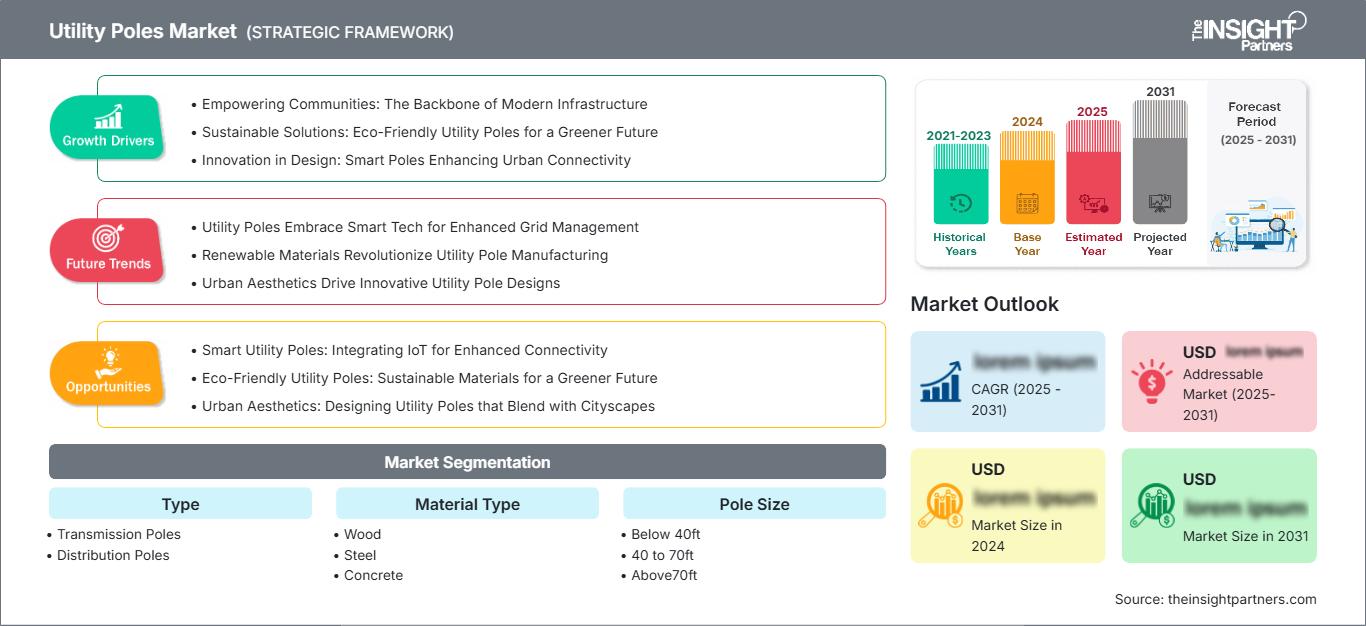
Utility Poles Market: Strategic Insights
Regional Insights
North America utility poles market
North America is estimated to hold a 31–35% share of the utility poles market revenue in 2025 and is projected to expand at a 3.8–4.4% CAGR through 2034. The region combines a mature installed base with recurring replacement requirements, storm hardening, wildfire mitigation, electrification, and new transmission investment. Utilities have now started to consider resilience along with lifecycle cost analysis, which provides an opportunity for the use of steel, concrete, and composites as alternatives to traditional wood where environmental conditions or loadings limit the use of wood materials. The need for multi-attachment poles also increases due to telecommunication deployment.
North America is a major regional demand center for the pole market, driven by the overhead distribution infrastructure as well as utility spending on infrastructure. In Canada, aging replacement, electrical infrastructure development, and harsh weather conditions contribute to demand in the region. The availability of local manufacturing capabilities is essential for North America due to the requirement for quick replacement post-severe weather. Therefore, companies with treatment capabilities, engineering expertise, inventory, and utility approval can retain their customers irrespective of material price changes.
U.S. utility poles Market
The U.S. is estimated to represent 72–76% of the North American utility poles market revenue in 2025, with a 3.9–4.5% CAGR through 2034. Demand is centered on distribution systems, transmission upgrades, telecommunications connections, and the upgrade of outdated structures. There is an effort by utilities to fortify infrastructure from hurricanes, wildfires, ice storms, and any form of extreme weather conditions. Some of the companies that operate within supply chains in response to the needs include Bell Lumber and Pole, Koppers Inc., Stella-Jones, and Valmont Industries, Inc.
Trends in the application of the industry include engineered products in situations where loading, fire hazard, corrosion, or difficulty of access render the use of conventional products impractical. In addition, wood is still very competitive in traditional distribution applications due to the maturity of its processing and installation techniques. Other materials, including steel and composites, get the chance to penetrate high-hazard routes and urban projects. Demand from replacement continues to be steady despite fluctuations in new construction cycles.
Europe utility poles Market
Europe is estimated to account for a 21–25% of the utility poles market share in 2025 and is expected to expand at a 3.5–4.1% CAGR through 2034. Germany is a leading market because renewable integration and grid reinforcement require substantial network upgrades. The UK is also significant as distribution networks are modernized and resilience requirements increase, while France, Italy, and Spain contribute through renewable interconnections, urban infrastructure, and replacement projects. Steel and concrete are particularly relevant where durability, loading, and environmental conditions influence specifications.
The UK market will benefit from the sustained focus on electricity network reliability and expansion, especially with respect to the new power flows that come with renewable generation. In Germany, the combination of high industrial demand and high renewables penetration leads to the need for robust distribution and transmission systems. France, Italy, and Spain offer diverse opportunities connected to grid modernization, telecommunication, urban development, and renewable energy projects. Increasingly in Europe, environmental and maintenance considerations play into procurement decisions. The regional forecast is solid, with Germany among the top country markets.
APAC utility poles Market
APAC is estimated to represent a 34–38% share of the utility poles market in 2025 and is projected to grow at a 4.9–5.6% CAGR through 2034, making it one of the fastest-expanding regions. China is the dominant consumer in the region, followed by India, Japan, South Korea, and Australia. Industrialization, urbanization, rural electrification, renewable energy initiatives, and telecommunications contribute to pole needs. Investments in the grid by governments and grid modernization efforts will continue to boost pole purchases in significant markets.
China profits from huge power infrastructure needs, while India uses distribution growth combined with rural and urban electrification initiatives. The focus for Japan and South Korea is resilient infrastructure, while for Australia, there is an increasing need for poles that can take into consideration bushfires and weather conditions. Manufacturing capabilities and delivery capabilities are becoming critical differentiators for the regional manufacturers.
Middle East & Africa utility poles Market
The Middle East & Africa utility poles market is expected to grow at a 3.8–4.5% CAGR through 2034, supported by electricity access programs, urban expansion, industrial projects, telecommunications deployment, and infrastructure diversification. Saudi Arabia and the UAE lead Gulf demand through large-scale development and energy investment, while South Africa represents an important sub-Saharan market. The rest of MEA remains fragmented but offers opportunities where grid access is expanding.
Saudi Arabia and the UAE require reliable infrastructure for industrial zones, new communities, and large development projects. South Africa faces both replacement requirements and network reliability challenges, while other African markets depend on electrification and telecom expansion. Material selection varies according to climate, logistics, availability, and project financing. Concrete and steel can be attractive in demanding environments, while treated wood remains relevant where supply chains and established specifications favor it.
Segmentation Analysis
Type
Type selection is closely connected with voltage, span requirements, loading, and network architecture. Transmission structures generally require greater strength and engineering precision, while distribution poles benefit from standardized production and installation practices. The Type segment is estimated to expand at a 4.3–4.8% CAGR from 2026–2034, supported by both replacement and new network construction, according to the Utility Poles Market forecast.
- Transmission Poles: Demand is linked to high-capacity network reinforcement, renewable interconnection, long-span requirements, and replacement of aging transmission infrastructure. Engineering specifications and structural loading determine procurement priorities.
- Distribution Poles: Distribution poles represent a recurring replacement market across urban and rural networks. Utilities prioritize cost, availability, treatment quality, installation speed, and compatibility with existing hardware.
Material Type
Material selection increasingly reflects lifecycle performance rather than initial acquisition cost alone. The Material Type segment is projected to grow at a 4.5–5.0% CAGR from 2026–2034, with established wood demand complemented by steel, concrete, and composites in demanding environments, reflecting key Utility Poles Market trends.
- Wood: Wood remains important because treatment infrastructure, established specifications, manageable weight, and competitive installed economics support broad utility acceptance across mature networks.
- Steel: Steel is favored where high strength, consistent geometry, fire exposure, or specialized loading requirements justify greater material and fabrication costs.
- Concrete: Concrete supports applications requiring substantial durability and resistance to rot, pests, and selected environmental conditions, particularly across markets with established precast supply chains.
- Composites: Composites are gaining specification interest because lightweight construction, corrosion resistance, and resilience can reduce handling challenges and lifecycle maintenance in selected applications.
Pole Size
Pole dimensions are determined by voltage, span, conductor arrangement, equipment loading, and clearance requirements. The Pole Size segment is expected to advance at a 4.2–4.7% CAGR from 2026–2034, with medium-sized configurations retaining broad applicability across utility networks in the Utility Poles Market.
- Below 4ft: This category serves specialized applications where compact structural configurations are suitable, with demand shaped by localized infrastructure, equipment support, and installation constraints.
- 4 to 7ft: Mid-range configurations support diverse utility requirements where structural capacity and manageable installation characteristics need to be balanced across distribution and related applications.
- Above7ft: Larger configurations are strategically important for applications requiring higher clearance, greater loading capacity, longer spans, or specialized transmission and heavy-power infrastructure.
Application
Application demand reflects the underlying expansion and renewal of electricity and communications infrastructure. The Application segment is estimated to grow at a 4.4–4.9% CAGR from 2026–2034, with electricity transmission and distribution remaining the principal use case.
- Electricity Transmission and Distribution: This application forms the core installed-base market, supported by grid expansion, replacement cycles, electrification, renewable integration, and resilience investment.
- Telecommunication: Fiber, wireless equipment, and network densification create incremental structural requirements and encourage utilities and telecom operators to manage shared pole capacity.
- Street Lighting: Municipal development and public-space modernization sustain demand for poles designed around lighting equipment, electrical loading, aesthetics, and installation requirements.
- Heavy Power Lines: Heavy power applications require stronger structures and engineered configurations capable of accommodating increased conductor and equipment loads.
- Sub Transmission Lines: Sub-transmission projects require reliable structural support between transmission and distribution systems, creating demand tied to network expansion and capacity reinforcement.
Opportunity Snapshot
| Application | Revenue Contribution (High/Medium/Low) | Trend Tag (MAX 2 words) | Adoption Stage (Emerging/Scaling/Mature) |
| Electricity Transmission and Distribution | High | Grid Reinforcement | Mature |
| Telecommunication | Medium | Fiber Expansion | Scaling |
| Street Lighting | Medium | Urban Retrofit | Mature |
| Heavy Power Lines | Medium | Load Upgrades | Scaling |
| Sub Transmission Lines | Medium | Network Reinforcement | Scaling |
Utility Poles Market Growth Drivers and Impact Analysis
Grid hardening and replacement of aging overhead infrastructure
Aging distribution networks create a persistent replacement requirement because poles must maintain structural integrity while supporting conductors, transformers, communications equipment, and other attachments. Severe weather further increases the value of stronger and more resilient structures. Utilities are therefore moving from reactive replacement toward planned asset management, prioritizing corridors according to age, failure history, environmental exposure, and criticality. This approach supports demand for treated wood while expanding opportunities for steel, concrete, and composite alternatives in higher-risk locations. The impact extends beyond unit volumes because utilities may specify upgraded designs, improved treatment, or enhanced structural ratings during replacement. Manufacturers able to provide engineering support, consistent certification, regional inventory, and emergency-response capacity can capture higher-value procurement programs and strengthen long-term utility relationships.
Electrification and increasing electricity network loading
Electrification of transportation, buildings, industrial processes, and data-intensive infrastructure is increasing pressure on electricity networks. Additional generation and load centers require reinforcement across transmission, sub-transmission, and distribution corridors. Poles must accommodate conductor configurations, equipment additions, and increased mechanical loading while maintaining required clearances. This dynamic favors manufacturers capable of supplying different materials and structural designs rather than relying on one standardized product. The impact is especially relevant in regions where overhead infrastructure remains the practical choice because undergrounding is technically difficult or economically restrictive. Utilities may also use replacement projects to increase capacity rather than simply restore existing specifications. Consequently, electrification can raise both replacement quality requirements and new-build pole demand, supporting steady procurement even when broader construction activity is cyclical.
Telecommunications convergence and shared infrastructure utilization
Telecommunications expansion is creating additional value from existing utility corridors by enabling fiber, wireless equipment, and related communications infrastructure to share poles with electricity assets. This convergence increases attachment density and can create engineering requirements beyond those of conventional electrical distribution. Pole owners and utilities consequently need better visibility into structural capacity, attachment configuration, clearance, and inspection status. The market impact is twofold: additional replacement demand emerges where existing structures cannot support new loading, while new poles may be specified with greater capacity to accommodate future attachments. Suppliers with engineering expertise can benefit from this trend because structural evaluation and customized configurations become more important. The opportunity is strongest in urbanizing regions and broadband expansion programs where network operators seek rapid deployment without undertaking extensive underground civil works.
Utility Poles Market Future Trends
Digitized pole inspection and predictive asset management
Digital inspection technologies are expected to become increasingly integrated with pole management programs through image recognition, geospatial databases, drones, mobile inspection platforms, and predictive analytics. These systems can help utilities identify leaning structures, visible deterioration, vegetation exposure, and other indicators before failure occurs. As datasets improve, procurement decisions may increasingly connect individual pole characteristics with replacement priority, expected service life, and network criticality. Manufacturers could respond by supplying traceable products and digital asset information that simplifies lifecycle management. The longer-term effect will be a shift from periodic manual inspection toward condition-based intervention. This trend does not eliminate physical pole demand; instead, it can make replacement programs more targeted and technically justified, improving visibility of future requirements for utilities and suppliers.
Material diversification for climate-resilient networks
Material diversification is likely to accelerate as utilities compare performance under wildfire, hurricanes, flooding, corrosion, insects, and extreme temperatures. Wood will remain important because of its established supply chain and cost position, but engineered alternatives can gain share in locations where specific environmental risks justify higher initial expenditure. Composite poles are particularly relevant where low weight, corrosion resistance, or fire performance can improve operational resilience. Steel and concrete will continue serving applications where structural capacity and durability are primary requirements. Procurement teams are expected to increasingly evaluate total lifecycle performance rather than relying solely on acquisition price. This shift should encourage manufacturers to improve material formulations, protective treatments, fabrication consistency, and installation methods while expanding the number of applications in which alternative materials can compete with conventional designs.
Utility Poles Market Opportunities
Regional manufacturing and resilient supply networks
Regional manufacturing offers an actionable opportunity because utility operators increasingly value dependable delivery during normal replacement cycles and emergency restoration events. Producers can strengthen their positions by locating treatment, fabrication, finishing, and inventory operations closer to major utility territories. Local capacity can reduce transportation exposure, shorten replenishment times, and improve responsiveness following storms or other infrastructure disruptions. Strategic investments should prioritize facilities capable of handling multiple specifications rather than narrow product configurations. Partnerships with utilities, contractors, and distributors can further improve demand visibility and inventory planning. In mature markets, regional capacity can support replacement programs, while in developing markets, it can establish local manufacturing ecosystems around electrification and telecommunications projects. The strongest investment cases will combine production efficiency with logistical resilience and established utility qualification.
Engineered poles for high-risk and high-loading applications
Specialized engineered poles provide an opportunity to address applications where conventional products face limitations related to fire, corrosion, structural loading, difficult terrain, or transportation. Suppliers can target high-value corridors rather than competing solely on commodity pricing. Composite, steel, and advanced concrete solutions can be designed around specific loading conditions, reducing unnecessary material use while improving performance. Engineering services, structural modeling, and installation support can increase differentiation and create closer relationships with utilities and contractors. Investment priorities should include standardized designs that can be adapted to regional specifications, alongside testing and certification capabilities. As utilities pursue resilience upgrades, procurement can increasingly favor solutions supported by quantified performance data and lifecycle economics. This creates a pathway for manufacturers to expand beyond replacement volumes into technically differentiated infrastructure projects.
Frequently Asked Questions

- Comprehensive Market Sizing and Forecast Analysis
- Detailed Segmentation Analysis
- In-Depth Market Dynamics Assessment
- Regional and Country-Level Insights
- Competitive Landscape and Company Benchmarking
- Strategic Business Intelligence
Recent Reports
Testimonials

The Insight Partners' SCADA System Market report is comprehensive, with valuable insights on current trends and future forecasts. The team was highly professional, responsive, and supportive throughout. We are very satisfied and highly recommend their services.
RAN KEDEM Partner, Reali Technologies LTDs
I requested a report on a very specific software market and the team produced the report in a few days. The information was very relevant and well presented. I then requested some changes and additions to the report. The team was again very responsive and I got the final report in less than a week.
JEAN-HERVE JENN Chairman, Future Analytica
We worked with The Insight Partners for an important market study and forecast. They gave us clear insights into opportunities and risks, which helped shape our plans. Their research was easy to use and based on solid data. It helped us make smart, confident decisions. We highly recommend them.
PIYUSH NAGPAL Sr. Vice President, High Beam Global
The Insight Partners delivered insightful, well-structured market research with strong domain expertise. Their team was professional and responsive throughout. The user-friendly website made accessing industry reports seamless. We highly recommend them for reliable, high-quality research services
YUKIHIKO ADACHI CEO, Deep Blue, LLC.
This is the first time I have purchased a market report from The Insight Partners.While I was unsure at first, I visited their web site and felt more comfortable to take the risk and purchase a market report.I am completely satisfied with the quality of the report and customer service. I had several questions and comments with the initial report, but after a couple of dialogs over email with their analyst I believe I have a report that I can use as input to our strategic planning process.Thank you so much for taking the extra time and making this a positive experience.I will definitely recommend your service to others and you will be my first call when we need further market data.
JOHN SUZUKI President and Chief Executive Officer, Board Director, BK Technologies
I wish to appreciate your support and the professionalism you displayed in the course of attending to my request for information regarding to infectious disease IVD market in Nigeria. I appreciate your patience, your guidance, and the fact that you were willing to offer a discount, which eventually made it possible for us to close a deal. I look forward to engaging The Insight Partners in the future, all thanks to the impression you have created in me as a result of this first encounter.
DR CHIJIOKE ONYIA MANAGING DIRECTOR, PineCrest Healthcare Ltd.Reason to Buy
- Informed Decision-Making
- Understanding Market Dynamics
- Competitive Analysis
- Identifying Emerging Markets
- Customer Insights
- Market Forecasts
- Risk Mitigation
- Boosting Operational Efficiency
- Strategic Planning
- Investment Justification
- Tracking Industry Innovations
- Aligning with Regulatory Trends





 Get Free Sample for