
Electro Optical System Market Growth, Trends & Forecast by 2034
Coverage: by System (Imaging, Non-Imaging); Type (Laser, Infrared, Image Intensifier); Platform (Land-Based, Sea-Based, Air-Based) and Geography, and Geography (North America, Europe, Asia Pacific, and South and Central America)
- Status : Data Released
- Report Code : TIPTE100000309
- Category : Electronics and Semiconductor
- No. of Pages : 150
- Available Report Formats :


- Last update date : August 25, 2026


2025 Market Size
US$ 15,092.62 Mn
Base year value
2034 Forecast
US$ 22,693.39 Mn
Projected by 2034
CAGR 2026-2034
4.64 %
Growth rate
Addressable Market
US$ 171,581.18 Mn
(2026-2034)
The global Electro Optical System market size is estimated to increase from US$ 15,092.62 Million in 2025 to US$ 22,693.39 Million by 2034, growing at a CAGR of 4.64% for the period 2026–2034. Growth is being fueled by modernization initiatives, surveillance needs, precision guidance, and incorporation of electro optical payloads into both manned and unmanned platforms. Detection, identification, tracking and surveillance continue to be key factors in determining the success of imaging systems.
In North America, the Electro Optical System market is projected to grow at an estimated 4.8–5.2% CAGR for the period 2026–2034. Key factors fueling growth include high defense expenditure, the procurement of aircraft and military equipment, the upgrading of sensor suites for air and naval operations, and the adoption of EO/IR sensors for autonomous systems.
Electro Optical System Market Assessment and Insights
- North America: North America is estimated to represent a 36–40% Electro Optical System market share in 2025 and expand at a 4.8–5.2% CAGR between 2026–2034, supported by defense modernization, autonomous platforms, maritime surveillance, and advanced sensor procurement.
- US: The US is estimated to account for 82–86% of North American demand in 2025 and grow at a 4.8–5.2% CAGR between 2026–2034, reflecting extensive defense programs and technology leadership.
- Europe: Europe is estimated at a 24–28% share in 2025 and is projected to grow at a 4.6–5.0% CAGR between 2026–2034, with Germany, the UK, France, Italy, and Spain supporting procurement.
- Asia Pacific: Asia Pacific is estimated at a 20–24% share in 2025 and is expected to register a 5.2–5.7% CAGR between 2026–2034, led by China, Japan, South Korea, India, and Australia.
- Largest Segment: Imaging is estimated to hold a 68–72% market share in 2025 and expand at a 4.5–4.9% CAGR during 2026–2034, reflecting broad surveillance applications.
- High Growth Segment: Air-Based platforms are estimated at a 30–34% market share in 2025 and are projected to grow at a 5.2–5.7% CAGR during 2026–2034, supported by airborne ISR.
- Key companies analyzed in detail: BAE Systems plc, Elbit Systems Ltd., L3Harris Technologies, Inc., Leonardo DRS, Lockheed Martin Corporation, Raytheon Company, Rheinmetall AG, Safran S.A., Textron Systems Corporation, Thales S.A.
Source: The Insight Partners' analysis based on proprietary research, government publications, company annual reports, investor presentations, industry databases, and expert interviews.
The industry is evolving from stand-alone optical instruments to integrated sensor systems with combined capabilities for visible imaging, infrared sensing, laser ranging, stabilization, processing, and automatic tracking. Production efforts are focusing on modular payloads, digital interfaces, small size electronics, and software-based enhancements. These developments permit suppliers to support several platforms using common architectures, while also simplifying integration and improving life-cycle supportability.
As far as future procurement trends, it will become broader in the areas of unmanned aircraft, maritime surveillance, counter-drone capability, and border security sensors. Investments will be made into multispectral sensors, edge computing, AI-based identification, and low-size-weight-power sensors. Initiatives in Europe and its allies regarding regulatory and defense readiness will also promote local manufacturing of strategic sensor technologies.
Electro Optical System Market Report Scope
| Report Attribute | Details |
|---|---|
| Market size in 2025 | US$ 15,092.62 Million |
| Market Size by 2034 | US$ 22,693.39 Million |
| Global CAGR (2026 - 2034) | 4.64% |
| Historical Data | 2021-2024 |
| Forecast period | 2026-2034 |
Electro Optical System Market Analysis
The demand is driven by the requirement of detecting and classifying objects in adverse weather conditions, increased range, and contested environments. Growth of the Electro Optical System Market thus depends upon the procurement of capabilities related to surveillance, targeting, reconnaissance, and navigation in the defense and security segments. The value chain includes materials used in detectors, optics assemblies, focal plane technologies, lasers, gimbals, electronics, processing, integration, and platform qualification.
On the supply side, there is an increasing trend toward suppliers having capability to integrate optics, electronics, software, and platform integration. Long qualification periods pose significant entry barriers, along with high priority for defense clients on aspects such as reliability, cybersecurity, environmental qualification, and sustainability. Availability of semiconductor detectors, special optics material, thermal management, and stabilization are among production factors. Suppliers having vertically integrated engineering and production capability may have lower integration risks.
Competitive positioning is based on sensor fusion, platform integration, and upgradability rather than performance of individual detectors. The Electro Optical System Market study reveals that BAE Systems plc, Elbit Systems Ltd., L3Harris Technologies, Inc., Leonardo DRS, Lockheed Martin Corporation, and Raytheon Company are competing through wide-range defense portfolio and project ties. Rheinmetall AG, Safran S.A., Textron Systems Corporation, and Thales S.A. enhance competitive environment through European, airborne, land, and maritime solutions.
Capital expenditure is oriented towards scalable architecture capable of integrating new sensor payload and software modifications without significant platform redesign. L3Harris Technologies, Inc. is growing its European manufacturing capacities, while Elbit Systems Ltd. is developing electro-optical sights integrated with artificial intelligence targeting. It illustrates how suppliers balance localization, upgrade revenue, technological specialization, and customer integration. As a result, the Electro Optical System Market analysis prefers suppliers which unite innovative sensors with successful life cycle execution.
● REPORT CUSTOMIZATION
Tailor This Report To Align With Your Specific Business Requirements
This report can be customized to align precisely with your business objectives, scope, and target markets. Customization options include tailored segmentation, geography, competitive analysis, and strategic insights to support informed decision-making.
Customize This Report →WHAT YOU CAN ADJUST
- ● Segmentations
- ● Geography
- ● Competitive Analysis
- ● Language Preferences
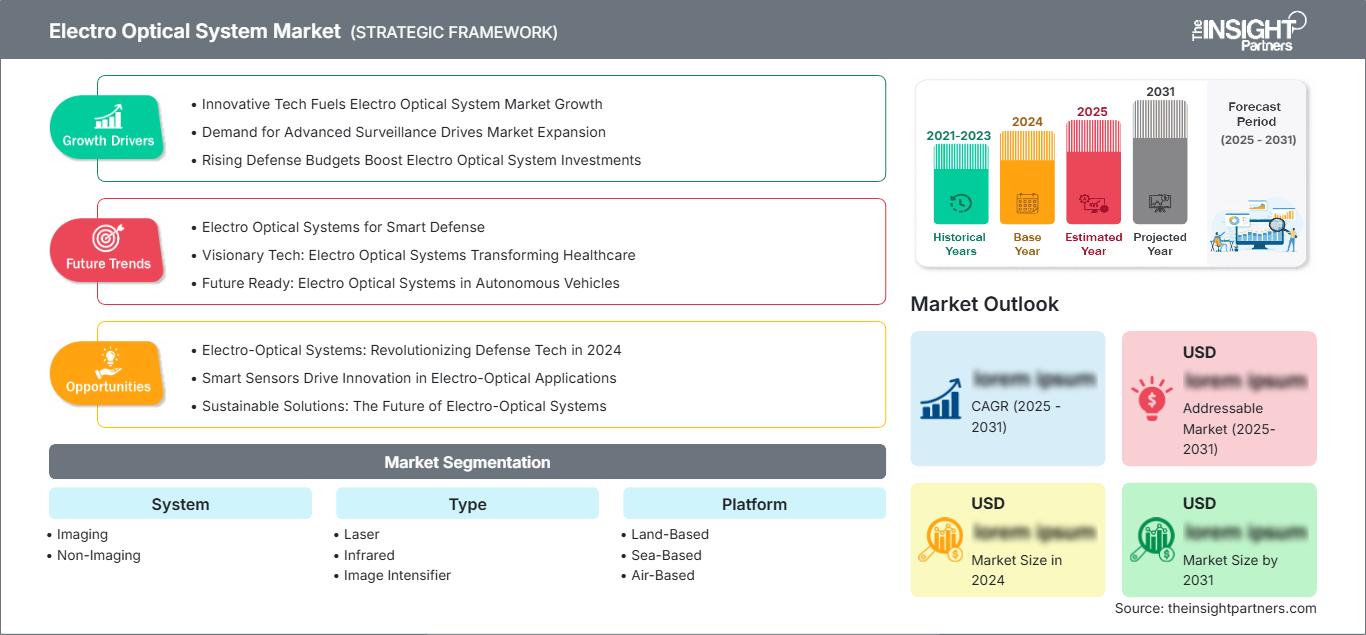
Electro Optical System Market: Strategic Insights
Regional Insights
North America Electro Optical System Market
North America’s 2025 market share and CAGR from 2025 to 2034 are projected to be 36-40% and 4.8-5.2%, respectively. The US dominates the region’s demand due to the continuous investment by the defense organizations on airborne ISR, maritime surveillance, precision targeting, missile warning, and autonomy. Canada contributes to regional demand in terms of Arctic surveillance, border security, and maritime surveillance.
The procurement activities in the region increasingly focus on interoperability, digital stabilization, multispectral sensors, and fast integration with unmanned systems. Current suppliers can leverage their existing programs and manufacturing base, while the new demand in the region is driven by the upgradation of existing systems. There is also an opportunity for the regional suppliers in terms of life cycle support, such as detector replacements and software updates.
U.S. Electro Optical System Market
The US accounts for about 82-86% of North American market share by 2025, while growth rates are expected to range from 4.8% to 5.2%. Among the major projects are those related to aircrafts, ships, land vehicles, satellites, and unmanned systems. Some of the suppliers of the segment include BAE Systems plc, L3Harris Technologies, Inc., Lockheed Martin Corporation, Raytheon Company, and Leonardo DRS, which all demonstrate considerable capacity.
As far as the application trends, they include persistent surveillance, counter-unmanned systems, long-range target tracking, and multi-domain intelligence applications. Such solutions as WESCAM systems, stabilized sights, infrared payloads, and space sensors serve as examples of such applications. Moreover, open architecture, sensor fusion, cybersecurity, and upgrade paths become more and more important in procurement processes to enable upgrades of processing and sensing capacities of systems, not entire platforms.
Europe Electro Optical System Market
Europe constitutes a 24-28% share forecasted in 2025 and has a 4.6-5.0% CAGR growth rate. Germany is a top national market; however, the UK, France, Italy, and Spain have contributions from defense modernization, aerospace programs, and surveillance needs.
The UK market receives benefits from modernization of naval, airborne, and land-based assets with demand from surveillance, targeting, and night vision. The German market sees the need for ground force enhancement and increasingly needs sights and optronics for armored vehicles. France continues to generate demand from aerospace and defense projects, whereas Italy and Spain provide needs for naval, airborne, and land applications.
APAC Electro Optical System Market
The APAC region is projected to have a 20-24% share and a 5.2-5.7% CAGR in 2025, making it the fastest growing among the other regions. The top countries in terms of demand include China, Japan, South Korea, India, and Australia. Defense and industrial development drives the procurement activities.
Applications of these sensors will be driven by requirements in airborne surveillance, naval observation, border monitoring, and unmanned systems. India and Australia will focus on building their own defense capabilities, while Japan and South Korea will continue enhancing their advanced sensor capabilities. Policy priorities will support the development of domestic technologies and systems interoperability as well as increasing maritime awareness.
Middle East & Africa Electro Optical System Market
Middle East and Africa demand is projected to expand at a 4.1–4.6% CAGR. Saudi Arabia is the leading market, followed by the UAE and South Africa, while the rest of MEA contributes through security, infrastructure, and defense applications. Energy-sector protection and border surveillance remain important requirements.
Procurement is increasingly linked with air-defense integration, unmanned systems, critical infrastructure monitoring, and maritime security. Saudi Arabia and the UAE are investing in advanced defense ecosystems, while South Africa provides a regional technology and industrial base. The combination of infrastructure development, energy assets, extensive borders, and maritime trade routes creates recurring requirements for electro-optical observation and targeting capabilities.
Segmentation Analysis
System
The System segment is expected to expand at a 4.4–4.8% CAGR during 2026–2034. Imaging architectures retain strategic importance because they directly support detection, recognition, identification, surveillance, and targeting. Non-imaging systems complement these functions through ranging, designation, and measurement, creating demand for integrated sensor suites.
- Imaging: Imaging systems remain central to surveillance and targeting because visible and infrared sensors provide actionable visual information across day, night, and degraded-weather missions.
- Non-Imaging: Non-imaging architectures support ranging, designation, and measurement functions, making them strategically important for fire control, navigation, and precision engagement workflows.
Type
The Type segment is projected to grow at a 4.5–4.9% CAGR during 2026–2034. Infrared systems benefit from persistent surveillance requirements, while laser technologies provide ranging and designation capabilities. Image intensifiers remain relevant where low-light observation and established night-vision architectures are required.
- Laser: Laser systems provide accurate ranging and designation capabilities, supporting precision targeting, fire control, guidance, and reconnaissance applications across multiple defense platforms.
- Infrared: Infrared systems support thermal detection and night operations, making them strategically valuable for surveillance, targeting, navigation, and threat identification under limited visibility.
- Image Intensifier: Image intensifiers remain relevant in low-light applications where mature night-vision architectures, compact equipment, and established operational doctrines influence procurement decisions.
Platform
The Platform segment is expected to grow at a 4.9–5.3% CAGR during 2026–2034. Platform-specific integration determines sensor size, stabilization, power, environmental protection, and communications requirements. Demand is increasingly influenced by autonomous systems and distributed sensing.
- Land-Based: Land platforms require stabilized sights, thermal imaging, laser ranging, and target tracking for armored vehicles, border surveillance, reconnaissance, and ground-force situational awareness.
- Sea-Based: Sea-based systems address maritime surveillance, navigation, targeting, and threat detection, with stabilization and corrosion resistance becoming critical design considerations.
- Air-Based: Air-based systems benefit from increasing ISR and autonomous-platform deployment, requiring compact payloads with high-resolution imaging, stabilization, tracking, and low-size-weight-power characteristics.
Opportunity Snapshot
| Platform | Revenue Contribution | Trend Tag | Adoption Stage |
| Land-Based | High | Vehicle Sights | Mature |
| Sea-Based | Medium | Maritime ISR | Scaling |
| Air-Based | High | Airborne ISR | Scaling |
Electro Optical System Market Growth Drivers and Impact Analysis
Expansion of autonomous and remotely operated platforms
With the rising number of unmanned aircrafts, ground vehicles, and even ships, there is a greater need for small sensors which will function independently from human involvement. Electro-optic sensors are used to provide the vision and infrared data needed for navigation, surveillance, identification, and targeting. The installation of such sensors on autonomous platforms also raises the importance of stabilization, processing, and automatic tracking. This trend creates more opportunities for manufacturers as their products become relevant not only to the traditional manned vehicles but also to more sophisticated platforms. The procurement process changes in favor of suppliers who can offer the whole payload architecture, comprising camera, infrared detector, laser functions, processing electronics, and interfaces for new types of autonomous platforms.
Defense modernization and persistent surveillance requirements
Persistent surveillance is a priority for defense procurement agencies in light of evolving threats that arise over large geographical areas and function in difficult environments. Modernization programs involve the replacement of outdated optical sighting systems and surveillance payloads with digital solutions that provide increased resolution, stabilization, thermal imaging, and automated target tracking capabilities. As a result, the need arises for upgradeable architectures as the sensors could become obsolete before the platforms themselves do. The influence on the commercial side involves original equipment, retrofits, service life maintenance, and software support needs. Those suppliers that already have an installed base are in a position to take advantage of qualification benefits and client relationships, whereas newcomers would have to prove their ability to integrate into the system and ensure reliability of the solution over its lifetime.
Growth of multispectral and AI-assisted sensing
Combining visible, infrared, laser, and computational capabilities can improve target recognition and mission effectiveness compared with isolated sensors. Artificial intelligence is increasingly being applied to object detection, classification, tracking, image enhancement, and anomaly recognition, although operational deployment still requires validation and human oversight. This development changes product economics because software, processors, and algorithms become increasingly important alongside optical assemblies. Suppliers can create differentiation through reusable processing frameworks that support multiple payload configurations. Customers benefit from faster interpretation of sensor data and reduced operator workload, particularly in surveillance-intensive environments. The commercial impact is strongest where large data volumes are generated by persistent platforms. Over time, AI-enabled processing may also encourage standardized interfaces and modular architectures, making software compatibility an increasingly important procurement criterion.
Electro Optical System Market Future Trends
Sensor fusion becoming a standard architecture
Future systems are likely to combine visible, infrared, laser, radar, and navigation inputs within unified mission architectures. Sensor fusion can improve confidence in object identification by comparing information across different wavelengths and sensing modalities. This approach is particularly relevant for autonomous platforms that must maintain situational awareness without continuous operator intervention. Manufacturers are therefore expected to develop common processing layers, standardized interfaces, and software frameworks capable of handling heterogeneous data. The Electro Optical System Market report indicates that differentiation will increasingly depend on how effectively suppliers transform multiple sensor outputs into actionable information. Open architectures may also shorten upgrade cycles by allowing customers to replace individual sensing modules while retaining processors, communications interfaces, and platform integration components.
Edge processing and low-size-weight-power payloads
Edge processing is expected to become more important as platforms generate larger volumes of high-resolution imagery. Processing information close to the sensor can reduce communication bandwidth, shorten response times, and support operations where connectivity is intermittent or contested. Smaller processors, improved thermal management, and more efficient detectors will enable increasingly capable payloads on smaller aircraft, vehicles, and autonomous systems. The Electro Optical System Market trends are therefore likely to favor suppliers that optimize the complete sensing chain rather than individual components. Integration of machine learning accelerators, digital stabilization, image enhancement, and onboard tracking can further improve mission utility. These developments should expand opportunities for compact payloads while increasing the importance of software engineering and electronics design.
Electro Optical System Market Opportunities
Localized production and sovereign sensor ecosystems
Defense customers are increasingly interested in domestic or regional production of strategically important sensors, particularly where geopolitical uncertainty can disrupt component availability. Manufacturers can capture this opportunity by establishing local assembly, calibration, repair, and testing capabilities while partnering with regional electronics and optics suppliers. Such arrangements can reduce procurement risk and improve lifecycle responsiveness without requiring complete vertical integration. The opportunity is especially relevant in Europe, India, the Middle East, and selected Asia Pacific markets where governments are strengthening indigenous defense industries. The Electro Optical System Market Forecasts should therefore consider localization not merely as a manufacturing decision but as a procurement qualification factor. Suppliers that combine technology transfer, workforce development, secure supply chains, and local maintenance capability may gain stronger access to long-duration modernization programs.
Modular upgrades for installed defense fleets
Large installed fleets create an attractive opportunity for modular retrofit programs because replacing entire platforms is expensive and time-consuming. Suppliers can develop plug-compatible imaging, infrared, laser, and processing modules that improve mission capability while preserving existing mechanical and electrical interfaces. Such solutions can reduce integration timelines and allow customers to prioritize the highest-value upgrades. Opportunities exist across armored vehicles, aircraft, naval platforms, and remotely operated systems where aging sensors limit operational performance. The approach also supports recurring revenue through replacement detectors, software enhancements, calibration, and maintenance. The Electro Optical System Market scope consequently extends beyond new platform procurement toward lifecycle modernization. Companies with established qualification data and platform integration experience are positioned to capture retrofit programs where reliability and deployment speed are critical decision factors.
Recent Developments
- June 2026: Electro Optic Systems Holdings Limited completed its acquisition of MARSS Group, integrating MARSS’s AI-enabled command-and-control technology with EOS’s counter-drone effectors. The transaction positions EOS to provide integrated counter-drone systems, combining detection, command and control, and defeat capabilities. The companies are also pursuing international opportunities, including a new US$124 million counter-drone order and a Middle East joint venture.
- August 2025: Rocket Lab Corporation completed its acquisition of Geost, adding electro-optical and infrared payload capabilities to its space systems portfolio. The US$275 million transaction expands Rocket Lab’s offerings for missile warning, tracking, tactical intelligence, surveillance, reconnaissance, Earth observation, and space domain awareness, while adding Geost’s manufacturing facilities, intellectual property, and product assets in Arizona and Virginia.
- May 2025: Rocket Lab Corporation agreed to acquire Geost, LLC for US$275 million, comprising US$125 million in cash and US$150 million in Rocket Lab shares, with potential additional earnout payments of up to US$50 million. The transaction was intended to bring advanced electro-optical and infrared payloads in-house and establish Optical Systems as a new capability within Rocket Lab’s end-to-end national security space portfolio..
Frequently Asked Questions

- Comprehensive Market Sizing and Forecast Analysis
- Detailed Segmentation Analysis
- In-Depth Market Dynamics Assessment
- Regional and Country-Level Insights
- Competitive Landscape and Company Benchmarking
- Strategic Business Intelligence
Recent Reports
Testimonials

The Insight Partners' SCADA System Market report is comprehensive, with valuable insights on current trends and future forecasts. The team was highly professional, responsive, and supportive throughout. We are very satisfied and highly recommend their services.
RAN KEDEM Partner, Reali Technologies LTDs
I requested a report on a very specific software market and the team produced the report in a few days. The information was very relevant and well presented. I then requested some changes and additions to the report. The team was again very responsive and I got the final report in less than a week.
JEAN-HERVE JENN Chairman, Future Analytica
We worked with The Insight Partners for an important market study and forecast. They gave us clear insights into opportunities and risks, which helped shape our plans. Their research was easy to use and based on solid data. It helped us make smart, confident decisions. We highly recommend them.
PIYUSH NAGPAL Sr. Vice President, High Beam Global
The Insight Partners delivered insightful, well-structured market research with strong domain expertise. Their team was professional and responsive throughout. The user-friendly website made accessing industry reports seamless. We highly recommend them for reliable, high-quality research services
YUKIHIKO ADACHI CEO, Deep Blue, LLC.
This is the first time I have purchased a market report from The Insight Partners.While I was unsure at first, I visited their web site and felt more comfortable to take the risk and purchase a market report.I am completely satisfied with the quality of the report and customer service. I had several questions and comments with the initial report, but after a couple of dialogs over email with their analyst I believe I have a report that I can use as input to our strategic planning process.Thank you so much for taking the extra time and making this a positive experience.I will definitely recommend your service to others and you will be my first call when we need further market data.
JOHN SUZUKI President and Chief Executive Officer, Board Director, BK Technologies
I wish to appreciate your support and the professionalism you displayed in the course of attending to my request for information regarding to infectious disease IVD market in Nigeria. I appreciate your patience, your guidance, and the fact that you were willing to offer a discount, which eventually made it possible for us to close a deal. I look forward to engaging The Insight Partners in the future, all thanks to the impression you have created in me as a result of this first encounter.
DR CHIJIOKE ONYIA MANAGING DIRECTOR, PineCrest Healthcare Ltd.Reason to Buy
- Informed Decision-Making
- Understanding Market Dynamics
- Competitive Analysis
- Identifying Emerging Markets
- Customer Insights
- Market Forecasts
- Risk Mitigation
- Boosting Operational Efficiency
- Strategic Planning
- Investment Justification
- Tracking Industry Innovations
- Aligning with Regulatory Trends





 Get Free Sample for