
Fixed Satellite Services Market Growth, Share & Trends by 2034
Coverage: by Service Type (Wholesale FSS, Managed FSS), Organization Size (Small Office, Home Office, Small and Medium Businesses, Large Enterprises), Vertical (Government, Education, Aerospace & Defense, Media & Entertainment, Oil & Gas, Retail, Telecom & IT), and Geography (North America, Europe, Asia Pacific, and South and Central America)
- Status : Data Released
- Report Code : TIPTE100000359
- Category : Electronics and Semiconductor
- No. of Pages : 150
- Available Report Formats :


- Last update date : September 09, 2026


2025 Market Size
US$ 20.39 Bn
Base year value
2034 Forecast
US$ 33.02 Bn
Projected by 2034
CAGR 2026-2034
5.50 %
Growth rate
Addressable Market
US$ 242.14 Bn
(2026-2034)
The Fixed Satellite Services Market was valued at US$ 20.39 Billion in 2025 and is projected to reach US$ 33.02 Billion by 2034, registering a CAGR of 5.50% during 2026–2034. Fixed satellite capacity continues to be required for broadcast, government communications, business continuity, cellular backhaul, and remote site operations. There is a transition in demand to flexible connectivity solutions, software defined payload services, and hybrid networks that combine geostationary and low earth orbit capabilities.
For the North American market, the Fixed Satellite Services Market size is anticipated to grow with a modeled 4.9-5.5% CAGR until 2034. Enabling factors for this include defense modernization initiatives, resilient backup connectivity, broadcast contribution applications, and broadband connectivity for remote locations. There is also considerable benefit in the form of teleport assets, enterprise cloud adoption, and protected multi-band capacity procurement by governments.
Fixed Satellite Services Market Assessment and Insights
- North America: Held 27–31% share in 2025 and is expected to grow at a 4.9–5.5% CAGR during 2026–2034, supported by defense, enterprise resilience, and remote-connectivity programs.
- US: Represented 78–82% of North American revenue in 2025 and is projected to expand at a 5.0–5.6% CAGR through 2034.
- Europe: Accounted for 21–25% share in 2025 and should grow at a 4.5–5.1% CAGR, led by the UK, Germany, France, Italy, and Spain.
- Asia Pacific: Captured 32–36% share in 2025 and is forecast to register a 6.2–6.8% CAGR, driven by China, Japan, India, Australia, and South Korea.
- Largest Segment: Wholesale FSS held 56–60% market share in 2025 and is expected to grow at a 4.8–5.4% CAGR during 2026–2034.
- High Growth Segment: Managed FSS represented 40–44% market share in 2025 and is projected to expand at a 6.4–7.0% CAGR during 2026–2034.
- Key companies analyzed in detail: SES S.A., Eutelsat Communications S.A., Telesat Corporation, SKY Perfect JSAT Corporation, Arab Satellite Communications Organization, Space42 PLC, Thaicom Public Company Limited, China Satellite Communications Co., Ltd., and Hispasat, S.A.
Source: The Insight Partners' analysis based on proprietary research, government publications, company annual reports, investor presentations, industry databases, and expert interviews.
The evolution of the service architecture involves the movement from the leased transponder-based services and broadcast services to an adaptable and application-defined connectivity. The evolution of high throughput satellites, steerable beams, digital payloads, cloud-based gateway and flat panel terminals is improving bandwidth utilization efficiency and reducing time-to-service. Ownership of capacity, partnering, managed terminals, cybersecurity, and orchestration have been increasingly integrated into the service provision process. Therefore, production economics include the procurement of spacecrafts as well as the software for the ground segment, teleport automation, launch scheduling, spectrum coordination, and lifecycle management of old geostationary satellites.
The growth in the coming years until 2034 is going to be from underdeveloped business paths, sovereign connectivity networks, and infrastructure investments in Asia Pacific, Africa, and Middle East. Investments will move towards multi-orbit integration, capacity protection for government, cell backhaul and managed network infrastructure for energy and logistics sectors. Government tailwinds will be from national broadband deployment initiatives, spectrum coordination, and funding of resilient communications, although providers will have to handle the opportunities in the light of launch economics, congestion and low cost standard capacity services.
Fixed Satellite Services Market Report Scope
| Report Attribute | Details |
|---|---|
| Market size in 2025 | US$ 20.39 Billion |
| Market Size by 2034 | US$ 33.02 Billion |
| Global CAGR (2026 - 2034) | 5.50% |
| Historical Data | 2021-2024 |
| Forecast period | 2026-2034 |
Fixed Satellite Services Market Analysis
Growth in Fixed Satellite Services Market is driven by the increasing demands for network redundancy, broadband at remote sites, media contribution, government mobility, and cellular backhaul services. Purchasers are now considering satellite technology to be a part of their software-defined WAN architecture rather than just another link. The market encompasses satellite providers, launch companies, satellite manufacturers, teleport operators, terminal suppliers, system integrators, resellers, cloud platforms, and local partners.
Availability of supply is capital-intensive since securing the right to operate in an orbit, building satellites, launching satellites into orbit, insuring them, and setting up the necessary ground segment takes considerable time to plan. Economics of capacity delivery vary depending on the beam size, band, orbit, coverage area, and level of service commitment. Service providers are reacting to customer needs by offering flexible contracts, managed terminals, teleport co-location, and dynamic bandwidth assignment.
Analysis of Fixed Satellite Services Market Report indicates that competition among players is more consolidated after the completion of the acquisition of Intelsat by SES S.A. in July 2025, resulting in an integrated GEO and MEO player. Differentiation of Eutelsat Communications S.A. is based on GEO and LEO capabilities; Telesat Corporation, SKY Perfect JSAT Corporation, Arab Satellite Communications Organization, Space42 PLC, Thaicom Public Company Limited, China Satellite Communications Co., Ltd., and Hispasat, S.A. have region-specific or vertical competencies.
The allocation of capital resources is focused on the deployment of replacement satellites, advanced digital processing capabilities, gateway capacity growth, optical feeder links, cybersecurity, and interoperable service platforms. The strategic positioning of satellite operators will involve an increasing degree of combining wholesale economics and managed service margin. The operator SES S.A. deploys approximately 120 GEO and MEO satellites after its acquisition of Intelsat, whereas Eutelsat Communications S.A. leverages its OneWeb constellation in addition to its GEO capability.
● REPORT CUSTOMIZATION
Tailor This Report To Align With Your Specific Business Requirements
This report can be customized to align precisely with your business objectives, scope, and target markets. Customization options include tailored segmentation, geography, competitive analysis, and strategic insights to support informed decision-making.
Customize This Report →WHAT YOU CAN ADJUST
- ● Segmentations
- ● Geography
- ● Competitive Analysis
- ● Language Preferences
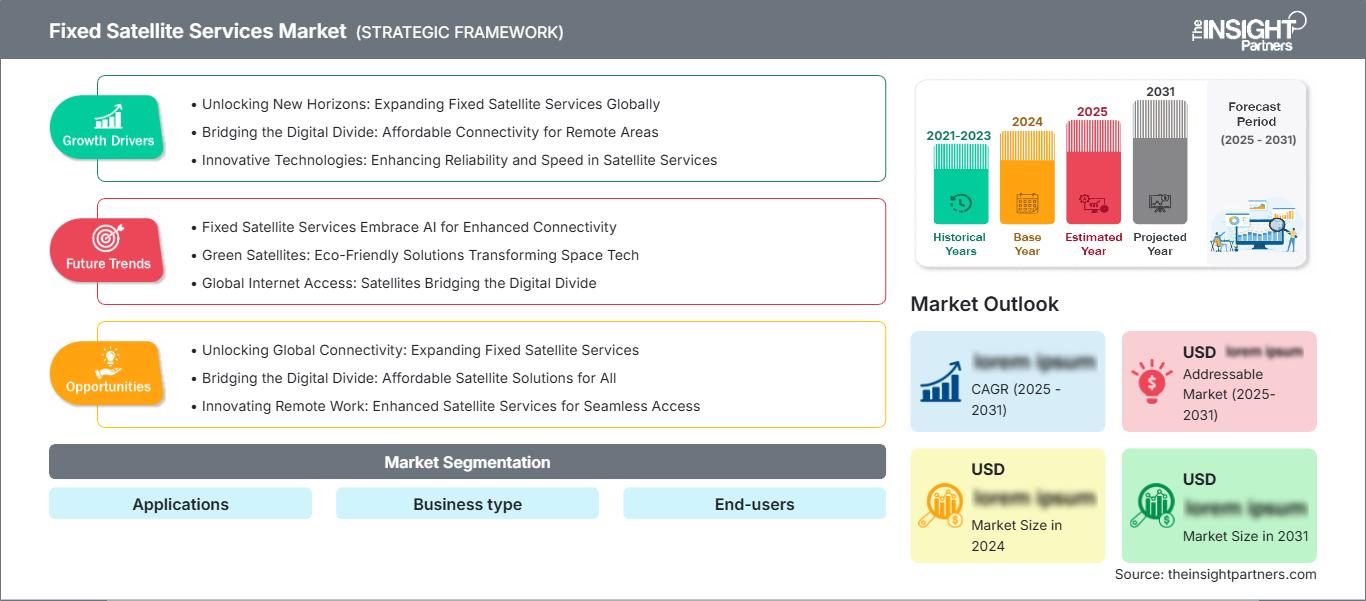
Fixed Satellite Services Market: Strategic Insights
Regional Insights
North America Fixed Satellite Services Market
North America accounted for 27–31% of world revenues in 2025 and will grow at a rate of 4.9–5.5% CAGR to 2034. The Fixed Satellite Services Market share is the outcome of robust government purchases, established media distribution services, enterprise continuity needs, and connectivity deficits in northern and rural regions. Defense users look for secured bandwidth, anti-jam capabilities, mobility, and sovereign gateway solutions, whereas commercial customers have started deploying satellites as failover for fiber and cellular networks. Established teleports and robust cloud ecosystems enable the integration of applications, security, and network management.
There is a diversification in service demands from dedicated bandwidth to managed connectivity that includes terminals, installation, monitoring, and service assurance. Canada accounts for demands of remote communities, mining, energy, maritime, and public sectors, while the US holds the demand from defense, aviation, media, and enterprises segments. Operators are developing multi-orbit routing and flexible capacity due to the fact that customers need performance guarantees at fixed sites and mobility. Pricing is competitive on standard bandwidth, which makes application engineering and cybersecurity key to retaining contracts.
U.S. Fixed Satellite Services Market
United States of America held a 78-82% share of North American revenue in 2025 and is forecast to achieve a CAGR of 5.0-5.6% between 2026 and 2034. Federal agencies such as defense, intelligence, disaster management, and diplomacy require highly valued demand for secured fixed and transportable connectivity solutions. The major commercial applications include broadcast contribution, cellular backhaul, offshore oil and gas, aviation gateways, business continuity, and rural broadband. Demand is increasing for multi-band connectivity solutions, assured capacity, domestic gateways, and unified monitoring in both satellite and terrestrial access solutions.
Leading companies such as SES S.A., Eutelsat Communications S.A., Telesat Corporation, Hispasat, S.A., and niche integrators have commercial or infrastructure presence for USA market. Application trends involve edge connectivity, cloud access, managed SD-WAN and command network. The USA has one of the largest installed terminal bases for upgradability; however, providers need to deal with challenges such as C-band transition, cybersecurity, and competitive pressure from fiber, 5G, and LEO only.
Europe Fixed Satellite Services Market
Europe had a market share of 21-25% in 2025 and is estimated to have a 4.5-5.1% CAGR between 2026-2034 due to demand from UK through government, maritime, aviation, and media channels. The finance and service capabilities of London help in creating contracts internationally whereas sovereign connectivity drives protected networks. Germany has contributions from industry, automobiles, public safety, and enterprise needs, with emphasis on resilient infrastructure and connectivity of distributed production sites.
France gains from the presence of Eutelsat Communications S.A., defense programs, and institutional connectivity. Italy gains from broadcasting, government, and maritime applications, while Spain gains due to the presence of Hispasat, S.A., rural connectivity, and connections with Latin America. The policies related to IRIS², strategic autonomy, and secure communications in Europe favor investments but the legacy broadcast decline helps moderate growth. The operators with gateways in the region, multilingual capabilities, and multi-orbit satellites can cater to cross-border government and enterprise demands.
APAC Fixed Satellite Services Market
The Asia Pacific region has a 32-36% market share in 2025 and is expected to increase by 6.2-6.8% CAGR until 2034, becoming the fastest-growing segment. China dominates via national operators, broadcasting, and extensive rural coverage. Japan and South Korea develop media applications, mobility, disaster resistance, and sophisticated ground segment equipment. India develops cellular backhauling and public communication. Australia expands its market via mining, energy, shipping, and remote communities.
Industrial policy encourages domestic satellite capacity, sovereignty of gateways, and satellite coverage of island and mountainous regions. High data consumption, development of 5G and dispersed infrastructures facilitate the managed services segment. The regional market growth is contingent upon license timing, affordable terminal solutions, and coordination between operators, telecom providers, and local partners.
Middle East & Africa Fixed Satellite Services Market
Expansion of Middle East & Africa market is expected to be at 5.8-6.4% CAGR till 2034. Leading in this market is Saudi Arabia with the help of Government, Energy, Aviation and infrastructure development. UAE has its market driven by Space42 PLC, international airports, maritime activities and smart government solutions. South Africa has contribution from Broadcasting, Mining, banking and regional distribution and the rest of the MEA is dependent on satellite for remote coverage and mobile network backhaul.
Energy infrastructure sites, pipeline, construction corridors and public service network sites present repetitive needs for those areas where there is less presence of the terrestrial infrastructure. Arab Satellite Communications Organization along with its regional partners provide sovereign capability and managed services model removes technical burden for customer.
Segmentation Analysis
Service Type
Service Type is expected to expand at a 5.3–5.9% CAGR during 2026–2034. The Fixed Satellite Services Market scope spans raw or committed capacity and fully managed outcomes. Wholesale contracts remain important for broadcasters, telecom carriers, and integrators with network-control capabilities. Managed offerings are gaining strategic value because customers increasingly require terminals, installation, cybersecurity, monitoring, and application performance under one service-level agreement.
- Wholesale FSS: Wholesale capacity remains the largest sub-segment, serving broadcasters, carriers, governments, and integrators that control ground infrastructure and aggregate demand across multiple customers or locations.
- Managed FSS: Managed services are scaling as enterprises seek packaged connectivity, terminal lifecycle support, cybersecurity, monitoring, and performance assurance without maintaining in-house satellite engineering teams.
Organization Size
Organization Size is forecast to grow at a 5.1–5.7% CAGR through 2034. Adoption patterns reflect site count, traffic profile, internal network expertise, and continuity risk. Large enterprises support multi-site contracts and stringent service levels, while SMBs and SOHO users depend on simplified packages and channel partners. Falling terminal complexity and cloud-based management are making satellite connectivity easier to deploy across dispersed organizations.
- Small Office, Home Office (SOHO): SOHO demand concentrates in remote premises, temporary operations, and backup access, with affordability, simple installation, predictable billing, and compact terminals shaping adoption.
- Small and Medium Businesses (SMBs): SMBs use satellite to connect rural branches, field sites, and mobile operations, favoring managed packages that minimize technical staffing and capital expenditure.
- Large Enterprises: Large enterprises represent strategically important demand through global networks, energy assets, logistics, retail continuity, and regulated operations requiring centralized monitoring and contracted availability.
Vertical
Vertical is projected to advance at a 5.5–6.1% CAGR during 2026–2034. Government and telecom requirements provide scale, while media sustains established broadcast capacity. Aerospace and defense support premium protected services, and oil and gas operations require coverage across offshore and desert locations. Education and retail increasingly adopt satellite for continuity and remote access, particularly where terrestrial alternatives remain unreliable.
- Government: Government demand emphasizes sovereign coverage, secure gateways, disaster response, border operations, and assured availability, supporting long contracts and specialized compliance requirements.
- Education: Education networks use satellite to connect remote campuses, digital classrooms, and research locations where terrestrial broadband is unavailable, seasonal, or insufficiently resilient.
- Aerospace & Defense: Aerospace and defense users require protected bandwidth, mobility support, global coverage, and resilient command links, making service assurance and cybersecurity decisive procurement factors.
- Media & Entertainment: Media remains a substantial capacity user for channel distribution, contribution, sports, and occasional use, although IP migration pressures traditional linear-broadcast economics.
- Oil & Gas: Oil and gas operators rely on fixed services for offshore platforms, pipelines, drilling sites, workforce communications, telemetry, and emergency connectivity across isolated assets.
- Retail: Retailers apply satellite as backup for payments, inventory, security, and branch communications, prioritizing rapid failover, centralized management, and predictable multi-site contracts.
- Telecom & IT: Telecom and IT customers use satellite for rural backhaul, network extension, cloud access, and resilience, aggregating demand through wholesale and managed-service arrangements.
Opportunity Snapshot
| Industry Vertical | Revenue Contribution | Trend Tag | Adoption Stage |
| Government | High | Sovereign Networks | Scaling |
| Education | Low | Remote Learning | Emerging |
| Aerospace & Defense | High | Protected SATCOM | Scaling |
| Media & Entertainment | High | IP Distribution | Mature |
| Oil & Gas | Medium | Remote Operations | Mature |
| Retail | Medium | Branch Resilience | Scaling |
| Telecom & IT | High | Rural Backhaul | Scaling |
| Others | Low | Field Connectivity | Emerging |
Fixed Satellite Services Market Growth Drivers and Impact Analysis
Resilience requirements elevate satellite within enterprise networks
Enterprises increasingly recognize that fiber cuts, terrestrial congestion, disasters, and remote geography can interrupt digital operations. Satellite provides path diversity that does not depend on the same local infrastructure, making it valuable for payments, cloud access, telemetry, voice, and emergency coordination. An Intelsat-sponsored 2025 enterprise survey reported that 68% of respondents identified secondary or backup connectivity as the most strategic satellite application for the following two years. Commercial impact extends beyond bandwidth because customers require automatic failover, managed terminals, security policy integration, and 24-hour monitoring. Providers that integrate satellite into SD-WAN and cloud-management environments can secure recurring contracts while improving customer retention across distributed branch, industrial, and public-sector networks.
Remote infrastructure and cellular backhaul sustain demand
Mining, oil and gas, construction, utilities, transport corridors, islands, and rural settlements often operate beyond economical fiber reach. Fixed satellite connectivity enables rapid deployment without waiting for extensive civil works, while cellular operators use it to backhaul towers where microwave links are impractical. Expansion is strongest when service providers combine capacity with power-aware terminals, installation, local maintenance, and traffic optimization. The commercial effect is a broad addressable base spanning temporary projects and permanent networks. As 4G and 5G coverage expands, backhaul traffic rises, but operators must control bandwidth costs through compression, caching, and dynamic allocation. Regional partnerships remain critical because licensing, field support, and customer acquisition are locally intensive.
Government and defense modernization supports premium services
Government users need secure communications across headquarters, remote posts, aircraft, vessels, and emergency sites. Modernization programs increasingly seek multi-band, multi-orbit architectures that improve resilience against congestion, interference, infrastructure damage, and adversarial action. In February 2025, SES S.A. confirmed that O3b mPOWER services were being provided to participating governments through the NATO Support and Procurement Agency framework, illustrating commercial demand for managed, low-latency capability. These contracts support premium pricing because procurement includes sovereign gateways, encryption, network visibility, and service assurance. Operators benefit from long planning cycles and recurring usage, but qualification standards, cybersecurity controls, domestic-content rules, and mission-specific integration raise the cost of market entry.
Fixed Satellite Services Market Future Trends
Software-defined multi-orbit service orchestration
Fixed Satellite Services Market trends will center on software platforms that select capacity by coverage, latency, cost, security, and application priority across GEO, MEO, and LEO networks. Customers will increasingly purchase an assured outcome rather than a specific orbital path. Automated routing, virtualized gateways, cloud-native network functions, and standardized terminal interfaces will reduce operational fragmentation. Operators with large fleets can monetize complementary assets, while regional providers can federate capacity through partnerships. Competitive differentiation will depend on transparent performance analytics, policy control, cybersecurity, and billing consistency. This architecture will also support rapid restoration when terrestrial or satellite links become unavailable.
Digitally reconfigurable payloads and flexible capacity
Next-generation geostationary satellites will use digital processors, steerable beams, and adaptable power allocation to respond to changing traffic patterns. This flexibility can reduce stranded capacity when demand shifts among regions, applications, or frequency bands. Operators will pair reconfigurable spacecraft with software-led ground systems that activate services faster and support shorter contracts. The model is particularly relevant for government contingencies, maritime corridors, seasonal media events, and emerging enterprise clusters. Commercial success will require accurate demand forecasting and disciplined fleet planning because digital flexibility does not eliminate launch, insurance, and replacement risk. Capacity marketplaces may emerge as interoperability improves.
Fixed Satellite Services Market Opportunities
Managed resilience packages for distributed enterprises
Providers can target banks, retailers, logistics companies, manufacturers, utilities, and public agencies with standardized backup-connectivity packages. A compelling offer combines compact terminals, automatic failover, pooled data, cybersecurity, cloud monitoring, and nationwide field support. Channel partnerships with telecom carriers and managed-service providers can lower acquisition costs while embedding satellite within existing enterprise contracts. Investment should prioritize zero-touch activation, application-aware traffic policies, and service dashboards that quantify avoided downtime. Tiered plans can address branch criticality without forcing uniform capacity across every site. This Fixed Satellite Services Market Forecast creates recurring revenue and reduces dependence on volatile wholesale pricing, particularly where fiber coverage appears adequate but remains operationally vulnerable.
Sovereign gateways and regional connectivity ecosystems
Governments and regulated industries increasingly want traffic to land within national borders, use approved encryption, and remain controllable during international disruption. Operators can invest with telecom carriers, defense integrators, and public agencies in sovereign gateways, network-operation centers, reserved capacity, and training. The model is attractive in Europe, the Middle East, Asia, and Africa, where strategic autonomy and underserved regions intersect. Revenue can combine long-term capacity commitments, managed operations, equipment, and lifecycle support. Projects should be structured around measurable availability and local capability transfer. Partnerships reduce licensing friction and improve credibility, while shared infrastructure raises utilization across public safety, education, healthcare, defense, and rural broadband programs.
Recent Developments
- July 2026: Amazon is expanding its satellite ambitions with a new Direct-to-Device (D2D) service that could allow compatible smartphones and other cellular devices to connect directly to satellites, even in locations where traditional mobile networks are unavailable. The company has submitted a proposal to the U.S. Federal Communications Commission (FCC) for a new constellation of up to 5,105 low Earth orbit (LEO) satellites. Amazon says the system is designed to provide voice calls, messaging, data connectivity and emergency communications from space. Satellite deployment for the new D2D network is planned to begin in 2028.
- August 2026: Vietnamese aerospace company VinSpace has signed a launch agreement with SpaceX, marking an important step in the company’s plans to develop Vietnam’s space technology capabilities. The agreement was announced on August 11, 2026. Under the deal, VinSpace’s satellites are scheduled to fly in 2027 aboard a SpaceX Transporter rideshare mission. The rideshare program allows several customers to place satellites into orbit on the same launch, helping reduce launch costs and make access to space more efficient.
- April 2026: Viasat has confirmed that its ViaSat-3 F3 communications satellite is scheduled to launch on April 27, 2026, aboard a SpaceX Falcon Heavy rocket. The launch is planned from Launch Complex 39A at NASA’s Kennedy Space Center in Florida, with an 85-minute launch window opening at 10:21 a.m. EDT.
Frequently Asked Questions

- Comprehensive Market Sizing and Forecast Analysis
- Detailed Segmentation Analysis
- In-Depth Market Dynamics Assessment
- Regional and Country-Level Insights
- Competitive Landscape and Company Benchmarking
- Strategic Business Intelligence
Recent Reports
Testimonials

The Insight Partners' SCADA System Market report is comprehensive, with valuable insights on current trends and future forecasts. The team was highly professional, responsive, and supportive throughout. We are very satisfied and highly recommend their services.
RAN KEDEM Partner, Reali Technologies LTDs
I requested a report on a very specific software market and the team produced the report in a few days. The information was very relevant and well presented. I then requested some changes and additions to the report. The team was again very responsive and I got the final report in less than a week.
JEAN-HERVE JENN Chairman, Future Analytica
We worked with The Insight Partners for an important market study and forecast. They gave us clear insights into opportunities and risks, which helped shape our plans. Their research was easy to use and based on solid data. It helped us make smart, confident decisions. We highly recommend them.
PIYUSH NAGPAL Sr. Vice President, High Beam Global
The Insight Partners delivered insightful, well-structured market research with strong domain expertise. Their team was professional and responsive throughout. The user-friendly website made accessing industry reports seamless. We highly recommend them for reliable, high-quality research services
YUKIHIKO ADACHI CEO, Deep Blue, LLC.
This is the first time I have purchased a market report from The Insight Partners.While I was unsure at first, I visited their web site and felt more comfortable to take the risk and purchase a market report.I am completely satisfied with the quality of the report and customer service. I had several questions and comments with the initial report, but after a couple of dialogs over email with their analyst I believe I have a report that I can use as input to our strategic planning process.Thank you so much for taking the extra time and making this a positive experience.I will definitely recommend your service to others and you will be my first call when we need further market data.
JOHN SUZUKI President and Chief Executive Officer, Board Director, BK Technologies
I wish to appreciate your support and the professionalism you displayed in the course of attending to my request for information regarding to infectious disease IVD market in Nigeria. I appreciate your patience, your guidance, and the fact that you were willing to offer a discount, which eventually made it possible for us to close a deal. I look forward to engaging The Insight Partners in the future, all thanks to the impression you have created in me as a result of this first encounter.
DR CHIJIOKE ONYIA MANAGING DIRECTOR, PineCrest Healthcare Ltd.Reason to Buy
- Informed Decision-Making
- Understanding Market Dynamics
- Competitive Analysis
- Identifying Emerging Markets
- Customer Insights
- Market Forecasts
- Risk Mitigation
- Boosting Operational Efficiency
- Strategic Planning
- Investment Justification
- Tracking Industry Innovations
- Aligning with Regulatory Trends





 Get Free Sample for