
Flip Chip Packages Market Trends, Demand & Growth by 2034
Coverage: by Bumping Technology (Gold Bumping, Solder Bumping, and Copper Pillar Bumping) and End User (Computing & Networking, Communication, Automotive, Industrial, and Others), and Geography (North America, Europe, Asia Pacific, and South and Central America)
- Status : Data Released
- Report Code : TIPEL00002487
- Category : Electronics and Semiconductor
- No. of Pages : 150
- Available Report Formats :


- Last update date : September 09, 2026


2025 Market Size
US$ 31.82 Bn
Base year value
2034 Forecast
US$ 50.27 Bn
Projected by 2034
CAGR 2026-2034
5.21 %
Growth rate
Addressable Market
US$ 372.35 Bn
(2026-2034)
The Flip Chip Packages Market is positioned at the intersection of semiconductor scaling, heterogeneous integration, and high-density interconnect requirements. The market is valued at US$ 31.82 Billion in 2025 and is projected to reach US$ 50.27 Billion by 2034, expanding at a CAGR of 5.21% during 2026–2034. Demand is supported by rising computing workloads, advanced communications architectures, automotive electronics, and increasing requirements for compact, thermally efficient semiconductor packages.
North American demand is expected to remain resilient, with the Flip Chip Packages Market size supported by advanced computing, automotive semiconductor localization, and investments in domestic packaging capacity. The regional market is estimated to expand at approximately 5.0–5.5% CAGR between 2026–2034. Increasing adoption of heterogeneous integration, chiplets, high-performance processors, and advanced substrate technologies should sustain packaging investment across the US and Canada.
Flip Chip Packages Market Assessment and Insights
- North America: North America is estimated to account for a 29–33% share in 2025 and expand at a 5.0–5.5% CAGR between 2026–2034, supported by advanced computing, semiconductor localization, automotive electronics, and packaging investments.
- US: The US represents approximately 78–82% of North America's 2025 market and is projected to grow at a 5.0–5.5% CAGR, supported by AI computing, domestic semiconductor capacity, and advanced packaging initiatives.
- Europe: Europe is estimated to hold a 22–26% share in 2025 and grow at a 4.7–5.2% CAGR, with Germany, France, the UK, Italy, and Spain supporting automotive, industrial, and communications semiconductor demand.
- Asia Pacific: Asia Pacific is estimated to represent 35–39% of 2025 demand and grow at a 5.7–6.2% CAGR, led by Taiwan, South Korea, China, Japan, and India through strong semiconductor manufacturing and packaging ecosystems.
- Largest Segment: Copper Pillar Bumping is estimated to command a 45–49% market share in 2025 and expand at a 5.4–5.9% CAGR, reflecting fine-pitch interconnection and high-density package requirements.
- High Growth Segment: Automotive is estimated to represent a 16–20% share in 2025 and grow at a 6.2–6.8% CAGR, driven by electrification, ADAS, domain controllers, and vehicle connectivity.
- Key companies analyzed in detail: Intel Corporation, Chipbond Technology, Taiwan Semiconductor Manufacturing Company, Advanced Semiconductor Engineering, Siliconware Precision Industries, Texas Instruments, Inc., Samsung Electronics Co., Ltd., Powertech Technology, IBM Corporation, and Amkor Technology, Inc.
Source: The Insight Partners' analysis based on proprietary research, government publications, company annual reports, investor presentations, industry databases, and expert interviews.
Packaging technologies in the Flip Chip Packages Market have moved away from traditional wire bonding systems towards denser interconnects capable of handling more I/Os, smaller packages, and better electrical performance. Flip-chip solutions have emerged for applications that require short electrical connections and well-controlled electrical characteristics. The evolution of copper pillar systems, tighter bump pitches, superior underfills, and automation has gradually led to improvements in manufacturing technologies in high-volume semiconductor products.
Going forward, resources will be allocated to packaging capacity capable of heterogeneous integration, chiplets, HBM, automotive processors, and advanced communication devices. Semiconductors policies in regions will also drive manufacturing locally. This trend will increase the opportunity space beyond computing applications, especially where reliability, thermal performance, package density, and supply chain reliability are key purchase considerations.
Flip Chip Packages Market Report Scope
| Report Attribute | Details |
|---|---|
| Market size in 2025 | US$ 31.82 Billion |
| Market Size by 2034 | US$ 50.27 Billion |
| Global CAGR (2026 - 2034) | 5.21% |
| Historical Data | 2021-2024 |
| Forecast period | 2026-2034 |
Flip Chip Packages Market Analysis
The Flip Chip Packages Market is being driven by the increasing functionality of semiconductors in smaller packages. Increased functionality in computing and networking applications necessitates increased interconnect density, whereas automotive electronics require strong packages that can work effectively under high thermal and mechanical conditions. The industry consists of processes such as wafer bumping, substrate manufacturing, assembly, underfill, test, and equipment suppliers, which requires consistency in processes throughout the value chain.
Increasing importance is being placed on suppliers who have strong wafer bumping capabilities, high-capacity assembly factories and established relationships with semiconductor manufacturers. Taiwan, South Korea, China, Japan and United States will continue to be strategically important locations for production. Wafer size, pad shape, device architecture, substrate availability and qualification requirements are the main factors influencing demand for copper pillar and solder interconnects.
According to the Flip Chip Packages Market analysis, the market features an oligopoly consisting of integrated semiconductor manufacturers, foundry, OSAT providers and packaging companies. Intel Corporation and Taiwan Semiconductor Manufacturing Company have leading technology position. Other companies active in the assembly and packaging services include Advanced Semiconductor Engineering, Siliconware Precision Industries, Amkor Technology, Inc., Chipbond Technology, and Powertech Technology. Application-specific semiconductors and packaging services provided by Texas Instruments, Inc., Samsung Electronics Co., Ltd., and IBM Corporation are worth mentioning.
Competitive advantages in the industry are becoming increasingly based on process yields, fine pitch capabilities, thermal performance, reliability, capacity and qualification cycle times. Consequently, capital investment is increasingly being made in advanced packaging facilities and process improvements. Geography diversification, automation and integration of packaging into semiconductor manufacturing strategies are gaining in prominence among major players.
● REPORT CUSTOMIZATION
Tailor This Report To Align With Your Specific Business Requirements
This report can be customized to align precisely with your business objectives, scope, and target markets. Customization options include tailored segmentation, geography, competitive analysis, and strategic insights to support informed decision-making.
Customize This Report →WHAT YOU CAN ADJUST
- ● Segmentations
- ● Geography
- ● Competitive Analysis
- ● Language Preferences
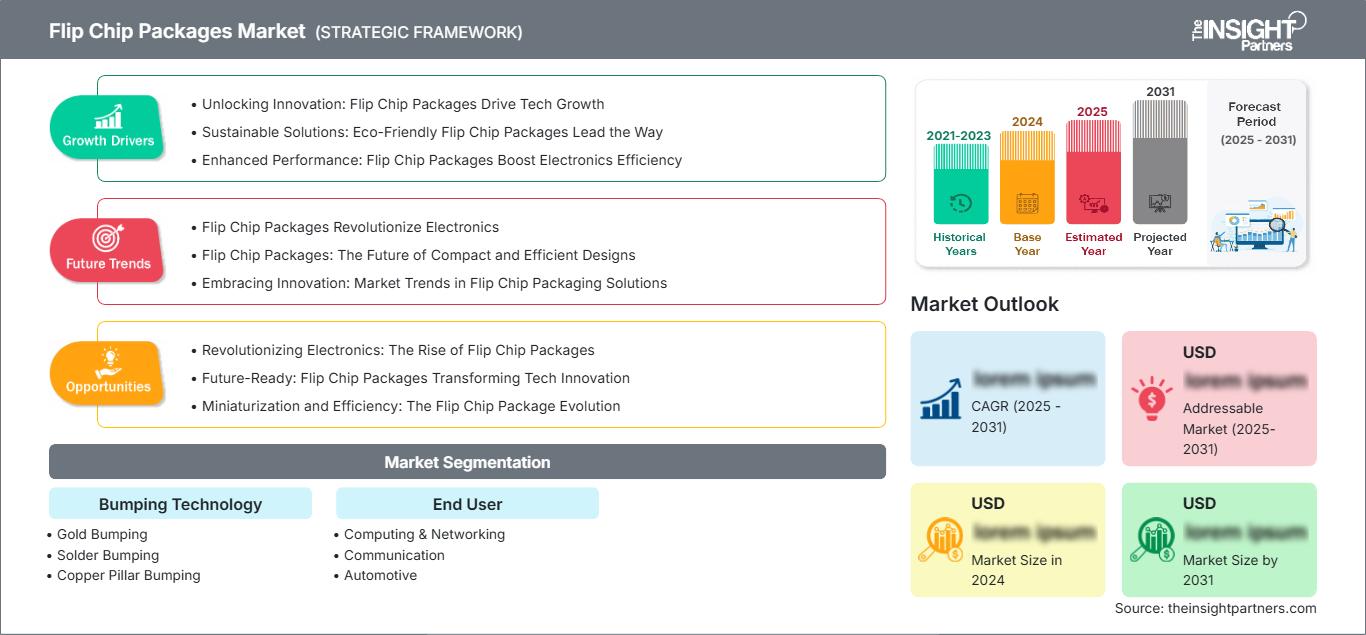
Flip Chip Packages Market: Strategic Insights
Regional Insights
North America Flip Chip Packages Market
North America is estimated to account for 29–33% of global demand in 2025 and expand at a 5.0–5.5% CAGR through 2034. The area is endowed with semiconductor design competencies, artificial intelligence computing investments, defense electronics, cloud computing infrastructure, and automobile technology investments. The United States accounts for regional consumption while Canada makes contributions via specialized electronics and industrial technology ecosystem.
There is a shift in domestic semiconductor policies that highlight the significance of back-end manufacturing and advanced packaging. Key contributors to the regional ecosystem include Intel Corporation, Texas Instruments, Inc. and Amkor Technology, Inc. The advanced semiconductor research and system contribution come from IBM Corporation.
U.S. Flip Chip Packages Market
The US represents approximately 78–82% of North America's 2025 demand and is projected to grow at a 5.0–5.5% CAGR through 2034. The government’s backing for semiconductor production, AI infrastructure buildout, military modernization, and localizing of automotive electronics will be bolstering the local packaging industry. Advanced packaging is becoming an increasingly important aspect of semiconductor supply chain resiliency.
The companies Intel Corporation, Texas Instruments, Inc., Amkor Technology, Inc., and IBM Corporation bring significant expertise in manufacturing, packaging, design, and R&D. The greatest application demand can be expected in relation to processors used in data centers, networking equipment, automotive semiconductors, industrial equipment, and military electronics. Heterogeneous integration and chiplet technology will continue to drive the demand.
Europe Flip Chip Packages Market
Europe is estimated to hold a 22–26% share in 2025 and grow at a 4.7–5.2% CAGR. Germany is the leading market, supported by automotive semiconductor demand and industrial electronics. The UK participates in design and research in semiconductors, whereas France, Italy, and Spain add demand from aerospace, automotive, communication, and industrial systems. The flip chip packages market share in the region is indicative of the well-developed downstream electronics sector in Europe.
Germany is key due to electrification in vehicles, ADAS, industrial automation, and power electronics, which all require more complex semiconductors. France and Italy have contributions in aerospace, defense, automotive, and industrial sectors, whereas Spain is focusing on semiconductor and electronics development. Europe’s semiconductor initiatives are also pushing for increased production resilience in the region.
APAC Flip Chip Packages Market
APAC is estimated to represent 35–39% of global demand in 2025 and expand at a 5.7–6.2% CAGR. Taiwan is the leading regional market, followed by South Korea, China, Japan, India, and Australia. Strong foundry, OSAT, electronics manufacturing, and semiconductor equipment ecosystems provide a structural advantage.
Industrial policy, AI infrastructure, mobile electronics, automotive semiconductors, and advanced computing are supporting investment. Taiwan and South Korea remain particularly important for sophisticated packaging, while China and Japan contribute substantial manufacturing capacity and application demand. India is expanding semiconductor capabilities and packaging investment.
Middle East & Africa Flip Chip Packages Market
Middle East and Africa represents a smaller demand base but is expected to expand at a 4.8–5.4% CAGR. Saudi Arabia and the UAE lead regional technology investment, while South Africa contributes through industrial and electronics applications. Rest of MEA demand remains concentrated in communications, industrial automation, energy systems, and data infrastructure.
Saudi Arabia and the UAE are investing in digital infrastructure and advanced technology ecosystems, supporting future semiconductor consumption. Energy-intensive data centers and telecommunications networks create indirect demand for advanced processors and high-density packages. Regional market development will depend on electronics localization, infrastructure investment, skilled technical capacity, and integration with global semiconductor supply chains.
Segmentation Analysis
Bumping Technology
Bumping Technology represents the core interconnection process supporting flip-chip assembly and continues to evolve with increasing I/O density and shrinking package dimensions. The segment is expected to expand at a 5.0–5.6% CAGR during 2026–2034. The Flip Chip Packages Market scope increasingly encompasses finer pitch, improved thermal characteristics, and reliable wafer-level processing.
- Gold Bumping: Gold bumping remains relevant in applications requiring established bonding characteristics, corrosion resistance, and specialized interconnect reliability. Its strategic role is strongest in selected display, sensor, and specialized semiconductor applications.
- Solder Bumping: Solder bumping supports established high-volume assembly requirements across computing, communications, and consumer-oriented semiconductor devices. Its mature processing infrastructure makes it important where cost, reliability, and scalable manufacturing remain priorities.
- Copper Pillar Bumping: Copper pillar bumping is increasingly important for fine-pitch interconnection and higher current-handling requirements. Its structural advantages support advanced processors, networking devices, automotive electronics, and other high-density semiconductor packages.
End User
End User applications are expected to expand at a 5.0–5.7% CAGR through 2034, supported by semiconductor content growth across computing, communications, automotive, and industrial equipment. Application requirements increasingly emphasize thermal performance, miniaturization, reliability, and electrical integrity, making packaging architecture a strategic component of product design.
- Computing & Networking: High-performance processors, accelerators, switches, and networking infrastructure require dense interconnections and efficient electrical paths. Increasing AI workloads and data-center connectivity reinforce the importance of advanced package architectures.
- Communication: Communication equipment increasingly integrates sophisticated processors, radio components, and connectivity functions within constrained form factors. Flip-chip packaging supports compact designs and high-frequency electrical performance across network infrastructure and communication devices.
- Automotive: Electrification, ADAS, infotainment, and vehicle connectivity are increasing semiconductor content per vehicle. Packaging must address thermal cycling, vibration, reliability, and extended operating lifetimes, strengthening the strategic role of flip-chip solutions.
- Industrial: Industrial automation, control systems, robotics, power management, and machine vision require dependable semiconductor packages. Long product lifecycles and demanding operating environments favor qualified packaging technologies with consistent manufacturing performance.
Opportunity Snapshot
| End User | Revenue Contribution | Trend Tag | Adoption Stage |
|---|---|---|---|
| Computing & Networking | High | AI Computing | Mature |
| Communication | High | Network Scaling | Mature |
| Automotive | Medium | Vehicle Electrification | Scaling |
| Industrial | Medium | Factory Automation | Scaling |
Flip Chip Packages Market Growth Drivers and Impact Analysis
AI and High-Performance Computing Increase Package Interconnect Requirements
AI accelerators and high-performance computing systems are increasing the number of processing functions integrated within advanced semiconductor packages. Greater data traffic necessitates more consideration of short electrical traces, interconnect density, thermal management, and robust packaging technology. This offers an ideal situation for the flip chip and its associated bumping technology. The commercial aspect goes well beyond the processors, since switches, accelerators, memory interface chips, and other auxiliary parts also need better packaging technology. Manufacturers that are able to perform fine pitch assembly and high yields have opportunities in many lucrative fields. In the long run, greater complexity in package will drive procurement decision to yield-based parameters.
Automotive Semiconductor Content Raises Reliability and Packaging Requirements
Automotive electrification and advanced driver assistance systems are increasing semiconductor content across power management, sensing, processing, connectivity, and vehicle control systems. These applications require packaging that can withstand thermal cycling, vibration, humidity, and extended operating periods. Flip-chip architectures can provide electrical and form-factor advantages where high-density integration is required, while advanced bumping processes support increasingly sophisticated automotive processors. The impact is significant because automotive qualification cycles are typically longer than those of consumer electronics, creating durable supplier relationships once technologies are validated. Demand should therefore favor manufacturers with strong reliability engineering, traceability, process control, and automotive-grade production systems rather than suppliers competing primarily through capacity or low unit costs.
Semiconductor Localization Strengthens Regional Packaging Investment
Government efforts to strengthen semiconductor supply chains are increasing attention on assembly, testing, and advanced packaging capacity. Semiconductor localization programs in North America, Europe, and Asia are encouraging manufacturers to diversify production footprints and reduce dependence on concentrated supply networks. Packaging has become strategically important because wafer fabrication alone does not provide a complete semiconductor manufacturing ecosystem. New or expanded facilities can create demand for bumping equipment, substrates, materials, assembly systems, and testing capabilities. For packaging suppliers, this environment creates opportunities to establish regional capacity closer to semiconductor fabs and major customers. It also increases the value of process qualification, workforce development, equipment automation, and supply-chain integration when customers evaluate long-term manufacturing partners.
Flip Chip Packages Market Future Trends
Greater Integration of Chiplets and Heterogeneous Architectures
The Flip Chip Packages Market trends are increasingly connected with chiplet architectures and heterogeneous integration. Instead of relying exclusively on larger monolithic dies, semiconductor designers are combining specialized dies within advanced packages to improve scalability, functionality, and manufacturing flexibility. This transition will increase requirements for precise interconnect placement, substrate performance, thermal management, and package-level testing. Bumping technologies are expected to evolve toward finer pitches and tighter process tolerances as the number of package-level connections rises. Suppliers that integrate wafer processing, assembly engineering, inspection, and reliability testing will be better positioned to address these requirements. Over the longer term, packaging design is likely to become an increasingly integrated part of semiconductor architecture rather than a downstream manufacturing step.
Packaging Optimization Becomes a Core Semiconductor Design Variable
Semiconductor development is moving toward simultaneous optimization of die architecture, interconnects, substrate selection, thermal paths, and final package dimensions. This approach is likely to make packaging constraints visible earlier in product development, particularly for AI accelerators, networking processors, automotive controllers, and high-performance communications devices. Simulation, digital manufacturing systems, inspection automation, and advanced materials will increasingly support package design decisions. Manufacturers may also develop application-specific packaging platforms that can be adapted across product families. Such standardization can shorten qualification cycles while preserving customization at the die and substrate levels. The resulting competitive advantage will depend on how effectively suppliers connect packaging engineering with semiconductor design, production planning, reliability testing, and customer-specific performance requirements.
Flip Chip Packages Market Opportunities
Regional Advanced Packaging Capacity Creates Localization Opportunities
Regional packaging investments create opportunities for suppliers of bumping equipment, substrates, materials, inspection systems, assembly services, and specialized testing. The Flip Chip Packages Market Forecasts should therefore be assessed not only through semiconductor unit growth but also through the geographic distribution of new manufacturing capacity. Suppliers can target regions where governments and semiconductor companies are establishing localized ecosystems, particularly North America and selected European and Asian markets. Partnerships with foundries, integrated device manufacturers, and OSAT providers can provide access to qualification pipelines and long-term production programs. Investors should prioritize technologies that address fine-pitch interconnection, automation, thermal performance, and process yield because these characteristics can support multiple semiconductor applications rather than relying on a single end market.
Automotive and Industrial Packaging Platforms Offer Long-Cycle Opportunities
Automotive and industrial electronics offer attractive strategic opportunities because product lifecycles can extend substantially beyond those of consumer devices. Suppliers can develop qualified packaging platforms optimized for thermal cycling, mechanical reliability, electrical performance, and traceability. The opportunity is particularly relevant for semiconductor manufacturers seeking standardized package architectures across multiple controller, sensing, connectivity, and power-management products. The Flip Chip Packages Market report should incorporate the effect of rising semiconductor content per vehicle and increasing automation in industrial equipment. Companies with established qualification processes can build durable customer relationships by combining package engineering with reliability testing and manufacturing consistency. This strategy can reduce dependence on highly volatile consumer electronics cycles while supporting incremental adoption across adjacent applications.
Recent Developments
- July 2026: Intel Corporation announced that its advanced packaging organization would be led as a focused business under Intel Foundry, covering advanced packaging, system integration, back-end technology development, and manufacturing. The move reflects the increasing strategic importance of packaging for AI systems and heterogeneous integration.
- May 2026: Amkor Technology, Inc. expanded its planned US advanced packaging footprint by securing an additional 67-acre parcel adjacent to its Arizona campus. The expansion is intended to provide capacity flexibility for advanced packaging and testing serving AI, high-performance computing, automotive, and communications applications.
- November 2025: Powertech Technology Inc. approved the acquisition of a Hsinchu Science Park factory for NT$6.898 billion to expand advanced manufacturing capacity. The company identified AI, high-performance computing, and automotive electronics as key demand areas supporting the investment and planned phased renovation, equipment installation, and recruitment.
Frequently Asked Questions

- Comprehensive Market Sizing and Forecast Analysis
- Detailed Segmentation Analysis
- In-Depth Market Dynamics Assessment
- Regional and Country-Level Insights
- Competitive Landscape and Company Benchmarking
- Strategic Business Intelligence
Recent Reports
Testimonials

The Insight Partners' SCADA System Market report is comprehensive, with valuable insights on current trends and future forecasts. The team was highly professional, responsive, and supportive throughout. We are very satisfied and highly recommend their services.
RAN KEDEM Partner, Reali Technologies LTDs
I requested a report on a very specific software market and the team produced the report in a few days. The information was very relevant and well presented. I then requested some changes and additions to the report. The team was again very responsive and I got the final report in less than a week.
JEAN-HERVE JENN Chairman, Future Analytica
We worked with The Insight Partners for an important market study and forecast. They gave us clear insights into opportunities and risks, which helped shape our plans. Their research was easy to use and based on solid data. It helped us make smart, confident decisions. We highly recommend them.
PIYUSH NAGPAL Sr. Vice President, High Beam Global
The Insight Partners delivered insightful, well-structured market research with strong domain expertise. Their team was professional and responsive throughout. The user-friendly website made accessing industry reports seamless. We highly recommend them for reliable, high-quality research services
YUKIHIKO ADACHI CEO, Deep Blue, LLC.
This is the first time I have purchased a market report from The Insight Partners.While I was unsure at first, I visited their web site and felt more comfortable to take the risk and purchase a market report.I am completely satisfied with the quality of the report and customer service. I had several questions and comments with the initial report, but after a couple of dialogs over email with their analyst I believe I have a report that I can use as input to our strategic planning process.Thank you so much for taking the extra time and making this a positive experience.I will definitely recommend your service to others and you will be my first call when we need further market data.
JOHN SUZUKI President and Chief Executive Officer, Board Director, BK Technologies
I wish to appreciate your support and the professionalism you displayed in the course of attending to my request for information regarding to infectious disease IVD market in Nigeria. I appreciate your patience, your guidance, and the fact that you were willing to offer a discount, which eventually made it possible for us to close a deal. I look forward to engaging The Insight Partners in the future, all thanks to the impression you have created in me as a result of this first encounter.
DR CHIJIOKE ONYIA MANAGING DIRECTOR, PineCrest Healthcare Ltd.Reason to Buy
- Informed Decision-Making
- Understanding Market Dynamics
- Competitive Analysis
- Identifying Emerging Markets
- Customer Insights
- Market Forecasts
- Risk Mitigation
- Boosting Operational Efficiency
- Strategic Planning
- Investment Justification
- Tracking Industry Innovations
- Aligning with Regulatory Trends





 Get Free Sample for