
Home Energy Management Market Growth, Trends & Forecast by 2034
Coverage: By Offering (Hardware, Software, Services); Product Type (Lighting Controls, Self-Monitoring Systems and Services, Programmable Communicating Thermostats, Advanced Central Controllers, Intelligent HVAC Controllers); Technology (Z-Wave, ZigBee, Wi-Fi, Ethernet, Others) , and Geography (North America, Europe, Asia Pacific, and South and Central America)
- Status : Data Released
- Report Code : TIPRE00012070
- Category : Electronics and Semiconductor
- No. of Pages : 150
- Available Report Formats :


- Last update date : September 17, 2026


2025 Market Size
US$ 6.47 Bn
Base year value
2034 Forecast
US$ 22.13 Bn
Projected by 2034
CAGR 2026-2034
14.64 %
Growth rate
Addressable Market
US$ 122.61 Bn
(2026-2034)
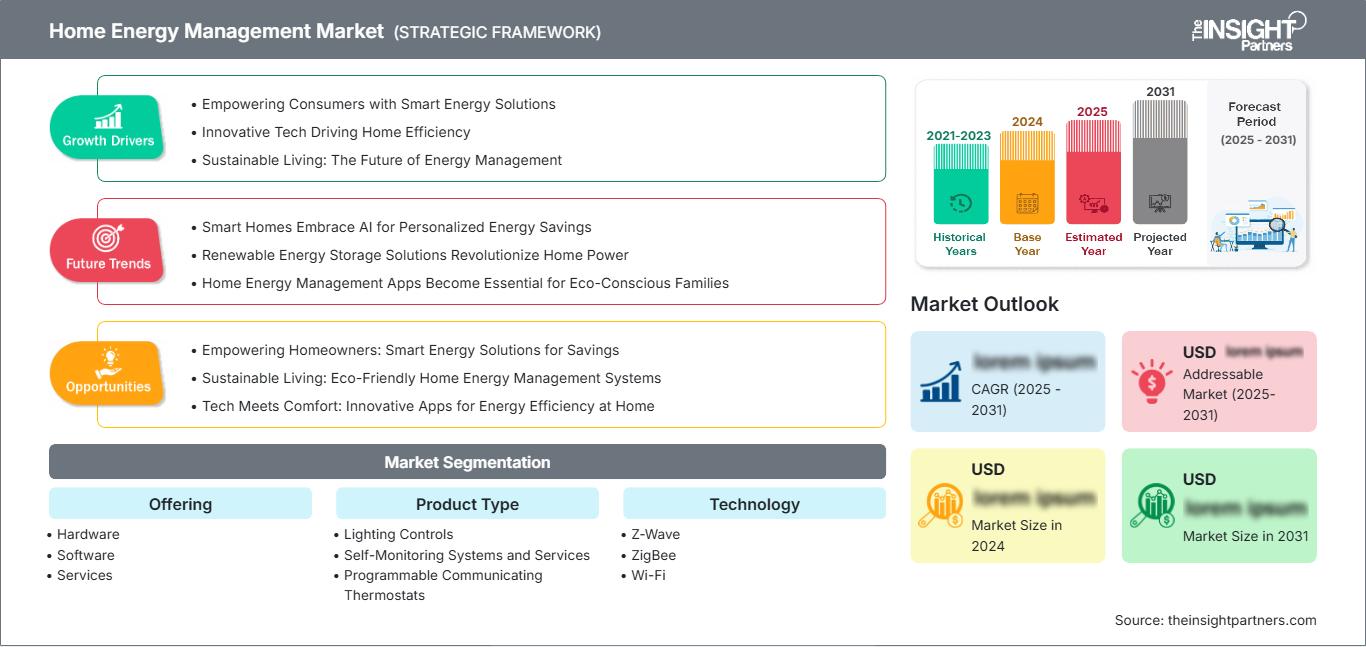
The Home Energy Management Market was valued at US$ 6.47 Billion in 2025 and is projected to reach US$ 22.13 Billion by 2034, registering a CAGR of 14.64% during 2026–2034. Growth is being driven by increased levels of household electrification, device connectivity, and the need for integrated management of lights, heating, ventilation, and air-conditioning systems, appliances, generation, and storage.
In North America, the Home Energy Management Market size is forecast to grow at a modeled CAGR of 13.8 to 14.6% to 2034. Advanced metering infrastructure, time-of-use pricing, and utility demand response programs are making connected thermostats and whole-house controllers more economically attractive. Increased residential use of solar power, batteries, heat pumps, and electric vehicles make it even more valuable to have software that manages load scheduling based on price, carbon footprint, and backup power needs.
Home Energy Management Market Assessment and Insights
- North America: Held a modelled 35–38% share in 2025 and should grow at 13.8–14.6% CAGR between 2026–2034, supported by smart meters, utility rebates, connected HVAC, and expanding residential distributed-energy resources.
- US: Represented 84–88% of North American revenue in 2025 and is projected to expand at 14.0–14.8% CAGR between 2026–2034 as utilities scale demand flexibility.
- Europe: Accounted for a modelled 27–30% share in 2025 and should grow at 13.2–14.0% CAGR between 2026–2034, led by Germany, the UK, and France through electrification and building-efficiency policy.
- Asia Pacific: Captured a modelled 25–28% share in 2025 and is forecast to post 16.0–17.2% CAGR between 2026–2034, with China, Japan, South Korea, India, and Australia advancing smart-home deployment.
- Largest Segment: Hardware held a modelled 45–49% market share in 2025 and should record 13.0–13.9% CAGR during 2026–2034 as controllers, sensors, and thermostats scale.
- High Growth Segment: Software represented a modelled 30–34% market share in 2025 and is expected to grow at 16.2–17.4% CAGR during 2026–2034.
- Key companies analyzed in detail: General Electric Company, Honeywell International Inc., Alphabet Inc., Vivint, Inc., Comcast Cable Communications, LLC, EcoFactor, Inc., EnergyHub, Inc., ecobee Inc., Panasonic Holdings Corporation, and Schneider Electric SE.
Source: The Insight Partners' analysis based on proprietary research, government publications, company annual reports, investor presentations, industry databases, and expert interviews.
Home energy management has moved from standalone timers and programmable thermostats to interoperable systems integrating cloud analytics, edge control, smart meters, sensors, and apps. Wi-Fi is still key for end-user connectivity, while Zigbee and Z-Wave handle low-power devices' network and Ethernet ensures solid backhaul for gateways. The economics of manufacturing lean towards module controllers and software-based functions, giving manufacturers the capability of updating their forecasting, automation and tariffs without changing the existing physical infrastructure.
Investment in home energy management systems will move from the expensive smart homes category to the utility-connected homes category, multifamily buildings, and fast-electrified regions by 2034. The energy efficiency measures, electricity price dynamic, energy incentive policies, and grid flexibility measures will improve the economics of home energy management systems. As per the IEA, global energy efficiency improvements achieved a record of 1.8% in 2025, with more than 250 energy efficiency policies enacted in economies that account for 85% of world energy use.
Home Energy Management Market Report Scope
| Report Attribute | Details |
|---|---|
| Market size in 2025 | US$ 6.47 Billion |
| Market Size by 2034 | US$ 22.13 Billion |
| Global CAGR (2026 - 2034) | 14.64% |
| Historical Data | 2021-2024 |
| Forecast period | 2026-2034 |
Home Energy Management Market Analysis
Home Energy Management Market growth is due to increased electricity costs, residential electrification, and the need to integrate more complex devices. These devices include heat pumps, electric cars, rooftop PVs, batteries, and smart home devices that allow shifting load according to tariffs and events on the network. The hardware suppliers, software providers, installers, utility companies, and aggregators act as a dependent ecosystem as opposed to separate products.
Vendor opportunities lie with suppliers who ease the commissioning process and ensure device connectivity regardless of the brands used. Availability of components is usually high; however, issues such as cybersecurity, radio approvals, cloud service security, and installer competency dictate the deployment process. It is noted by ENERGY STAR that about half of the average cost of energy in a typical US household is devoted to heating and cooling.
Home Energy Management Market Report suggests the competition is shifting from owning the device to being relevant in the control plane. Schneider Electric SE offers a combination of electrical distribution, storage, and connected loads, Honeywell International Inc. and ecobee Inc. compete with intelligent thermostats, Alphabet Inc. connects Nest products with the consumer’s broader ecosystem, while EnergyHub, Inc. connects distributed household assets with utilities.
General Electric Company and Panasonic Holdings Corporation bring appliances and electronics into their portfolios, while EcoFactor, Inc. brings cloud-based optimization to the game. Vivint, Inc. and Comcast Cable Communications, LLC bring energy plus subscription services for a smart home into their portfolios. Strategic investments emphasize increasingly AI, interoperability, security, and involvement in the virtual power plant. Defensibility of the position depends on savings, ease of deployment, utility telemetry, and permissioning protocols.
● REPORT CUSTOMIZATION
Tailor This Report To Align With Your Specific Business Requirements
This report can be customized to align precisely with your business objectives, scope, and target markets. Customization options include tailored segmentation, geography, competitive analysis, and strategic insights to support informed decision-making.
Customize This Report →WHAT YOU CAN ADJUST
- ● Segmentations
- ● Geography
- ● Competitive Analysis
- ● Language Preferences
Home Energy Management Market: Strategic Insights
Regional Insights
North America Home Energy Management Market
The North American market occupied a modeled market share of 35–38% in the Home Energy Management Market Share in 2025 and is projected to register a CAGR of 13.8–14.6% through 2034. High adoption potential is fueled by smart meters, demand response portfolio of utilities, weather-driven HVAC loads, and advanced connected home distribution channels. The ENERGY STAR qualification program uses actual field data to boost consumer trust in smart thermostats.
Market growth is increasingly shifting away from the thermostat and towards other devices such as electrical panels, batteries, solar inverters, EV chargers, and load controllers with single user interface. Companies with strong commercial or ecosystem presence in the space include Schneider Electric SE, Honeywell International Inc., Alphabet Inc., ecobee Inc., EnergyHub, Inc., Vivint, Inc., and Comcast Cable Communications, LLC. Implementation issues include cybersecurity standards and fragmented state legislation, while time-of-use rates and resilience are in favor of whole-house systems.
U.S. Home Energy Management Market
Modelled, the US accounted for 84–88% of the North American revenue in 2025, and is expected to witness a CAGR growth of 14.0–14.8% up to 2034. Utility rebates, advanced metering, residential solar, storage, and adoption of heat pumps and EVs create large pools of controllable loads. The applications are moving away from remote control of the thermostat to demand-response peak reduction, prioritization of backup power, scheduling of appliances, and utility events.
Some of the competitive companies are Alphabet Inc., ecobee Inc., Honeywell International Inc., EnergyHub, Inc., Vivint, Inc., Comcast Cable Communications, LLC, General Electric Company, and Schneider Electric SE through their devices, platforms, distribution channels or utilities. It has been indicated by ENERGY STAR that the smart thermostats can help the average home to save US$ 50 per year and additional spending on heating and cooling can result in more savings.
Europe Home Energy Management Market
Europe is projected to have a modelled share of 27-30% in 2025 and needs to grow at a CAGR of 13.2-14.0% between 2025 and 2034. Germany stands out because of rooftop solar, home battery, heat pump, dynamic tariffing, and excellent electric installation channel. Increasingly, homeowners in Germany will need integration solutions that optimize their self-consumption and peak import requirements in order to connect inverters, meters, HVAC, and controllable appliances.
In the UK, integration of smart meter deployment with flexible tariffs and active energy retailers is expected to drive the market, while in France, electrification of heating and building renovation will be the key driver. In Italy and Spain, solar economics and increasing storage will be the key driving factors. Interoperability and data protection affect the choice of platform in Europe. The companies providing solutions are Schneider Electric SE, Honeywell International Inc., Alphabet Inc., Panasonic Holdings Corporation, and ecobee Inc.
APAC Home Energy Management Market
Asia Pacific grabbed a modelled share of 25-28% in 2025 and is expected to register a CAGR of 16.0-17.2% up to 2034. China dominates on account of smart appliances production, digital ecosystems, and distributed solar. Japan and South Korea focus on energy-efficient houses, automation, and resilience, thanks to their developed electronics industries.
Growing requirements of energy generation, urban buildings, and solar rooftops favor India's future, while abundant residential solar panels and batteries make Australia a perfect fit for high-end load orchestration. Panasonic Holdings Corporation and Schneider Electric SE both have a robust sales and marketing network in the region. The fragmented housing sector and sensitivity to prices favor modular systems due to instant benefits from automation.
Middle East & Africa Home Energy Management Market
Middle East and Africa region is expected to see growth rates in a range of 12.5% -13.5% CAGR during 2026-2034. UAE takes the lead due to high-end connected housing, solar energy use, and smart city projects, while Saudi Arabia's high number of residential projects offers possibilities for embedded controls and efficient cooling management solutions.
South Africa profits from solar, battery, and outage resilience interest; Rest of MEA grows selectively in upscale urban areas and utility upgrades. Cooling loads, grid reliability, and infrastructure development drive demand. Adoption relies on local hardware support, mobile connections, installer availability, and systems able to integrate self-generation and critical load backup.
Segmentation Analysis
Offering
The Offering segment is expected to grow at 14.2–15.1% CAGR during 2026–2034. Its Home Energy Management Market scope spans physical controls, analytics platforms, and implementation services. Hardware supplies the installed base, software captures recurring value through optimization and updates, and services reduce integration friction. Revenue mix should gradually shift toward software and managed programs as utilities and households demand continuous intelligence.
- Hardware: Controllers, sensors, smart thermostats, switches, and gateways form the operational layer, with demand tied to retrofits, new construction, electrification assets, and reliable local control.
- Software: Platforms translate tariffs, weather, occupancy, and device data into schedules and recommendations, making interoperability, cybersecurity, mobile experience, and utility connectivity strategically important differentiators.
- Services: Installation, integration, maintenance, analytics, and demand-response enrollment support adoption where homeowners or utilities require verified configuration, ongoing optimization, and accountable performance across diverse equipment.
Product Type
The Product Type segment should expand at 14.0–14.9% CAGR through 2034. Thermostats remain a practical entry point because HVAC represents a large household load, while advanced controllers and intelligent HVAC systems enable broader optimization. Growth depends on balancing automated savings with comfort, transparent overrides, equipment compatibility, and installer-friendly commissioning across both new and existing homes.
- Lighting Controls: Connected switches, dimmers, occupancy sensors, and schedules deliver familiar automation and incremental savings, often serving as an accessible first purchase within wider smart-home ecosystems.
- Self-Monitoring Systems and Services: Dashboards and alerts give households appliance-level or circuit-level visibility, supporting behavioral change, fault detection, bill validation, and prioritization of future efficiency investments.
- Programmable Communicating Thermostats: These devices combine schedules, remote control, occupancy logic, and utility connectivity, maintaining strong demand because heating and cooling offer measurable savings and flexible-load potential.
- Advanced Central Controllers: Central hubs coordinate multiple energy assets and protocols, becoming strategically important as solar, storage, EV charging, appliances, and backup requirements converge within one household.
- Intelligent HVAC Controllers: Advanced controls optimize variable-speed equipment, zones, humidity, weather response, and tariffs, supporting comfort while addressing the largest controllable residential energy loads.
Technology
The Technology segment is forecast to grow at 14.3–15.2% CAGR during 2026–2034. No single protocol fits every device. Wi-Fi delivers direct consumer connectivity, Zigbee and Z-Wave support low-power mesh networks, and Ethernet provides dependable gateway backhaul. Market success increasingly depends on gateways and software that abstract protocol differences, enable secure updates, and preserve local operation during cloud or broadband disruptions.
- Z-Wave: A mature low-power mesh protocol with broad smart-home device support, valued for interoperable sensors and controls where dependable in-home coverage matters more than high bandwidth.
- ZigBee: Widely used for low-power lighting, sensors, and energy devices, Zigbee remains strategically relevant through large ecosystems, mesh capability, and utility-adjacent smart-meter implementations.
- Wi-Fi: Direct router connectivity and consumer familiarity make Wi-Fi central to thermostats, appliances, and gateways, although power consumption, network congestion, and credential management require careful design.
- Ethernet: Wired connectivity provides stable, low-latency backhaul for central controllers, smart panels, and fixed gateways, supporting dependable local orchestration and secure links to broadband equipment.
Opportunity Snapshot
| Product Type | Revenue Contribution | Trend Tag | Adoption Stage |
| Lighting Controls | Medium | Occupancy Logic | Mature |
| Self-Monitoring Systems and Services | Medium | Energy Insights | Scaling |
| Programmable Communicating Thermostats | High | Demand Response | Mature |
| Advanced Central Controllers | High | Whole-Home | Scaling |
| Intelligent HVAC Controllers | High | Adaptive HVAC | Scaling |
Home Energy Management Market Growth Drivers and Impact Analysis
Household Electrification Expands Controllable Load
Heat pumps, electric vehicles, induction cooking, and electric water heating increase household electricity use while creating loads that can be shifted without materially reducing comfort. The International Energy Agency reported global electricity demand rose 4.3% in 2024, with electrification contributing across major economies. Home management systems translate this complexity into automated schedules based on tariffs, weather, occupancy, and household priorities. The commercial impact extends across controllers, sensors, software subscriptions, and installation services. Utilities gain a channel for reducing peaks, while homeowners can avoid simultaneous high-load operation and potential electrical-service upgrades. Vendors that integrate equipment APIs and provide understandable controls can capture value at each electrification event rather than relying on a one-time smart-home purchase.
Distributed Energy Resources Require Coordination
Residential solar, batteries, generators, and EVs turn households into active energy nodes. Without orchestration, self-generation may be exported at low value, batteries may cycle at suboptimal times, and backup capacity may be exhausted on nonessential loads. Advanced controllers can forecast generation, prioritize circuits, schedule charging, and respond to tariff windows. This creates measurable value beyond convenience, particularly in regions facing outages or widening peak-to-off-peak price spreads. The market impact is a shift from isolated devices toward integrated systems linking electrical distribution, power conversion, and software. Equipment manufacturers gain attachment opportunities, installers can offer higher-value projects, and aggregators can enroll coordinated fleets into demand-response or virtual power plant programs.
Utility Flexibility Programs Reduce Adoption Barriers
Utilities increasingly view connected homes as dispatchable flexibility resources rather than passive customers. Rebates can lower device cost, while recurring incentives compensate households for allowing temporary thermostat, battery, water-heater, or EV adjustments during constrained periods. ENERGY STAR reports that approximately one-third of US households can access rebates for certified smart thermostats, illustrating how program design can broaden adoption. For suppliers, utility channels provide scale but impose stricter requirements for cybersecurity, telemetry, consent, and performance verification. The resulting market impact favors platforms that support fleet enrollment, event dispatch, opt-out controls, and auditable measurement. Successful programs convert consumer hardware into longer-lived grid assets, creating recurring software and service revenue alongside initial equipment sales.
Home Energy Management Market Future Trends
Artificial Intelligence Moves From Insight to Autonomous Control
Home Energy Management Market trends will increasingly center on predictive, closed-loop control. Systems will combine weather forecasts, dynamic tariffs, occupancy patterns, equipment states, and solar generation to schedule loads before users intervene. Artificial intelligence can also detect abnormal consumption and recommend maintenance, but adoption depends on transparent reasoning and easy overrides. Edge processing should preserve essential automation during connectivity failures and limit unnecessary cloud transfer. Vendors will differentiate through forecast accuracy, comfort preservation, and explainable decisions rather than dashboard volume. As variable-speed HVAC becomes more common, simulation-based benchmarking may complement traditional runtime methods and improve confidence in algorithm performance.
Interoperable Whole-Home Platforms Replace Device Silos
Future platforms will compete on their capacity to coordinate mixed brands and protocols across electrical panels, thermostats, appliances, batteries, solar inverters, and chargers. Consumers are unlikely to accept separate applications for every asset as electrification deepens. Open APIs, protocol bridges, and emerging interoperability standards should reduce integration costs, while local controllers maintain deterministic operation. Strategic value will migrate toward the platform that understands household constraints and can translate them into actions across devices. Manufacturers may preserve differentiated hardware while exposing secure control interfaces. This architecture supports modular adoption, allowing households to begin with monitoring or HVAC and add resilience and distributed resources later.
Home Energy Management Market Opportunities
Utility-Integrated Platforms for Dynamic Tariffs
Dynamic pricing creates an investment opportunity in the Home Energy Management Market forecast for platforms that automate household response without requiring constant attention. Suppliers can package tariff ingestion, appliance scheduling, thermostat optimization, EV charging, and battery dispatch into utility-ready programs. Commercial execution requires integrations with billing systems, secure enrollment, customer consent, and settlement-grade reporting. Vendors should prioritize markets with smart meters, meaningful price spreads, and active flexibility procurement, then demonstrate bill reduction and peak-load impact through controlled deployments. White-label offerings can help utilities move faster while preserving their customer relationship. Recurring platform fees, performance payments, and device attachment can create a diversified revenue model that is less dependent on hardware replacement cycles.
Retrofit Kits for Multifamily and Midmarket Homes
Most existing homes were not built around integrated energy controls, creating a large retrofit opportunity. Modular kits combining a gateway, circuit monitoring, thermostat integration, and selected smart relays can deliver immediate visibility without replacing every appliance. Multifamily properties add value through common-area optimization, tenant submetering, and portfolio-level maintenance alerts, although ownership and consent structures require tailored workflows. Suppliers should partner with electricians, HVAC contractors, property managers, and insurers to reduce installation friction. Products must support mixed equipment vintages, secure remote diagnostics, and staged expansion. Financing or subscription models can align upfront cost with monthly savings and provide a pathway toward solar, storage, or EV integration.
Recent Developments
- August 2026: Enphase Energy has launched a new AI-powered assistant within the Enphase App, bringing agentic artificial intelligence to residential energy management. The assistant is designed to help homeowners understand their energy systems, identify issues and take appropriate actions through natural-language interactions. The new system goes beyond a traditional chatbot. It combines large language models, model routing, retrieval-augmented generation and specialized energy-management tools to provide responses based on a home's specific energy system and operating conditions.
- March 2026: Enphase Energy has launched its IQ Energy Management solution in Australia and New Zealand, bringing AI-driven control to residential solar and energy-storage systems. The platform is designed to help homeowners use their electricity more efficiently, reduce energy costs and increase the amount of solar power consumed within the home. The system integrates with Enphase solar and IQ Battery systems and can intelligently manage electricity use based on factors such as variable electricity prices and solar generation.
- November 2025: Conow has launched the CBE2000 Pro, a next-generation home micro-energy storage system designed to combine battery storage, solar power management and AI-driven energy optimization in a single plug-and-play solution. The system was introduced at a price of €1,099. The CBE2000 Pro combines the convenience of balcony solar systems with the capabilities of a home battery. Its goal is to help households increase energy independence, reduce electricity costs and make better use of renewable energy.
Frequently Asked Questions

- Comprehensive Market Sizing and Forecast Analysis
- Detailed Segmentation Analysis
- In-Depth Market Dynamics Assessment
- Regional and Country-Level Insights
- Competitive Landscape and Company Benchmarking
- Strategic Business Intelligence
Recent Reports
Testimonials

The Insight Partners' SCADA System Market report is comprehensive, with valuable insights on current trends and future forecasts. The team was highly professional, responsive, and supportive throughout. We are very satisfied and highly recommend their services.
RAN KEDEM Partner, Reali Technologies LTDs
I requested a report on a very specific software market and the team produced the report in a few days. The information was very relevant and well presented. I then requested some changes and additions to the report. The team was again very responsive and I got the final report in less than a week.
JEAN-HERVE JENN Chairman, Future Analytica
We worked with The Insight Partners for an important market study and forecast. They gave us clear insights into opportunities and risks, which helped shape our plans. Their research was easy to use and based on solid data. It helped us make smart, confident decisions. We highly recommend them.
PIYUSH NAGPAL Sr. Vice President, High Beam Global
The Insight Partners delivered insightful, well-structured market research with strong domain expertise. Their team was professional and responsive throughout. The user-friendly website made accessing industry reports seamless. We highly recommend them for reliable, high-quality research services
YUKIHIKO ADACHI CEO, Deep Blue, LLC.
This is the first time I have purchased a market report from The Insight Partners.While I was unsure at first, I visited their web site and felt more comfortable to take the risk and purchase a market report.I am completely satisfied with the quality of the report and customer service. I had several questions and comments with the initial report, but after a couple of dialogs over email with their analyst I believe I have a report that I can use as input to our strategic planning process.Thank you so much for taking the extra time and making this a positive experience.I will definitely recommend your service to others and you will be my first call when we need further market data.
JOHN SUZUKI President and Chief Executive Officer, Board Director, BK Technologies
I wish to appreciate your support and the professionalism you displayed in the course of attending to my request for information regarding to infectious disease IVD market in Nigeria. I appreciate your patience, your guidance, and the fact that you were willing to offer a discount, which eventually made it possible for us to close a deal. I look forward to engaging The Insight Partners in the future, all thanks to the impression you have created in me as a result of this first encounter.
DR CHIJIOKE ONYIA MANAGING DIRECTOR, PineCrest Healthcare Ltd.Reason to Buy
- Informed Decision-Making
- Understanding Market Dynamics
- Competitive Analysis
- Identifying Emerging Markets
- Customer Insights
- Market Forecasts
- Risk Mitigation
- Boosting Operational Efficiency
- Strategic Planning
- Investment Justification
- Tracking Industry Innovations
- Aligning with Regulatory Trends





 Get Free Sample for