
Thick Film Resistors Market Size, Share & Growth by 2034
Coverage: by End-Use Industry (Automotive, Electrical and Electronics, Telecommunication); Type (Thick Film Power Resistor, Shunt Resistor) , and Geography (North America, Europe, Asia Pacific, and South and Central America)
- Status : Data Released
- Report Code : TIPRE00004348
- Category : Electronics and Semiconductor
- No. of Pages : 150
- Available Report Formats :


- Last update date : July 27, 2026


2025 Market Size
US$ 2.64 Bn
Base year value
2034 Forecast
US$ 3.58 Bn
Projected by 2034
CAGR 2026-2034
3.87 %
Growth rate
Addressable Market
US$ 28.87 Bn
(2026-2034)
Thick Film Resistors Market are anticipated to witness growth from US$ 2.64 Billion in 2025 to US$ 3.58 Billion in 2034, at a CAGR of 3.87% during 2026–2034. The market indicates sustained demand for cost-effective passive components employed in densely packed circuitry, power management, signal processing, and current limiting in electronics manufacturing, telecommunication, automotive, healthcare, aerospace and defense industries, and allied industries.
North America is considered as one of the quality-oriented markets for demand, with Thick Film Resistors market size driven by automotive electronics, medical devices, aerospace electronics, and electronics manufacturing in the region. The market is expected to witness a growth of 3.4% – 3.8% CAGR through 2034, owing to increased adoption of high-reliability components in battery management system components, 5G infrastructure components, defense electronics, and industrial electronics equipment.
Thick Film Resistors Market Assessment and Insights
- North America accounted for 23–25% of the Thick Film Resistors Market share in 2025 and is projected to grow at a 3.4–3.8% CAGR between 2026–2034, supported by automotive electronics, aerospace controls, medical instrumentation, and secure component sourcing.
- US represented 78–82% of North America in 2025 and is expected to grow at a 3.5–3.9% CAGR between 2026–2034, led by EV systems and defense electronics.
- Europe held 19–21% share in 2025 and is forecast to expand at a 3.1–3.5% CAGR between 2026–2034, with Germany, France, the UK, Italy, and Spain anchoring demand.
- Asia Pacific captured 43–46% share in 2025 and is expected to grow at a 4.2–4.8% CAGR between 2026–2034, led by China, Japan, South Korea, India, and Taiwan-centered supply chains.
- Largest Segment Chip Resistors held 68–72% market share in 2025 and is forecast to grow at a 3.8–4.2% CAGR between 2026–2034 due to high-volume surface-mount adoption.
- High Growth Segment Automotive held 21–24% market share in 2025 and is projected to grow at a 4.6–5.2% CAGR between 2026–2034 as electrification increases resistor density.
- Key companies analyzed in detail: YAGEO Corporation, TE Connectivity Ltd., KOA Speer Electronics, Inc., Panasonic Holdings Corporation, Vishay Intertechnology, Inc., ROHM Co., Ltd., Viking Tech Corporation, Murata Manufacturing Co., Ltd., TT Electronics plc, and Bourns, Inc.
Source: The Insight Partners' analysis based on proprietary research, government publications, company annual reports, investor presentations, industry databases, and expert interviews.
Market development is being influenced by the shift away from leaded assemblies into chip configurations, higher tolerance needs, and greater application of anti-sulfur, high-power, and pulse resistant components. Manufacturing will be driven by volume since screen printing, ceramic substrates, and baking procedures require high-volume outputs. On top of that, companies are working on enhancing ruthenium paste formulations and terminal shapes to increase heat resistance without increasing exposure to material volatility.
In the coming years, new manufacturing regions including India, South East Asia, and Mexico are expected to create additional growth opportunities for market participants since electronics manufacturing is expanding from classic regions. Governmental initiatives promoting semiconductors, electric vehicle manufacturing chains, and defense localizing should boost the visibility of passive component manufacturers. Compliance issues regarding lead presence and testing for durability will favor suppliers with certified products and automotive manufacturing capabilities.
Thick Film Resistors Market Report Scope
| Report Attribute | Details |
|---|---|
| Market size in 2025 | US$ 2.64 Billion |
| Market Size by 2034 | US$ 3.58 Billion |
| Global CAGR (2026 - 2034) | 3.87% |
| Historical Data | 2021-2024 |
| Forecast period | 2026-2034 |
Thick Film Resistors Market Analysis
The development of Thick Film Resistors Market is associated with the increasing number of passive elements per PCBs due to shrinking size, greater intelligence, and higher power density of products. All automotive ECUs, telecom base stations, wearable medical devices, industrial controllers, and aerospace electronics need small resistors that combine cost efficiency, reliability, and temperature stability. According to the report by the International Energy Agency, there were over 17 million electric cars sold in 2024.
The value chain includes ceramic substrates, conductive and resistive pastes, screen-printing, trimming, termination, testing, and distribution up to electronic manufacturing services. The supply dynamics are vulnerable to the use of precious metals in the production process, namely, ruthenium chemistry, yet large-scale manufacturers can mitigate any risks due to their procurement volumes and processes. There is a growing focus on the demand for the ability to withstand surges and anti-sulfur and AEC-Q200 compliance.
In Thick Film Resistors Market report, one finds a highly competitive scenario wherein industry players pursue different margins for profitability, either in large scale and specialization. While YAGEO Corporation and Vishay Intertechnology, Inc. rely on broad product lines and global presence, other companies, like KOA Speer Electronics, Inc., ROHM Co., Ltd. and Panasonic Holdings Corporation, leverage automotive, industrial and miniaturized resistor products. TE Connectivity Ltd. and TT Electronics plc have gained advantages via specific engineering of applications.
Financing goes to automation, wide terminals, high voltage encapsulation and logistics strength per region. Murata Manufacturing Co., Ltd., Viking Tech Corporation and Bourns, Inc. are positioned towards compactness, adjacent circuit protection products and design support services. In the future, strategic distinction will depend increasingly on reliability records, quick qualification cycles and customer needs in managing costs and performance.
● REPORT CUSTOMIZATION
Tailor This Report To Align With Your Specific Business Requirements
This report can be customized to align precisely with your business objectives, scope, and target markets. Customization options include tailored segmentation, geography, competitive analysis, and strategic insights to support informed decision-making.
Customize This Report →WHAT YOU CAN ADJUST
- ● Segmentations
- ● Geography
- ● Competitive Analysis
- ● Language Preferences
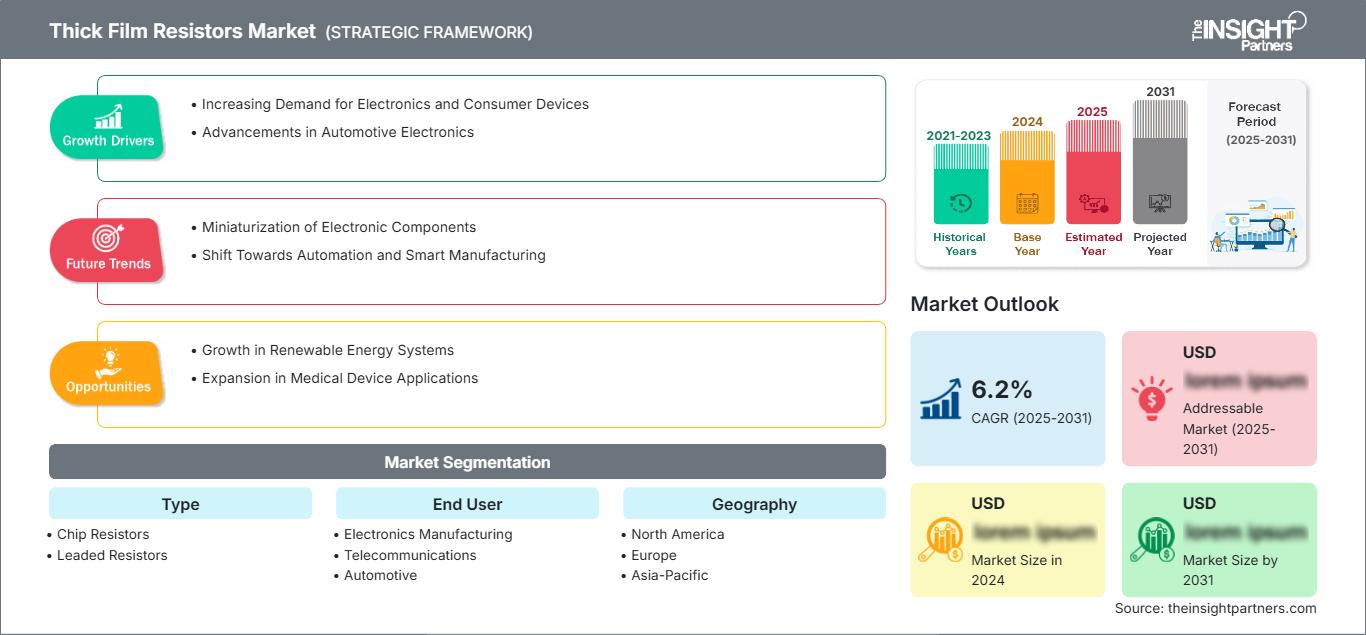
Thick Film Resistors Market: Strategic Insights
Regional Insights
North America Thick Film Resistors Market
North America held a market share of 23–25% of the world's revenue in 2025, and the market size of Thick Film Resistors Market is driven by high-end electronics rather than production volumes. The region is projected to grow at a rate of 3.4–3.8% CAGR due to the increased demand for passive components having predictable performance through the temperature cycles in electric vehicle platforms, aerospace electronics, defense, diagnostics, and industry.
The drivers consist of re-shoring of semiconductors, enhanced supply chain qualification, and continuous investment in infrastructure such as batteries, charging stations, and communication systems. End customers in the USA and Canada are looking to partner with companies able to provide technical data, tracking information, and products with long life spans.
U.S. Thick Film Resistors Market
The United States accounted for 78-82% of North American demand in 2025 and will see a CAGR growth rate of 3.5-3.9%. The automotive industry’s need for electric cars, grid infrastructure hardware, satellites, medical equipment, and 5G technology represent some of the primary applications. Resistor designs can be influenced by local design facilities despite dispersed final assembly operations in Mexico, Asia, and elsewhere.
Vishay Intertechnology, Inc., Bourns, Inc., TE Connectivity Ltd., and KOA Speer Electronics, Inc. have substantial customer access through US-based sales, engineering, or distribution functions. Application trends include wide terminal resistors for heat sinking, high pulse resistors for pre-charge circuitry, and miniaturized chip resistors for dense telecommunications and medical boards with automated assembly capability.
Europe Thick Film Resistors Market
Europe accounted for 19–21% market share in 2025 and is expected to experience growth with a 3.1–3.5% CAGR. Germany is the top player in the market owing to automotive electronics, industrial drives, automation, and power converters. Engineering requirements in the region value components that have good documentation, environmental compatibility, and sustainability.
UK is one of the contributors in terms of demand coming from aerospace, defense, medical devices, and instrumentation where reliability is valued more than cost savings. France is one of the regions providing demand from aerospace, rail transport, energy systems, and defense electronics. Italy and Spain contribute to the market by virtue of industrial automation, automotive, renewables integration, and appliance electronics.
APAC Thick Film Resistors Market
In 2025, APAC held a market share of 43% to 46%, and is predicted to witness 4.2% to 4.8% CAGR to emerge as the dominant region. China dominates due to its electronics manufacturing volumes, electric vehicles production, telecom devices, and industrial automation systems. Japan and South Korea contribute to demand for advanced automotive components, semiconductors, and electronics.
India, Australia, Taiwan, and the Southeast Asian countries drive growth opportunities through electronics assembly initiatives, data infrastructures, and energy projects. Manufacturing localization and supply chain diversification policy is favoring new design-ins. Regional manufacturers gain from being close to printed circuit board assembly and consumer electronics facilities.
Middle East & Africa Thick Film Resistors Market
The Middle East and Africa region is forecasted to grow at a CAGR of 3.0%-3.6%, with Saudi Arabia driving regional demand in energy infrastructure, smart cities, industrial automation, and defense electronics. The UAE drives demand through data centers, aviation, and communications infrastructure, while South Africa drives demand for industrial and medical equipment.
Rest of MEA regional demand will be project-based and dependent on imports, but infrastructure modernization provides recurring replacement/upgrades. Energy transition initiatives, grid monitoring, oil and gas electronics, and telecommunication expansion initiatives will require strong passive component support. Growth is moderate due to lack of local manufacturing compared with APAC, Europe, and North America.
Segmentation Analysis
Type
Type is forecast to grow at a 3.6–4.1% CAGR during 2026–2034 as buyers select formats based on board density, assembly method, thermal dissipation, and repair requirements. The Thick Film Resistors Market scope across type remains centered on chip formats for automated assembly, while leaded designs retain importance in selected power, legacy, and ruggedized applications.
- Chip Resistors dominate high-volume demand because surface-mount compatibility enables compact boards, automated placement, and consistent electrical performance across consumer, telecom, automotive, medical, and industrial electronics.
- Leaded Resistors remain strategically relevant where through-hole mounting, mechanical robustness, heat spacing, or field serviceability is preferred in power supplies, industrial equipment, aerospace systems, and legacy designs.
End User
End User demand is projected to grow at a 3.7–4.3% CAGR during 2026–2034 as electronics content rises across mobility, communications, healthcare, industrial, and aerospace systems. Procurement decisions are increasingly shaped by reliability certifications, lifecycle support, and compatibility with automated PCB assembly, making qualified Thick Film Resistors essential for both high-volume and regulated applications.
- Electronics Manufacturing remains the broadest demand base, absorbing chip resistors for consumer devices, computing hardware, appliances, industrial controllers, and contract manufacturing programs requiring scale, low cost, and stable supply.
- Telecommunications uses compact resistors in routers, base stations, optical equipment, and RF-adjacent boards where miniaturization, thermal stability, and high placement volumes support network densification.
- Automotive is the fastest-growing end user as EVs, ADAS, lighting, infotainment, and battery systems require qualified resistors capable of operating under vibration, heat, and voltage stress.
- Healthcare demand is supported by patient monitoring, diagnostics, imaging, wearable medical devices, and laboratory equipment where consistent signal conditioning and component reliability are critical to device performance.
- Aerospace & Defense relies on high-reliability resistors for avionics, radar, communication systems, satellites, and mission electronics that require traceability, durability, and stable operation in harsh environments.
Opportunity Snapshot
| End User | Revenue Contribution | Trend Tag | Adoption Stage |
| Electronics Manufacturing | High | Mini Boards | Mature |
| Telecommunications | Medium | 5G Hardware | Scaling |
| Automotive | High | EV Control | Scaling |
| Healthcare | Medium | Wearable Care | Scaling |
| Aerospace & Defense | Medium | Rugged Systems | Mature |
| Others | Low | Industrial Retrofit | Emerging |
Thick Film Resistors Market Growth Drivers and Impact Analysis
Rising Electronics Content in Electric and Connected Vehicles
The automotive platforms feature an increasing number of sensors, power converters, light-emitting devices, batteries and management units, and infotainment systems resulting in ongoing demand for suitable thick film resistors, heaters, and components. In general, electric vehicles use more passive components than cars with internal combustion engines since voltage measurement, temperature control, and power conversion grow more difficult. Continuous publication by IEA about growing sales of electric vehicles serves as confirmation of the need for the products in question. The effect on the market is straightforward: companies offering AEC-Q200 products, sulfur-tolerant components, and regional applications receive long-lasting design wins.
Miniaturization and High-Volume Surface-Mount Manufacturing
Designers are shrinking circuits while adding function, creating a need for miniaturized, reliable, and producible passive components. Thick-film printed components offer potential for small form factors, automation and scale in placement, and scalable firing processes. This influence can be seen in supply roadmaps for smaller chip sizes, better process control, and terminations. Companies that are able to consistently produce components with reliable electrical properties in large quantities have an advantage when it comes to purchasing due to the requirements of manufacturers.
Energy Efficiency and Smart Infrastructure Expansion
Metering and grid automation, integration of renewable energy and transportation systems is being done by utilities, cities and industrial entities which increases the requirement for robust electronic controls. Thick film heater, resistor and PV component helps in measuring and providing resistance to harsh conditions and also performing accurately when installed outside or high duty cycle applications. The regulation on energy efficiency and infrastructure digitization results into increased procurement activity for components that provide stability and performance over time. The impact in the market occurs in areas where suppliers offer technical documentation, availability and distribution.
Thick Film Resistors Market Future Trends
Shift Toward High-Power and Wide-Terminal Architectures
Thick Film Resistors Market trends point toward wider terminals, improved heat paths, and higher pulse handling as power density rises in EV electronics, industrial drives, and compact power supplies. Future designs will likely integrate better thermal dissipation without increasing board area, helping engineers manage reliability in constrained layouts. Suppliers are expected to compete on documented endurance under cycling, humidity, and surge events rather than only resistance range. This trend supports premiumization because design teams can reduce component count, simplify layouts, and improve system robustness by adopting resistor families engineered for demanding thermal and electrical profiles.
Regionalized Supply Chains and Design-In Localization
Procurement teams are moving from purely cost-optimized sourcing toward regional resilience, second-source approval, and closer technical support. Over the next decade, this will encourage more local warehousing, application engineering, and qualification support in North America, Europe, India, and Southeast Asia. Thick Film Resistors Market suppliers with flexible distribution and multi-site production will have an advantage when customers seek continuity after recent component shortages. The shift also encourages earlier collaboration between resistor vendors, PCB designers, and contract manufacturers, reducing redesign risk and shortening qualification timelines for automotive, telecom, and regulated industrial programs.
Thick Film Resistors Market Opportunities
Automotive Platform Qualification Programs
Automotive electronics offer a high-value route for suppliers willing to invest in qualification, lifecycle management, and engineering support. Thick Film Resistors Market Forecasts indicate that demand will be strongest where EV power electronics, charging, ADAS, lighting, and infotainment converge on compact, thermally resilient components. Vendors can capture opportunity by expanding AEC-Q200 portfolios, publishing application notes, and supporting early-stage validation with Tier 1 suppliers. The commercial payoff is sticky platform demand because approved components can remain in production for several model years, improving revenue visibility and reducing price-only competition.
Localized Electronics Manufacturing Partnerships
Electronics manufacturing expansion in India, Mexico, Vietnam, and Eastern Europe creates an opening for resistor suppliers to build closer links with contract manufacturers and OEM design centers. Opportunity lies in offering regional stock, technical substitution support, and standardized part libraries that simplify procurement during new product introduction. Thick Film Resistors market vendors can also support manufacturers shifting from consumer electronics into automotive, medical, or industrial programs by providing documentation, compliance files, and reliability data. This approach converts supply chain diversification into design-in wins rather than one-time spot sales.
Recent Developments
- October 2025: Vishay Intertechnology, Inc. — introduced the Vishay Sfernice LTA 50, an AEC-Q200 qualified 50 W thick film power resistor in a compact TO-220 package for heatsink mounting. The device targets EV, HEV, and PHEV precharge, discharge, battery management, onboard charger, and motor control applications, with high temperature operation to +175 °C.
- September 2025: Bourns, Inc. — launched the CWM-Q Series automotive-grade, AEC-Q200 compliant wide-terminal thick film resistors for high power density applications. The series offers 0612 and 1225 package sizes, ratings up to 2 W, resistance values from 1 ohm to 1 megaohm, and operation from -55 °C to +155 °C.
- April 2025: Vishay Intertechnology, Inc. — extended its LTO series with the AEC-Q200 qualified Vishay Sfernice LTO 150H thick film power resistor, offering 150 W dissipation, 75 J/0.1 s pulse absorption, and a clip-mount TO-247 package. The device addresses EVs, HEVs, fuel cells, industrial motor drives, networking equipment, and defense electronics.
Frequently Asked Questions

- Comprehensive Market Sizing and Forecast Analysis
- Detailed Segmentation Analysis
- In-Depth Market Dynamics Assessment
- Regional and Country-Level Insights
- Competitive Landscape and Company Benchmarking
- Strategic Business Intelligence
Recent Reports
Testimonials

The Insight Partners' SCADA System Market report is comprehensive, with valuable insights on current trends and future forecasts. The team was highly professional, responsive, and supportive throughout. We are very satisfied and highly recommend their services.
RAN KEDEM Partner, Reali Technologies LTDs
I requested a report on a very specific software market and the team produced the report in a few days. The information was very relevant and well presented. I then requested some changes and additions to the report. The team was again very responsive and I got the final report in less than a week.
JEAN-HERVE JENN Chairman, Future Analytica
We worked with The Insight Partners for an important market study and forecast. They gave us clear insights into opportunities and risks, which helped shape our plans. Their research was easy to use and based on solid data. It helped us make smart, confident decisions. We highly recommend them.
PIYUSH NAGPAL Sr. Vice President, High Beam Global
The Insight Partners delivered insightful, well-structured market research with strong domain expertise. Their team was professional and responsive throughout. The user-friendly website made accessing industry reports seamless. We highly recommend them for reliable, high-quality research services
YUKIHIKO ADACHI CEO, Deep Blue, LLC.
This is the first time I have purchased a market report from The Insight Partners.While I was unsure at first, I visited their web site and felt more comfortable to take the risk and purchase a market report.I am completely satisfied with the quality of the report and customer service. I had several questions and comments with the initial report, but after a couple of dialogs over email with their analyst I believe I have a report that I can use as input to our strategic planning process.Thank you so much for taking the extra time and making this a positive experience.I will definitely recommend your service to others and you will be my first call when we need further market data.
JOHN SUZUKI President and Chief Executive Officer, Board Director, BK Technologies
I wish to appreciate your support and the professionalism you displayed in the course of attending to my request for information regarding to infectious disease IVD market in Nigeria. I appreciate your patience, your guidance, and the fact that you were willing to offer a discount, which eventually made it possible for us to close a deal. I look forward to engaging The Insight Partners in the future, all thanks to the impression you have created in me as a result of this first encounter.
DR CHIJIOKE ONYIA MANAGING DIRECTOR, PineCrest Healthcare Ltd.Reason to Buy
- Informed Decision-Making
- Understanding Market Dynamics
- Competitive Analysis
- Identifying Emerging Markets
- Customer Insights
- Market Forecasts
- Risk Mitigation
- Boosting Operational Efficiency
- Strategic Planning
- Investment Justification
- Tracking Industry Innovations
- Aligning with Regulatory Trends





 Get Free Sample for