
Blood Drawing Chairs Market Growth, Trends & Demand by 2034
Coverage: By Type (Adjustable Chairs, Non-adjustable Standard Chairs); End User (Hospitals, Clinics Diagnostics Centers, Blood Banks, Others) , and Geography (North America, Europe, Asia Pacific, and South and Central America)
- Status : Data Released
- Report Code : TIPRE00028904
- Category : Life Sciences
- No. of Pages : 150
- Available Report Formats :


- Last update date : August 19, 2026


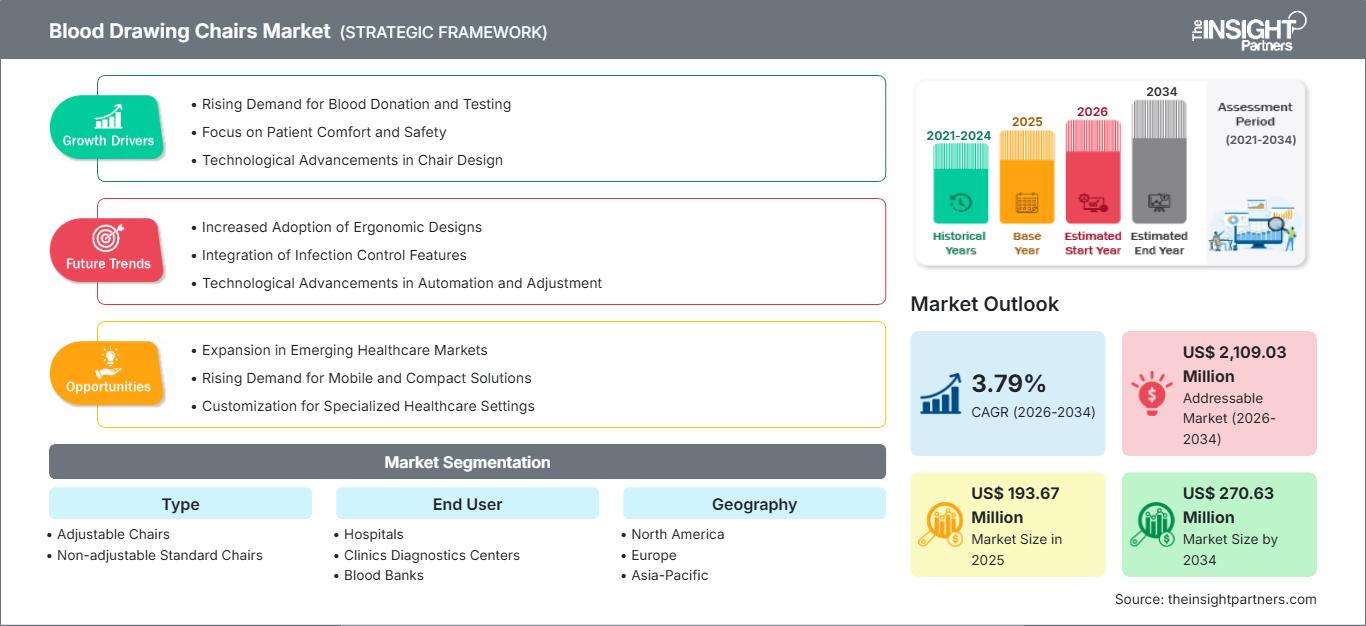
2025 Market Size
US$ 193.67 Mn
Base year value
2034 Forecast
US$ 270.63 Mn
Projected by 2034
CAGR 2026-2034
3.79 %
Growth rate
Addressable Market
US$ 2,109.03 Mn
(2026-2034)
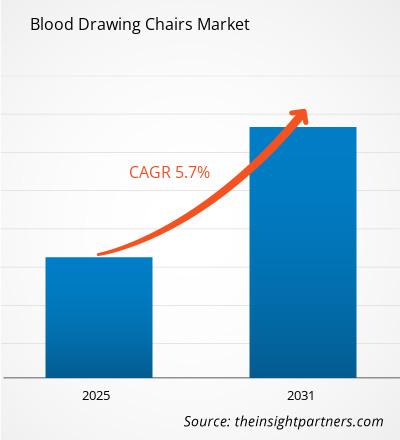
The Blood Drawing Chairs Market size is valued at US$ 193.67 Million in 2025 and will grow to US$ 270.63 Million by 2034, growing at a CAGR of 3.79% between 2026–2034. This market represents special purpose chairs intended for phlebotomy and drawing of blood from patients and includes seats required for patient safety, ergonomics, work efficiency, accessibility and updating old clinical chairs.
In North America, Blood Drawing Chairs Market is forecast to witness growth with an estimated CAGR of 3.9-4.2% between 2026-2034. Growth is driven by modernization of outpatient facilities and increasing concerns about accessiblity of medical equipment. Increased importance of proper patient positioning, caregiver ergonomics, infection control surfaces and work flow of phlebotomy have become more important.
Blood Drawing Chairs Market Assessment and Insights
- North America: North America is expected to command a 34–38% Blood Drawing Chairs Market share in 2025 and grow at a CAGR of 3.9–4.2% between 2026–2034, supported by replacement demand, outpatient expansion, accessibility considerations, and established blood collection infrastructure.
- US: The US is estimated to represent 72–76% of North America's 2025 share, growing at a CAGR of 3.9–4.2% between 2026–2034 as hospitals and laboratories prioritize ergonomic, accessible collection environments.
- Europe: Europe is projected to hold a 26–30% share in 2025 and expand at a CAGR of 3.5–3.9% during 2026–2034, led by Germany, the UK, France, Italy, and Spain, where healthcare modernization supports equipment replacement.
- Asia Pacific: Asia Pacific is estimated at a 20–24% share in 2025 and is expected to grow at a CAGR of 4.3–4.8% between 2026–2034, led by China, Japan, India, South Korea, and Australia through expanding diagnostic capacity.
- Largest Segment: Adjustable Chairs are expected to hold a 62–66% market share in 2025 and grow at a CAGR of 4.1–4.5% during 2026–2034, reflecting ergonomic and positioning advantages.
- High Growth Segment: Blood Banks are projected to represent 18–22% of end-user demand in 2025 and grow at a CAGR of 4.5–4.9% during 2026–2034, supported by collection-center modernization.
- Key companies analyzed in detail: Medline Industries, LP, Clinton Industries, Inc., MarketLab, Inc., The Brewer Company, Cardinal Health, Inc., Midmark Corporation, Mercy Medical Equipment Company, Med Care Mfg., Tech-Med Services, and Winco Mfg., LLC.
Source: The Insight Partners' analysis based on proprietary research, government publications, company annual reports, investor presentations, industry databases, and expert interviews.
Blood Drawing Chairs Market forecast indicates that development in recent times is increasingly becoming about progression from simple fixed seat height designs to adjustable and ergonomic patient-friendly designs. Makers of such devices have distinguished themselves with the inclusion of features such as movable arm rests, easy-to-clean covers, sturdier frames, wide seating space, and other accessories that assist phlebotomy positions. Production of medical furniture is still mostly localized, with distribution channels and procurement systems of hospitals increasing availability.
According to Blood Drawing Chairs Market report, future growth will see the industry reward those manufacturers who can incorporate durability with access and quick procurement. Growing healthcare infrastructures in Asia Pacific and selected Middle Eastern countries offer an additional replacement market as they develop diagnostic centers. Accessible medical diagnostic equipment is also becoming a regulatory issue affecting purchasing decisions. Future investment will be more directed towards seating which enables efficient transfer and which fits into standard blood collection room environments.
Blood Drawing Chairs Market Report Scope
| Report Attribute | Details |
|---|---|
| Market size in 2025 | US$ 193.67 Million |
| Market Size by 2034 | US$ 270.63 Million |
| Global CAGR (2026 - 2034) | 3.79% |
| Historical Data | 2021-2024 |
| Forecast period | 2026-2034 |
Blood Drawing Chairs Market Analysis
Market demand for Blood Drawing Chairs is contingent on the number and effectiveness of blood drawing points, frequency of replacement, and construction of new healthcare facilities. The industry players include chair makers, medical furniture distributors, hospitals, outpatient laboratories, blood banks, and purchasing organizations. Suppliers' competitive advantages include fast delivery, quality, customization, service, and compliance with facility specifications. The demand also depends on patient comfort and efficiency of procedures.
The value chain of the market is less technology-based than that of diagnostic equipment; however, the design engineering plays a vital role in performance. Adjustment and accessibility of armrests may help position patients better in case of venipuncture; moreover, use of easy-to-clean materials allows adhering to infection control policies. The supply factors include prices of steel, foam, upholstery, casters, and hardware. Chair makers capable of local production have an advantage.
Positioning is done among specialized medical furniture manufacturers, diversified healthcare distributors, and distribution-based companies. Medline Industries, LP offers wide range of healthcare distribution and multiple phlebotomy seating options, while Clinton Industries, Inc. focuses on specialized medical furniture and blood drawing equipment. MarketLab, Inc. offers competitive advantage through a wide range of clinical products, but Midmark Corporation offers comfort, adjustability of the armrests, and workflow considerations with the Ritter 281 chair.
Competitors in the Blood Drawing Chairs Market are Cardinal Health, Inc., The Brewer Company, Mercy Medical Equipment Company, Med Care Mfg., Tech-Med Services, and Winco Mfg., LLC. Competitive positioning is based on accessibility, durability, customization, and timely fulfillment of orders instead of just being able to offer seating. Analysis of the Blood Drawing Chairs Market suggests that gradual premiumization should be expected as the result of evaluation of TCO and patients' comfort along with pricing.
● REPORT CUSTOMIZATION
Tailor This Report To Align With Your Specific Business Requirements
This report can be customized to align precisely with your business objectives, scope, and target markets. Customization options include tailored segmentation, geography, competitive analysis, and strategic insights to support informed decision-making.
Customize This Report →WHAT YOU CAN ADJUST
- ● Segmentations
- ● Geography
- ● Competitive Analysis
- ● Language Preferences
Blood Drawing Chairs Market: Strategic Insights
Regional Insights
North America Blood Drawing Chairs Market
North America is estimated to account for 34–38% of the global demand in 2025, growing at a CAGR of 3.9–4.2% through 2034. The region profits from the availability of advanced laboratories, widespread outpatient clinics, routine equipment upgrades, and efficient institutional buying process. Hospitals and independent diagnostic centers tend to consider seating in terms of accessibility for patients, easy cleaning, ergonomics of caregivers, and space utilization. The US is the key driver.
Demand for the Canadian market is driven by hospital renovations, upgrades of laboratories, and procurement programs focused on sturdy medical furniture. Local suppliers enjoy the advantages of well-established supply chain infrastructure and product range. Accessibility issues become increasingly important as medical institutions consider examination and diagnostics equipment. As a result, adjustable chairs capable of accommodating various patient sizes and transfers without interfering with collection-room processes become a preference.
U.S. Blood Drawing Chairs Market Market
US will account for roughly 72–76% of the 2025 North American demand and is predicted to grow at a CAGR of 3.9–4.2%. Hospital groups, ambulatory laboratories, clinics, and blood banks make up the replacement base which is diverse. Procurement procedures and standards for products that are consistent with the multi-site hospitals have developed well in this nation.
Trends for application are focused on the ability to adjust arm position, transfer ease, long-lasting upholstery, and ease of cleaning. Companies that have been identified include Midmark Corporation, Medline Industries, LP, Clinton Industries, Inc., MarketLab, Inc., and Winco Mfg., LLC. Also, increased interest in accessible medical diagnostic equipment has made it easier for providers to consider height-adjustable seating during renovations and capital replacement.
Europe Blood Drawing Chairs Market
The Europe region accounts for a 26–30% market share in 2025 and is expected to have a 3.5–3.9% CAGR until 2034. Germany leads the market due to the presence of well-established hospitals and manufacturing facilities of medical equipment. The UK, France, Italy, and Spain also support demand through existing healthcare facilities and laboratories and through blood donation centers.
The UK and Germany represent significant replacement demand with procurement increasingly looking at features such as ergonomics and infection control surface along with accessibility. France, Italy, and Spain help demand through the renovation of hospitals, expansion in diagnostics in outpatient settings and modernization of blood collection centers. European buyers are usually concerned about the life cycle durability and maintenance along with initial purchase price.
APAC Blood Drawing Chairs Market
APAC is estimated to hold a 20–24% share in 2025 and grow at a CAGR of 4.3–4.8%. China is the leading market, followed by Japan, South Korea, India, and Australia. Expansion of hospitals, diagnostic laboratories, and blood collection infrastructure is broadening the installed base.
Industrialization, healthcare investment, and public blood-service programs support demand, while India and China offer particularly strong opportunities for new collection capacity. Australia and Japan provide replacement-led demand focused on quality and accessibility. Procurement is gradually shifting toward standardized, cleanable, adjustable seating as healthcare networks expand beyond major metropolitan facilities.
Middle East & Africa Blood Drawing Chairs Market Market
Demand from the Middle East and Africa region is forecast to grow with a CAGR of 3.8%–4.3% on the back of healthcare infrastructure development and modernization of diagnostics facilities. Saudi Arabia and the UAE are key adopters from the region, while South Africa serves as a major market in Africa. Demand from RoMEA continues to be driven by public healthcare sector developments.
Investment in energy sector and construction of hospitals in Gulf markets will continue to drive purchases of durable clinical furniture, whereas the African markets will be driven by cost considerations and availability of products. Blood bank and diagnostic centers represent good opportunities for replacement purchases as collection facilities become modernized.
Segmentation Analysis
Type
Type segmentation is projected to grow at a CAGR of 3.9–4.3% during 2026–2034. Adjustable Chairs remain the principal product category because they accommodate diverse patient requirements and support more efficient venipuncture positioning. Non-adjustable Standard Chairs continue to serve cost-sensitive facilities and lower-throughput applications, but replacement decisions increasingly favor flexibility, comfort, and ergonomic functionality. Blood Drawing Chairs Market scope is therefore gradually shifting toward configurable products.
- Adjustable Chairs: Adjustable chairs provide positioning flexibility through movable arms, variable height, reclining functions, or configurable supports. Their strategic importance is increasing as healthcare providers prioritize patient comfort, accessibility, caregiver ergonomics, and efficient blood collection workflows.
- Non-adjustable Standard Chairs: Standard chairs remain relevant where procurement budgets are constrained and collection procedures are relatively simple. Their straightforward construction, lower acquisition cost, and limited maintenance requirements sustain demand among smaller clinics and lower-volume facilities.
End User
End User segmentation is expected to advance at a CAGR of 3.7–4.1% between 2026–2034. Hospitals account for substantial purchasing activity because of their broad diagnostic and transfusion-related operations. Blood banks represent the faster-growing institutional category as dedicated collection infrastructure expands. Clinics Diagnostics Centers also contribute through decentralized testing, while smaller institutional users support replacement demand.
- Hospitals: Hospitals require durable seating across inpatient laboratories, outpatient departments, phlebotomy rooms, and transfusion services. High utilization makes cleanability, structural strength, patient positioning, and rapid replacement important procurement considerations.
- Clinics Diagnostics Centers: Clinics and diagnostic centers increasingly perform routine blood collection outside major hospitals. Compact designs, efficient room utilization, adjustable arm supports, and ease of cleaning are strategically important for high-throughput outpatient environments.
- Blood Banks: Blood banks depend on dedicated collection areas and repeated donor throughput. Seating must support stable positioning and donor comfort while allowing staff to perform venipuncture efficiently, making specialized adjustable configurations increasingly relevant.
- Others: Smaller institutional users include occupational health services, academic facilities, mobile collection operations, and specialized healthcare settings. Demand is generally project-based, with portability, storage efficiency, and uncomplicated maintenance influencing purchasing decisions.
Opportunity Snapshot
| Segment Name | Revenue Contribution | Trend Tag | Adoption Stage |
|---|---|---|---|
| Hospitals | High | High Utilization | Mature |
| Clinics Diagnostics Centers | Medium | Outpatient Phlebotomy | Scaling |
| Blood Banks | Medium | Donor Comfort | Scaling |
| Others | Low | Mobile Collection | Emerging |
Blood Drawing Chairs Market Growth Drivers and Impact Analysis
Expansion of Outpatient Diagnostic and Phlebotomy Networks
Growing availability of outpatient diagnostic services is causing an increase in the number of venues at which blood sampling occurs outside of hospitals' lab environments. The need for seating will be repeated, as smaller labs require equipment that is compact enough to fit into standard workflows without taking up too much room. In addition, growing consolidation among diagnostic networks will allow procurement departments to standardize chair specifications across several locations, streamlining the purchasing process and making maintenance simpler. This effect is most pronounced in the case of adjustable chairs, as these chairs serve more patient types and offer the same positioning of the arm for the staff members. Growth in the Blood Drawing Chairs Market will thus occur not only due to new venues being built but also due to replacement processes throughout the network.
Greater Emphasis on Patient Accessibility and Transfer Safety
Accessibility is becoming a more visible purchasing criterion for medical diagnostic equipment, including phlebotomy seating. Facilities are increasingly expected to consider how patients with mobility limitations can approach, enter, use, and leave diagnostic equipment. This gives a competitive edge for chairs that have movable arm rests, appropriate clearance for transfers, and proper positioning. This goes beyond compliance because it would lower the number of staff needed and increase the confidence of the patients in drawing blood. Companies who innovate on their arm rests and seating system designs by making them accessible could have a better chance of standing out from the competition in tender bids. Growth in the Blood Drawing Chairs market would follow suit as the current stock of furniture is renewed over several years.
Rising Demand for Durable, Easy-Clean Clinical Furniture
High-frequency blood collection exposes seating to repeated contact, cleaning agents, spills, and mechanical movement. Healthcare providers consequently place greater emphasis on upholstery durability, welded frames, stable arm mechanisms, and surfaces that can withstand routine disinfection. This requirement affects both product specifications and replacement economics because facilities increasingly evaluate expected service life rather than acquisition price alone. The resulting market impact favors suppliers with proven materials, robust construction, and readily available replacement components. Hospitals and blood banks with high daily utilization are particularly sensitive to downtime, making dependable products strategically valuable. Manufacturers can strengthen positioning by combining durable construction with ergonomic adjustments rather than treating comfort and longevity as separate features. This dynamic supports gradual migration from basic fixed seating toward higher-value institutional models.
Blood Drawing Chairs Market Future Trends
Patient-Centered Adjustable Seating Becoming Standard
Patient-centered design is expected to reshape purchasing specifications as healthcare providers place greater weight on comfort, accessibility, and consistent positioning. Future chairs are likely to combine adjustable arm supports, smoother positioning mechanisms, improved cushioning, and easier transfer paths within a single product architecture. Blood Drawing Chairs Market trends will increasingly reflect design convergence between traditional phlebotomy furniture and broader accessible diagnostic seating. Manufacturers may also offer modular options allowing healthcare networks to select configurations according to room size, patient population, and collection volume. This could reduce the number of completely different models required across a hospital network. Over time, procurement teams may evaluate seating using standardized criteria covering accessibility, cleaning performance, durability, and workflow efficiency. Such criteria would encourage suppliers to compete through measurable functional attributes rather than appearance or basic pricing alone.
Data-Informed Procurement and Lifecycle Management
Procurement is likely to become more data-informed as large healthcare systems centralize equipment inventories and monitor maintenance, utilization, and replacement schedules. Although chairs remain relatively simple medical furniture, standardized asset records can identify locations with excessive wear, recurring repairs, or mismatched configurations. Blood Drawing Chairs Market trends may consequently include greater use of lifecycle cost comparisons during capital planning. Suppliers could support this transition by offering standardized product documentation, replacement-part availability, configuration records, and service information. Digital procurement platforms may also make it easier for healthcare organizations to compare specifications across multiple facilities. The resulting market structure would favor manufacturers capable of supporting enterprise accounts rather than relying solely on individual product transactions. This approach can improve purchasing consistency while allowing healthcare networks to phase replacement programs according to operational priorities.
Blood Drawing Chairs Market Opportunities
Accessible Phlebotomy Furniture for New Healthcare Facilities
New hospitals, outpatient centers, and diagnostic facilities in developing healthcare markets offer an opportunity to specify accessible seating from the beginning rather than retrofit existing rooms. Blood Drawing Chairs Forecasts indicate that procurement tied to new construction can favor adjustable configurations when facility planners incorporate transfer requirements into room design. Manufacturers can target these projects through partnerships with architects, healthcare equipment planners, distributors, and laboratory contractors. The opportunity is especially relevant in Asia Pacific and Gulf markets where diagnostic infrastructure continues to expand. Product localization, multilingual documentation, regional service networks, and modular configurations can improve competitiveness. Suppliers should also emphasize total installation efficiency because new facilities often require coordinated delivery of multiple furniture categories. Early participation in facility planning can provide a stronger strategic position than competing only after equipment specifications have been finalized.
Premium Replacement Programs Across Multi-Site Providers
Large healthcare networks represent an attractive opportunity because replacement programs can span multiple hospitals, laboratories, and collection centers. Blood Drawing Chairs Market opportunities are strongest where procurement teams seek consistent specifications while allowing selected configurations for different patient populations. Suppliers can develop tiered portfolios covering standard, adjustable, and accessibility-oriented models without forcing customers to manage unrelated brands. Service agreements, spare-part availability, upholstery options, and predictable delivery schedules can further strengthen enterprise relationships. Replacement programs also create opportunities to bundle seating with phlebotomy carts, storage solutions, and other clinical furniture. A supplier that demonstrates measurable reductions in downtime or replacement frequency can compete on lifecycle economics rather than unit price. This strategy is particularly relevant in mature markets where new facility construction is slower than ongoing refurbishment.
Recent Developments
- March 2026: Cardinal Health, Inc. highlighted continued supply-chain resilience initiatives and healthcare distribution capabilities, reinforcing the importance of reliable medical-product availability for healthcare providers. The company's Global Medical Products and Distribution business remains focused on supporting provider operations through supply continuity and operational resilience.
- December 2025: Medline Industries, LP reported a transformative year that included its initial public offering and several supply-chain initiatives. The company also highlighted Mpower, a planned cloud-based AI digital control tower intended to improve product substitutions, approvals, and communications, indicating broader investment in healthcare supply-chain visibility.
- May 2025: Midmark Corporation launched the Midmark 631 Procedure Chair, designed around patient accessibility and the updated medical diagnostic equipment environment. The company stated that the chair incorporates a low entry height, transfer-oriented design, and compatibility with patient lifts, reinforcing the industry's shift toward accessible clinical furniture.
Frequently Asked Questions

- Comprehensive Market Sizing and Forecast Analysis
- Detailed Segmentation Analysis
- In-Depth Market Dynamics Assessment
- Regional and Country-Level Insights
- Competitive Landscape and Company Benchmarking
- Strategic Business Intelligence
Recent Reports
Testimonials

The Insight Partners' SCADA System Market report is comprehensive, with valuable insights on current trends and future forecasts. The team was highly professional, responsive, and supportive throughout. We are very satisfied and highly recommend their services.
RAN KEDEM Partner, Reali Technologies LTDs
I requested a report on a very specific software market and the team produced the report in a few days. The information was very relevant and well presented. I then requested some changes and additions to the report. The team was again very responsive and I got the final report in less than a week.
JEAN-HERVE JENN Chairman, Future Analytica
We worked with The Insight Partners for an important market study and forecast. They gave us clear insights into opportunities and risks, which helped shape our plans. Their research was easy to use and based on solid data. It helped us make smart, confident decisions. We highly recommend them.
PIYUSH NAGPAL Sr. Vice President, High Beam Global
The Insight Partners delivered insightful, well-structured market research with strong domain expertise. Their team was professional and responsive throughout. The user-friendly website made accessing industry reports seamless. We highly recommend them for reliable, high-quality research services
YUKIHIKO ADACHI CEO, Deep Blue, LLC.
This is the first time I have purchased a market report from The Insight Partners.While I was unsure at first, I visited their web site and felt more comfortable to take the risk and purchase a market report.I am completely satisfied with the quality of the report and customer service. I had several questions and comments with the initial report, but after a couple of dialogs over email with their analyst I believe I have a report that I can use as input to our strategic planning process.Thank you so much for taking the extra time and making this a positive experience.I will definitely recommend your service to others and you will be my first call when we need further market data.
JOHN SUZUKI President and Chief Executive Officer, Board Director, BK Technologies
I wish to appreciate your support and the professionalism you displayed in the course of attending to my request for information regarding to infectious disease IVD market in Nigeria. I appreciate your patience, your guidance, and the fact that you were willing to offer a discount, which eventually made it possible for us to close a deal. I look forward to engaging The Insight Partners in the future, all thanks to the impression you have created in me as a result of this first encounter.
DR CHIJIOKE ONYIA MANAGING DIRECTOR, PineCrest Healthcare Ltd.Reason to Buy
- Informed Decision-Making
- Understanding Market Dynamics
- Competitive Analysis
- Identifying Emerging Markets
- Customer Insights
- Market Forecasts
- Risk Mitigation
- Boosting Operational Efficiency
- Strategic Planning
- Investment Justification
- Tracking Industry Innovations
- Aligning with Regulatory Trends





 Get Free Sample for