
Dental Consumables Market Growth, Trends & Forecast by 2034
Coverage: By Product [Dental Restoration Products (Dental Implants, Dental Prosthetics, CAD/CAM Restoration Consumables, and Dental Restoration Materials), Orthodontics (Clear Aligners/Removable Braces, Fixed Braces, and Others), Periodontics (Dental Anesthetics, Dental Hemostats, and Dental Sutures), Infection Control (Sanitizing Gel, Personal Protective Wear, and Disinfectants), Endodontics (Shaping & Cleaning Consumables, Access Preparation Consumables, and Obturation Consumables), Whitening Products (In-Office Whitening Products and Take-Home Whitening Products), Finishing & Polishing Products (Prophylaxis Products and Fluorides), and Others] and End User (Dental Hospitals & Clinics, Dental Laboratories, and Others)
- Status : Data Released
- Report Code : TIPRE00003492
- Category : Life Sciences
- No. of Pages : 150
- Available Report Formats :


- Last update date : August 24, 2026


2025 Market Size
US$ 38.96 Bn
Base year value
2034 Forecast
US$ 75.52 Bn
Projected by 2034
CAGR 2026-2034
7.63 %
Growth rate
Addressable Market
US$ 515.62 Bn
(2026-2034)
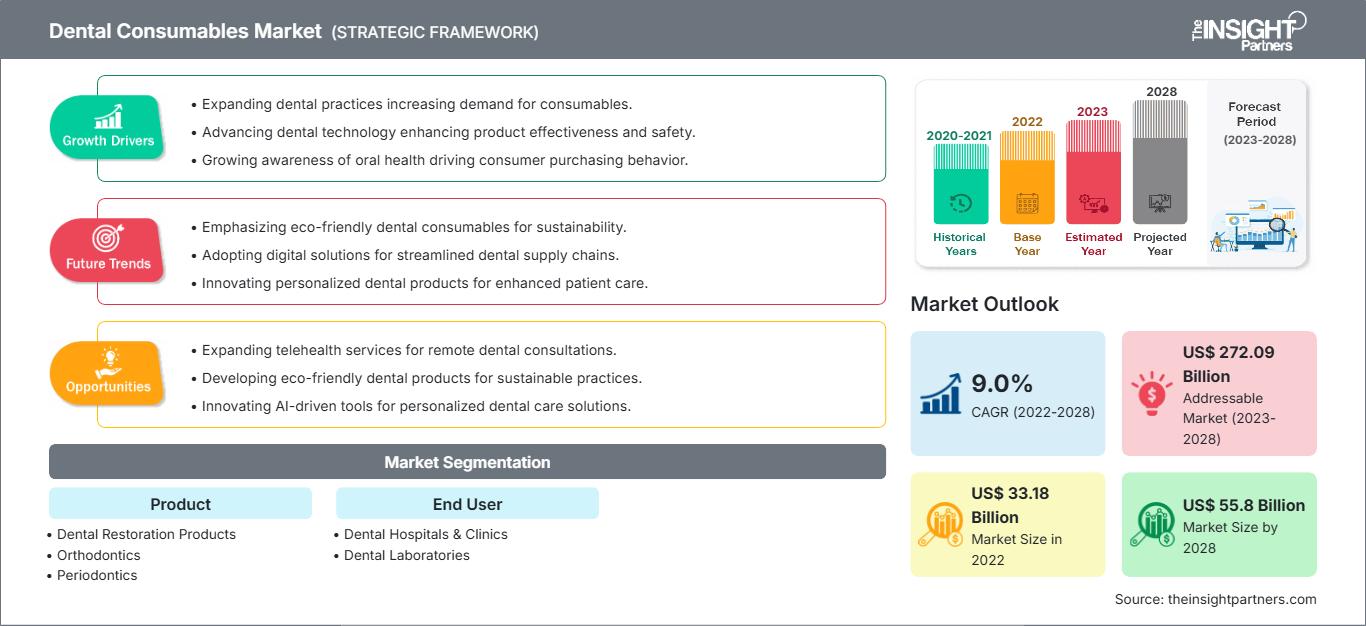
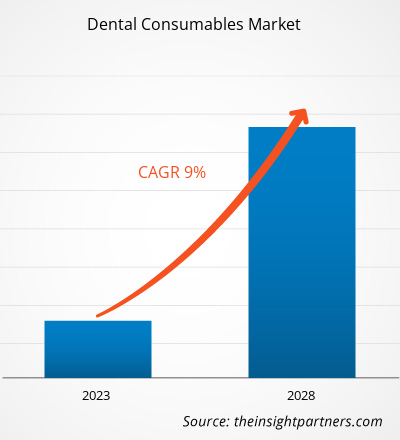
The Dental Consumables Market is valued at US$ 38.96 Billion in 2025 and is projected to reach US$ 75.52 Billion by 2034, expanding at a CAGR of 7.63% from 2026 to 2034. It includes materials and products that are required in restorative, orthodontics, periodontics, infection control, endodontics, bleaching, and finishing treatments where market demand is determined by treatment frequency, innovations, demographics, and investments in dental infrastructures.
North America continues to be strategically significant as a source of demand on the strength of established dental networks, high treatment prevalence, and considerable dental spending by private sources. Dental Consumables Market size in North America is projected to grow at an estimated 5.8% to 6.5% CAGR from 2026 to 2034. National dental spending in the United States rose to US$189 billion in 2024.
Dental Consumables Market Assessment and Insights
- North America: North America is expected to retain the largest regional position, with a 2025 share of 37–40% and a CAGR of 6.0–6.6% between 2026 and 2034, supported by advanced dental infrastructure, recurring procedural consumption, and established reimbursement channels.
- US: The U.S. represents approximately 88–91% of North America's 2025 market, with a 6.0–6.6% CAGR between 2026 and 2034, underpinned by high dental expenditure and extensive practice networks.
- Europe: Europe is estimated at 27–30% share in 2025 and a 6.3–7.0% CAGR between 2026 and 2034. Germany, the UK, France, Italy, and Spain provide broad demand through public-private dental systems, laboratory activity, and technology adoption.
- Asia Pacific: Asia Pacific accounts for 21–24% share in 2025 and is expected to grow at 8.0–9.0% CAGR between 2026 and 2034. China, Japan, India, South Korea, and Australia combine expanding access with increasing restorative and orthodontic utilization.
- Largest Segment: Dental Restoration Products hold an estimated 40–43% market share in 2025, with a 7.2–7.6% CAGR between 2026 and 2034, reflecting their broad procedural application and recurring material requirements.
- High Growth Segment: Orthodontics represents approximately 18–21% market share in 2025 and is projected to expand at 9.0–9.5% CAGR between 2026 and 2034, driven by clear-aligner adoption and aesthetic treatment demand.
- Key companies analyzed in detail: ENVISTA HOLDINGS CORPORATION, 3M Company, Institut Straumann AG, Vannini Dental Industry S.p.A., PLANMECA OY, DENTSPLY SIRONA Inc., Henry Schein, Inc., Kerr Corporation, Align Technology, Inc., Koninklijke Philips N.V., KURARAY CO., LTD., Brasseler USA Dental, LLC, EdgeEndo, LLC, FKG Dentaire SA, and Ivoclar Vivadent AG.
Source: The Insight Partners' analysis based on proprietary research, government publications, company annual reports, investor presentations, industry databases, and expert interviews.
Clinical workflows are becoming increasingly digitized, using technologies like CAD/CAM-based restoration, digital planning, advanced biomaterials, and standardized protocols on the chairside. The development of consumables in turn is becoming focused on materials designed for ease-of-use, aesthetics, durability, and compatibility with digital workflows. Simultaneously, producers are trying to reconcile the issues of regional production, compliance with regulatory standards, robustness of their inventory, and distributor relationships in order to ensure reliable availability in fragmented dentistry practices.
In terms of the forecasted period, investments in the industry will probably be directed towards digitally-integrated restorative workflows, advanced orthodontic materials, minimal-invasive solutions, and products that will reduce chairside time. The emerging markets of Asia will attract investments in capacities and distribution channels, while the mature markets of developed countries will seek efficiency and product differentiation.
Dental Consumables Market Report Scope
| Report Attribute | Details |
|---|---|
| Market size in 2025 | US$ 38.96 Billion |
| Market Size by 2034 | US$ 75.52 Billion |
| Global CAGR (2026 - 2034) | 7.63% |
| Historical Data | 2021-2024 |
| Forecast period | 2026-2034 |
Dental Consumables Market Analysis
Dental Consumables Market growth in Dental Consumables is largely determined by procedure volume, cycles of replacement, prevalence of oral diseases, and greater access to dental services. According to WHO statistics, approximately 3.7 billion individuals suffer from oral diseases, with untreated caries being the most prevalent health problem on the planet. In other words, the market has an ample base of demand for restorative, preventative, periodontal, and endodontic materials.
The supply chain includes specialist chemical and biomaterial companies, dental manufacturing companies, laboratories, distributors, clinics, hospitals, and end-users who are dentists or patients. It is important to stress that the demand in this case is repetitive because many consumable materials are used during every single procedure. The supply strategy is determined by regulation, formulation, batch identification, and availability of distributors.
Positioning becomes more and more dependent on such factors as product range, proof-of-efficacy data, manufacturing capacity, distribution channel access, and integration into digital dentistry. According to the Dental Consumables Market Report, diversified companies can retain market share via bundled workflows, whereas specialists do it with the help of differentiated biomaterials, orthodontic systems, high-precision instruments, and procedures' individual solutions.
DENTSPLY SIRONA Inc., Straumann, Henry Schein, Align Technology, 3M, ENVISTA, Ivoclar Vivadent, KURARAY CO., LTD., and FKG Dentaire have distribution channels coupled with ongoing product innovation. There is a trend of investment directed to localization of manufacturing and digitization. For instance, the localization of manufacturing processes in China has been emphasized by Straumann.
● REPORT CUSTOMIZATION
Tailor This Report To Align With Your Specific Business Requirements
This report can be customized to align precisely with your business objectives, scope, and target markets. Customization options include tailored segmentation, geography, competitive analysis, and strategic insights to support informed decision-making.
Customize This Report →WHAT YOU CAN ADJUST
- ● Segmentations
- ● Geography
- ● Competitive Analysis
- ● Language Preferences
Dental Consumables Market: Strategic Insights
Regional Insights
North America Dental Consumables Market
North America is forecasted to represent 37–40% of total Dental Consumables Market Share in 2025 and to grow at a CAGR of 6.0–6.6% up to 2034. It enjoys developed dental infrastructure, well-established specialist network, laboratory facilities, and considerable private spending. U.S. dental expenses are $189 billion in 2024, up by 3.6% adjusted for inflation, and are driven by private insurance and self-pays.
The market supply landscape favors companies with sound distribution and regulatory practices. Canada provides stable demand, whereas the U.S. generates 88–91% of regional sales. Practice consolidation and increased involvement of DSOs create an opportunity for improved centralized procurement practices, thus raising the significance of contract pricing, inventory management, and portfolio standardization. According to ADA data, economic challenges faced by practices are growing, which motivates buyers to look into productivity of consumables and costs per procedure.
U.S. Dental Consumables Market
U.S. contributes 88-91% of the North American demand in 2025 and will have a 6.0-6.6% CAGR from 2025 to 2034. Its position is a consequence of high levels of dental spending, significant network of private practices, specialists, and distribution in place. Restorative materials, infection control products, orthodontic equipment, and endodontic supplies continue to be essential parts of regular purchases by practices and labs.
Usage patterns become more and more aligned with digital treatment planning and increasing demand for efficiency. Usage patterns of clear aligners, CAD/CAM compatible restorations and advanced materials gain importance next to the traditional consumable usage. According to the ADA data, the role of the larger practice model and DSOs is growing while dentist economics of 2025 demonstrates expenses increasing faster than reimbursements, which creates interest in minimizing wastage.
Europe Dental Consumables Market
Europe has an estimate of 27% to 30% share in 2025 and will grow at a CAGR of 6.3% to 7.0% up to 2034. Germany leads in regional demand followed by the UK, France, Italy, and Spain. Advanced clinical protocols, laboratory networks, public/private delivery services, and esthetic treatment demands drive the recurrent consumption in restorative and orthodontic segments.
The UK has a diverse private and public dental environment which fuels the demand for restorative and preventive products. The combination of a large laboratory presence and manufacturing capacity with advanced restorative treatments defines the German segment. Established clinics, dental tourism, cosmetic dentistry, and digitized workflow practices characterize France, Italy, and Spain.
APAC Dental Consumables Market
APAC is expected to command a market share of 21% - 24% in 2025 and is anticipated to exhibit a CAGR of 8% - 9% during the period up to 2034. China represents the dominant market, followed by Japan, India, South Korea, and Australia. Increased availability of dental services, urbanization, heightened awareness, and adoption of private care drive demand in restorative and orthodontics.
The procedures in China have become more economical due to change in procurement policies while India benefits from its large population as well as growing dental care services. In Japan and South Korea, clinical technologies prevail while professional standards prevail in Australia. In the year 2025, Straumann has been performing well in APAC region.
Middle East & Africa Dental Consumables Market
Middle East & Africa is a smaller, but growing regional market, driven by investment in dental infrastructure, healthcare privatization, and specialist centers. Saudi Arabia and UAE are examples of major Gulf markets, whereas South Africa is the largest established clinical and laboratory market in the region. The regional compound annual growth rate (CAGR) is forecasted to be 7.0–7.8% up to 2034.
There are developments in the area of health care infrastructure and specialist staff in Saudi Arabia and UAE, thereby creating chances for the introduction of high-end restoration, orthodontic and infection control products. South Africa has private dental practices and laboratory requirements, while MEA region excepting South Africa is more distributor-focused. Oil money and investment in infrastructure in the Gulf nations could help in making healthcare investments.
Segmentation Analysis
Product
The Product segment is projected to expand at a 7.5–7.8% CAGR between 2026 and 2034. Its performance is supported by recurring procedural use, increased preference for esthetic outcomes, advances in restorative materials, and broader adoption of orthodontic and endodontic technologies. Portfolio breadth remains important because clinics seek fewer suppliers capable of meeting multiple clinical requirements.
- Dental Restoration Products: Restoration products maintain the largest position because fillings, crowns, bridges, implants, and related materials address high-frequency treatment needs. Their strategic importance increases as clinicians favor durable, esthetic, and digitally compatible solutions.
- Orthodontics: Orthodontic consumables benefit from clear-aligner adoption, aesthetic preferences, and broader adult treatment. Suppliers increasingly differentiate through material properties, workflow integration, treatment planning compatibility, and clinician support.
- Periodontics: Periodontal products support recurring treatment for gum disease and maintenance procedures. Demand remains tied to preventive care, aging populations, and greater recognition of periodontal health as part of broader health management.
- Infection Control: Infection-control consumables remain essential to clinical compliance and workflow safety. Purchasing is influenced by sterilization protocols, single-use preferences, product reliability, regulatory requirements, and the need to minimize cross-contamination risk.
- Endodontics: Endodontic products serve root-canal procedures where precision, handling, and predictable clinical performance are critical. Continued refinement of instruments, sealers, obturation materials, and related consumables supports specialized demand.
- Whitening Products: Whitening products address cosmetic dentistry and consumer interest in esthetic treatment. Demand varies by disposable income and practice mix, with professional systems benefiting from clinician oversight and controlled treatment protocols.
- Finishing & Polishing Products: Finishing and polishing products are recurring chairside requirements across restorative procedures. Their strategic value derives from procedure completion, surface quality, esthetics, and compatibility with different restorative materials.
End User
The End User segment is forecast to grow at a 7.4–7.8% CAGR between 2026 and 2034. Dental hospitals and clinics generate broad recurring demand because most consumables are used directly during treatment. Laboratories are increasingly important for restorative and orthodontic workflows, particularly where digital design and outsourced manufacturing increase material requirements.
- Dental Hospitals & Clinics: Clinics and hospitals represent the principal point of consumable utilization, with purchasing shaped by patient volume, procedure mix, inventory management, reimbursement, and clinician preferences. Centralized procurement can improve standardization.
- Dental Laboratories: Laboratories support restorative and prosthetic workflows and increasingly rely on specialized materials compatible with CAD/CAM production. Their purchasing decisions emphasize machinability, esthetics, consistency, turnaround time, and predictable laboratory outcomes.
Opportunity Snapshot
| End User | Revenue Contribution (High/Medium/Low) | Trend Tag | Adoption Stage |
|---|---|---|---|
| Dental Hospitals & Clinics | High | Chairside Efficiency | Mature |
| Dental Laboratories | Medium | Digital Milling | Scaling |
Dental Consumables Market Growth Drivers and Impact Analysis
Rising Global Burden of Oral Disease
The growing prevalence of untreated dental conditions creates sustained demand for restorative, periodontal, endodontic, and preventive materials. WHO reports that oral diseases affect nearly 3.7 billion people globally, while untreated caries remains the most common health condition. The burden is particularly significant in low- and middle-income economies where treatment access remains uneven. This creates a two-speed opportunity: mature markets replace products through established procedural volumes, while developing markets add first-time treatment capacity. For manufacturers, the commercial impact is a wider addressable patient pool and stronger demand for cost-effective formulations. Suppliers that can balance clinical performance with affordability may gain access to emerging procurement channels, while established markets continue favoring advanced materials, esthetic performance, and procedure efficiency.
Expansion of Digital and Esthetic Dentistry
Digital workflows are changing the specifications demanded from dental materials and related consumables. Intraoral scanning, CAD/CAM production, digitally planned orthodontics, and image-based treatment planning increasingly require materials designed for predictable digital workflows. Align Technology reported 2.6 million clear-aligner shipments in 2025, with clear-aligner volumes increasing 4.7% year over year, demonstrating the scale of digital orthodontic treatment. The broader impact is not limited to orthodontics because digital impressions and laboratory production influence restorative material selection, finishing requirements, and workflow integration. Manufacturers can therefore create value by developing consumables compatible with scanners, milling systems, software platforms, and standardized laboratory processes.
Practice Consolidation and Procurement Professionalization
Dental practice consolidation is changing purchasing behavior by shifting some decisions from individual clinicians toward centralized procurement teams. Larger organizations can negotiate volume agreements, standardize product specifications, and monitor inventory across locations, increasing the importance of supply reliability and portfolio breadth. ADA research indicates that dental practices are increasingly gravitating toward larger practice models and DSOs. This structural shift can favor suppliers capable of offering consistent quality across multiple sites and integrating logistics with predictable replenishment. Smaller specialist manufacturers can remain competitive when they provide differentiated clinical performance, strong education, or products addressing specialized procedures. The market impact is therefore a clearer division between scale-driven procurement and clinically differentiated niches, creating distinct routes to customer acquisition.
Dental Consumables Market Future Trends
Digitally Native Consumable Ecosystems
The Dental Consumables Market trends are likely to increasingly reflect integration between physical materials and digital treatment ecosystems. Future product development will prioritize compatibility with scanners, CAD/CAM systems, guided workflows, and automated manufacturing rather than treating consumables as isolated products. Suppliers may increasingly validate materials through digital workflows and provide standardized libraries, recommended parameters, and clinical protocols. This could reduce variability between clinics and laboratories while improving repeatability. Orthodontic and restorative products are particularly positioned for this transition because digital planning directly influences material selection and production. Over time, purchasing decisions may increasingly consider ecosystem compatibility alongside conventional criteria such as price, handling, and durability. This shift should encourage partnerships between consumable manufacturers, software developers, laboratories, and dental service organizations.
Localized Manufacturing and Supply Resilience
Manufacturers are likely to place greater emphasis on geographically diversified production, regional sourcing, and inventory resilience. Dental consumables depend on specialized chemicals, polymers, ceramics, metals, packaging, and precision manufacturing, making supply interruptions capable of affecting clinical workflows. Straumann's decision to establish manufacturing capabilities in China illustrates how localization can address procurement requirements while improving supply continuity. Similar strategies may emerge in other high-growth regions where regulatory requirements, tariffs, or public procurement rules favor local production. The strategic objective will not necessarily be full manufacturing relocation, but rather a balanced network combining global technology platforms with regional production and distribution. Companies that establish resilient supply architectures may gain stronger access to institutional and government-supported procurement channels.
Dental Consumables Market Opportunities
Premium Materials for Emerging Dental Economies
Emerging economies offer an opportunity to build differentiated product tiers that combine clinical reliability with controlled acquisition costs. Investors and manufacturers can target markets where dental access is expanding but premium imported products remain expensive relative to local purchasing power. Product strategies can include simplified restorative systems, localized packaging, regional distribution partnerships, and clinician education programs. China demonstrates how procurement reform can expand patient access by reducing treatment prices, while India and Southeast Asia provide additional opportunities from growing private dental capacity. The commercial opportunity is strongest where companies can localize supply without compromising regulatory compliance. A flexible product architecture can also allow suppliers to move customers from basic materials toward higher-value esthetic and digitally compatible products as treatment economics improve.
Integrated Supply Models for Large Dental Networks
Large dental groups and DSOs create an opportunity for suppliers to move beyond transactional product sales toward integrated procurement models. Dental Consumables Market Forecasts indicate that buyers with multiple locations can benefit from standardized product catalogs, inventory visibility, usage analytics, and contracted replenishment. Suppliers can develop account-specific bundles spanning restorative, endodontic, orthodontic, infection-control, and finishing categories. Such models can improve demand predictability while reducing emergency purchasing and inventory fragmentation. Investment priorities should include digital ordering interfaces, regional distribution capacity, customer analytics, and training programs that support consistent product usage. The approach is particularly relevant in mature markets where practice consolidation is increasing and purchasing decisions are becoming more centralized.
Recent Developments
- June 2026: Straumann Holding AG launched the Muskaan Oral Care mobile dental outreach program in partnership with United Way of Mumbai, using two fully equipped mobile dental units to provide preventive care, screenings, oral-health education, and treatment referrals in underserved communities in Mumbai and Karjat. The initiative expands the company's India-focused oral healthcare access activities.
- May 2026: DENTSPLY SIRONA Inc. reported first-quarter 2026 results and launched Smart View - Detect, an FDA-cleared AI-enabled diagnostic aid for detecting periapical radiolucencies in CBCT images. The company stated that the tool was associated with an approximately 46% relative increase in detection and positioned it within its connected dentistry strategy.
- February 2026: Henry Schein, Inc. introduced Zirlux Independence ML through Zahn Dental, its U.S. dental laboratory business. The zirconia discs are manufactured in the U.S. with imported materials and are designed around consistent shade performance, multilayer esthetics, strength, and milling productivity for dental laboratories.
Frequently Asked Questions

- Comprehensive Market Sizing and Forecast Analysis
- Detailed Segmentation Analysis
- In-Depth Market Dynamics Assessment
- Regional and Country-Level Insights
- Competitive Landscape and Company Benchmarking
- Strategic Business Intelligence
Recent Reports
Testimonials

The Insight Partners' SCADA System Market report is comprehensive, with valuable insights on current trends and future forecasts. The team was highly professional, responsive, and supportive throughout. We are very satisfied and highly recommend their services.
RAN KEDEM Partner, Reali Technologies LTDs
I requested a report on a very specific software market and the team produced the report in a few days. The information was very relevant and well presented. I then requested some changes and additions to the report. The team was again very responsive and I got the final report in less than a week.
JEAN-HERVE JENN Chairman, Future Analytica
We worked with The Insight Partners for an important market study and forecast. They gave us clear insights into opportunities and risks, which helped shape our plans. Their research was easy to use and based on solid data. It helped us make smart, confident decisions. We highly recommend them.
PIYUSH NAGPAL Sr. Vice President, High Beam Global
The Insight Partners delivered insightful, well-structured market research with strong domain expertise. Their team was professional and responsive throughout. The user-friendly website made accessing industry reports seamless. We highly recommend them for reliable, high-quality research services
YUKIHIKO ADACHI CEO, Deep Blue, LLC.
This is the first time I have purchased a market report from The Insight Partners.While I was unsure at first, I visited their web site and felt more comfortable to take the risk and purchase a market report.I am completely satisfied with the quality of the report and customer service. I had several questions and comments with the initial report, but after a couple of dialogs over email with their analyst I believe I have a report that I can use as input to our strategic planning process.Thank you so much for taking the extra time and making this a positive experience.I will definitely recommend your service to others and you will be my first call when we need further market data.
JOHN SUZUKI President and Chief Executive Officer, Board Director, BK Technologies
I wish to appreciate your support and the professionalism you displayed in the course of attending to my request for information regarding to infectious disease IVD market in Nigeria. I appreciate your patience, your guidance, and the fact that you were willing to offer a discount, which eventually made it possible for us to close a deal. I look forward to engaging The Insight Partners in the future, all thanks to the impression you have created in me as a result of this first encounter.
DR CHIJIOKE ONYIA MANAGING DIRECTOR, PineCrest Healthcare Ltd.Reason to Buy
- Informed Decision-Making
- Understanding Market Dynamics
- Competitive Analysis
- Identifying Emerging Markets
- Customer Insights
- Market Forecasts
- Risk Mitigation
- Boosting Operational Efficiency
- Strategic Planning
- Investment Justification
- Tracking Industry Innovations
- Aligning with Regulatory Trends





 Get Free Sample for