
Dental Prosthetic & Implant Consumables Market Demand, Size & Forecast by 2034
Coverage: By Product Type (Root Form Dental Implants, Plate Form Dental Implants, Crowns, Bridges, Dentures, Abutments, Veneers, Inlays and Onlays); End User (Dental Clinics, Hospitals, Others), and Geography (North America, Europe, Asia Pacific, and South and Central America)
- Status : Data Released
- Report Code : TIPRE00018036
- Category : Life Sciences
- No. of Pages : 150
- Available Report Formats :


- Last update date : September 08, 2026


2025 Market Size
US$ 11.97 Bn
Base year value
2034 Forecast
US$ 21.17 Bn
Projected by 2034
CAGR 2026-2034
6.54 %
Growth rate
Addressable Market
US$ 149.86 Bn
(2026-2034)
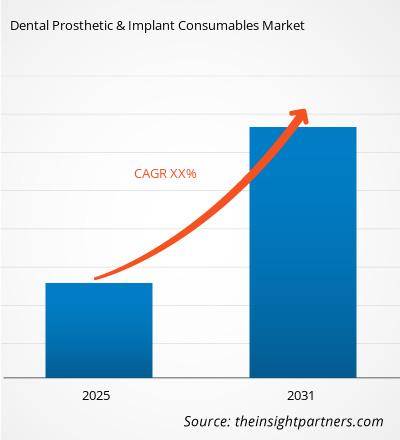
The Dental Prosthetic & Implant Consumables market is valued at US$ 11.97 Billion in 2025 and is projected to reach US$ 21.17 Billion by 2034, expanding at a CAGR of 6.54% during 2026–2034. Market is located at the convergence of restorative dentistry, implantology, and dental lab operations. The demand will be driven by restorative treatments, implants, aesthetics, and continual need for replacements in both developed and developing healthcare markets.
The demand in North America is forecast to grow at an estimated CAGR of 5.9% - 6.4% between 2026 and 2034 due to high procedure volume and reimbursement system. The Dental Prosthetic & Implant Consumables Market size is also driven by the aging population, growth in dental services organizations, and increasing number of digitally designed restorations.
Dental Prosthetic & Implant Consumables Market Assessment and Insights
- North America: North America is expected to account for a 35–39% share in 2025, with growth at a CAGR of 5.9–6.4% between 2026–2034. Mature implantology, restorative demand, DSO expansion, and digital workflows support sustained consumption.
- US: The US represents 88–92% of North America's 2025 market, with a CAGR of 5.8–6.3% during 2026–2034. High procedure intensity and established laboratory networks reinforce demand.
- Europe: Europe is projected to hold a 27–31% share in 2025 and grow at a CAGR of 5.6–6.1% during 2026–2034, led by Germany, the UK, France, Italy, and Spain, where aging populations and sophisticated restorative practices support demand.
- Asia Pacific: Asia Pacific is estimated at a 21–25% share in 2025 and is expected to grow at a CAGR of 7.4–8.1% during 2026–2034. China, Japan, South Korea, and India provide the strongest expansion opportunities.
- Largest Segment: Root Form Dental Implants hold a 27–31% market share in 2025 and are expected to expand at a CAGR of 6.7–7.2%, supported by broad clinical applicability.
- High Growth Segment: Abutments represent a 7–10% market share in 2025 and are projected to grow at a CAGR of 7.6–8.2%, benefiting from digitally integrated implant restoration.
- Key companies analyzed in detail: Straumann Holding AG, Danaher Corporation, Dentsply Sirona, Henry Schein, Inc., Kuraray Co., Ltd., Geistlich Pharma AG, Ivoclar Vivadent AG, GC Corporation, Keystone Dental, Inc., Envista Holdings Corporation.
Source: The Insight Partners' analysis based on proprietary research, government publications, company annual reports, investor presentations, industry databases, and expert interviews.
The Dental Prosthetic & Implant Consumables market has shifted from traditional manual manufacturing to digitally driven implant and prosthetics. CAD/CAM design, digital dentistry through intraoral scanning, milling technology, guided surgery, advanced materials and ceramics, and standardization of implants have changed production dynamics. Material science and digital technologies are increasingly being merged by the manufacturers, while labs are more focused on reliability, faster delivery, and reduction in remakes. All this will foster the relationship between clinical treatment planning and lab production.
During the forecast period, growth is likely to go beyond developed Western nations and move towards China, India, Southeast Asia, Latin America, and some parts of Middle East. Investment will likely focus on manufacturing scalability, regional distribution, development of biomaterials, and digitally-driven restorative ecosystems. Harmonized regulation and traceability issues will make manufacturers pay attention to their quality and documentation processes, as well as post-market surveillance and diversified product range.
Dental Prosthetic & Implant Consumables Market Report Scope
| Report Attribute | Details |
|---|---|
| Market size in 2025 | US$ 11.97 Billion |
| Market Size by 2034 | US$ 21.17 Billion |
| Global CAGR (2026 - 2034) | 6.54% |
| Historical Data | 2021-2024 |
| Forecast period | 2026-2034 |
Dental Prosthetic & Implant Consumables Market Analysis
Growth of demand is connected to tooth loss, periodontitis, restorative procedures, aesthetics, and replacement schedules. In that case, the growth of the Dental Prosthetic & Implant Consumables Market will be influenced by the creation of procedures and constant usage of consumable materials. Policies formulated by the WHO should focus on the reduction of the disease burden on the population, and aging population increases the necessity for restorative and replacement treatments. The value chain includes producers of dental implants, biomaterials companies, dental laboratories, distribution channels, clinics, hospitals, and digital solutions.
Supply is becoming more localized and technologically driven. Titanium, zirconia, ceramics, polymers, and composites need to be available in high quality in a predictable way for manufacturers. Digital formats make the link between clinicians and laboratories less dependent on physical impressions, and therefore, more standard. Distribution will continue to be an important aspect as the consumable components of implants need constant supply, support, and integration. Regional manufacturing capacity may become a competitive asset in that case.
According to the Dental Prosthetic & Implant Consumables market, positioning based on competition is about portfolios, clinical training, distribution coverage, materials expertise, and technology integration. Straumann Holding AG and Dentsply Sirona function in the ecosystems of implants and restorations, whereas Danaher Corporation and Envista Holdings Corporation have significant market share through technologies and consumables. The role of the distribution connection is played by Henry Schein, Inc., while Kuraray Co., Ltd., Geistlich Pharma AG, Ivoclar Vivadent AG, and GC Corporation focus on materials and restorations.
In terms of investment, there is an increasing emphasis on manufacturing strength, high-quality biomaterials, digital compatibility, and clinical education. Keystone Dental, Inc. offers specialized implant competition, and diversified firms will be able to take advantage of cross-sellings and distribution partnerships. As a result, differentiation will move away from products to clinical workflows. Recent business activities also reveal an increased focus on regional distribution, production capacity, connected dentistry, and local supplies.
● REPORT CUSTOMIZATION
Tailor This Report To Align With Your Specific Business Requirements
This report can be customized to align precisely with your business objectives, scope, and target markets. Customization options include tailored segmentation, geography, competitive analysis, and strategic insights to support informed decision-making.
Customize This Report →WHAT YOU CAN ADJUST
- ● Segmentations
- ● Geography
- ● Competitive Analysis
- ● Language Preferences
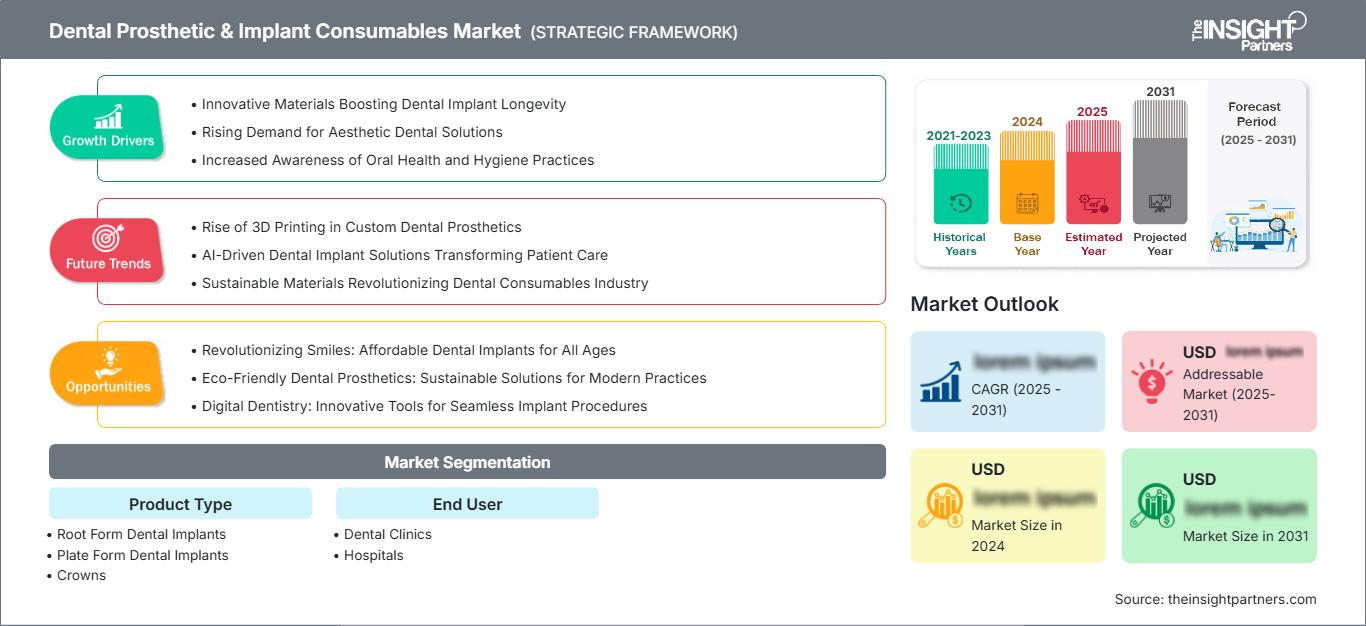
Dental Prosthetic & Implant Consumables Market: Strategic Insights
Regional Insights
North America Dental Prosthetic & Implant Consumables Market
North America is expected to have a Dental Prosthetic & Implant Consumables Market share of 35-39% in 2025 and will exhibit growth at a CAGR of 5.9-6.4% up to 2034. United States dominates regional consumption based on high intensity of implant surgeries, well-established dental labs, increasing consolidation of DSOs, specialized practice and high adoption rate of computer-aided restoration.
Region-wise purchasing is driven by clinical research, quality assurance, training, and relationships with distributors rather than just pricing. Hospitals continue to be significant for complicated cases of oral surgery whereas dentistry clinics represent regular workflows associated with implantology and prosthodontics. Premium ceramics, implant parts, and digitally compatible material will maintain their popularity due to need for predictable delivery and reduced number of remakes.
U.S. Dental Prosthetic & Implant Consumables Market
The US represents 88–92% of North America's 2025 market and is expected to grow at a CAGR of 5.8–6.3% through 2034. The country's large private dental base, DSO expansion, specialist networks, and extensive laboratory infrastructure create a substantial addressable market for implants, crowns, bridges, dentures, and abutments. Major international suppliers maintain direct or distributor-supported presence.
Increasingly, application trends are inclined towards integration of digital workflow solutions, especially where intra-oral scanning, CADCAM fabrication, and implant-guided planning can save treatment time. The dental clinic is the primary consumption point, whereas the hospital is focused on cases that are complex and multidisciplinary. Increasingly, procurement is taking into account the compatibility of components and clinical assistance, stock availability, and connection to the lab.
Europe Dental Prosthetic & Implant Consumables Market
Europe is predicted to be at a market share of 27% – 31% in 2025, with a forecasted CAGR of 5.6% – 6.1%, where Germany will lead the country segment. Europe has strong capabilities in implantology, dental laboratories, and restorations; however, reimbursement and procurement processes differ greatly between European countries.
The United Kingdom and Germany have advanced ecosystems for specialists and private practices which allows the use of high-end implants, ceramic, and digital restorations. France, Italy, and Spain have influence on the market due to aging population, aesthetic dentistry, private practices, and increased use of CAD/CAM technology. Market entry is highly dependent on national reimbursement processes, regulations for medical devices, training of clinicians, and laboratories.
APAC Dental Prosthetic & Implant Consumables Market
APAC represents an estimated share of 21%–25% in 2025 and is projected to grow at a CAGR of 7.4%–8.1%, thus representing the biggest region in terms of growth. The biggest demand drivers in the region include China, Japan, South Korea, India, and Australia. Growth drivers in the region include the development of dental infrastructure and private clinics.
The elements which would make it easier for people to get access to dental restorations would be the investment in industries and manufacturing, health care advancements, and increased patient education. While China is an example of mass production capacity and increasing clinical acceptance, India is an example of a country with potential for future growth due to increased private dental care practices.
Middle East & Africa Dental Prosthetic & Implant Consumables Market
Middle East and Africa represent a smaller addressable base but are projected to grow at a CAGR of 6.3–7.0%. Saudi Arabia is the leading country, with the UAE serving as a regional hub and South Africa providing the most developed Sub-Saharan market. Rest-of-MEA demand remains uneven.
Revenue from energy will help in the development of healthcare facilities, hence the ability for superior dentistry clinics and laboratories. Modernization of hospitals and medical tourism will contribute to more expensive treatments. There is greater professionalism in South Africa compared to lower income countries, which are limited by cost and expertise. Partnership with distributors and supply chain will play an important role in developing the market.
Segmentation Analysis
Product Type
The Product Type segment in the Dental Prosthetic & Implant Consumables Market is expected to expand at a CAGR of 6.3–6.9% during 2026–2034. Product demand is shaped by procedure mix, restoration complexity, material preference, implantology adoption, and laboratory digitization. Integrated product portfolios can improve clinical compatibility, while material innovation continues to influence premium positioning. Root Form Dental Implants remain central to implant workflows, whereas crowns, abutments, bridges, and other restorative products generate complementary demand across treatment stages.
- Root Form Dental Implants: The principal implant format supports broad clinical use because its geometry aligns with established surgical protocols. Demand remains linked to restorative case volumes, clinician familiarity, and component compatibility.
- Plate Form Dental Implants: This format occupies a specialist position where anatomical limitations influence implant selection. Its strategic relevance comes from providing alternatives for selected bone conditions and treatment planning requirements.
- Crowns: Crowns represent a major restorative application, supported by replacement of damaged teeth and implant-supported restorations. Ceramic development and digital fabrication strengthen their role in aesthetic and functional treatment.
- Bridges: Bridges remain important for fixed tooth replacement where clinicians select alternatives to individual implants. Demand depends on case suitability, laboratory capabilities, material selection, and patient preferences.
- Dentures: Dentures retain strategic importance because removable restoration remains accessible across broad patient groups. Digitally designed bases and improved materials are gradually enhancing fit, aesthetics, production consistency, and personalization.
- Abutments: Abutments connect implant fixtures with definitive restorations and are increasingly influenced by digital planning. Customization, interface precision, and compatibility make them important components of integrated implant workflows.
- Veneers: Veneers primarily serve aesthetic restoration and minimally invasive cosmetic procedures. Advanced ceramics and digital smile planning support greater personalization, although adoption remains concentrated in markets with stronger elective dental expenditure.
- Inlays and Onlays: These restorations provide conservative alternatives for selected damaged teeth. Their position is supported by adhesive dentistry, improved ceramics, and digital manufacturing that can enhance fit and production efficiency.
End User
The End User segment is forecast to grow at a CAGR of 6.1–6.7% during 2026–2034. Dental clinics remain the dominant purchasing and treatment environment because they manage routine implant placement and prosthetic restoration. Hospitals retain importance for complex surgery, medically compromised patients, and multidisciplinary cases. The balance between these channels varies with healthcare infrastructure, specialist availability, reimbursement, and the prevalence of integrated dental organizations.
- Dental Clinics: Dental clinics represent the primary consumption setting, combining consultation, treatment planning, implant placement, restoration, and follow-up. DSO expansion and digital workflow adoption strengthen their purchasing influence.
- Hospitals: Hospitals concentrate higher-complexity cases requiring surgical infrastructure or multidisciplinary management. Their procurement decisions emphasize quality assurance, clinical compatibility, inventory reliability, and integration with broader healthcare systems.
Opportunity Snapshot
| End User | Revenue Contribution (High/Medium/Low) | Trend Tag | Adoption Stage |
|---|---|---|---|
| Dental Clinics | High | DSO Integration | Mature |
| Hospitals | Medium | Complex Surgery | Scaling |
Dental Prosthetic & Implant Consumables Market Growth Drivers and Impact Analysis
Rising Implant Adoption and Tooth Replacement Needs
Population aging, cumulative tooth loss, periodontal disease, and greater acceptance of implant-supported restoration are expanding the clinical pool for prosthetic consumables. The impact is not limited to implant fixtures because each completed case can generate demand for abutments, crowns, restorative materials, and laboratory services. Greater clinician familiarity with implant protocols also reduces barriers to treatment selection. In established markets, replacement of aging restorations adds recurring demand, while emerging markets gain from expanding access to private dental care. Manufacturers can capture this driver by coordinating implant components with prosthetic materials, training, and digital planning tools. The resulting value shift favors suppliers able to support the complete treatment pathway rather than only individual products.
Digital Dentistry Is Improving Restoration Throughput
Digital impressions, CAD/CAM design, milling, scanning, and guided workflows are changing how prosthetic cases move between clinics and laboratories. The effect on consumables is significant because digitally standardized interfaces can improve component consistency, reduce remakes, and shorten production cycles. Dental laboratories can process greater case volumes without proportionally increasing manual fabrication time. Clinics also gain greater visibility over treatment planning and restoration design. As digital adoption broadens, consumable suppliers face pressure to ensure that implants, abutments, ceramics, and restorative systems work reliably within connected workflows. This creates opportunities for premium materials and digitally optimized components, while suppliers with limited interoperability may face slower adoption. Investment in compatible ecosystems therefore becomes an important competitive requirement.
Material Innovation Is Expanding Premium Restoration Options
Advances in zirconia, ceramics, polymers, titanium surfaces, and composite materials are broadening the range of clinical choices available to dentists and laboratories. Improved strength, esthetics, machinability, and surface characteristics can support more demanding indications while reducing compromises between appearance and functionality. Material innovation also creates opportunities for differentiated pricing because clinicians may prioritize predictable performance over initial acquisition cost. Suppliers are consequently investing in formulations, processing technologies, and product portfolios that address specific restorative workflows. The commercial effect extends beyond premium products because successful materials can establish new laboratory protocols and generate complementary demand for milling, finishing, bonding, and implant components. Over time, material performance can therefore reshape product substitution patterns across established restorative categories.
Dental Prosthetic & Implant Consumables Market Future Trends
Patient-Specific Prosthetics Will Become More Data Driven
Patient-specific restoration is likely to become increasingly data driven as digital impressions, facial scanning, imaging, and design software converge. Future workflows can combine anatomical measurements with occlusal information and aesthetic parameters to create restorations tailored to individual clinical requirements. This development should increase demand for flexible materials, customizable components, and software-compatible production systems. Manufacturers may increasingly offer modular platforms that allow clinicians and laboratories to adjust designs without rebuilding complete workflows. Data interoperability will become strategically important because fragmented systems can introduce errors or duplicate work. The longer-term effect should be a shift from standardized restoration alone toward configurable treatment solutions, with suppliers competing on personalization capability, workflow reliability, and the ability to translate patient data into reproducible manufacturing instructions.
Regionalized Manufacturing Will Strengthen Supply Resilience
Regionalized production is expected to gain importance as manufacturers manage logistics uncertainty, regulatory differences, and changing trade conditions. Local or regional plants can shorten delivery routes, reduce exposure to transportation disruptions, and make it easier to tailor products to local requirements. The trend does not imply complete supply-chain separation because specialized materials and components will continue crossing borders. Instead, companies are likely to build strategically distributed capacity around major demand centers while retaining centralized production for highly specialized processes. Dental manufacturers may also increase dual sourcing for critical materials and components. Such arrangements can improve inventory resilience and reduce the operational impact of temporary disruptions. Regional production could consequently become an important consideration in supplier selection alongside clinical performance and price.
Dental Prosthetic & Implant Consumables Market Opportunities
Build Integrated Implant-to-Restoration Platforms
Suppliers can pursue greater value capture by linking implant fixtures, abutments, restorative materials, and digital design workflows into compatible platforms. An integrated proposition can simplify procurement and reduce uncertainty for clinicians and laboratories managing complex cases. The Dental Prosthetic & Implant Consumables Market Forecasts indicate an attractive environment for businesses that can combine clinical reliability with workflow interoperability. Investment priorities should include open digital interfaces, component libraries, validated material combinations, and professional education. Partnerships with laboratories and dental service organizations can accelerate adoption by embedding products into recurring case workflows. Companies should also evaluate regional customization because procurement preferences, reimbursement structures, and regulatory requirements differ considerably. A platform strategy can therefore support retention while reducing dependence on a single product category.
Expand Specialist Access in Emerging Dental Ecosystems
Emerging markets provide an opportunity to broaden access to implant and prosthetic treatment through distributor partnerships, training centers, localized manufacturing, and tiered product portfolios. Investment should prioritize markets where private dental infrastructure is expanding faster than specialist capacity. The strategy should not rely solely on premium products because affordability and clinician education remain decisive adoption factors. A structured portfolio can combine established implant systems with selected value-oriented components while maintaining quality controls. The Dental Prosthetic & Implant Consumables Market trends also extends into laboratory services, where digital equipment and training can increase treatment capacity. Companies that build relationships with local clinicians, laboratories, distributors, and educational institutions can establish durable market positions while adapting product offerings to regional clinical practices.
Recent Developments
- August 2026: DENTSPLY SIRONA Inc. reported second-quarter 2026 net sales of US$898 million and announced an expanded Medline Sinclair partnership to broaden access to connected technology solutions across Canada. The company also reiterated its 2026 outlook while continuing its Return-to-Growth strategy, emphasizing distributor expansion and reinvestment in dental technology.
- August 2026: Henry Schein, Inc. reported second-quarter 2026 results and raised full-year guidance, with expected 2026 sales growth of 4.5–5.5%. The company cited sustained sales momentum, margin improvement, and progress from value-creation initiatives, reinforcing its position across office-based dental and medical distribution.
- August 2026: Kuraray Co., Ltd. announced that a new production line at Kuraray Noritake Dental’s Miyoshi Plant began operations. The expansion increased annual inorganic dental-material capacity by 60 tons to 300 tons, with approximately ¥2.7 billion invested, strengthening zirconia and porcelain supply for global restorative applications.
Frequently Asked Questions

- Comprehensive Market Sizing and Forecast Analysis
- Detailed Segmentation Analysis
- In-Depth Market Dynamics Assessment
- Regional and Country-Level Insights
- Competitive Landscape and Company Benchmarking
- Strategic Business Intelligence
Recent Reports
Testimonials

The Insight Partners' SCADA System Market report is comprehensive, with valuable insights on current trends and future forecasts. The team was highly professional, responsive, and supportive throughout. We are very satisfied and highly recommend their services.
RAN KEDEM Partner, Reali Technologies LTDs
I requested a report on a very specific software market and the team produced the report in a few days. The information was very relevant and well presented. I then requested some changes and additions to the report. The team was again very responsive and I got the final report in less than a week.
JEAN-HERVE JENN Chairman, Future Analytica
We worked with The Insight Partners for an important market study and forecast. They gave us clear insights into opportunities and risks, which helped shape our plans. Their research was easy to use and based on solid data. It helped us make smart, confident decisions. We highly recommend them.
PIYUSH NAGPAL Sr. Vice President, High Beam Global
The Insight Partners delivered insightful, well-structured market research with strong domain expertise. Their team was professional and responsive throughout. The user-friendly website made accessing industry reports seamless. We highly recommend them for reliable, high-quality research services
YUKIHIKO ADACHI CEO, Deep Blue, LLC.
This is the first time I have purchased a market report from The Insight Partners.While I was unsure at first, I visited their web site and felt more comfortable to take the risk and purchase a market report.I am completely satisfied with the quality of the report and customer service. I had several questions and comments with the initial report, but after a couple of dialogs over email with their analyst I believe I have a report that I can use as input to our strategic planning process.Thank you so much for taking the extra time and making this a positive experience.I will definitely recommend your service to others and you will be my first call when we need further market data.
JOHN SUZUKI President and Chief Executive Officer, Board Director, BK Technologies
I wish to appreciate your support and the professionalism you displayed in the course of attending to my request for information regarding to infectious disease IVD market in Nigeria. I appreciate your patience, your guidance, and the fact that you were willing to offer a discount, which eventually made it possible for us to close a deal. I look forward to engaging The Insight Partners in the future, all thanks to the impression you have created in me as a result of this first encounter.
DR CHIJIOKE ONYIA MANAGING DIRECTOR, PineCrest Healthcare Ltd.Reason to Buy
- Informed Decision-Making
- Understanding Market Dynamics
- Competitive Analysis
- Identifying Emerging Markets
- Customer Insights
- Market Forecasts
- Risk Mitigation
- Boosting Operational Efficiency
- Strategic Planning
- Investment Justification
- Tracking Industry Innovations
- Aligning with Regulatory Trends





 Get Free Sample for